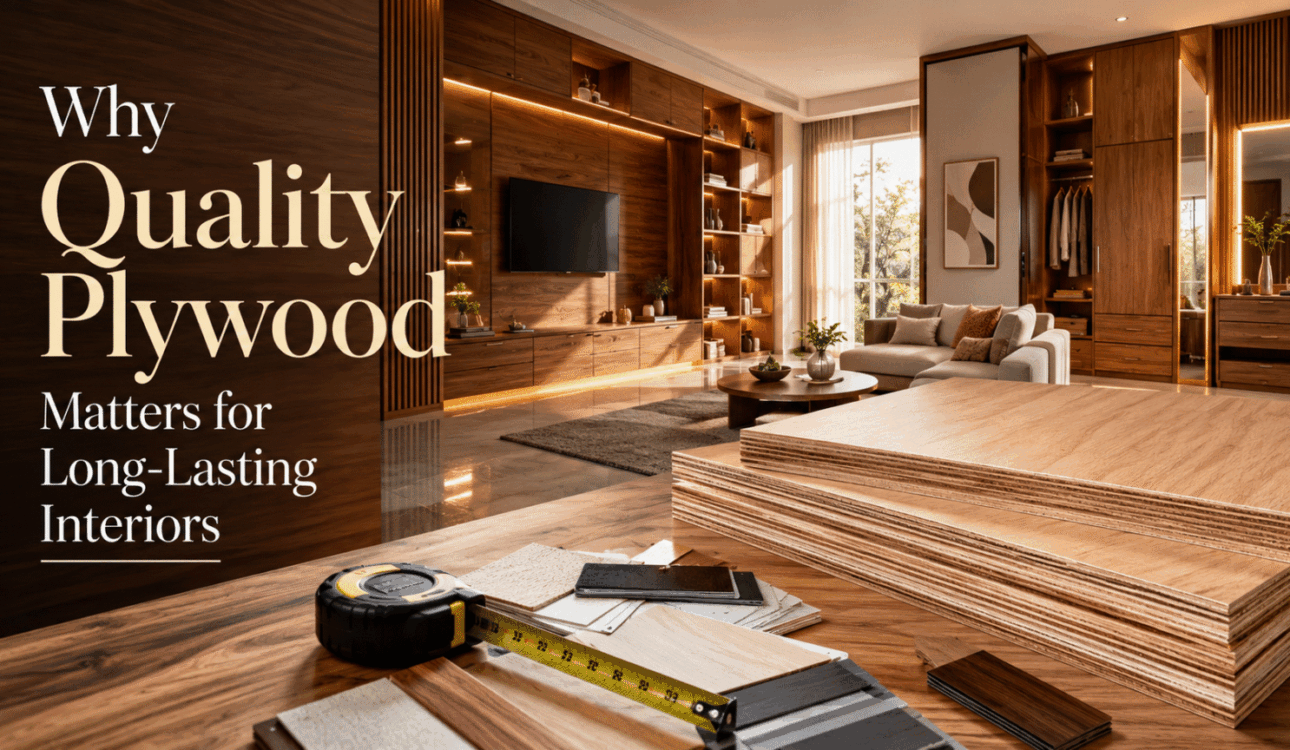
If you’re comparing quality plywood in Bangalore for an upcoming project, here’s the first thing to know: nobody falls in love with plywood. You fall in love with the laminate’s colour, the veneer’s grain, the handle’s finish. The plywood underneath — the actual skeleton of every wardrobe, kitchen and bed you’ll own — gets chosen in a hurry, often by whoever’s holding the tape measure, frequently on price alone.
And that’s a shame, because here’s what two decades of furniture repairs have taught us: interiors don’t fail at the surface. They fail at the skeleton. The laminate is usually fine. It’s the board beneath it that sagged, swelled, crumbled around its own screws, or became someone’s lunch.
This guide is the case for spending that extra ₹20–40 per square foot on quality plywood — told through the five ways cheap plywood dies, what a genuinely good sheet is made of, and the fifteen-year maths that makes “expensive” plywood the bargain of the project.
Table of Contents
Quality Plywood in Bangalore: The Five Ways Cheap Boards Die
When quality plywood in Bangalore gets skipped for a cheaper board, furniture failure is rarely dramatic. It’s a slow-motion story told in small annoyances — a door that needs a hip-check, a shelf with a gentle smile. Every one of these autopsies traces back to the same five causes:
- The hammock shelf (shelves bow under books) — cause: low-density core. Budget sheets use soft poplar or plantation timber with wide glue lines. Under load, the core creeps — slowly, permanently. No bracket fixes a board that has forgotten it was straight.
- The drooping shutter (doors scrape and sag off their hinges) — cause: screw pull-out. Hinges live and die by the board’s grip. In weak, gappy cores, screw threads chew the fibre loose within a few thousand open-close cycles — and re-screwing into the same hole only makes it worse.
- The swollen sink cabinet (bubbled laminate, crumbling base) — cause: the wrong glue met water. MR-grade boards use urea-formaldehyde adhesive that softens with sustained moisture. One slow plumbing leak, one monsoon of wet mops, and the layers quietly divorce — that’s delamination, and it’s terminal.
- The wavy wardrobe (shutters won’t align, gaps everywhere) — cause: uneven thickness and warp. Uncalibrated boards can vary by millimetres across a single sheet. The carpenter shims what he can; the rest announces itself every time you look at the shutter line.
- The hollow thud (fine powder, then collapse) — cause: termites and core voids. Untreated boards in termite country get eaten from the inside out — the surface looks fine until the day it doesn’t. Gaps inside the core make their work even easier.
Notice what these five have in common: not one is visible on delivery day. Cheap plywood looks identical to good plywood on the morning it’s installed. The difference arrives on a schedule — year two, year four, year six — which is exactly why the saving never actually saves.
What “Quality” Physically Means
When you’re shopping for quality plywood in Bangalore, remember this: “good plywood” isn’t a vibe — it’s six measurable things. When a premium sheet costs more, this is the itemised bill for what you’re actually buying:
- Dense hardwood core — gurjan or eucalyptus, not soft poplar
- Full, gap-free plies — 11–13 layers in 18 mm, no voids
- Real glue — melamine (BWR) or phenolic (BWP) resin
- Calibration — uniform thickness, ±0.5 mm
- Honest face veneer — smooth, thick enough to sand & finish
- Low emissions — E1 or E0 formaldehyde class
For quality plywood in Bangalore, core density is the big one — it’s what grips screws and resists sag. Pick up two same-size sheets: the heavier one almost always has the denser, better core. Hardwood cores also bring natural termite resistance that softwood cores lack.
Emissions deserve a mention most brochures skip: plywood glue contains formaldehyde, which off-gasses into your rooms for years. The E1 class (≤1.5 mg/L) is the sensible floor for interiors; E0 (≤0.5 mg/L) is what to ask for in bedrooms and kids’ rooms. Phenolic BWP glues, incidentally, run inherently low — one more reason wet-zone grade punches above its price. The 2024 revisions of IS 303 & IS 710 now include formaldehyde requirements.
You don’t pay for quality plywood in Bangalore on invoice day. You pay for bad plywood every year after.
Evospace shop-floor wisdom
Screw-Holding: The Underrated Superpower
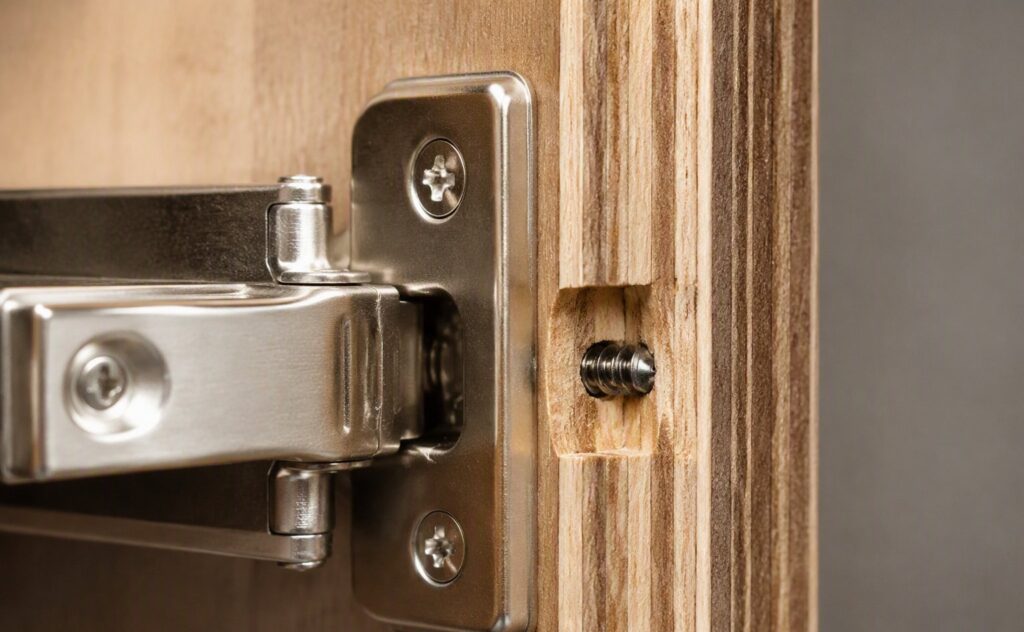
If you had to reduce quality plywood in Bangalore to a single measurable property, pick this one. Modern furniture is essentially a collection of hardware — hinges, drawer channels, wardrobe lifts, monitor arms — and every piece of it is held by screws biting into board. The furniture lasts exactly as long as the grip does.
This is where plywood humiliates its rivals. Its cross-laminated plies give screw threads alternating grain directions to bite into, in the face and along the edge. MDF holds screws acceptably through the face but poorly at its edges; particle board pulls out under the routine stress of a hinge cycle. It’s the main reason a plywood cabinet can be repaired, re-hinged and even moved house twice — while its particle-board cousin is effectively single-use.
| Board | Screw-holding | Hinge & channel life | Repairable? |
|---|---|---|---|
| Quality plywood (hardwood core) | Excellent — face and edge | Decades of daily cycles | Yes — re-drill, re-hinge, re-polish |
| Cheap plywood (soft, gappy core) | Mediocre — loosens over time | Sagging shutters in 2–5 years | Partially, with skill and plugs |
| MDF | Fair in face, weak at edges | Holes strip with repeated use | Barely — stripped holes are permanent |
| Particle board | Poor — pull-out risk | The usual suspect in failed hinges | No — replacement is the repair |
Comparative performance per industry material guides; plywood’s cross-grain construction is roughly 2–3× stronger than particle board in structural terms, with a service life measured in decades rather than years.
The Fifteen-Year Maths
Let’s do the arithmetic nobody does at the timber yard when pricing quality plywood in Bangalore. Take a kitchen — the hardest-working room in the house — and run two versions of it over fifteen years:
| Budget build | Quality build | |
|---|---|---|
| Board choice | Economy MR, mixed core | Branded BWR/BWP, hardwood core |
| Board cost (≈30 sheets) | ₹55,000 – ₹70,000 | ₹85,000 – ₹1,10,000 |
| Year 4–6: hinge & shelf repairs | ₹8,000 – ₹15,000 | — |
| Year 6–8: sink cabinet rebuild | ₹25,000 – ₹40,000 | — |
| Year 8–10: partial re-fit, matching pain | ₹60,000 – ₹1,00,000 | — |
| 15-year total | ₹1.5–2.2 lakh (and counting) | ₹0.85–1.1 lakh |
| Condition at year 15 | On its second life, badly | Middle-aged, going strong |
Illustrative ranges from Bangalore carpentry and re-fit rates; the rebuild line is where budget builds actually lose — labour and disruption always cost more than boards.
The pattern is consistent across every quality plywood in Bangalore project: the plywood premium is typically 8–12% of a furniture budget, while a premature rebuild costs 100% of it — plus labour, plus the unique misery of living through carpentry twice. Buying quality isn’t a luxury decision. It’s an insurance premium, and a cheap one.
There’s a quieter dividend too: quality plywood in Bangalore is backed like it. The warranty ladder in the Indian market tracks quality almost perfectly — and it’s the easiest way to sanity-check what a manufacturer really thinks of its own sheet:
| Tier | Typical warranty | Realistic lifespan | Reading |
|---|---|---|---|
| Economy MR | 0–5 years | 8–12 years | Fine for rentals and short horizons |
| Branded BWR | 7–15 years | 15–20 years | The sensible family-home default |
| Premium BWP / marine (IS 710) | 15 years to lifetime | 18–25+ years | Forever-home territory; flagship lines carry 30-year to lifetime terms |
Warranty terms vary by brand and product line — e.g. premium marine lines from leading brands now carry 30-year or lifetime warranties, often with zero-formaldehyde or CARB certification bundled in.
Decoding the Warranty
For quality plywood in Bangalore, a warranty is a useful document and an occasionally creative one. Before you let “lifetime warranty” influence a purchase, read for these four things:
What’s actually covered. Most warranties cover manufacturing defects — delamination under normal use, termite failure in treated boards. Almost none cover water damage from plumbing leaks, outdoor exposure, or “improper installation,” which is where real-world claims go to die.
What “lifetime” means. For quality plywood in Bangalore, it’s often the expected service life of the product category, not your lifetime — 20 or 25 years in the fine print. That’s still excellent. Just know which number you’re buying.
The claim mechanics. Warranties are honoured against the invoice and the sheet’s printed markings — which vanish the moment a carpenter cuts the board. Photograph every sheet’s stamp before work begins, and file the invoice somewhere you’ll actually find it in year nine.
Who stands behind it. A 25-year warranty from a brand that has existed for five is a poem, not a promise. The warranty is worth exactly the manufacturer’s expected remaining lifespan — which is why the unglamorous advice is to buy boring, established, IS-marked brands from authorised dealers.
The 10-Minute Yard Inspection
You don’t need a lab to judge quality plywood in Bangalore — you need ten minutes and your hands. Run this protocol at the yard, before a single board is loaded:
- The lift test. Heft two same-size sheets from different stacks. The heavier board has the denser core — density is the single best proxy for strength and screw-holding.
- The knock test. Tap across the face with your knuckles. A consistent, solid note means a bonded core; a hollow, papery patch means a void — walk away from that sheet.
- Read the edge. Count the plies (11–13 in an 18 mm sheet), look for gaps, overlaps and thick glue lines. Even, tight layers are the signature of a good press.
- The sight test. Hold the sheet at eye level and look along its length. Any wave, cup or bow you can see now will be a crooked shutter later.
- The corner dig. Press a fingernail into a corner edge. It should resist. If layers separate or crumble at nail pressure, the glue line is weak.
- Measure the thickness. A tape across the sheet — corners and centre. “18 mm” reading 16.5 mm is a discount wearing a label.
- Check the stamp, then verify it. Brand, grade, IS 303 or IS 710, CML licence number — cross-checked on the BIS Care app. Two minutes, definitive.
- Ask for the emission class in writing. E1 or E0 for bedrooms and kids’ rooms; a dealer who can’t answer is telling you something.
Quick-Fire FAQ
Is expensive plywood always better plywood?
No — for quality plywood in Bangalore, price tracks brand and finish as much as core quality. A mid-range branded BWR often outperforms a premium-priced economy import. That’s why the physical tests (weight, knock, edge, thickness) matter more than the rate card. Buy the spec, not the sticker.
Can a good finish protect a weak board?
Only from the outside. Laminate seals the face, but sag, screw pull-out and core voids attack from within — no surface finish stops physics. Finish decides how furniture looks; the board decides how long it stays that way.
Is plywood furniture really repairable decades later?
Yes — this is where quality plywood in Bangalore has its quiet superpower. Dense cores accept fresh screws, surfaces can be re-laminated or re-polished, and carcasses can be re-hung with new hardware. We’ve seen 20-year-old plywood kitchens get a second life with new shutters. Particle board gets one life, and it’s short.
What about the “smell test” for formaldehyde?
A sharp chemical sting in a freshly cut board suggests high emissions — a decent alarm, but not a measurement. The reliable route is asking for the declared class (E1/E0) tied to the exact product on your invoice. The 2024 revisions of IS 303 and IS 710 have added formaldehyde requirements, so branded boards increasingly publish this.
Does a lifetime warranty mean my kitchen lasts forever?
It means the board is expected to last its rated service life under normal use — typically 20–25 years for premium marine lines. Hinges, channels and daily wear live on their own schedules. But as a signal of manufacturing confidence, a long warranty from an established brand is the most honest marketing in the building materials trade.
Where can I safely economise, then?
When buying quality plywood in Bangalore, economise on thickness and grade placement, not on core quality. Use 12 mm where 18 mm isn’t structural, MR in genuinely dry rooms, and mid-tier branded boards for furniture with light loads. Never economise on the carcass of a kitchen, the base of a sink cabinet, or the board a hinge screws into.
Purchase from a Reliable Supplier
The performance of quality plywood in Bangalore depends on both the product and the supplier. Experienced suppliers can explain different plywood grades, recommend suitable options for each application, and help you choose genuine products from trusted manufacturers.
If you’re planning a residential or commercial project involving quality plywood in Bangalore, consult the Best Plywood Suppliers in Bangalore to explore high-quality plywood that meets your interior needs and ensures lasting performance.
Final Thought
Quality plywood in Bangalore is the cheapest insurance your interiors will ever get. From the five ways cheap boards fail to the six-point spec of a genuinely good sheet, the screw-holding advantage, and the fifteen-year maths, the case keeps landing in the same place: spend a little more on the skeleton, and the furniture built on top of it will still be standing — and looking good — long after the cheaper version has been rebuilt twice over.