If you’re choosing plywood for every room in Bangalore, here’s an uncomfortable truth from the shop floor: most furniture failures we see aren’t design failures — they’re plywood failures. The wardrobe shelf that sags like a hammock. The kitchen cabinet that’s swollen shut by the second monsoon. The “waterproof” board that turned out to be anything but.
And almost every time, the root cause is the same: the wrong grade of plywood in the wrong room. Not cheap plywood, necessarily — just mismatched plywood. A ₹2,000 sheet wasted in a dry bedroom is as much a mistake as a ₹1,400 sheet drowning under a kitchen sink.
So let’s fix this properly. We’ll start with what plywood actually is, decode the grade alphabet once and for all, then go room by room through your home.
Table of Contents
Plywood for Every Room in Bangalore: What It Actually Is
Strip away the marketing and plywood is a beautifully simple idea: thin sheets of wood — called plies or veneers — glued together with each layer’s grain running at right angles to the one below it. Always an odd number of layers, so the sheet stays balanced and flat.
That criss-cross is the entire magic. Solid wood is strong along its grain but weak across it — which is why a solid shelf can cup, warp and split with the seasons. Plywood’s alternating grain cancels those forces out. The result is a sheet that’s stable, holds screws in every direction, and shrugs off the humidity swings that make solid timber misbehave.
This is also why the edge of a sheet is its honest face. Count the layers, look for gaps and overlaps, check that the glue lines run continuous and even — everything a dealer’s brochure won’t tell you is printed right there on the cross-section.
The criss-cross that does all the work
Choosing plywood for every room in Bangalore starts at the ply count. Every layer fights the next layer’s tendency to warp. An 18mm sheet typically carries 11 to 13 plies — more plies, generally better balance and screw-holding.
What separates a great sheet from a mediocre one is the core: dense hardwood species like gurjan and eucalyptus hold screws and resist sag far better than soft plantation poplar — and they weigh noticeably more in the hand. Always an odd ply count, grain alternates 90° per layer, hardwood core (gurjan, eucalyptus) beats poplar core.
The grades, decoded: it’s all about the glue
When picking plywood for every room in Bangalore, here’s the secret the industry doesn’t advertise: MR, BWR and BWP are not really about the wood — they’re about the adhesive holding it together. Change the resin, change the grade.
MR (Moisture Resistant) — the famous “commercial ply” — is bonded with urea-formaldehyde glue. The name is honest if you read it carefully: it resists moisture in the air, not water on its surface. Perfectly fine for wardrobes and beds; a slow disaster under a sink. It carries the IS 303 mark.
BWR (Boiling Water Resistant) upgrades the bond to a melamine-urea blend that survives steam, splashes and the odd overnight leak — still under IS 303. This is the sensible kitchen default.
BWP (Boiling Water Proof) is the real deal: phenol-formaldehyde glue, tested by boiling samples for 72 hours and checking that the layers refuse to let go. This grade falls under IS 710 — the marine plywood standard — and as per the revised IS 303:2024 and IS 710:2024 standards, only IS 710 sheets can legitimately call themselves “marine grade.” If a sheet says 710, both the waterproofing and the termite treatment are mandatory parts of the spec.
The three grades at a glance (Bangalore prices, Aug 2026)
| Grade | Glue | Standard | Survives | 18mm price / sq ft |
|---|---|---|---|---|
| MR “commercial” | Urea-formaldehyde | IS 303 | Humidity, not water | ₹52 – ₹78 |
| BWR | Melamine-urea | IS 303 | Steam, splashes, spills | ₹68 – ₹95 |
| BWP / marine | Phenol-formaldehyde | IS 710 | 72-hour boiling test | ₹100 – ₹150+ |
Indicative metro ranges for 18mm sheets; economy brands run lower, calibrated premium brands higher. A standard 8×4 ft (32 sq ft) sheet works out to roughly ₹1,600–2,400 (MR), ₹2,000–3,200 (BWR) and ₹3,000–5,500 (BWP). 18% GST applies.
“Waterproof” is a standard with a number, not a word on a brochure. If the sheet doesn’t say IS 710, it isn’t marine ply — whatever the invoice calls it.
The single most useful sentence in this guide
Thickness, and the calibration question
Choosing plywood for every room in Bangalore comes down to two variables. Grade decides where your plywood can live; thickness decides what it can carry. The rule of thumb we give every customer: thin sheets for backing and panels, thick sheets for anything that holds weight or hangs on hinges.
Match the thickness to the job
| Thickness | Right for | Wrong for |
|---|---|---|
| 4–6mm | Cabinet backs, drawer bottoms, panelling | Anything load-bearing |
| 9mm | Drawer sides, light partitions, small shelves | Shutters, wide shelves |
| 12mm | General furniture, supported shelves, table tops | Long unsupported spans |
| 16–19mm | Shutters, doors, wardrobe carcasses, kitchen cabinets | Over-engineering a back panel |
| 25mm | Heavy-duty shelving, counters, study desks | Most home furniture (overkill) |
Now, the word that’s quietly taken over the modular furniture world: calibrated plywood. Regular ply leaves the factory with natural thickness variation — an “18mm” sheet can genuinely measure anywhere from 16.5 to 19.5mm across its surface. Calibrated ply is precision-sanded on both faces to a uniform thickness, within roughly ±0.5mm.
Why should you care about a millimetre? Because your wardrobe shutters do. Uneven boards mean misaligned shutters, gaps that collect dust, and laminates that telegraph every bump underneath. For CNC-cut modular kitchens and sliding wardrobes, calibrated ply isn’t a luxury — it’s the difference between furniture that clicks shut and furniture that almost does. Expect to pay a 10–15% premium, and consider it money returned in labour and rework saved.
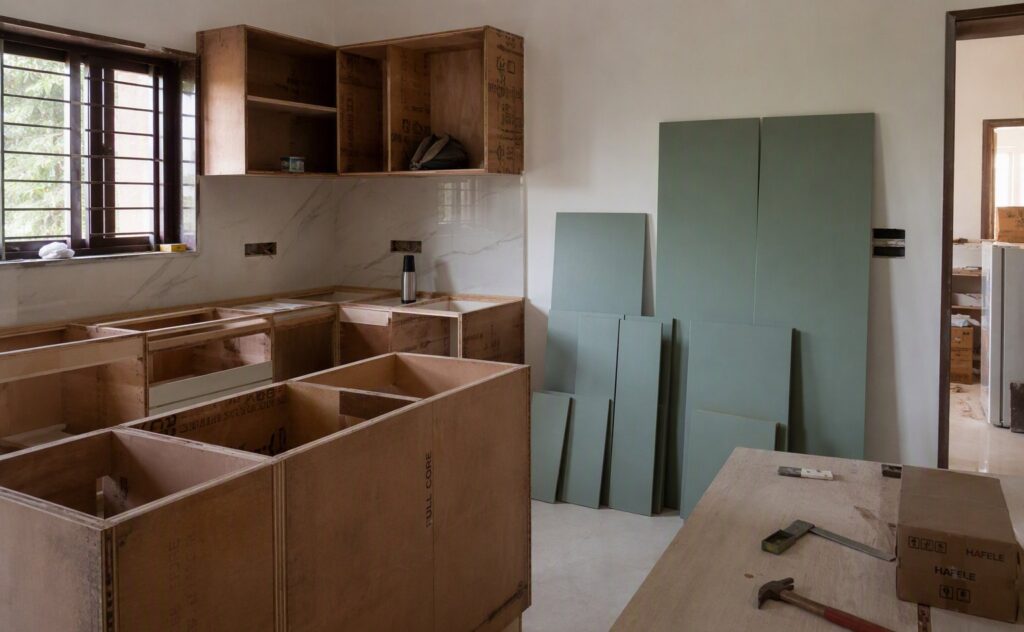
The termite chapter (yes, it deserves one)
No plywood for every room in Bangalore is complete without this chapter. In most Indian cities, the question isn’t whether termites will find your furniture — it’s when. And “termite-proof plywood” is one of the most loosely used phrases in the market. Here’s what actually protects a sheet:
Treatment happens in three ways — chemicals mixed into the glue line during pressing (often called GLP, or glue-line protection), veneers preservative-treated before lay-up, and naturally resistant hardwood species chosen for the core. A serious sheet uses more than one. A suspiciously cheap sheet often uses none, and just says the words.
The good news: you don’t have to take anyone’s word for it. The standards do the talking. IS 710 makes borer and termite resistance mandatory — it’s part of the marine-ply specification itself. IS 303 sheets, by contrast, may or may not be treated; the manufacturer only has to declare it. And IS 5539 governs any panel specifically sold as “preservatively treated.”
So the practical rule: in termite-active zones — and honestly, that’s most of India — specify IS 710 for kitchens and ground-floor furniture, verify the ISI mark carries the actual standard number, and cross-check the manufacturer’s CML licence number on the free BIS Care app before the sheets are cut. Once a sheet becomes a cabinet, the stamp is gone forever.
Real protection looks like
- IS 710 stamp with a verifiable CML licence number
- Glue-line protection or treated veneers, named on the datasheet
- Hardwood core species with natural resistance
- A written warranty — with terms you’ve actually read
Red flags at the yard
- “Termite-proof” with no standard number anywhere
- An ISI mark that doesn’t cite IS 303, 710 or 5539
- Powder or frass along the edges of stacked sheets
- A price far below market — treatment costs money
Room by room: the cheat sheet
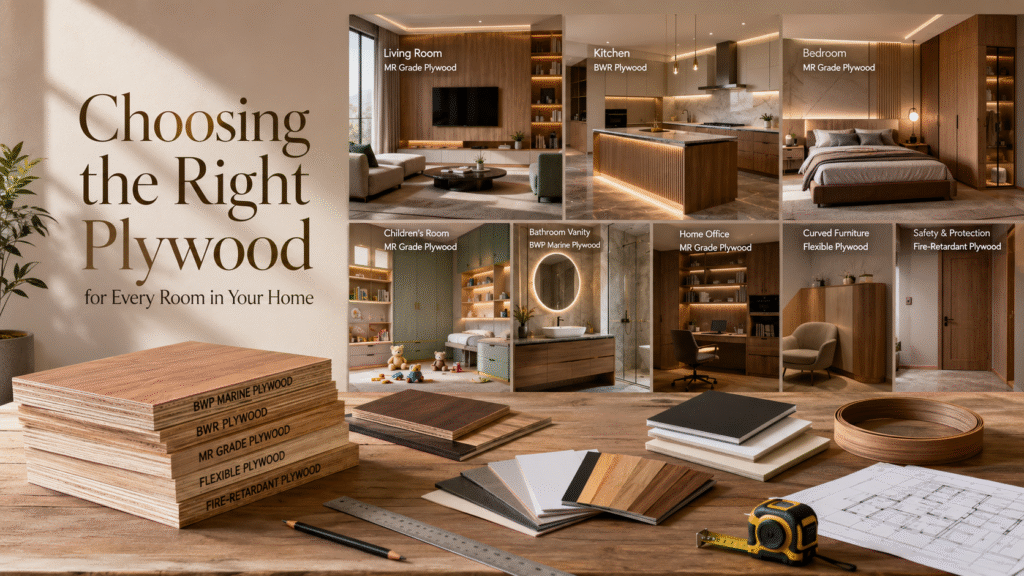
This is the core of picking plywood for every room in Bangalore. Here’s the part to screenshot: every room in your home has a moisture profile and a load profile — match the plywood to both, and you’re done:
| Room | Pick | Why |
|---|---|---|
| Living room | MR or BWR, 18mm | TV units, bookshelves and coffee tables live in dry air — MR grade is genuinely enough here. Upgrade to BWR only if the wall is shared with a bathroom or kitchen. |
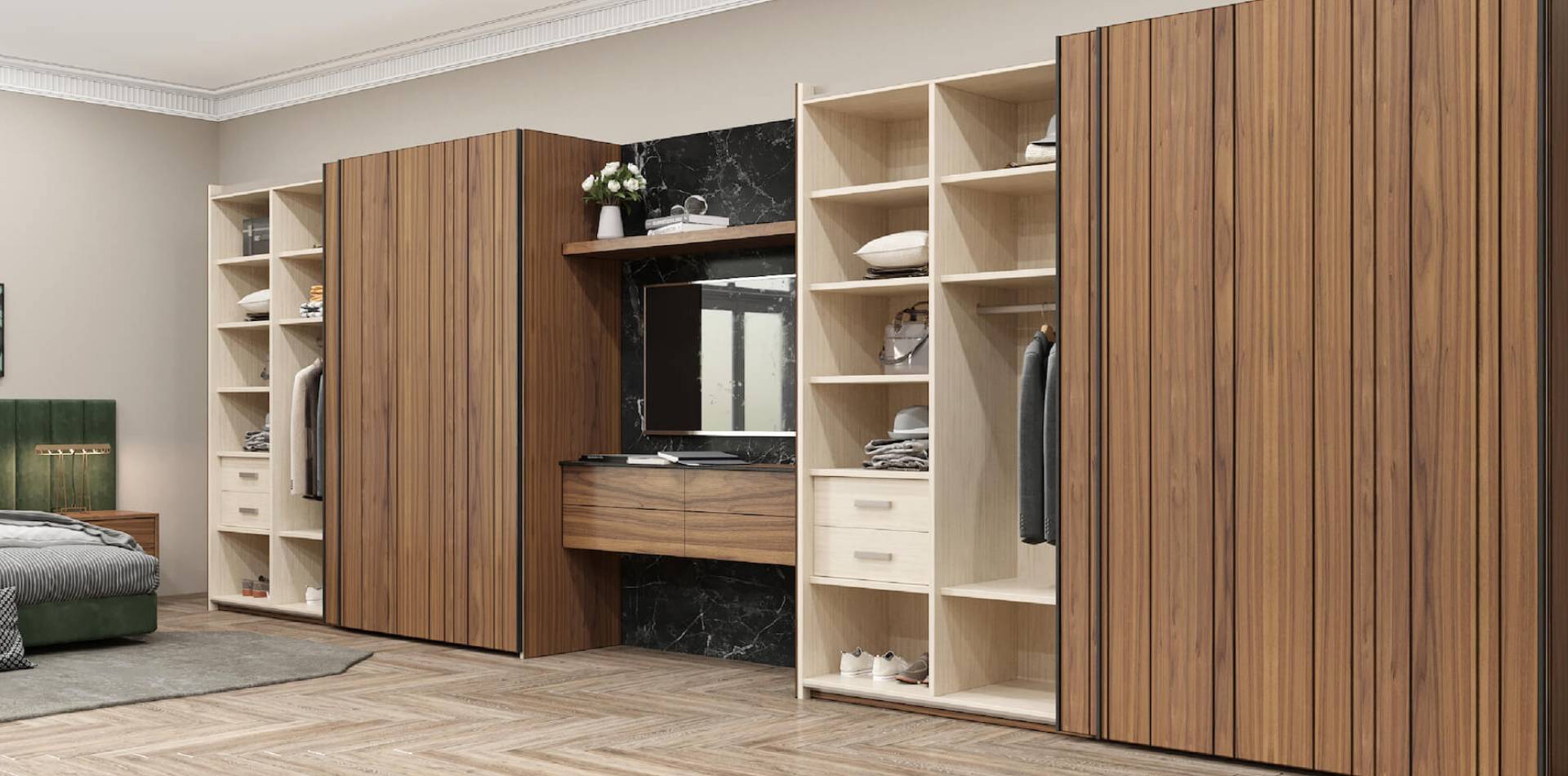
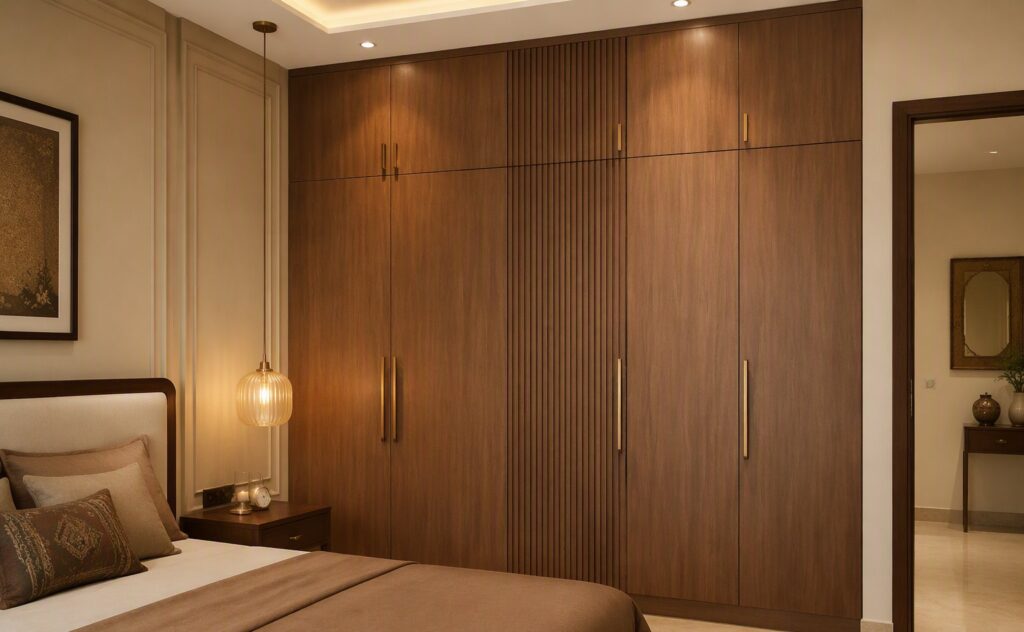
| Bedroom wardrobes | MR 18mm, calibrated | Calibrated MR ply keeps long shutter runs aligned and sliding panels gliding. Wardrobes attached to bathrooms? Step up to BWR for the carcass. |
| Kitchen | BWR everywhere, BWP at the sink | Steam and splashes rule out MR entirely. BWR for wall units and general carcasses; IS 710 BWP for the sink base, dishwasher bay and anything near the floor. |
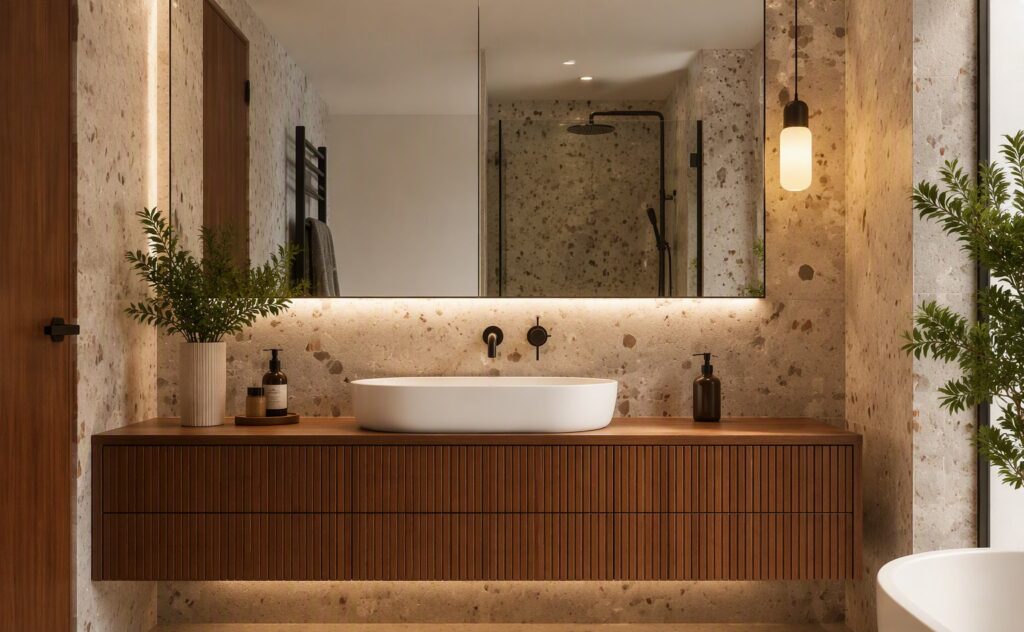
| Bathroom vanity | BWP (IS 710) only | Non-negotiable. Constant humidity plus direct splashes plus plumbing leaks waiting to happen. Seal every cut edge, raise the unit on legs or a plinth. |
| Home office | MR / BWR, 18–25mm | Desks need thickness for spans — 18mm minimum, 25mm if you hate sag. Plywood’s screw-holding keeps monitor arms and cable trays anchored for years. |
| Kids’ room | BWR, calibrated, E1/E0 | Bunk beds and toy storage take abuse — BWR forgives the spills. Ask for low-emission (E1 or E0) boards for the room your child sleeps in. |
Plywood vs the newcomers
Before you finalise plywood for every room in Bangalore, know the alternatives. Your carpenter says plywood. Your modular kitchen brand says HDHMR. The budget quote says “engineered wood” (ask which kind — that phrase hides everything). Here’s the honest lay of the land:
| Board | What it is | Strengths | Weakness | ~Price / sq ft |
|---|---|---|---|---|
| Plywood (BWR/BWP) | Cross-laminated veneers | Screw-holding, load, longevity, repairable | Premium grades cost more | ₹55 – ₹150 |
| HDHMR | Dense fibreboard, moisture-resistant | Silky surface for acrylic/laminate, CNC routing | Moisture-resistant, not waterproof; heavy | ₹55 – ₹85 |
| MDF | Medium-density fibreboard | Smoothest paint finish, carved panels | Swells with moisture; weak screw-holding | ₹35 – ₹60 |
| Particle board | Wood chips + resin | Cheapest option that exists | Water, screws, weight — fails all three | ₹20 – ₹35 |
Our shop-floor verdict: plywood for carcasses and anything structural, HDHMR for shutters and routed designs, MDF for decorative panels in dry rooms, particle board for nothing you love. The best modular kitchens in the country are built exactly this way — BWP ply boxes with HDHMR shutters. It’s not either/or; it’s a team selection.
The money maths, done honestly
Budgeting for plywood for every room in Bangalore starts here. A typical 3BHK costs between ₹1.2 and ₹2.5 lakh in material alone — the single biggest line item in most interior budgets after labour. Where that number lands depends almost entirely on how intelligently you mix grades.
Run the two extremes. An all-MR home is the cheapest build on paper — and a gamble, because one wet-wall wardrobe or sink cabinet failure costs more to rebuild than the entire saving. An all-marine home is bulletproof and roughly 60–80% pricier on board cost — lovely, but you’re paying monsoon insurance for rooms that will never see a cloud.
The pattern that works for plywood for every room in Bangalore, project after project: MR for dry-room furniture (about a third of your boards), BWR for kitchens and humid-adjacent units (the bulk), BWP strictly where water touches (a handful of sheets). That mix typically saves 25–35% over all-BWP while putting the waterproofing exactly where physics demands it.
Buy plywood like you buy raincoats — for the weather each room actually gets, not the weather you fear.
Evospace shop-floor wisdom
The yard checklist
Before you commit to plywood for every room in Bangalore, run this checklist. It’s bought at a timber yard, not a showroom — and the checks are physical. Do these before the sheets get loaded:
Before you pay
- Read the stamp. Brand, grade, and the standard number — IS 303 or IS 710 — printed on the sheet face, not just the invoice.
- Verify the licence. Match the CML number on the BIS Care app to the manufacturer. Two minutes, free, definitive.
- Study the edge. Even layers, no gaps, no overlaps, glue lines continuous. The edge never lies.
- Lift it. An 18mm hardwood-core sheet is noticeably heavy. Feather-light “18mm” usually means poplar or fewer plies.
- Sight down the surface. Hold the sheet at eye level — waviness or a dip means warping that no carpenter can fix.
- Measure the thickness. Carry a tape. “18mm” that reads 16.5mm is a discount disguised as a deal.
- Ask for the emission class. E1 or E0 for bedrooms and kids’ rooms — plywood glue is chemistry, and your family breathes it.
- Get the grade per room on the quote. “BWP throughout” on a quote usually means “BWR mostly.” Names, numbers, per zone.
Quick-fire FAQ
Is “marine plywood” actually for boats?
Originally, yes — that’s where the name comes from. Today IS 710 marine ply is simply the highest waterproof grade you can buy for interiors. You don’t need a boat to justify it; a kitchen sink cabinet in coastal humidity qualifies on merit.
Is BWR “waterproof”?
No — and this is the most expensive misunderstanding in Indian interiors. BWR is water-resistant: it handles steam and splashes, not sustained wetting. Only IS 710 BWP is genuinely boil-proof. If a quote says “waterproof plywood” and the sheet says IS 303, one of them is wrong.
How long does good plywood furniture last?
A well-made BWR or BWP carcass, properly sealed and finished, comfortably serves 15–20 years and often much longer. The failure points are almost never the sheet itself — they’re unsealed edges, wrong grade in a wet zone, or untreated boards in termite country.
Is calibrated plywood worth the premium?
For plywood for every room in Bangalore, calibration matters most in modular kitchens and sliding wardrobes — uniform thickness (±0.5mm) is what makes shutters align and laminates lie flat. For a simple bookshelf the carpenter builds on site, regular ply is fine. Match the precision to the project.
Should my whole kitchen be BWP?
For plywood for every room in Bangalore, it doesn’t hurt, but it isn’t necessary. BWP for the sink base, dishwasher bay and floor-contact units; BWR handles everything else. Put the saving into better hardware — hinges and channels affect your daily life more than the extra grade does.
What about blockboard and flush doors?
Blockboard — strips of softwood sandwiched between veneers — is lighter and resists bending over long spans, which is why it’s still the classic choice for doors and very long shelves. For everything modular, plywood’s screw-holding and consistency win. Different tools, different jobs.
The only way to get plywood for every room in Bangalore right is in person. At the Evospace studio, you can compare MR, BWR and IS 710 marine boards face to face — lift them, check the cores, verify the stamps — and leave with a grade-by-room plan that fits your home and your budget. Plan your visit.