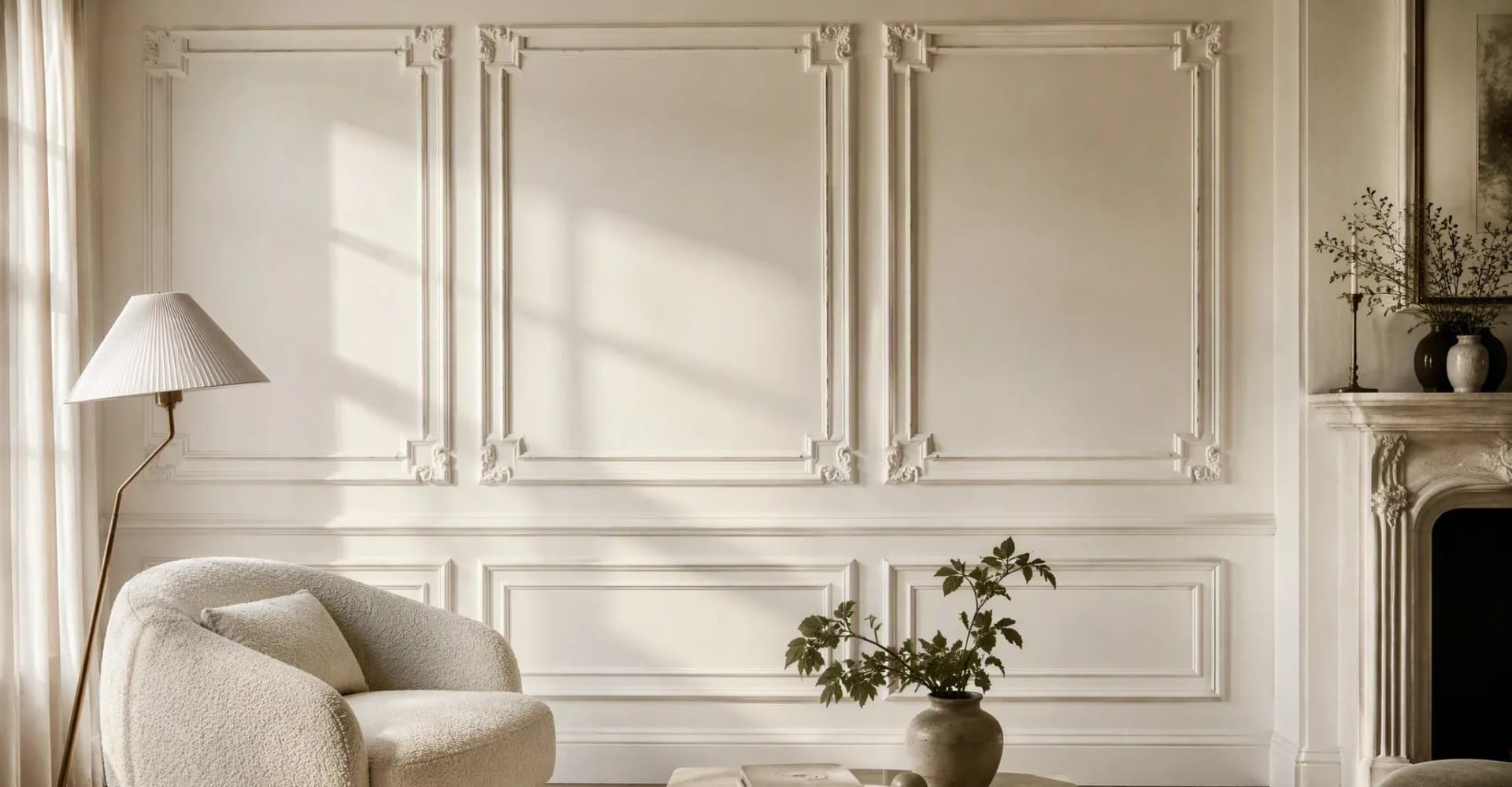
Wall Moulding, Explained: Wainscoting, Crown & the Art of the Frame
Wainscoting, crown, chair rails, picture-frame panels — the vocabulary of elegant walls, decoded. With proportion rules, real Indian prices, and the mistakes that make moulding look cheap.
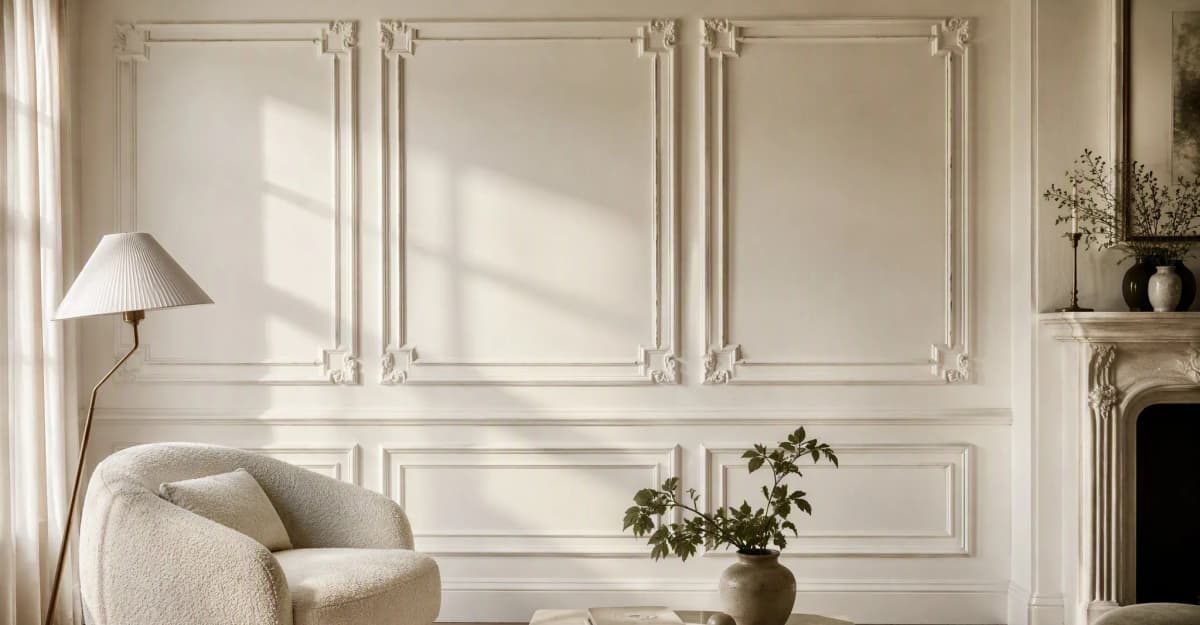
Ever walked into a room and thought "this feels expensive" — then looked closer and realised there was nothing costly in it? Same paint you could buy. Ordinary sofa. No chandelier. And yet the room had… presence.
Nine times out of ten, that presence comes from the walls. Specifically, from moulding — strips of shaped trim that turn a flat painted surface into architecture. It's the oldest trick in interior design (wainscoting dates back to 14th-century Holland, where it insulated stone walls and shielded plaster from chair backs), and it's having a serious moment in Indian homes right now.
The best part? Moulding is arguably the highest impact-per-rupee upgrade in all of interiors. But it's also easy to get wrong — wrong proportions, wrong material, wrong room. So let's walk through it properly: the vocabulary, the maths, the materials, and the rooms.
Why Moulding Works: It's Really About Shadows
Here's the design secret hiding in plain sight: a moulded wall isn't more decorated than a flat wall — it's more three-dimensional. Every strip of trim catches light on its raised edge and throws a hairline shadow beneath it. Multiply that by a dozen frames across a wall and you get a surface that changes with the sun, glows under evening lamps, and never looks flat in a photograph.
That's why moulding photographs so well, why it makes ceilings feel higher and rooms feel "finished," and why a ₹2-lakh room with good trim routinely out-shines a ₹10-lakh room with bare walls. You're not buying decoration. You're buying depth — the one thing paint alone can never give you.
There's a practical dividend too. Chair rails and wainscoting still do their original 600-year-old job: taking the scuffs, chair bumps and suitcase knocks so your paint doesn't have to. In hallways and dining rooms, that's not aesthetics — that's armour.
The whole thesis, in one breath: Paint gives a wall colour. Moulding gives it architecture. Homes feel expensive when the walls have both.
The Vocabulary: One Wall, Fully Annotated
Half the confusion around moulding is just terminology — people use "wainscoting" to mean five different things. So here's the cast of characters, exactly where each one lives on a wall:
- Crown moulding crowns the wall where it meets the ceiling — and visually raises it.
- Baseboards (skirting) do the same job at the floor, while hiding the floor-wall joint.
- Chair rail runs horizontally at roughly a third of the wall height — originally chair-back armour, now mostly a divider for two-tone walls.
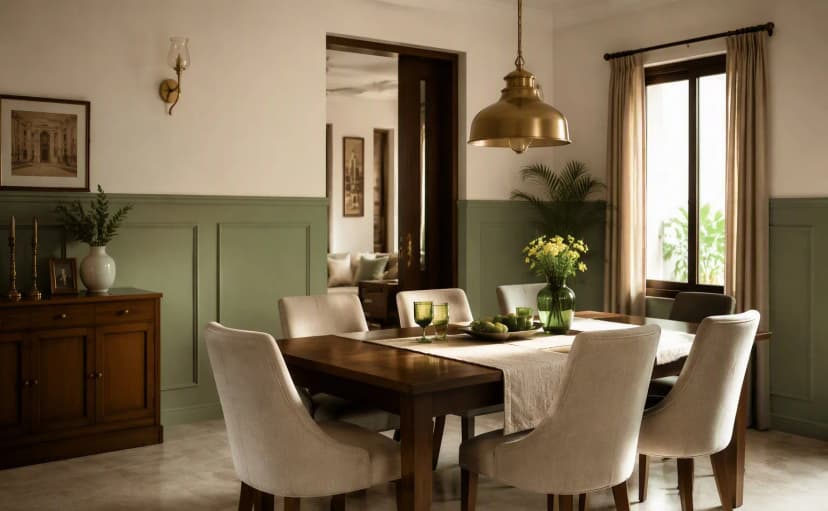
- Wainscoting is everything below the chair rail: panelling that can be simple frames, beadboard, or board-and-batten.
- Picture-frame moulding — the current favourite — is purely decorative: rectangles of trim applied to flat wall, creating the panelled look of a heritage home for the price of paint and beading.
The spec: Chair rail at ~32–36 in from floor · Wainscoting = the lower third · Picture frames = trim + wall paint, nothing else.
A quick word on the cousins you'll meet in catalogues: beadboard (narrow vertical planks with grooves — charming in bathrooms and foyers), board-and-batten (wide boards with slim battens over the seams — the farmhouse favourite), and judges panelling (full-height framed panels, the boardroom look). All of them are variations on the same idea — trim creating rhythm on a flat plane.
POP vs PU vs MDF vs Wood: What Your Trim Is Made Of
In India, moulding conversations quickly become material conversations. Each option has a personality:
POP (Plaster of Paris) is the traditional route — cast on site or from moulds, seamless, and cheap on material. It's how most Indian cornices and ceiling borders have been done for decades. The trade-offs: it needs a skilled artisan, it chips if knocked, and intricate wall frames are slow work.
PU (polyurethane) is the modern disruptor — factory-moulded, featherlight, waterproof, termite-proof, and available in hundreds of crisp profiles from simple beading to full baroque. It cuts and sticks like thermocol, paints like wood, and never cracks with building movement. For picture-frame walls, it's what we'd reach for first.
MDF trim is the budget workhorse for painted wainscoting — smooth, consistent, takes paint beautifully — but keep it away from bathrooms and damp walls, because swollen MDF is a one-way street. Solid wood (teak, oak, pine) is the premium choice when trim will be stained rather than painted, or where it takes daily physical abuse — staircases, for instance.
| Material | Best for | Watch out for | Indicative price |
|---|---|---|---|
| POP | Cornices, ceiling borders, curves | Needs skilled casting; chips on impact | ₹25 – ₹80 per rft (simple profiles) |
| PU (polyurethane) | Picture frames, chair rails, crown — almost everything | Needs paint to look premium; avoid silicone-heavy caulks | ₹80 – ₹350 per rft by profile |
| MDF trim | Painted wainscoting, budget frames | Moisture swells it — never in bathrooms | ₹40 – ₹120 per rft |
| Solid wood | Stained finishes, staircases, abuse zones | Cost, movement with seasons, termite treatment | ₹150 – ₹500+ per rft |
Note: rft = running foot. Prices vary by profile complexity, brand and city; ornate PU cornices run higher than plain beading. Full wall treatments are usually quoted per sq ft — see the money maths below.
The Proportion Rules (Where Most Projects Go Wrong)
Moulding fails quietly. Nobody's trim falls off the wall — it just looks off, and nobody can say why. Almost always, it's proportion. Three rules prevent 90% of disasters:
One — never split a wall in half. Wainscoting at exactly half the wall height creates a static, chopped-up look. Keep it at the classic one-third (roughly 32–36 inches on a 9–10 ft ceiling), or go boldly two-thirds for a dramatic, panelled-room feel. Anything in between looks like a measuring error.
Two — scale the trim to the room. A delicate 1-inch bead disappears on a 14-foot wall; a heavy 4-inch profile suffocates a compact bedroom. Small rooms: slim profiles, generous breathing space between frames. Large rooms and high ceilings: wider rails, taller baseboards, bigger panels. When in doubt, go slightly slimmer than you think — restraint reads as expensive.
Three — spacing is the design. Keep gaps between picture frames, and between frames and adjacent walls, consistent — typically 3 to 6 inches. A wall of evenly spaced rectangles looks intentional; the same frames with random gaps look like a measuring error (sensing a theme?). Dry-fit with painter's tape, photograph it, sleep on it, then commit.
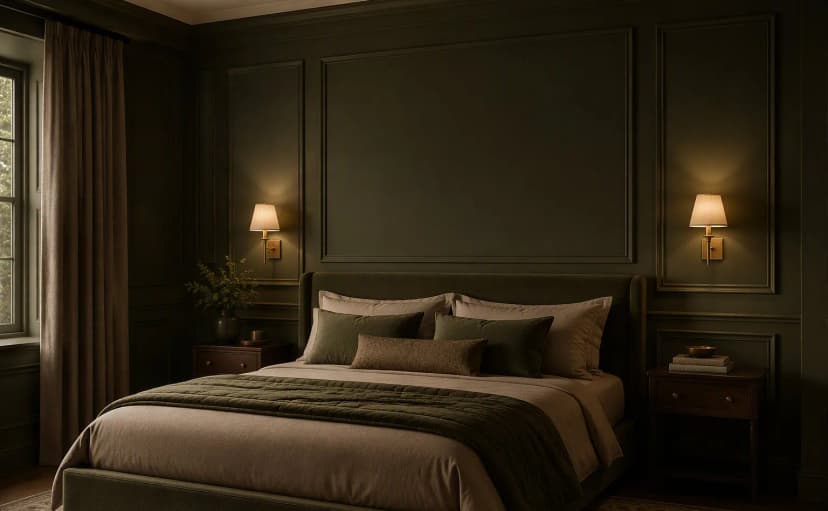
And the colour question that comes up in every consult: contrast or tonal? White trim on a coloured wall is the classic route — crisp, graphic, heritage. Trim and wall in the same colour (as above) is the contemporary one — the moulding appears as pure shadow-play. Both are correct. What's not: five colours of trim in one room. Pick a lane.
Room by Room: the Cheat Sheet
Where moulding earns its keep, and which type to use where:
Living room — pick picture frames + crown
Frame the sofa or TV wall with slim panels, add crown at the ceiling. One treated wall plus crown on the rest gives the whole room the effect for half the budget.
Bedroom — pick tonal frames behind the bed
The headboard wall is moulding's natural home. Trim and wall in one deep, restful colour, sconces centred in the side panels — instant boutique hotel.
Dining room — pick wainscoting
The one room where chairs genuinely attack walls daily. Panel the lower third, run a bold colour above the rail, and let the trim take the knocks.
Foyer & hallway — pick wainscoting + crown
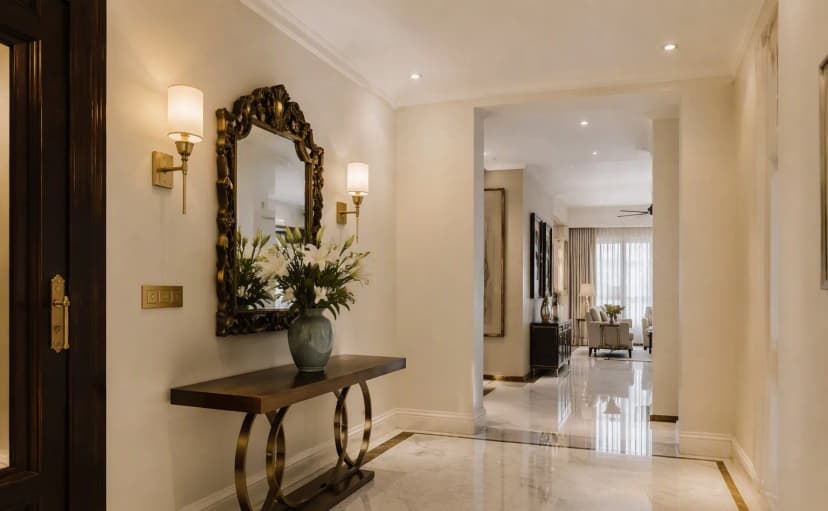
Your entrance sets the tone of the home, and hallways take suitcase abuse. Wainscoting here is half decoration, half armour — and all first impression.
Home office — pick slim frames, calm colour
Enough structure to feel designed on video calls, restrained enough to not distract you. One framed wall behind the desk is usually perfect.
Bathroom — pick PU beadboard only
Moisture rules out MDF and raw POP at splash level. PU trim is waterproof, so wainscot away — just seal every cut edge and keep it out of the shower line.
The Money Maths, Done Honestly
Moulding is priced two ways in India: per running foot for trim-only work (frames, rails, crown), and per square foot for full panelled treatments. Here's what the market looks like right now:
| Treatment | Typical price | Notes |
|---|---|---|
| Picture-frame wall (PU/MDF trim + paint) | ₹135 – ₹200 per rft of trim | A 10 ft feature wall typically uses 60–90 rft → roughly ₹10,000–₹20,000 all-in |
| Wainscoting (solid wood or MDF, painted) | ₹135 – ₹200 per rft | Per running foot of wall, at chair-rail height |
| Beadboard / board-and-batten | ₹750 – ₹950 per sq ft | Paint finish included in most quotes |
| Geometric wooden panelling | ₹500 – ₹750 per sq ft | Statement walls, headboard backdrops |
| Overlay panelling (laminate/veneer) | ₹700 – ₹1,050 per sq ft | TV walls; veneer + PU polish pushes higher |
| Full panelled wall, all-in | ₹300 – ₹2,300 per sq ft | Panel + backing ply + labour + finish — the honest end-to-end range |
Note: Ranges from Indian interior cost guides and installer quotes; 18% GST extra. Labour is typically ₹50–₹150 per sq ft within full-treatment quotes.
The sanity-check we give every customer: a genuinely transformative picture-frame feature wall usually lands between ₹12,000 and ₹25,000 — trim, adhesive, caulking, primer, two coats of paint, the works. For what it does to a room, that is astonishing value. Wallpaper of similar visual weight costs more, ages worse, and can't take a knock.
Where budgets blow up is scope creep: "while we're at it, all four walls." Our advice — do one wall per room, brilliantly. Accent walls work precisely because the other three are quiet.
Evospace shop-floor wisdom: One framed wall is architecture. Four framed walls are a wedding venue. Spend the difference on a great lamp.
The Mistakes That Make Moulding Look Cheap
Moulding done well looks like the house was born with it. Done badly, it looks like a craft project. The difference is almost always one of these:
- Mind the sockets and switches. Plan frame layouts around switchboards — a frame edge slicing through a switch plate ruins the illusion instantly. Move the switch, not the frame.
- Caulk every joint. Hairline gaps where trim meets wall are what separates "built-in" from "stuck-on." Paintable acrylic caulk, then paint.
- Paint the trim the wall's finish, not the carpentry's. Unpainted or mismatched sheen on trim is the #1 tell of a rushed job. Same colour family, decided upfront.
- Check the wall is flat. Moulding telegraphs every wave in bad plaster. Skim-coat first if the wall isn't true — trim follows the wall it's glued to.
- Respect the one-third line. Wainscoting at half-height looks like an accident. A third up, or two-thirds — never the middle.
- Scale down in small rooms. Slim profiles, fewer, larger frames. Petite rooms wearing chunky baroque trim look like they're in costume.
- Keep frames off damp-prone exterior walls in MDF. Monsoon moisture travels through walls; PU doesn't care, MDF swells. Choose per wall, not per room.
- Level is a religion. A chair rail 5 mm off-level across a 12-foot wall is visible from the doorway. Laser level or nothing.
Quick-Fire FAQ
Is wall moulding just a passing trend?
Wainscoting has been fashionable since the 1300s, which makes it the longest-running trend in interior history. What's cycling right now is the style — slim, tonal, picture-frame panels rather than heavy ornamentation. Keep profiles simple and the look survives every wave.
Can moulding work in a small apartment?
It works better there than anywhere — small rooms gain the most from perceived depth. Use slim profiles, tonal paint, and frame just one wall. Done right, moulding makes compact rooms feel taller and more considered, never busier.
PU moulding vs POP — which should I pick?
For wall frames and straight runs, PU: lighter, faster, crack-resistant, waterproof, and forgiving of building movement. For curved cornices and seamless ceiling work with a skilled artisan available, POP still holds its own. Most modern homes mix both — PU on walls, POP or PU at the ceiling.
Can it be added to an existing, lived-in home?
Yes — picture-frame moulding is a one-to-two-day job per wall with minimal mess: adhesive, a nail gun, caulk, paint. It's one of the few upgrades that doesn't require moving out. Wainscoting with backing boards is dustier; plan a weekend per room.
Does moulding add resale value?
It adds perceived value, which in property viewings is the same thing. Buyers read panelled walls as "well-maintained, premium build." Just keep colours neutral if resale is the horizon — dramatic tones are for forever homes.
How do I maintain it?
A soft brush or vacuum with a brush head for the ledges, a damp cloth for scuffs, and a small jar of touch-up paint for the inevitable suitcase corner. PU and painted MDF need nothing else — no polish, no treatment, no drama.
Walls Are Easier to Judge in Person.
At the Evospace studio in Bangalore, you can compare PU, POP and timber profiles side by side, see finished panel samples in real light, and leave with a proportioned layout and an honest quote for your walls.
Plan your visit