How to Choose the Best Plywood for Kitchen Cabinets in Bangalore
One kitchen, three humidity zones, four sheet grades and a dozen dealer pitches. Here is how to spec the right plywood for every cabinet — what to buy, what thickness, what it should cost, and the two upsell tricks that quietly add ₹50,000+ to Bangalore kitchen bills.
Spec BWR (IS 303) plywood for the whole kitchen, and upgrade only the sink cabinet to BWP (IS 710). Use 18–19 mm for carcass and shutters, 12 mm for shelves and drawers, 6 mm for backs. In Bangalore rates, that mix costs roughly ₹85–130 per sq ft (BWR) plus ₹120–180 per sq ft for the few BWP sheets — a typical 60–70 sq ft kitchen carcass lands at ₹55,000–₹85,000 in plywood. Reject the two standard traps: an all-marine-ply upsell (₹45,000–₹1,00,000 of dead spend) and MR sheets quietly substituted for BWR. Verify every sheet at delivery with the ISI mark, a caliper and the edge test below.
1. Why kitchens destroy ordinary plywood
A kitchen is the harshest room in an Indian home for engineered wood. Bedroom wardrobes sit in conditioned air for decades; kitchen cabinets face four simultaneous stresses that no other room combines.
Steam. Pressure cookers, boiling dal and tadka pans push hot, moisture-laden air directly into wall cabinets and under-shutter edges. Steam condenses inside unsealed laminate joints and sits against the plywood face for hours every day.
Standing water. The under-sink zone deals with dripping waste pipes, wet mops stored in buckets, garbage bins and RO reject lines. A slow coupling leak can keep a cabinet floor damp for weeks before anyone notices.
Oil and masala aerosols. Indian cooking atomises oil and turmeric into a fine film that settles on every horizontal surface. On low-grade boards this film works into surface checks and edge banding seams, swelling the core from the face inward.
Point loads and cycles. A loaded grain drawer can hold 25–40 kg and opens 10–15 times a day. Hinges and channels transfer all of that into 18 mm panel edges. Weak core veneers or under-spec thickness means sagging shelves and shutters drifting out of alignment within two monsoons.
Bangalore's twist: the city's moderate climate is misleading. Monsoon months push indoor RH above 75% for weeks, and most kitchens here are interior rooms with a single window and a chimney that runs for 20 minutes a day. Moisture goes in faster than it comes out — which is exactly why grade selection matters more here than in drier cities.
If you want the broader durability picture beyond kitchens — wardrobes, TV units, pooja shelves — our guide on selecting durable materials for modern home interiors covers zone-by-zone specs for the whole house.
2. MR vs BWR vs BWP — grades decoded with prices
Every plywood pitch in Bangalore eventually reduces to three letters. Understanding what each grade is actually tested for — not what the dealer says it means — is the single highest-value knowledge you can carry into a timber yard.
| Grade | BIS standard | Glue | Test it passes | Price / sq ft | 8×4 sheet | Kitchen verdict |
|---|---|---|---|---|---|---|
| MR (Commercial) | IS 303 | Urea-formaldehyde | Cold-water resistance only | ₹60–90 | ₹1,900–2,900 | Avoid — wardrobes and dry rooms only |
| BWR (Boiling Water Resistant) | IS 303 | Phenolic (synthetic resin) | 8-hour boiling-water test | ₹85–130 | ₹2,700–4,150 | Yes — default for all cabinets except sink |
| BWP (Boiling Water Proof / Marine) | IS 710 | Phenol-formaldehyde, denser core | 72-hour boiling-water test | ₹120–180 | ₹3,850–5,750 | Yes — sink cabinet and wet zones only |
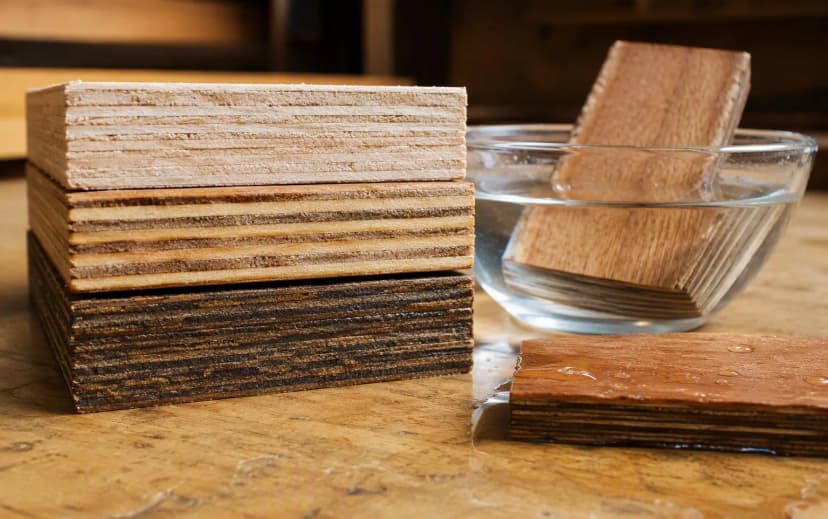
The critical insight hides in the test column. MR grade is bonded with urea-formaldehyde — fine for a bedroom, but its glue line softens with sustained steam exposure. BWR uses phenolic resin and must survive 8 hours in boiling water without delaminating: that comfortably covers steam, splashes and monsoon humidity for decades. BWP goes further — phenol-formaldehyde glue, tighter core veneers and a 72-hour boil test, which is immersion territory your kitchen will never see outside the sink zone.
Note what the grades do not certify: screw-holding strength, core species, termite treatment or face veneer quality. Two BWR sheets at ₹90 and ₹125 per sq ft can be genuinely different products. That is a physical-inspection problem, and it is covered test-by-test in our guide to the top signs of high-quality plywood.
Where do brands and calibrated ply fit in?
Within each grade, branded plywood (Century, Greenply, Kitply, Austin and similar) buys you three things: consistent core veneer quality, reliable treatment chemicals, and a warranty that exists on paper. Unbranded "yard ply" at 20–30% lower prices is where MR-substitution and core-gap problems concentrate. Calibrated plywood — sanded to a uniform thickness of ±0.2–0.3 mm — matters if your kitchen is factory-made with machine-pressed laminates; uneven thickness telegraphs through glossy acrylic and membrane shutters as visible waviness.
3. Zone-by-zone: the right grade for each cabinet
A kitchen is not one environment — it is three. Specifying one grade across all of them either leaves the wet zone exposed or wastes money in the dry zones. Here is the spec we use.
Sink cabinet → BWP, no exceptions
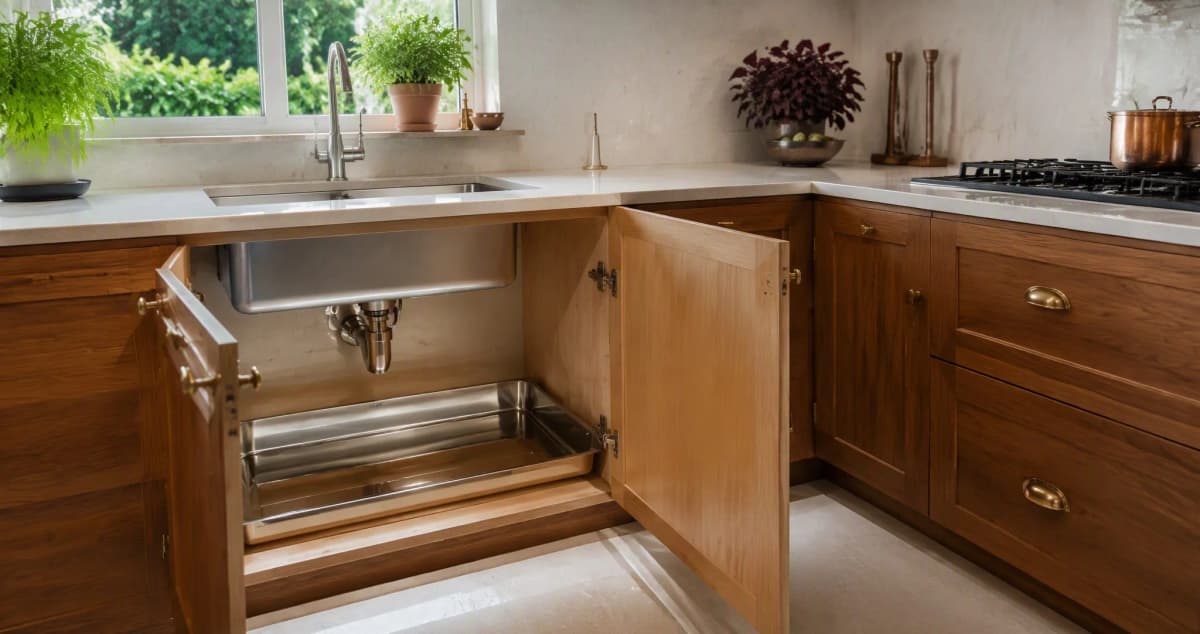
This is the only cabinet that regularly sees standing water. Waste-pipe couplings weep, RO systems drip, and wet dustbins sit directly on the panel floor. BWP's 72-hour boil rating and denser core are built for exactly this. The area involved is small — typically 8–12 sq ft of sheet — so the upgrade costs ₹1,500–3,000 in total. It is the cheapest insurance in the entire kitchen.
Base units (hob, drawers, pull-outs) → BWR
Base cabinets take steam from below the counter, splashes from the counter edge, and the heaviest loads. BWR handles all three. Pay attention to the floor panels of drawer units — they carry 25–40 kg of grain and masala dabbas, so this is where 18 mm thickness matters most.
Wall cabinets → BWR
Wall units sit directly in the steam plume from the cooktop. Despite carrying lighter loads, they fail from the bottom edge upward as steam condenses and soaks the unsealed edge banding line. BWR with properly sealed edges (see Section 6) is the right spec; MR here typically swells at the lower edge within three to four monsoons.
Tall units and lofts → BWR
Pantry pull-outs and appliance garages carry heavy loads over tall spans. Grade-wise BWR is sufficient; structurally, insist on full 18–19 mm sides and a stiff back panel so the unit does not rack when a loaded pantry frame slides out.
This zone logic is the plywood half of a complete kitchen spec. For carcass alternatives (HDHMR, MDF), shutter finishes, countertops and hardware that survive the same conditions, see our Bangalore modular kitchen materials guide — the two articles are designed to be read together.
4. Thickness by component (and why 16 mm is a red flag)
Grade answers "will it survive moisture?" Thickness answers "will it survive load?" Bangalore kitchens need both answers to be right, component by component.
| Component | Thickness | Why | Common shortcut to reject |
|---|---|---|---|
| Carcass sides, base and dividers | 18–19 mm | Carries all static and dynamic load; hinge and channel screws bite into edges | 16 mm panels billed as "18 mm" |
| Shutters | 18 mm | Hinge cups are bored for 18 mm; thinner doors sag and drift out of alignment | 16 mm shutters with packing shims |
| Shelves (spans under 60 cm) | 12 mm | Adequate for dish loads on short spans; keeps weight off wall fixings | Same 12 mm spec on spans over 80 cm — it will sag |
| Long shelves (over 60 cm) | 18 mm | Span stiffness scales badly with length; upgrade or add a centre support | — |
| Drawer sides and bottom | 12 mm | Grain drawers hit 25–40 kg; the bottom panel is the failure point | 8–9 mm drawer bottoms |
| Cabinet backs | 6 mm | Non-structural; only braces the carcass against racking | Skipping the back entirely on tall units |
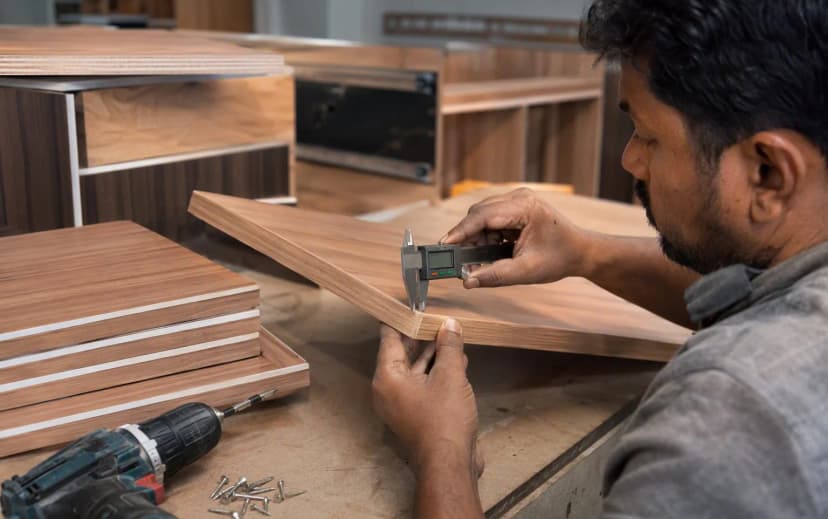
One number to memorise: 18 mm, measured. BIS tolerance allows ±0.5 mm, so a genuine 18 mm sheet reads 17.5–18.5 mm on a digital caliper. If your carpenter's "18 mm" order reads 16.2 mm, you are holding 16 mm commercial panels — a different price band and a weaker carcass. Check at several points across the sheet, not just the corners, and photograph the readings before cutting begins. The full physical inspection routine (tap test, edge test, weight check) is in our plywood quality signs guide.
Modular factories: if your kitchen is CNC-cut and edge-banded at a factory, ask for calibrated ply. The ±0.2–0.3 mm thickness consistency keeps hot-pressed laminates uniform and lets the bander run without gaps. On site-built kitchens it is optional; on factory-built ones it is the difference between shutters that align and shutters that almost align.
5. The two plywood traps Bangalore buyers keep falling for
Most money lost on kitchen plywood is not lost to bad material — it is lost to two specific sales manoeuvres. Both are easy to defeat once you can name them.
Trap 1: The all-marine-ply upsell
The pitch: "Madam, kitchen means water, water means marine ply — full kitchen BWP, only ₹40 more per sq ft." The arithmetic nobody shows you: a typical 3BHK kitchen uses 25–35 sheets across carcass and shutters. At ₹30–50 per sq ft of premium, that is ₹45,000–₹1,00,000 extra — spent waterproofing wall cabinets and lofts that will never see standing water in thirty years. The correct move is the zone spec from Section 3: BWP for the sink cabinet's 2–3 sheets, BWR everywhere else. Total premium over an all-BWR kitchen: roughly ₹3,000–6,000.
Trap 2: The quiet BWR→MR substitution
You specify and pay for BWR. The sheets that arrive are MR with a convincing face. The dealer pockets ₹25–40 per sq ft across the order — and you discover it in year three, when wall-cabinet bottom edges start swelling. Defences:
- Read the stamp, verify the licence. Every genuine panel carries an ink stamp with the IS number (IS 303 or IS 710), the ISI mark and a CM/L licence number. Enter that CM/L number in the free BIS Care app — it shows the licensee's name, address and what grades they are actually certified to make.
- Get the grade on paper. Your carpenter's material order and the dealer's invoice should name grade, thickness and brand per line item. "Plywood 18 mm — 30 nos" is how substitutions stay deniable.
- Inspect at delivery, before cutting. Once sheets are cut into carcass parts, provenance is gone. The 90-second edge-and-stamp check in our quality signs article is designed for exactly this moment.
Choosing who you buy from matters as much as what you buy — our plywood supplier evaluation checklist covers authorised-dealer verification, invoice hygiene and red flags in the yard. And if a vendor pushes the phrase "BWR and BWP are the same thing, sir," our BWR vs BWP explainer has the BIS test data that settles it.
6. Installation details that protect your plywood
Even perfect BWP fails early if the installation leaves it exposed. Four details decide whether your plywood spec actually delivers its design life.
Edge banding on every cut edge
Factory edge banding (or minimum 2 mm PVC banding on site) on every exposed edge — including shelf undersides and the bottom edges of wall cabinets, which is where steam attacks first.
CHECK: run a fingernail along edges — no open plywood grain
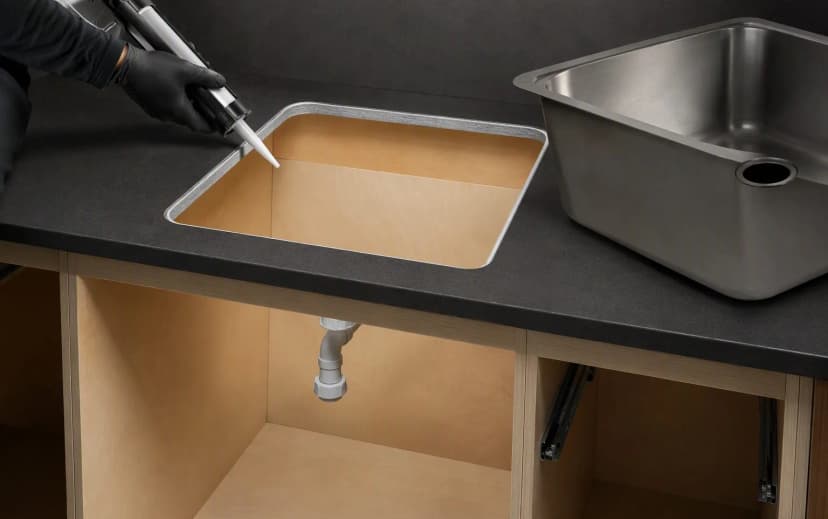
Silicone seal at the sink cutout
The raw cutout rim around the sink is the single most attacked edge in the kitchen. A continuous bead of sanitary-grade silicone seals it; recheck annually.
CHECK: no gap between sink rim, sealant and counter
Stainless tray under the sink
A removable SS tray on the sink-cabinet floor catches coupling drips and wet-bin moisture before they reach even BWP plywood. ₹800–1,500, worth every rupee.
CHECK: tray lip on all four sides, removable for cleaning
Skirting gap off the floor
Base cabinets should sit on 100 mm PVC or aluminium skirting — never plywood to floor. Daily mopping water wicks upward through any panel edge that touches the slab.
CHECK: no plywood edge within 100 mm of the floor
Sealed hinge bores and cutouts
Hinge cups, handle borings and hob/chimney cutouts expose fresh core. A coat of primer or PU sealer on every machined surface before hardware goes in.
CHECK: no raw core visible inside any drilled hole
Ventilation behind tall units
Leave 25–50 mm behind tall units and appliance garages so monsoon humidity does not trap against the back panels. A vented back or spacer battens does the job.
CHECK: hand fits behind the tall unit back panel
The 10-point plywood delivery checklist
- Grade on the stamp matches the invoice — IS 303 for BWR sheets, IS 710 for the sink-cabinet sheets, MR nowhere in the pile.
- CM/L number verified on the BIS Care app — the licensee name should match the brand on the invoice, and the certificate should cover the grade sold to you.
- Thickness measured with a caliper — 17.5–18.5 mm for carcass sheets, at multiple points, with photos before cutting starts.
- Edge sighting done — hold each sheet at eye level: no core gaps, overlaps or putty-filled voids along the edge line.
- Tap test passed — knock across the face; a uniform solid note, no hollow or papery patches.
- Faces flat, no warp — lay one sheet flat and eyeball the diagonals; rocking or bowing sheets become misaligned shutters.
- Sink-cabinet sheets set aside and marked — BWP sheets labelled on delivery day so they cannot get mixed into the general pile.
- Edge banding spec confirmed — every cut edge, including shelf undersides and wall-cabinet bottom edges, in the work order.
- Sink cutout sealing in scope — silicone bead plus SS tray written into the carpenter's job list, not assumed.
- Skirting material confirmed — PVC or aluminium skirting, no plywood touching the floor anywhere in the base run.
Frequently asked questions
Which plywood is best for kitchen cabinets in Bangalore?
BWP (IS 710) marine-grade plywood for the sink cabinet and BWR (IS 303) for all other base, wall and tall units. This combination handles Bangalore's steam, splashes and monsoon humidity without paying a marine-grade premium across the whole kitchen.
Is BWP plywood necessary for the entire kitchen?
No. Only the sink cabinet and any panel within roughly 60 cm of a water source genuinely needs BWP. Base units, wall cabinets and tall units are well served by BWR. Specifying BWP everywhere typically adds ₹30–50 per sq ft for no functional gain.
What thickness of plywood is used for kitchen cabinets?
18–19 mm for the carcass, shutters and drawer fronts; 12 mm for shelves under 60 cm spans and drawer sides; 6 mm for cabinet backs. Never accept 16 mm carcass panels passed off as 18 mm.
How much does kitchen plywood cost in Bangalore?
As of, expect ₹60–90 per sq ft for MR, ₹85–130 for BWR and ₹120–180 for BWP (18 mm). An 8×4 sheet works out to roughly ₹1,900–2,900 (MR), ₹2,700–4,150 (BWR) and ₹3,850–5,750 (BWP) depending on brand and core species.
Is marine plywood worth it for a Bangalore kitchen?
Only in the wet zone. Bangalore kitchens face steam and splashes, not immersion. A full marine-ply upsell on a typical 3BHK kitchen adds ₹45,000–1,00,000 over a BWR+BWP mix without extending cabinet life in dry zones.
How do I check plywood quality at delivery?
Verify the ISI mark and CM/L licence number on the BIS Care app, measure thickness with a caliper at multiple points (18 mm should read 17.5–18.5 mm), sight along the edge for core gaps or overlaps, and tap the face for hollow spots before signing the delivery challan.
BWR vs BWP plywood — what is the actual difference?
Both use phenolic resins, but BWP (IS 710) uses phenol-formaldehyde glue with a denser core and passes a 72-hour boiling-water test, while BWR (IS 303) passes an 8-hour boiling test. BWR handles steam and splashes; BWP survives standing water.
Should I use calibrated plywood for a modular kitchen?
Yes, if your shutters and carcass are machine-pressed. Calibrated plywood holds thickness within ±0.2–0.3 mm across the sheet, which keeps laminate pressing uniform and shutters aligned. For site-built carpenter kitchens it is a nice-to-have, not a must.
Get your kitchen spec'd right the first time
Evospace designs and builds modular kitchens across Bangalore with documented material specs — grade, thickness, brand and hardware named line by line, so nothing gets substituted on the way to your site.
Get a Free Material Consultation