
Common Mistakes to Avoid When Selecting Laminates for Furniture
Most laminate furniture does not fail because the sheet was bad. It fails because of eight small decisions made at the shop or on the order list — wrong thickness, wrong finish for the room, no edge banding, a brand name trusted without a spec. Here is each mistake, what it costs you, and the exact fix.
The eight mistakes that ruin laminate furniture in Indian homes: choosing by looks alone, accepting 0.6–0.7 mm liner sheets on working surfaces (1 mm HPL is the floor), using high-gloss everywhere, ignoring the board underneath, skipping matched edge banding, trusting a brand name without the decor code on the invoice, over-mixing patterns, and ignoring maintenance reality. None of these costs more than ₹30–60 per sq ft to get right — but each one can force a ₹15,000–50,000 redo per unit within 2–4 years.
1. What a wrong laminate actually costs
Laminate is the cheapest layer of your furniture to buy — and the most expensive to redo, because redoing it means touching everything around it.
The saving from a wrong choice is tiny. Upgrading from a liner-grade sheet to proper 1 mm HPL costs roughly ₹20–40 per sq ft. A wardrobe shutter bank of 100 sq ft saves you perhaps ₹2,000–4,000 at the shop. Now watch what that saving becomes. The sheet starts lifting at a corner in year two. You cannot replace one shutter — the decor is discontinued, the batch shade has shifted, so the whole bank gets re-skinned. New laminate, fresh adhesive, carpenter labour, edge banding, plus the risk of damaging the carcass while stripping the old sheet: ₹15,000–30,000 for a wardrobe, ₹40,000–90,000 for a kitchen.
This is why laminate selection deserves more attention than the price tag suggests. The sheet is 5–8% of furniture cost, but it is 100% of what you see and touch every day — and the surface every failure shows up on first.
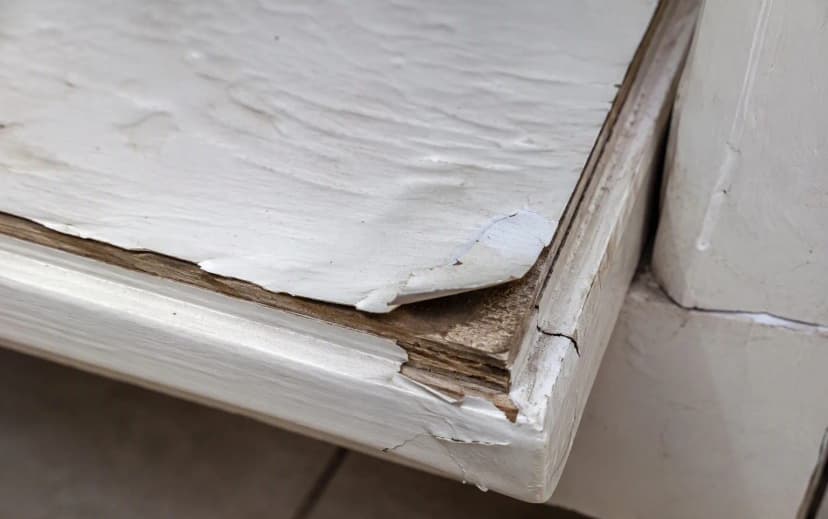
Nearly every peeling, bubbling or faded panel we get called to inspect traces back to one of the eight mistakes below — and every one of them was avoidable at the buying stage, usually for less than the cost of a dinner out.
One thing to be clear about: laminate itself is an excellent material. Branded 1 mm HPL from Greenlam, Merino, Century or Royale Touche routinely outlasts the furniture's design life. This guide is not anti-laminate — it is anti-shortcut.
2. The 8 selection mistakes, with fixes
In rough order of how often we see them in Bangalore homes.
1. Choosing by looks alone — from a 2-inch chip
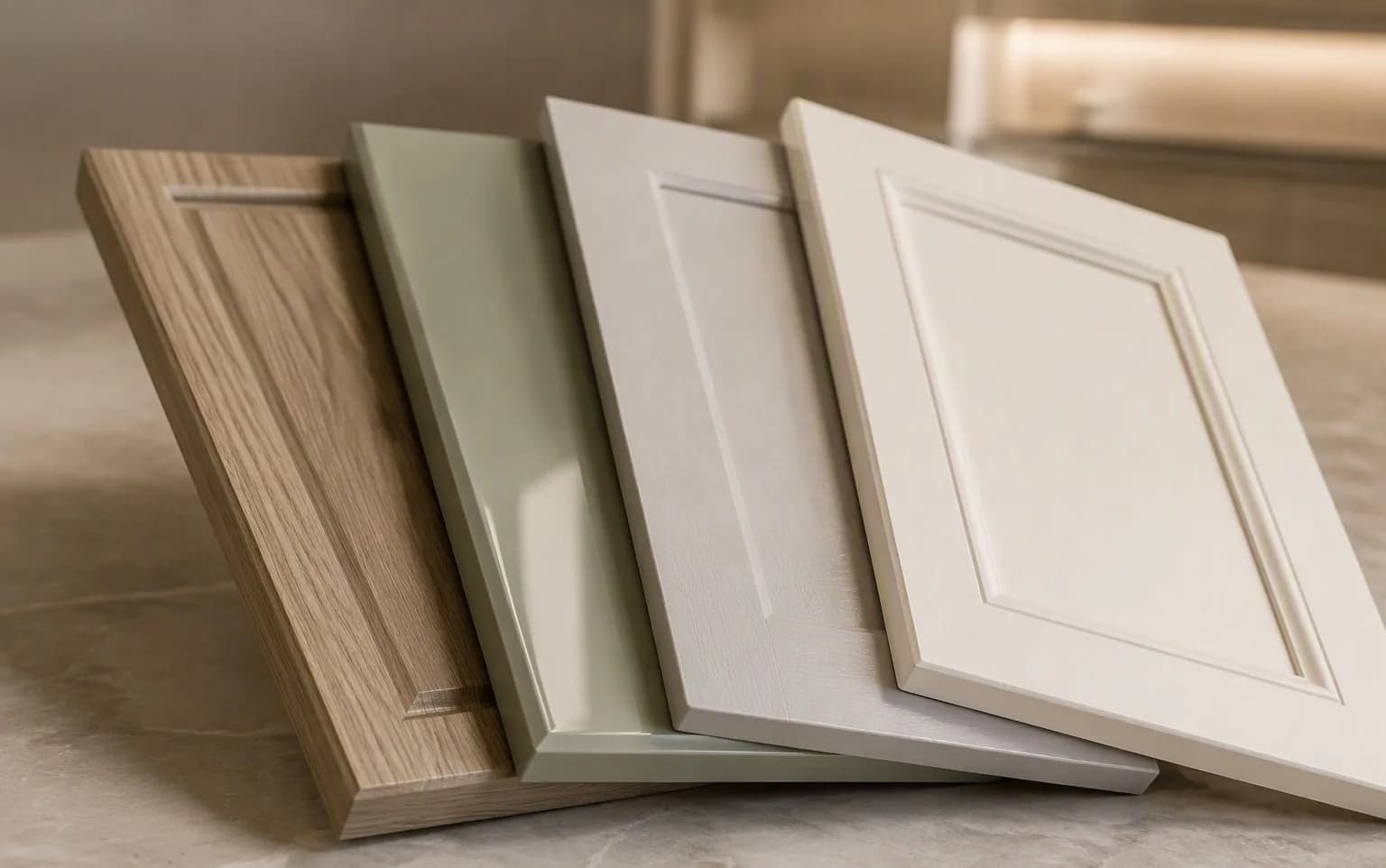
The catalogue chip hides everything that matters: grain repeat, texture depth, true colour at scale, and how the finish behaves in your room's light. Glossy white looks crisp in a showroom; on a full kitchen it glares and shows every fingerprint. Always insist on a full-size sample or a large dealer board, and check it in daylight, ideally in the room it will live in. Colour and texture are the last things to decide — after thickness, finish family and zone fit.
2. Accepting liner-grade thickness on working surfaces
This is the most expensive mistake on the list. Sheets at 0.6–0.72 mm are liner grade — engineered for the inside of cabinets, not for surfaces you touch daily. On shutters and drawer fronts they chip at corners, lift at edges and telegraph every bump in the board beneath. The rule is simple: 1 mm HPL minimum on every working surface — kitchen shutters, wardrobe faces, drawers, tabletops. Use 0.8 mm only on low-touch verticals, and liner strictly where hands never go.
3. Using high-gloss everywhere
Gloss is a spotlight finish, not a whole-house one. It shows fingerprints, smudges and micro-scratches within weeks on daily-touch surfaces, and it dates a room faster than matte. Keep gloss for upper kitchen cabinets, feature panels and small dark spaces that need reflectivity. Everywhere hands go — wardrobes, base cabinets, study desks — matte, satin or anti-fingerprint finishes stay presentable with a fraction of the wiping.
4. Ignoring the board underneath
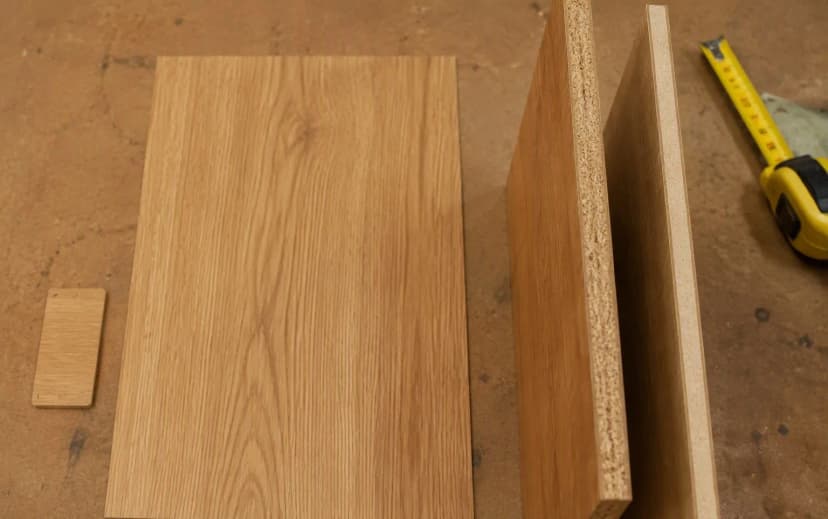
A laminate is only as good as what it is stuck to. Premium 1 mm HPL on MR-grade board in a kitchen still swells at the first leak; the laminate gets blamed for the plywood's failure. Pair the surface with the right base: BWP plywood in kitchens and wet zones, BWR for wardrobes and general furniture, and expect boards to acclimatise indoors for a day or two before pasting. The full grade-by-zone logic is in our kitchen plywood guide.
5. Skipping edge banding — or mismatching it
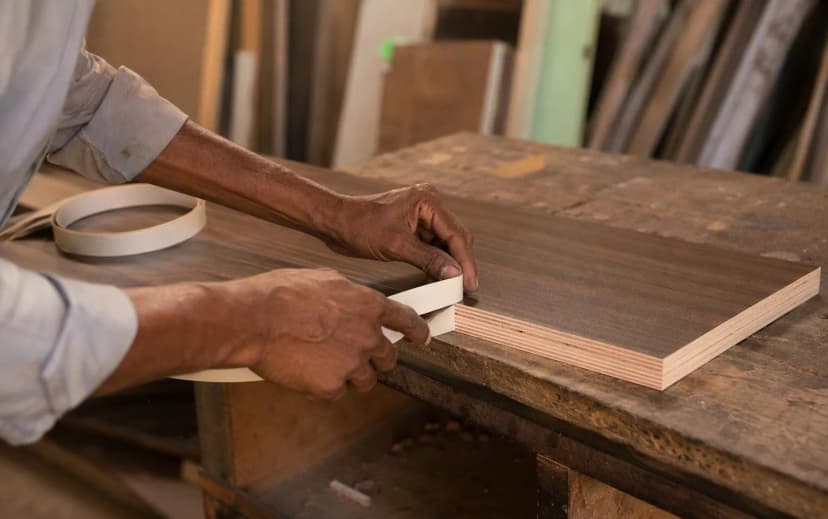
Every exposed edge of a laminated panel needs a 2 mm PVC edge band in the same decor code as the face. Without it, moisture enters the board through the raw edge, corners chip on first impact, and the shutter looks unfinished from day one. The budget version of this mistake is "near-enough" banding — a walnut face with a generic brown edge that announces itself across the room. Edge banding is a line item on the order, not an afterthought the carpenter improvises.
6. Trusting the brand name, not the spec
"Greenlam hai, achha hai" is not a specification. Every major brand sells everything from liner sheets to premium synchronized ranges — a top brand's 0.7 mm liner is still a liner. What protects you is the full spec on the invoice: brand + range + decor code + thickness, per line item. Generic entries like "laminate sheets — 20 nos" are exactly how substitutions stay invisible until the peeling starts. Our supplier verification guide covers the invoice test and authenticity checks in detail.
7. Over-designing with too many patterns
Five laminate families in one room does not read as rich — it reads as a catalogue. The reliable composition is the 60-30-10 split: a dominant neutral across most surfaces, a secondary woodgrain or solid, and one accent used once. More than three laminate families per home, or more than one hero surface per room, creates visual noise and dates fastest, because there is nothing calm for the eye to rest on when tastes shift.
8. Ignoring your maintenance reality
The honest question is not "which finish is best" but "which finish survives my household." Deep textures near the hob trap oil in every groove. High-gloss in a home with toddlers is a full-time wiping job. Dark solid colours show dust in a city like Bangalore within hours. Match the finish to the life it will live: smooth matte or anti-fingerprint in grease and touch zones, texture on feature walls, and dark shades where sun and dust do not punish them daily.
3. Symptom decoder: what each failure means
Already have laminate furniture that is misbehaving? The symptom usually names the original mistake.
| What you see | What actually went wrong | Could it have been prevented? |
|---|---|---|
| Edges lifting or peeling | Liner-grade sheet on a handled surface, or missing/poor edge banding letting moisture in | Yes — 1 mm spec + matched 2 mm edge banding |
| Bubbles under the surface | Wrong adhesive, uneven pressing, or pasting on a board that had not dried/acclimatised | Yes — correct adhesive, roller pressing, dry board |
| Fine scratches everywhere | High-gloss or soft finish on a daily-touch surface | Yes — matte/anti-fingerprint in touch zones |
| Colour fading near windows | Non-UV-stable print in direct afternoon sun, often on dark shades | Yes — lighter shades or UV-rated ranges on sun-facing units |
| Swelling near the sink | Not a laminate failure — MR board or unsealed edges underneath a perfectly good sheet | Yes — BWP board + sealed edges in wet zones |
| Whole unit looks tired in 3 years | Compound effect: thin sheet + wrong finish + no edge banding | Only by re-skinning — prevention was the cheap part |
The pattern worth noticing: none of these rows blames the laminate. Every failure is a specification, installation or maintenance decision. That is good news — it means the buying checklist at the end of this guide genuinely prevents them.
4. Right finish, right room: the quick map
Most mistakes disappear if the finish is matched to the zone before colour is even discussed.
| Zone | Thickness | Finish to use | Finish to avoid |
|---|---|---|---|
| Kitchen shutters & drawers | 1 mm HPL | Matte / anti-fingerprint, smooth texture | Deep texture near hob, gloss on base units |
| Kitchen uppers & tall units | 1 mm HPL | Gloss or matte both work; gloss adds light | Liner grade to save cost |
| Wardrobe shutters | 1 mm HPL | Matte, suede or woodgrain; fingerprint-resistant | High-gloss in daily-use bedrooms |
| Study & TV units | 1 mm HPL | Woodgrain, matte solids; fluted as an accent | Full textured walls that trap dust |
| Kids' room furniture | 1 mm HPL | Matte solids — survive scrubbing without streaks | Dark woodgrains (every scratch shows), deep grooves |
| Cabinet backs & interiors | 0.8 mm / liner | Liner-grade white or neutral — the right place to save | Spending 1 mm money where hands never go |
| Pooja / display / feature panels | 1 mm HPL | Stone-look, fluted, or a bold accent — statement lives here | Repeating the statement in every room |
For the design side of this decision — which colours and textures are current and which age well — pair this guide with our piece on laminate design trends in Bangalore. And for what a well-specified surface is worth over 15 years, see the durability math in how materials impact your home's durability.
5. Three things to supervise on installation day
Even a perfectly specified laminate fails with a careless paste-up. These three checks take ten minutes and prevent the failures no warranty covers.
1. The board must be dry and acclimatised. Pasting laminate on a freshly delivered or damp board traps moisture that escapes later as bubbles. Boards should sit indoors 24–48 hours before work starts, and the surface must be clean, sanded and dust-free.
2. The adhesive must match the material. Solvent-based adhesive for HPL, PVC-grade adhesive for PVC sheets, applied evenly to both surfaces and allowed to tack before contact. Watered-down or wrong-type adhesive is the number-one cause of bubbling within weeks.
3. Pressing must be centre-out, with a roller. Hand pressure or centre-only pressing traps air at the edges — exactly where the first bubbles appear. Watch for a rubber roller, steady centre-to-edge strokes, and immediate edge banding while the panel is fresh.
The 10-point laminate selection checklist
- Zone decided before colour — kitchen, wardrobe, study, kids' room — the finish family follows the zone, not the other way round.
- Thickness at 1 mm HPL on every working surface — shutters, drawers, tabletops; 0.8 mm only on low-touch verticals; liner only inside cabinets.
- Full-size sample seen in daylight — never finalised from a 2-inch catalogue chip or a phone photo.
- Finish matched to household reality — matte/anti-fingerprint where hands and grease go; gloss and texture kept to feature zones.
- Base board specified with the laminate — BWP in kitchens and wet zones, BWR elsewhere; laminate and board bought as a pair, not separately.
- 2 mm edge banding in the same decor code — written on the order for every exposed edge, not left to the carpenter's stock.
- Palette capped at three families — one dominant neutral, one secondary, one accent; one hero surface per room.
- Invoice names brand + range + decor code + thickness per line — no generic "laminate" entries.
- Authenticity verified — authorised dealer, brand QR or marking checked, current catalogue code confirmed.
- 1–2 spare sheets kept — stored flat and dry, because decor lines get discontinued and batches shift.
Frequently asked questions
What is the most common mistake when selecting laminates for furniture?
Choosing by looks alone — a colour or pattern picked from a small catalogue chip or showroom lighting, without checking thickness, finish type or suitability for the room. Most laminate failures (peeling, scratching, fading) trace back to a wrong specification made at the buying stage, not a defective sheet.
Is 0.8 mm laminate good enough for furniture?
Only for low-touch surfaces like cabinet backs and inner panels. For working surfaces — kitchen shutters, wardrobe faces, drawer fronts, tabletops — 1 mm HPL is the minimum. Sheets at 0.6–0.7 mm are liner grade, meant for hidden interiors; on visible, handled surfaces they chip and lift at edges within a few years.
Are glossy laminates a bad choice for furniture?
Not bad, but badly overused. High-gloss shows every fingerprint, smudge and fine scratch, and demands frequent wiping. It works on upper kitchen cabinets, feature panels and small dark rooms where reflectivity helps. For daily-use furniture like wardrobes, study desks and base cabinets, matte or satin finishes stay presentable with far less effort.
Why is my laminate peeling at the edges?
Edge peeling almost always comes from one of three causes: a thin liner-grade sheet that cannot hold its bond under handling, missing or poor-quality edge banding that lets moisture into the board, or installation with the wrong adhesive and uneven pressure. All three are specification and workmanship decisions made before the sheet was stuck.
Do I need edge banding with laminates?
Yes — every exposed panel edge needs it. A 2 mm PVC edge band in the same decor code as the face laminate seals the raw board against moisture, protects corners from chipping and gives the shutter a finished look. Skipping it, or using a near-enough colour, is one of the most visible and most damaging shortcuts in budget furniture work.
How do I check if a laminate sheet is genuine?
Buy from authorised dealers and verify three things: the brand's authenticity marking or QR verification on the sheet or packaging, the exact decor code from the current catalogue, and an invoice that names brand, range, decor code and thickness per line. Generic invoice entries like "laminate sheets — 20 nos" are how substitutions stay invisible.
Which laminate finish is best for kitchen cabinets versus wardrobes?
Kitchens need 1 mm matte or satin laminates that wipe clean — anti-fingerprint finishes are ideal — with nothing heavily textured near the hob where oil settles in grooves. Wardrobes do best with matte, suede or woodgrain finishes that resist fingerprints and read calm under bedroom lighting. Gloss suits upper cabinets and feature panels, not daily-touch surfaces.
How long should laminate furniture last?
Correctly specified laminate furniture — 1 mm HPL on a BWR or BWP board, with matched 2 mm edge banding and proper adhesive — stays presentable for 12 to 18 years in Indian conditions. Furniture built with liner-grade sheets, no edge banding or poor bonding typically shows peeling, chipping or swelling within 2 to 4 years.
Get the laminate spec right the first time
Evospace specs every project by decor code, thickness and edge band — and verifies the material at delivery, so the furniture you approve is the furniture you get.
Get a Free Material Consultation




