Latest Laminate Design Trends in Bangalore Homes
Fluted panels are everywhere, cool grey is quietly leaving, and the matte-vs-gloss debate finally has a winner. Here are the laminate trends actually showing up in Bangalore homes — what they cost, where each one works, and the buying mistakes that make a trending finish look dated before the year ends.
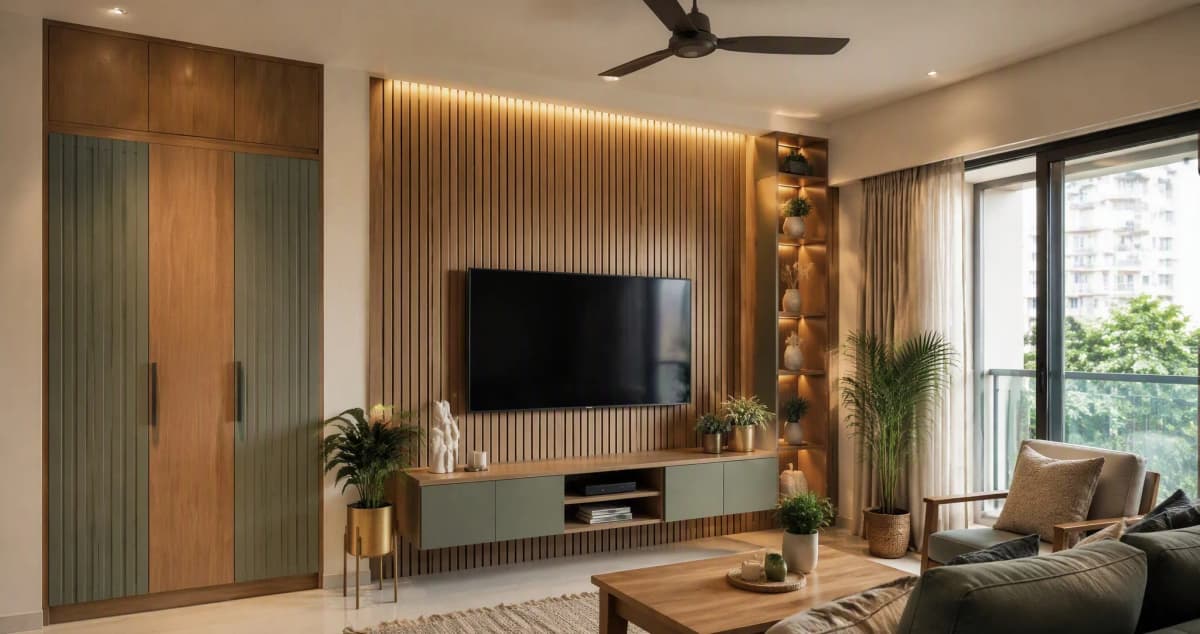
The five trends defining Bangalore interiors: fluted/reeded panels, super-matte and soft-touch finishes, warm earth tones (oak, walnut, sage, terracotta), synchronized woodgrains, and stone-look accents used sparingly. Cool greys and high-gloss white are on the way out. Budget-wise, standard 1 mm decorative sheets run ₹900–1,850 per 8×4 sheet from Greenlam, Merino or Century; premium textured ranges go to ₹3,600. Whatever trend you pick, the durability rules do not change: 1 mm minimum on working surfaces, matching 2 mm edge banding, and a catalogue code on the invoice — not "this design."
1. The 5 laminate trends defining
Bangalore's design scene this year has converged on a clear vocabulary. These are the finishes we are speccing most — and seeing most often in new apartments across the city.
1. Fluted and reeded panels
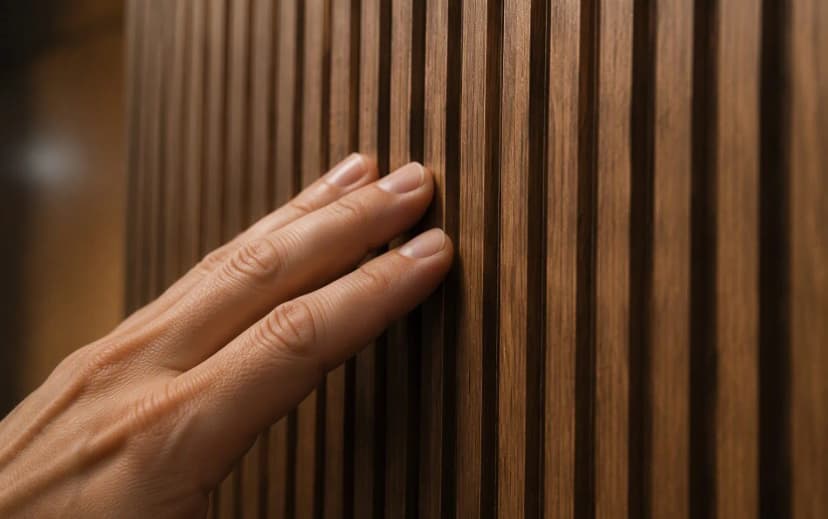
The runaway trend of the year. Vertical grooves on a woodgrain or matte laminate turn a flat surface into architecture — light and shadow do the decorating. In Bangalore homes you see fluting on TV feature walls, the odd wardrobe shutter bank, headboard panels and pooja unit backdrops. Use it as an accent: one fluted element per room is a statement; three is a ribbed box. Note that grooves collect dust — factor a soft-brush wipe into weekly cleaning.
2. Super-matte and soft-touch finishes
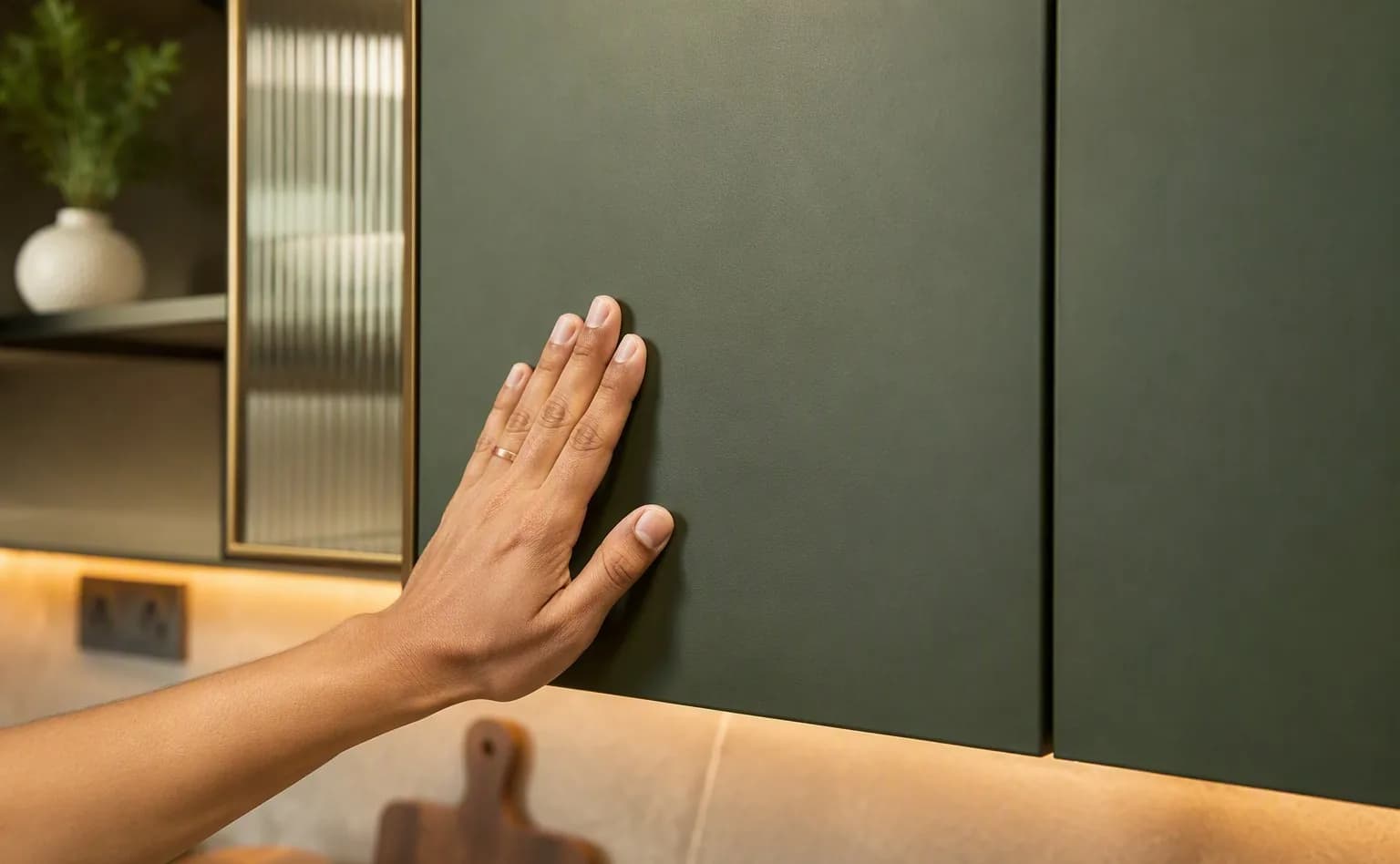
Matte has decisively beaten gloss. Super-matte and suede-touch laminates absorb light rather than bounce it, hide fingerprints and dust (Bangalore's constant companion), and read as quietly expensive. They now dominate bedrooms and wardrobes, and have taken over most kitchen shutters too. Gloss survives in exactly one use case — small or dark kitchens that need reflectivity to feel bigger.
3. Warm earth tones
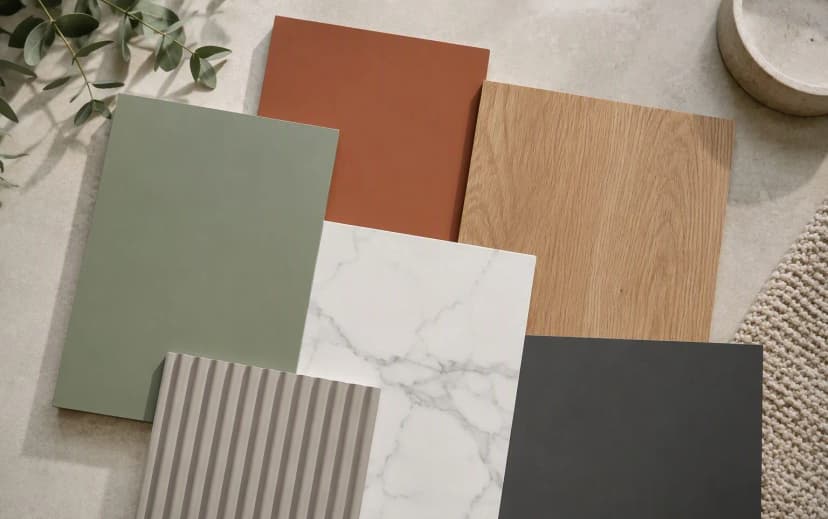
The palette has warmed across the board: natural oak, walnut, greige, putty, sage green, terracotta and warm beige have replaced the cool greys and stark whites of the last five years. These tones pair naturally with Bangalore's most-used hard finishes — vitrified floors, granite counters, brass hardware — and they age gracefully instead of dating loudly.
4. Synchronized woodgrains
The quality line inside the woodgrain revival: on synchronized (registered-emboss) laminates, the physical texture aligns with the printed grain, so the surface feels like timber, not a photo of it. Once you have touched a synchronized oak, flat-printed teak looks like what it is. The premium is real (roughly 40–70% over standard prints) but so is the difference — this is where to spend if the wood look matters to you.
5. Stone-look accents, used sparingly
Matte marble-look laminates (Calacatta and Statuario patterns) and slate/concrete-look finishes are appearing on kitchen islands, crockery unit backs and the occasional wardrobe panel. The discipline that makes them work: one stone-look surface per room, balanced by warm solids or woodgrain. A whole kitchen in marble-print laminate reads showroom, not home.
2. Colour palette: what's in, what's out
Colour moves slower than texture but matters longer — you will live with the shade for a decade after the trend cycle forgets it.
| Direction | Shades | Best used on | Pairs with |
|---|---|---|---|
| In — warm woodgrains | Natural oak, walnut, warm ash | Wardrobes, TV units, study | Brass hardware, cream walls, rattan |
| In — earthy solids | Greige, putty, sage green, terracotta | Kitchen shutters, bedroom units | Oak accents, matte black handles |
| In — deep accents | Charcoal, deep walnut, espresso | Tall units, fluted panels, one hero wall | Warm brass, fluted glass, warm lighting |
| In — soft whites | Warm white, ivory, cream | Small kitchens, low-light rooms | Woodgrain base units, wooden flooring |
| Out — cool greys | Slate, steel grey, blue-grey | — | Feels cold against warm palettes |
| Out — high-gloss white | Stark glossy white everywhere | — | Shows every smudge; reads 2018 |
| Fading — reddish teak prints | Orange-red teak, glossy cherry | — | Replaced by neutral oaks and walnuts |
The safe composition for most Bangalore homes: one warm woodgrain + one earthy solid + one deep accent, distributed across the house. Woodgrain carries public areas, the solid calms bedrooms, and the accent appears once — a tall unit, a fluted panel, a study backdrop. More than three laminate families in one home starts looking like a catalogue, not a design.
3. Room-by-room: which trend goes where
Trends behave differently under different stresses. Here is the mapping we use when speccing Bangalore homes.
Living room
The fluted TV or feature wall lives here — it is the room where a texture statement earns its keep. Pair with warm woodgrain storage and keep the rest of the room in calm solids. One hero surface only; a fluted wall plus a busy crockery unit plus patterned curtains is visual noise.
Kitchen
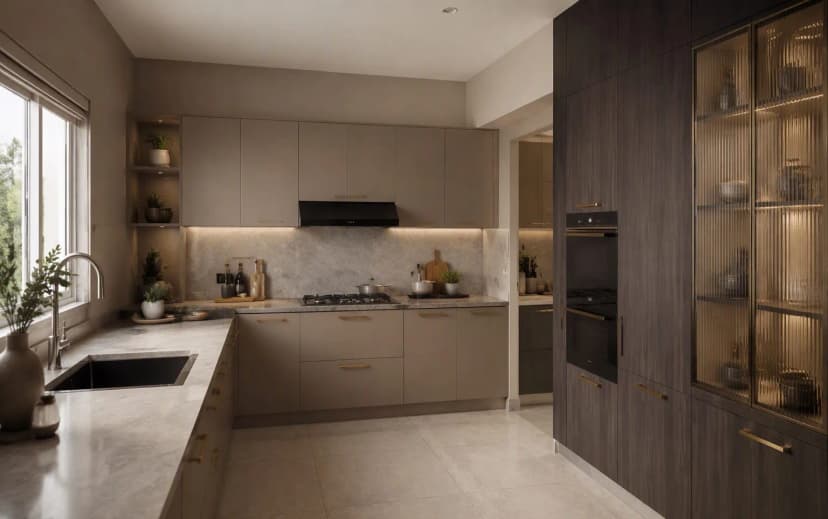
Super-matte earthy shutters (greige, sage, warm white) with a woodgrain or charcoal tall unit. Durability rules override trend here: 1 mm HPL minimum, gloss only if the kitchen is small and dark, and nothing textured where oil splatter lands daily — grooves and heavy texture near the hob are a cleaning sentence. The full kitchen spec is in our modular kitchen materials guide.
Master bedroom
Matte and suede finishes earn their premium here — fingerprint-resistant, calm under warm lighting, tactile. Soft oak woodgrain or a muted solid; a fluted or textured headboard panel as the single statement. Keep high-gloss out of bedrooms entirely; it fights the mood the room exists for.
Kids' room
Matte solid colours — sage, dusty blue, soft pastels — chosen for cleanability over fashion. Kids' rooms get scrubbed; matte solids survive scrubbing without polishing streaks. Avoid dark woodgrains (every scratch shows) and anything with deep texture (crayon grooves are forever).
Study and pooja
Study: light oak or warm beige for a calm, professional backdrop on video calls. Pooja: woodgrain or a stone-look panel with a slim brass-tone inlay — the one place a touch of the traditional-metallic trend sits naturally.
4. laminate prices in Bangalore
Laminate pricing is quoted per 8×4 ft sheet (32 sq ft). Knowing the bands stops both overpaying and the "premium design" that is a standard print with a story.
| Category | Thickness | Price per sheet | ≈ per sq ft | Notes |
|---|---|---|---|---|
| Liner / interior grade | 0.6–0.72 mm | ₹300–450 | ₹9–14 | Inner panels and backs only — never visible faces |
| Standard decorative | 0.8 mm | ₹350–1,200 | ₹11–38 | Low-touch verticals; budget furniture |
| 1 mm HPL decorative (Greenlam, Merino, Century) | 1 mm | ₹900–1,850 | ₹28–58 | The workhorse — kitchens, wardrobes, shutters |
| Premium woodgrain | 1 mm | ₹1,400–2,900 | ₹44–91 | Richer prints, better colour depth |
| Textured / synchronized | 1 mm+ | ₹1,800–3,600 | ₹56–113 | Registered emboss; the grain you can feel |
| Acrylic-finish laminate | 1 mm+ | ₹2,300–5,500+ | ₹72–172+ | Mirror-gloss statement kitchens and walls |
Two reference points for budgeting: a typical 2BHK needs 30–60 sheets of laminate across wardrobes, kitchen and TV unit, so the jump from standard to premium woodgrain is roughly ₹15,000–35,000 on the whole home — meaningful, but not project-breaking. And brand choice among the big four (Greenlam, Merino, Century, Royale Touche) is nearly price-neutral at equivalent ranges; the honest differentiators are the specific design, stock availability and your dealer, not the logo. For dealer selection and verification, see our guide to reliable material suppliers in Bangalore.
5. 5 buying traps that ruin trending finishes
The trend is the easy part. These are the five places where a good choice goes wrong between catalogue and cabinet.
Choosing from a 2-inch chip
Catalogue chips hide repeat patterns, grain direction and true colour. Always view a full-size sheet or a large dealer sample, ideally in daylight — and ideally in your own room's light before ordering 40 sheets of it.
FIX: full-size sample, checked in daylight
Mismatched edge banding
A beautiful walnut face with a near-enough brown edge band announces itself from across the room. Specify 2 mm banding in the same decor code as the face — it is a line item, not an afterthought.
FIX: decor code + edge-band code on the invoice
Trend texture in grease zones
Fluted and heavily textured laminates beside the hob collect oil in every groove. Trendy for three months, grimy for ten years. Keep textures to dry zones; the kitchen gets smooth, wipeable faces.
FIX: texture on walls and wardrobes, not hob-side shutters
Buying the brand, skipping the spec
"Merino hai, achha hai" is not a specification. Thickness (1 mm), finish family and decor code decide the result. A premium brand's 0.7 mm liner is still a liner.
FIX: brand + thickness + decor code, all three
No spare sheets
Shades and batches change; a damaged shutter in year four cannot always be matched. Keep 1–2 spare sheets of your main decor, stored flat and dry. The cheapest insurance in interiors.
FIX: 1–2 spare sheets per main decor, stored flat
The invoice habit: whatever you choose, the invoice should name brand, range, decor code and thickness per line. "Laminate sheets — 40 nos" is how substitutions stay invisible. The full verification routine is in our supplier selection guide.
6. How to pick a trend that ages well
Laminates live on your walls for 12–18 years — longer than most trend cycles. The trick is separating the durable part of a trend from the disposable part.
Put trend spending on the surface, not the structure. Carcass plywood, hardware and countertop are the expensive-to-change layers — spec them for durability and neutrality. Laminate is the cheapest layer to replace (re-skinning shutters runs a fraction of a rebuild), so it can carry the trend risk. If a finish turns out to be a five-year fashion, you have lost a reskinning, not a kitchen.
Apply the decade test to every sample: has some version of this finish existed for the last ten years? Woodgrains, warm neutrals and matte textures pass — they cycle in prominence but never look absurd. Heavy patterns, aggressive colours and gimmick prints fail — they date on a schedule. Fluted panels sit in between: the groove is classical architecture (centuries old), so fluted woodgrain will age fine; fluted in a fashion colour may not.
Cap the statement count. One hero finish per room, one trend-forward element per home zone. A house where every surface shouts has no focal point — and dates fastest, because there is nothing neutral for the eye to rest on when tastes shift.
For how laminate choices fit the wider material picture — boards underneath, hardware alongside — see our guide on selecting durable materials for modern home interiors and the durability math in how materials impact your home's durability.
The 8-point laminate buying checklist
- Full-size sample seen in daylight — not a 2-inch catalogue chip; checked against your room's actual light.
- Thickness specced at 1 mm for every working surface — kitchen shutters, wardrobe faces, drawers; 0.8 mm only for backs and inner panels.
- Edge banding matched by decor code — 2 mm banding in the same code as the face, written on the order.
- Finish suits the zone — matte/soft-touch for bedrooms and wardrobes; smooth wipeable faces in the kitchen; texture kept away from grease zones.
- Whole-home palette capped at 3 families — one woodgrain, one solid, one accent; hero surfaces at one per room.
- Invoice names brand + range + decor code + thickness per line item — no generic "laminate" entries.
- Spare sheets secured — 1–2 extra sheets of each main decor, stored flat and dry for future repairs.
- Supplier verified — authorised channel, sheets checked for flatness and surface defects before dispatch.
Frequently asked questions
What are the latest laminate design trends in Bangalore homes?
The five dominant trends are fluted and reeded panels, super-matte and soft-touch finishes, warm earth-tone palettes (oak, walnut, sage, terracotta), synchronized woodgrains where printed grain matches physical texture, and stone-look laminates used sparingly on feature elements. Cool greys and high-gloss white are on the way out.
Are matte or glossy laminates better for Indian homes?
Matte wins for most surfaces. It hides fingerprints, smudges and fine scratches, suits Bangalore's dust levels, and reads more premium design language. Gloss retains one strong use: small or dark kitchens where its reflectivity adds light and the illusion of space.
What laminate colours are trending?
Warm neutrals and earth tones: natural oak, walnut, greige, putty, sage green, terracotta and warm beige. Deep walnut and charcoal remain popular as accent tones. Stark white, cool grey and reddish teak prints are fading from new Bangalore projects.
How much do laminates cost in Bangalore?
Standard 1 mm decorative laminates from brands like Greenlam, Merino and Century run roughly ₹900–1,850 per 8×4 sheet (about ₹28–58 per sq ft). Premium woodgrains cost ₹1,400–2,900 per sheet, textured and synchronized ranges ₹1,800–3,600, and acrylic-finish sheets ₹2,300–5,500 or more.
What thickness of laminate should I use for wardrobes and kitchens?
1 mm HPL is the minimum for all working surfaces — kitchen shutters, wardrobe faces and drawers. 0.8 mm is acceptable for low-touch verticals like cabinet backs and inner panels. Avoid 0.6–0.7 mm liner sheets on anything visible or frequently touched; they lift at edges within a few years.
Which laminate brands are best in Bangalore?
Greenlam, Merino, Century and Royale Touche dominate quality supply in Bangalore. Greenlam offers the widest catalogue and stock depth; Merino has strong textures; Century adds antibacterial treatments and long warranties. At equivalent ranges the quality gap is negligible — choose by the exact design, thickness and edge-band availability.
What are fluted laminates and why are they trending?
Fluted laminates feature vertical grooves or ribs that create depth and light-shadow play on flat surfaces. They are the single strongest trend in Bangalore, used on TV feature walls, wardrobe shutters and headboard panels. They cost more per sheet and collect dust in the grooves, so they work best as accents rather than full rooms.
How do I keep laminate finishes looking new for years?
Specify 1 mm thickness with matching 2 mm edge banding, clean with a soft cloth and mild soap (never abrasive powders), keep hot vessels off laminate surfaces, wipe moisture quickly, and avoid direct afternoon sun on dark finishes. Well-specified laminates stay presentable for 12–18 years.
See the trends on your actual floor plan
Evospace designs Bangalore homes with the current palette — fluted panels, super-matte finishes, warm earth tones — specced by decor code and built to stay beautiful past the trend cycle.
Get a Free Material Consultation