Best Materials for Modular Kitchen Interiors in Bangalore Homes
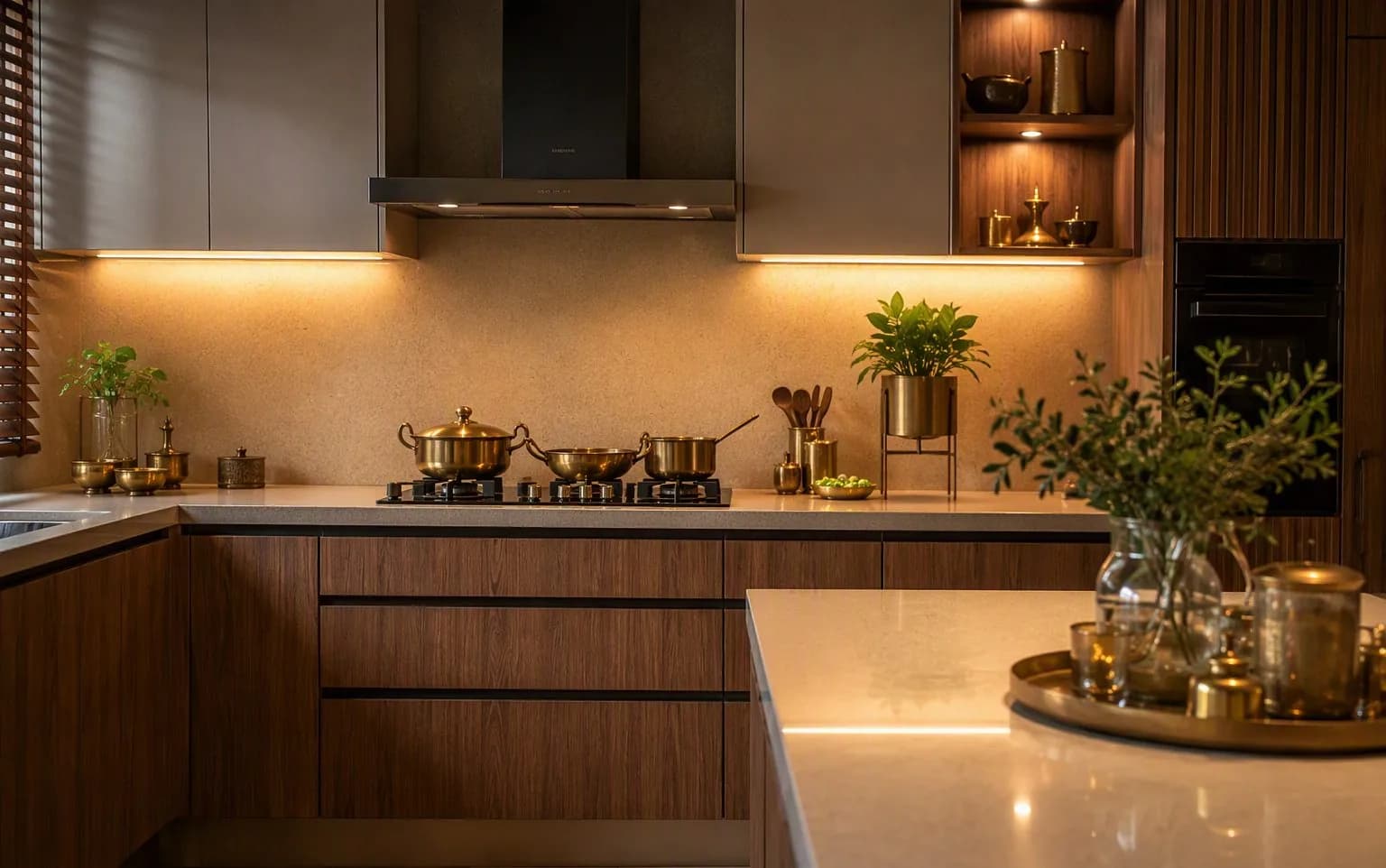
A modular kitchen faces more abuse than any other room in the house — steam, oil, turmeric, daily wiping, and Bangalore's monsoon humidity on top. Get the four material layers right (carcass, shutters, counter, hardware) and the kitchen runs for 15–20 years; get one wrong and you're replacing swollen cabinets by year five. Here is the full spec, with real prices.
The quick answer
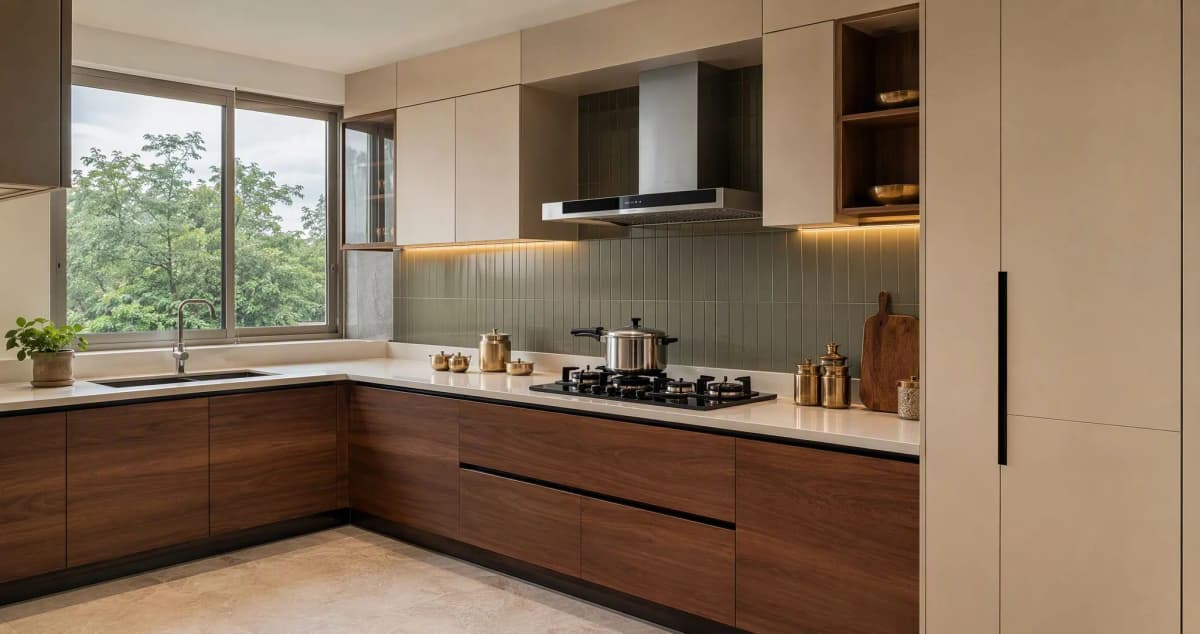
The best-performing modular kitchen spec for Bangalore is: BWP (marine, IS 710) plywood for all base cabinets and BWR (IS 303) for wall units; 1 mm high-pressure laminate on shutters (acrylic only on uppers if you want gloss); a granite or quartz countertop; branded hardware rated 50,000+ cycles with SS304 near the sink; and 2 mm edge banding plus silicone-sealed sink zones. Budget ₹1,500–1,800 per sq ft of cabinetry for this spec in laminate, ₹2,200–3,500 in premium finishes. Follow it and the kitchen should serve 15–20 years without structural repair.
1. Why material choice decides kitchen lifespan
No other room works as hard as an Indian kitchen. Cabinet shutters open 15–30 times a day. The counter takes hot kadhais straight off the flame, turmeric splashes that stain in seconds, oil films that build up under the hob, and a daily wipe-down with a wet cloth. Bangalore adds its own pressures: monsoon months of elevated indoor humidity, borewell water with high mineral content in many neighbourhoods, and termite pressure in ground-floor and older homes.
Every common kitchen failure maps to one material shortcut:
- Swollen sink cabinet → MR plywood or MDF used where BWP was needed
- Peeling shutter edges → missing edge banding, or membrane wrap too close to the hob
- Sagging shutters and grinding drawers → unbranded ₹40 hinges and thin channels
- Stained, etched counter → marble or solid surface under daily Indian cooking
- Loose handles and pulled-out screws → low-density board that can't grip hardware
The four layers below — carcass, shutter finish, countertop and hardware — are where those failures are prevented. Layout and colour get the attention in showrooms, but these layers decide what the kitchen looks like in year ten.
2. Carcass: the box that holds everything up
The carcass is the cabinet box you never see — and the single most important material decision in the kitchen. It carries the countertop's weight, holds every hinge and channel screw, and sits inches away from water. Here's how the four options compare for Bangalore conditions:
| Material | Water resistance | Screw-holding | Verdict |
|---|---|---|---|
| BWP / Marine ply (IS 710) | Excellent — survives 72-hr boiling test | Excellent | Best for all base units, sink cabinet mandatory |
| BWR ply (IS 303) | Very good — boiling cycles without delamination | Excellent | Good for wall units, lofts; acceptable base-unit budget option |
| HDHMR board | Good for humidity; weak vs standing water | Good | Acceptable for wall units and shutters; keep out of sink zone |
| MDF / particle board | Poor — swells permanently when wet | Weak to moderate | Avoid for carcasses; MDF only for profiled membrane shutters |
The standard professional spec in Bangalore — used by most serious studios — is BWP for base units, BWR for wall units and lofts. It puts the expensive waterproof material only where water actually reaches, and typically saves 15–20% against an all-BWP build without meaningfully reducing lifespan. Our BWR vs BWP guide explains the chemistry behind the two grades.
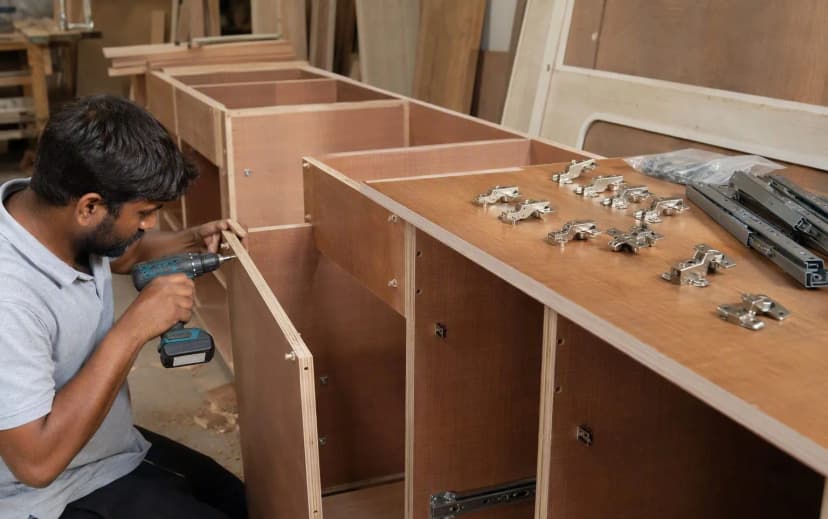
Whatever board you choose, verify it before cutting starts: check the ISI stamp and CM/L licence number on the BIS Care app, and confirm the batch on the invoice matches the sheets delivered. The plywood quality checklist covers the full two-minute verification routine.
Insist on 18–19 mm boards for carcass sides and bases (the hinge-holding minimum), 12 mm for internal partitions, and 2 mm PVC/ABS edge banding on every exposed edge. Edge banding is not cosmetic — it's the seal that keeps monsoon moisture out of the core.
3. Shutter finishes: what your kitchen looks like — and cleans like
Shutters are the kitchen's face and its most-touched surface. The finish has to survive oil-splattered hands, turmeric steam and daily wiping. Five options dominate the Bangalore market:
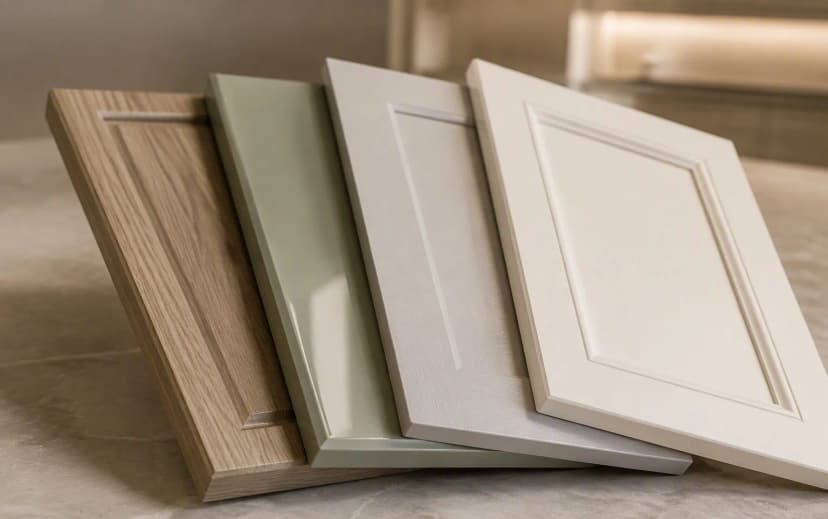
| Finish | Cost / sq ft | Durability | Best for |
|---|---|---|---|
| Laminate (1 mm HPL) | ₹400–900 | Good — scratch, stain and heat tolerant | Most kitchens; matte hides fingerprints, gloss brightens small spaces |
| Membrane (foil-wrapped MDF) | ₹350–800 | Moderate — heat-sensitive near hob | Profiled/classic shutters away from heat |
| Acrylic | ₹700–1,400 | Good but scratches show on gloss | Premium contemporary look; ideal on upper cabinets |
| PU (polyurethane paint) | ₹1,200–2,500 | Excellent moisture resistance; chips at corners | Premium handleless kitchens, careful households |
| Lacquered glass | ₹1,500–3,000+ | Excellent — toughened, inert | Ultra-premium accent units |
For most Bangalore families, 1 mm laminate is the right default — nothing else matches its combination of durability, wipeability and price. The most popular premium compromise: acrylic on upper cabinets (eye level, where gloss shows) and laminate below the counter (where the abuse happens). If you're weighing sheen levels, our matte vs glossy guide covers which finish hides smudges where. Two practical notes: super-matte anti-fingerprint laminates are worth the premium on dark colours, and membrane wraps must stay at least 60 cm from the hob — heat peels the foil.
4. Countertops: granite vs quartz under Indian cooking
The counter takes the worst of Indian cooking: hot pressure cookers, turmeric, oil, lime and daily scrubbing. Only two materials consistently survive it — and they trade different strengths.
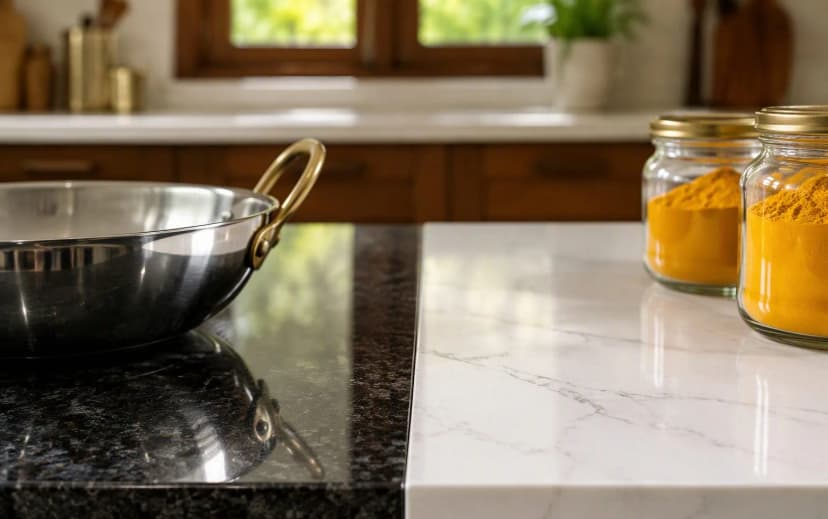
| Granite | Quartz (engineered) | |
|---|---|---|
| Installed cost | ₹150–400 / sq ft | ₹350–700 / sq ft |
| Heat | Excellent — hot kadhais directly on the surface | Moderate — resin scorches above ~150°C; always use trivets |
| Stains (haldi, oil, lemon) | Porous — needs sealing every 1–2 years | Non-porous — wipes clean, no sealing ever |
| Looks | Natural, unique per slab; dark colours hide everything | Uniform, consistent; marble-look veining available |
| Lifespan | 25+ years | 20+ years with heat discipline |
The practical rule: heavy daily Indian cooking with hot vessels → granite. A lighter kitchen where low maintenance and a consistent premium look matter more → quartz. Many Bangalore homes split the difference with granite on the main counter and quartz on an island or breakfast ledge. Either way, skip marble (etches with the first squeeze of lime) and solid-surface acrylic (scratches under steel vessels) for the main counter. Our countertop selection guide compares the full field.
5. Hardware: the part that actually moves
Ask any carpenter what fails first in a five-year-old kitchen and the answer is never the plywood — it's the hinge. Hardware is 3–5% of the budget but causes the majority of day-to-day failures, and it's the easiest place for a quote to quietly downgrade you from "branded soft-close" to unbranded fittings.
The spec to write into your quote
- Hinges: concealed soft-close, tested to 50,000–200,000 cycles, from established brands (Hettich, Blum, Hafele, Ebco). A shutter opened 20 times a day crosses 7,000 cycles a year — unrated hardware often starts sagging around 10,000.
- Drawer channels: ball-bearing or tandem-box rated for the load you actually store — Indian cookware means 30–45 kg rated drawers for pots and pressure cookers, not the 20 kg economy channel.
- Near the sink: 304-grade stainless or equivalent corrosion-rated fittings. Cheaper 202-grade steel and mild-steel baskets rust within two monsoons.
- Lift-ups and corner units: flap stays and carousel mechanisms are convenience items — buy them branded or skip them; a failed flap stay is worse than a plain shelf.
- Warranty: established brands carry 5–15 year warranties. Get the hardware list — brand, model, quantity — as a line item in the quote, not a lump "hardware included".
The premium for fully branded hardware across an entire kitchen is usually under ₹25,000 — the best-value durability money in the project. For the full hardware playbook, see our durable materials guide.
6. The details that prevent 90% of kitchen damage
Beyond the four big layers, five inexpensive details do an outsized share of the protection work:
DETAIL 01
Skirting that lifts the carcass
A 100 mm PVC or stainless skirting keeps cabinet bases off a wet mopped floor — the quiet killer of bottom shelves.
Cost: negligible · always specify
DETAIL 02
Silicone around the sink
The sink cutout is raw board. Quality silicone sealing at cutout edges and tap holes stops water creeping into the core.
Check: reseal every 2–3 years
DETAIL 03
SS304 sink + floor tray
A stainless sink (not coated mild steel) and a removable SS/aluminium tray on the sink-cabinet floor catch the drips you never see.
Verify: 304 stamp on the sink
DETAIL 04
Backsplash that wipes clean
Glazed ceramic or vitrified tile, or quartz run up the wall — grout lines kept thin and dark. Avoid bare paint behind the hob.
Height: full 600 mm counter-to-cabinet
DETAIL 05
Ventilation and chimney ducting
Steam and oil that aren't extracted condense inside cabinets. Duct the chimney outside, and size it for Indian cooking (1,200 m³/hr+ suction).
Rule: ducted > recirculating
DETAIL 06
Termite treatment
Ground-floor and older Bangalore homes: preservative-treated plywood plus a pre-installation pest treatment of the kitchen shell.
Confirm: treatment certificate on ply
What it costs in Bangalore
Modular kitchens in Bangalore are quoted per square foot of cabinetry (length × height of each unit run) or per running foot. Either way, the carcass material and shutter finish drive the number:
| Spec tier | Per sq ft of cabinetry | Typical L-shaped kitchen (8×7 ft) |
|---|---|---|
| Practical: BWP base + BWR walls, 1 mm laminate, branded standard hardware | ₹1,500–1,800 | ₹2.2–2.8 lakh |
| Mid: same carcass, super-matte or acrylic uppers, tandem drawers, corner units | ₹1,900–2,600 | ₹2.8–3.8 lakh |
| Premium: all-BWP, acrylic/PU shutters, full tandem + lift-ups, tall units | ₹2,600–3,500+ | ₹3.8–5.5 lakh+ |
Budget separately for the counter (granite ₹150–400 / quartz ₹350–700 per sq ft installed), chimney + hob (₹25,000–80,000), and sink + tap (₹8,000–30,000). When comparing quotes, always ask for the per-sq-ft rate broken into carcass, shutter and hardware lines — a single lump figure hides the exact downgrade this guide protects you from. Where you buy matters as much as what you buy: our supplier evaluation guide covers the questions professionals ask, and the Evospace studio follows the same spec-first approach.
The modular kitchen materials checklist
- Carcass: BWP (IS 710) for all base units; BWR minimum for wall units; sink cabinet BWP without exception
- Board thickness: 18–19 mm carcass, 12 mm partitions, 6 mm backs
- ISI verified: CM/L number checked on the BIS Care app; batch matches invoice
- Edge banding: 2 mm PVC/ABS on every exposed edge, machine-applied
- Shutters: 1 mm laminate default; acrylic only uppers; membrane 60 cm+ from hob
- Counter: granite for heavy Indian cooking, quartz for low-maintenance — sealed sink cutout either way
- Hardware line-item: brand + model + cycle rating in the quote; SS304 near the sink; 30–45 kg drawer ratings
- Details: 100 mm skirting, sink floor tray, silicone seals, wipeable backsplash, ducted chimney
Frequently asked questions
Which material is best for modular kitchen cabinets in Bangalore?
How much does a modular kitchen cost in Bangalore?
Is laminate or acrylic better for kitchen shutters?
Which countertop is best for Indian cooking — granite or quartz?
Is MDF OK for modular kitchens?
What hardware should I use in a modular kitchen?
How do I protect a modular kitchen from termites and water damage?
How long should a well-built modular kitchen last?
Spec your kitchen before someone else does.
Evospace stocks ISI-verified BWP and BWR plywood, 1 mm laminates and acrylics, branded hardware and granite/quartz — with a zone-wise material spec for your kitchen plan and itemised GST invoicing.
Get a Free Material Consultation