

What Interior Designers Look for in Material Suppliers
Designers stake their reputation on materials they didn't manufacture — so they vet the people who sell them hard. Here are the six criteria professionals use, the questions that expose a weak dealer, and how homeowners can borrow the same playbook.

Designers judge suppliers on six things: consistency, range, technical depth, reliability, billing hygiene, and accountability. Consistency means the tenth sheet matches the first; range means boards, laminates, veneers and hardware under one roof; technical depth means advice that survives contact with a carpenter; reliability means stock on the shelf and delivery on the day; billing hygiene means a GST invoice naming brand, grade and quantity; accountability means one phone call fixes a defective board. Price comes last — a supplier who's 5% cheaper but delays a week costs far more than they save. Homeowners should apply the same six tests before spending a rupee.
Section 01 · The evaluation
The six criteria designers actually use
A designer's supplier list is built over years and defended fiercely — one bad board on a client site costs more than any discount recovers. Here's what earns a dealer a place on that list.
Batch after batch, the same board
A wardrobe project ordered in two lots is the classic trap: the second lot's laminate is a shade off, the ply runs a millimetre thin, the grain direction differs. Designers test a supplier with a small first order, then watch whether reorder matches. Inconsistency shows up as wavy shutters and mismatched panels — months after the supplier has been paid.
Test: order a small quantity first; reorder in two weeks and compare sheets side by side
The whole stack under one roof
Boards, laminates, veneers, adhesives, edge banding, hardware — when one supplier stocks all of it, compatibility is designed in: banding matched to laminate codes, hinges rated for the board thickness, adhesives suited to the finish. It also means one delivery schedule and one invoice trail instead of four of each.
Test: can they quote your entire BOQ, or do they start saying "that you'll get elsewhere"?
Advice that survives the carpenter
A good supplier tells you not to buy things: MR ply in a kitchen, veneer on a sun-facing wall, 12mm where 18mm is needed. They know how materials behave in Bangalore's monsoon humidity, which brands hold calibration, which laminate codes are being discontinued. A dealer who agrees with everything you say is selling, not advising.
Test: describe a wrong choice and see if they correct you or just take the order
Stock on shelves, not promises
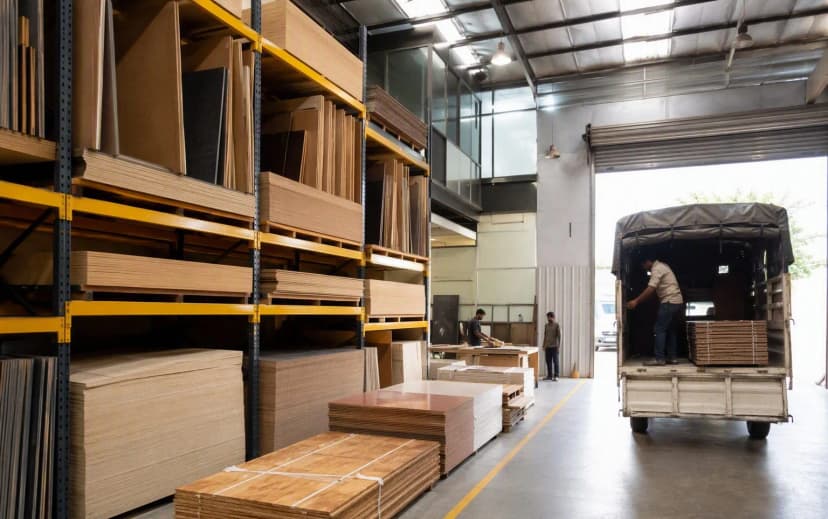
"Arranged in two days" is the most expensive sentence in an interior project. A two-day slip idles a carpentry team at ₹3,000–₹6,000 a day in Bangalore and pushes every trade behind it. Designers favour suppliers with visible warehouse stock and a track record of delivering on the committed date — and they confirm stock before scheduling labour.
Test: ask to see the actual stock for your full order before paying the advance
A GST invoice that names everything
Brand, grade, thickness, quantity — written on a proper GST invoice, not a cash memo. This is your only proof of purchase for warranty claims, your protection against grade substitution, and the paper trail that keeps everyone honest. A dealer reluctant to bill properly is telling you how defects will be handled later.
Test: ask for a pro-forma invoice with full material specs before paying anything
One call when something fails
Boards warp, laminates lift, a batch arrives damaged. The question isn't whether problems happen — it's who owns them. The supplier designers keep is the one who inspects a defective board, replaces it, and doesn't route you through the "carpenter's fault" loop. Multi-vendor buying is where accountability goes to die: the ply dealer blames the laminate dealer blames the adhesive.
Test: ask directly — "if a board delaminates in six months, what exactly happens?" — and judge the specificity of the answer
Section 02 · The interrogation
10 questions that expose a weak supplier
You don't need a designer's experience — you need their questions. Ask these at the counter and watch how they're answered. Confident, specific answers mean a supplier worth keeping; vague reassurances mean keep walking.
| Ask this | A good answer sounds like | A bad answer sounds like |
|---|---|---|
| Which brands are you an authorised dealer for? | Named brands, and they can show authorisation or point you to the brand's dealer locator | "We stock all brands, sir" — with none named |
| Can I verify the ISI mark and licence number? | "Check it on bis.gov.in right now" — they hand you the board | "All our material is ISI standard" — no mark shown |
| Will a reorder in two weeks match this batch? | "Buy your full quantity now; if you must reorder, same brand and batch code gets you close" | "Same same, no problem" |
| What's the thickness tolerance on this board? | A number, or "calibrated — check with the caliper" | Blank look; tolerance isn't a word they use |
| What's actually in stock for my full list? | They walk you to the racks or show the godown | "Everything can be arranged" |
| What's your delivery timeline, in writing? | A committed date on the estimate, with delivery terms | "Two-three days max" — said while looking away |
| GST invoice with brand, grade and quantity? | "Of course — it's how we bill everything" | "Bill will cost extra" / "cash memo is enough" |
| What happens if a board is warped or delaminated? | A stated replacement policy — inspect, replace, timeline | "That never happens with our material" |
| Can I take samples home to check in my light? | Samples signed out with a smile | "Catalogue is enough, same colour will come" |
| What would you not recommend for my kitchen? | A real answer — MR ply, dark gloss on base units, veneer near the sink | "Everything we have is excellent for kitchens" |
Notice what none of these questions ask: what's your best price? Price is negotiated after a supplier passes the tests that determine whether their material and their word are worth paying for at all. The Bangalore price guide gives you the market ranges to negotiate from knowledge, not hope.
Section 03 · The warnings
Red flags: when to walk away
Some dealer behaviours predict problems with near-perfect accuracy. Each of these has a well-worn story behind it — usually discovered after the carpenter has cut the board.
- "Bill will cost extra" or cash-memo-only billing. No invoice means no proof of grade, no warranty, no recourse. The 5% you "save" is the premium on being cheated later.
- Discouraging inspection. "The stock is at the godown, take my word" — said about material you're paying a lakh for. Good dealers want you to look; hiding stock is the tell.
- Prices far below market. Plywood and laminate have genuine floor prices. A quote 20% below everyone else is a board that's 16mm sold as 18mm, a "BWP" that's really MR, or a laminate roll of unknown origin. Our buying-mistakes guide catalogues how this plays out.
- "Rates go up tomorrow." Manufactured urgency exists to stop you from comparing. Material prices move over months, not overnight.
- Blaming the carpenter reflexively. Ask how a past defect claim was handled. If every story ends with "the carpenter's fault," you know your future.
- No opinion on anything. A dealer who has sold boards for a decade and has no view on which brands hold calibration hasn't been paying attention — or has been paid not to have opinions.
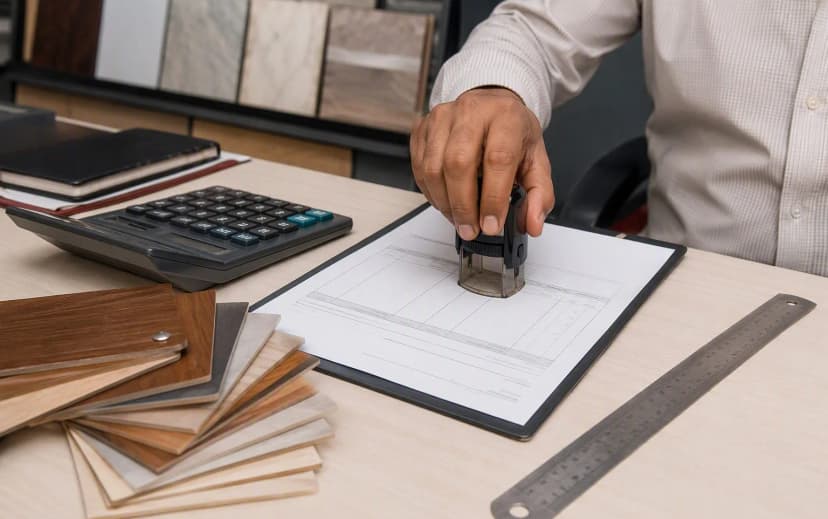
And a quieter flag: watch how the dealer treats the small stuff. Edge banding, adhesive, screws — the ₹5,000 of consumables on a ₹2 lakh order. A supplier who specifies matched banding and branded adhesive unprompted is thinking about your project's outcome. One who throws in "whatever banding we have" is thinking about your payment.
Section 04 · The strategy
One supplier vs bargain hunting
The instinct to split purchases — ply from one dealer, laminates from another, hardware from a third — feels like smart shopping. Designers do the opposite, and the reason is arithmetic most homeowners never run.
What splitting actually costs: three delivery schedules to coordinate (any slip idles paid labour); batch and shade mismatches across lots; three separate transport charges; emergency purchases at retail prices when something runs short; and — the expensive one — nobody accountable when a board fails. The ply dealer blames the laminate adhesive, the laminate dealer blames the board, and you're funding the argument.
What one accountable supplier returns: materials specified as a compatible system (banding matched to laminate codes, hardware rated for the board), one consolidated delivery timed to your carpentry schedule, one invoice trail, and one phone number that owns any defect. The bundled pricing on a full BOQ typically lands within a few percent of split-buying — and the first avoided delay pays the difference several times over.
When splitting does make sense: large commercial projects with a dedicated purchase manager, or a genuinely specialist item (a rare veneer species, imported hardware line) that your primary supplier doesn't carry. For a home or apartment, it almost never does. The renovation materials checklist shows the full shopping list — if one supplier can quote all of it, that's the first green flag.
Section 05 · The scorecard
The supplier scorecard
Score any supplier against these eight checks before your first order. Six or more — place the order. Four or fewer — keep looking.
Supplier evaluation — 8 checks
- Authorised dealerships confirmed: named brands, verifiable on the brand's dealer locator or via a call to the company.
- Physical stock inspected: you've seen the actual boards and sheets for your order — not a catalogue, not a promise.
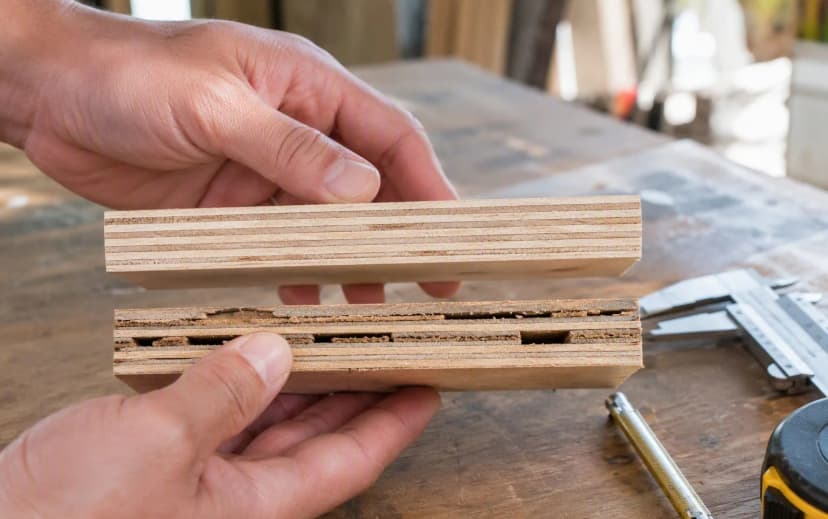
- Cross-section check passed: even layers, no core gaps, caliper confirms claimed thickness on a sample sheet.
- Technical advice tested: they corrected at least one thing you proposed — proof they're advising, not just selling.
- Full BOQ quoted in writing: boards, laminates, banding, adhesive, hardware — with brand, grade, shade codes and quantities.
- Delivery date committed: on the estimate, with terms for delay — and stock to back it.
- GST billing confirmed: proper invoice naming every line item, no "extra for bill" conversation.
- Replacement policy stated: a specific answer to "what happens if a board is defective" — inspect, replace, timeline.
Section 06 · FAQ
Frequently asked questions
How do interior designers choose material suppliers?
On six criteria: consistent quality across batches, wide in-stock range, genuine technical knowledge, reliable delivery, clean GST billing, and single-point accountability when defects appear. Price comes last — a supplier who saves 5% but delays a week costs far more than they save. Designers test new suppliers with small orders before trusting them with a full project.
One supplier or multiple dealers — which is better?
For homes and apartments, one accountable supplier almost always wins. Splitting purchases creates batch mismatches, staggered deliveries, hidden transport and emergency-purchase costs, and — worst of all — an accountability gap where each dealer blames the other when something fails. One supplier who stocks the full stack designs compatibility in and owns the outcome.
What should I ask a plywood dealer before buying?
Six essentials: Which brands are you authorised for? Can I verify the ISI mark on bis.gov.in? Will a reorder match this batch? What's the thickness tolerance? Do you bill GST with brand, grade and quantity named? What's your replacement policy for defective boards? Confident, specific answers to all six mean a supplier worth keeping.
What are the red flags of a bad supplier?
Refusing GST invoices, discouraging physical inspection, quoting far below market price, being unable to name brands or grades, blaming carpenters for every defect, manufactured urgency ("rates go up tomorrow"), and having no opinion on what suits your project. Each predicts a problem discovered after the boards are cut.
Why does the GST invoice matter so much?
It's your only enforceable proof of what you bought — brand, grade, thickness, quantity. It enables warranty claims, protects against grade substitution, and gives you legal recourse if defects appear. A cash memo for a ₹2 lakh material order leaves you with no leverage whatsoever when a board delaminates.
How much do material delays actually cost?
More than the material. A two-day board delay idles a carpentry team at ₹3,000–₹6,000 per day in Bangalore, pushes polishing, hardware fitting and painting behind it, and can shift move-in by weeks. A supplier with real stock and committed delivery dates prevents the most common cause of interior project overruns.
Should I use the same supplier my designer uses?
Usually yes — a designer's regular supplier protects that relationship with better prices, priority stock and faster problem resolution than a walk-in gets. Just keep billing transparent: the GST invoice should name you, the brands and the grades, whoever made the introduction.
What does "authorised dealer" actually guarantee?
That the brand's supply chain reaches the shop directly: genuine material, fresh batches, valid warranties and escalation to the manufacturer for defects. It doesn't guarantee fair pricing or honest advice — judge those yourself — but it removes the counterfeit and grey-market risk around popular plywood and laminate brands.
Buy where the designers buy.
Boards, laminates, veneers, hardware — one roof, real stock, honest advice, and GST billing that names every line. Come run our shelves through the scorecard above.
Visit the Studio




