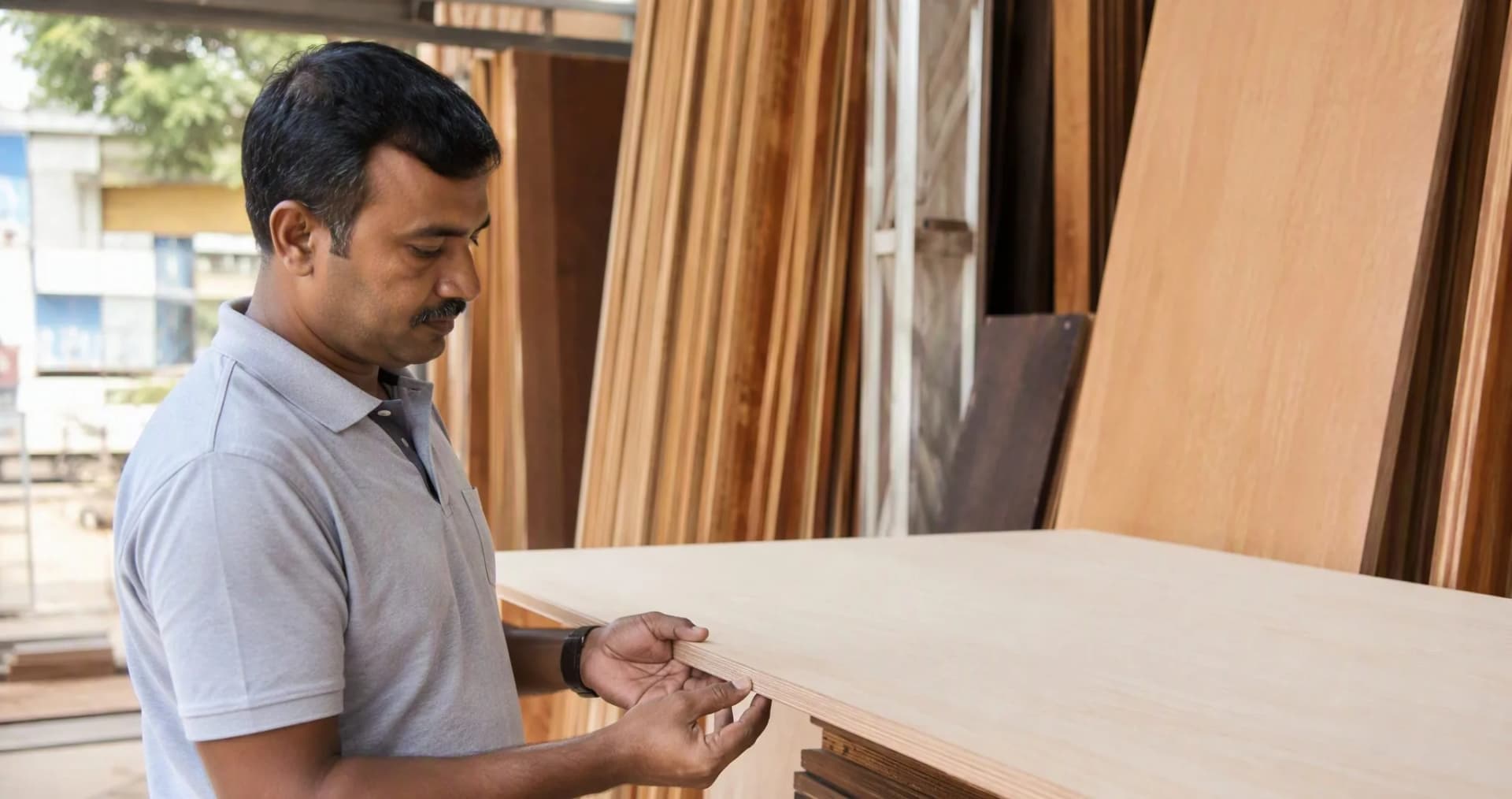
Common Mistakes to Avoid When Buying Plywood in Bangalore
Bangalore's plywood market rewards the buyer who checks and punishes the one who trusts. Relabelled brands, trade-size thickness, monsoon-damaged godown stock, carpenter commissions — here are the nine mistakes that cost homeowners lakhs, and the exact checks that protect you at the shop, on the invoice and at delivery.
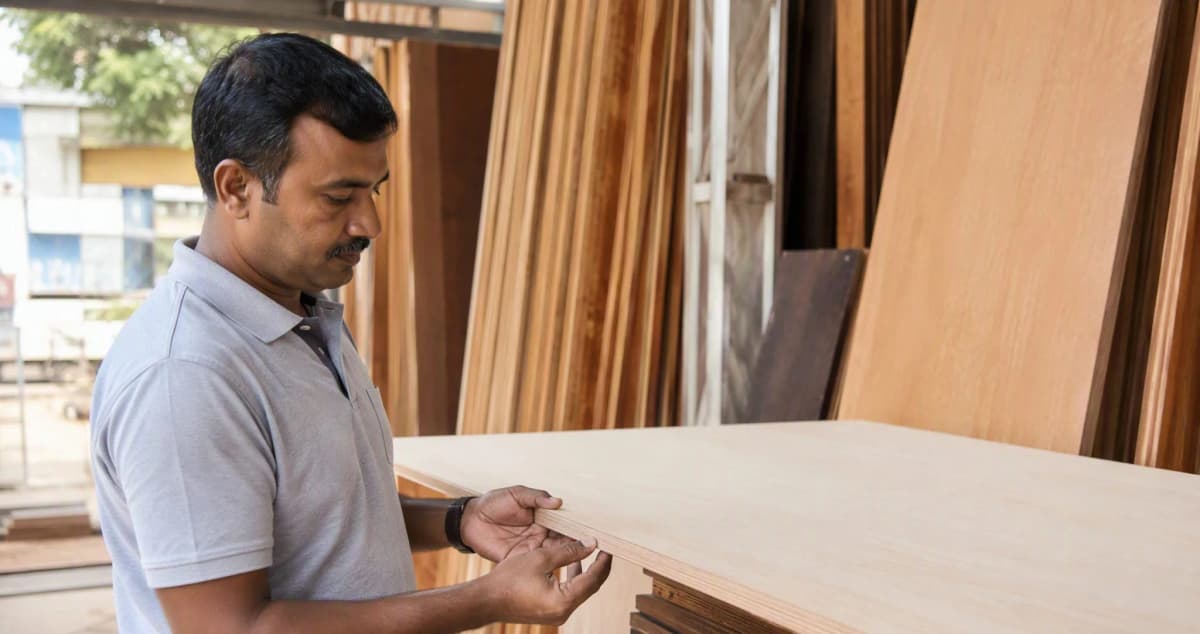
Bangalore plywood buyers lose money in nine predictable ways: buying on price alone, wrong grade for the zone (MR in kitchens), trusting the surface instead of the core, accepting "18 mm" without measuring, ignoring how the dealer stored the stock, skipping the ISI / CML / QR verification, taking one quote instead of three, letting the carpenter choose unsupervised, and signing the delivery receipt before inspecting every sheet. Each mistake has a fix, and most fixes take under five minutes. The full list — with what each mistake actually costs — is below.
The nine mistakes Bangalore buyers keep making
Each mistake below is something dealers, carpenters, and regretful homeowners in the city report over and over. For each one: what goes wrong, what it costs you, and the fix.
Shopping by price per sheet alone
The classic. Two "18 mm BWP" sheets can differ by ₹1,500 — and by density, core species, and glue quality. The cheaper one is usually lighter, with softer plantation core and more core gaps. In Bangalore's price spread (roughly ₹1,800–₹3,200 for branded 18 mm MR/BWR and ₹3,200–₹5,500 for premium BWP in), the bottom of the range is almost always a compromise sheet.
Fix: shortlist by grade and brand first, then compare prices for the same spec across 2–3 dealers. A ₹400-per-sheet saving on 20 sheets is ₹8,000 — less than the cost of rebuilding one sagging wardrobe.
Using MR grade in kitchens and wet zones
MR (moisture-resistant, IS 303) is a dry-zone board. In a kitchen it faces steam, splashes, and wet vessels daily; in Bangalore's monsoon humidity it deteriorates faster. Swollen sink cabinets and bubbling laminates within 2–4 years are the signature of this mistake.
Fix: BWR (boiling-water-resistant) minimum for all kitchen and utility cabinetry; BWP/marine for the sink unit and any bathroom vanity. The grade decision matters more than the brand — our BWR vs BWP breakdown maps it zone by zone.
Judging the sheet by its face, not its core
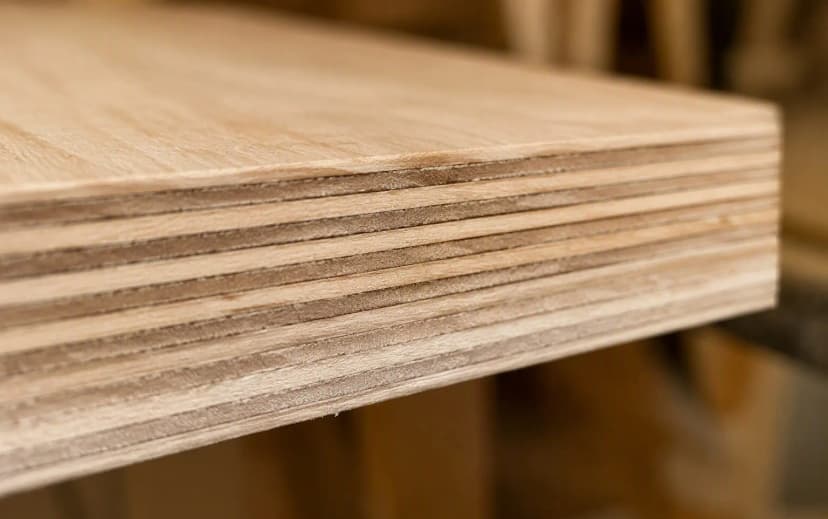
A smooth, glossy face veneer tells you almost nothing. Dealers know buyers look at faces, so seconds-quality sheets often get decent face veneers over a gappy, uneven core. The core — visible on the edges — is where quality lives: ply count, gaps, overlaps, species mix.
Fix: at the shop, always inspect the cut edge of a stack. You want uniform layers (roughly 9–13 plies in 18 mm), no visible voids or overlaps, and an even dark glue line. Ask the dealer to cut a small corner piece if you want to see fresh edge.
Paying for 18 mm, receiving 16.5 mm
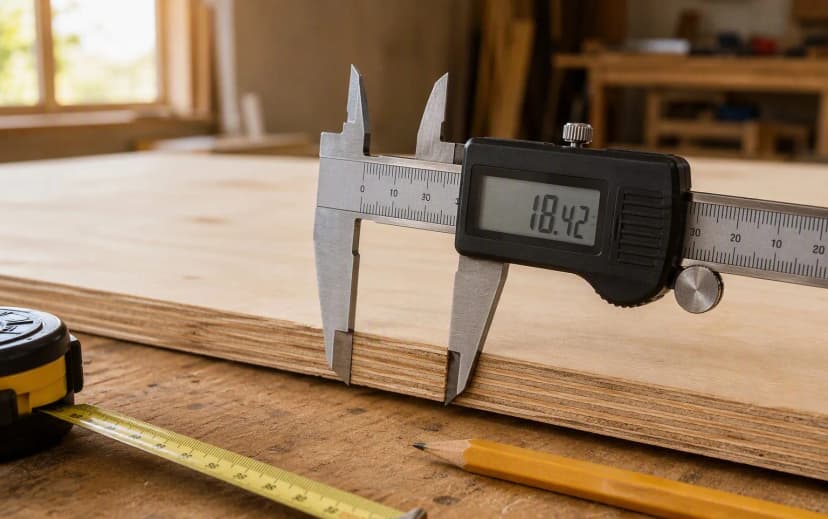
The "trade size" trap: in Bangalore's unbranded market, sheets sold as 18 mm routinely measure 16.5–17.2 mm, and 12 mm often arrives as 10.5–11 mm. Thin sheets flex more, hold screws worse, and your carpenter's shutter gaps come out uneven because the laminate adds thickness he didn't plan for.
Fix: carry a ₹300 digital caliper. Measure at 4–5 points across the sheet — a genuine calibrated sheet stays within ±0.5 mm everywhere. Branded "calibrated" lines exist precisely to solve this; pay the small premium for carcasses and shutters.
Ignoring how the dealer stores plywood
Plywood absorbs whatever environment it sits in. Sheets stacked on a wet godown floor, leaning against a damp wall, or stored in an open-sided shed through the monsoon arrive at your site pre-loaded with moisture — and sometimes pre-warped. You pay full price for a damaged product.
Fix: visit the dealer's godown, not just the front counter. Good storage: sheets flat on wooden pallets, off the floor, under a roof, away from walls. If the stack bottom sheets look stained or the stack leans, buy elsewhere.
Skipping the ISI mark and CML verification
Bangalore's market is flooded with lookalike sheets carrying printed "ISI" logos that were never certified. The genuine mark has two parts: the ISI symbol plus a CML licence number (format CM/L-XXXXXXX) and the IS standard number (IS 303 or IS 710). Neither alone is enough.
Fix: take 60 seconds: note the CML number on the sheet, check it on the BIS portal (bis.gov.in) or the BIS Care app, and confirm the licence is valid and matches the manufacturer. Major brands also have QR-code verification apps (CenturyPromise, Greenply's app, etc.) — scan before you pay.
Buying from the first dealer you visit
Plywood prices in Bangalore vary 10–20% between dealers for identical branded sheets — and far more between a brand's authorised dealer and a grey-market reseller. One quote is not a price; it's an opening offer. The same applies to "this brand is out of stock, take this one instead" — the classic switch.
Fix: get three quotes for the exact same brand, grade, and thickness — try one authorised dealer (from the brand's website locator), one big timber market (J.C. Road, BVK Iyengar Road), and one local depot. Refuse substitutions you didn't spec.
Letting the carpenter buy on your behalf, unsupervised
Many carpenters have dealer arrangements — commissions of 5–10% are routine, and the incentive is to push the brand that pays, not the one that lasts. Worse: the spec quietly changes ("BWR not available, this is same-same") while the bill stays the same.
Fix: you don't need to distrust your carpenter — just separate the roles. You choose the brand and grade (see our selection guide), you pay the dealer directly, and the carpenter advises on quantities. If he insists on "his" dealer, ask to see the CML and do the verification yourself.
Signing the delivery receipt before inspecting
Sheets arrive at your site while you're at work; the driver asks the watchman or your spouse to sign; later you find corner damage, a warped sheet in the middle of the stack, or three sheets of a different (cheaper) batch. Once signed "received in good condition," the exchange fight is nearly lost.
Fix: be present for delivery or delegate someone briefed. Check count, brand batch printing on every sheet, edges for damage, and flatness (sight along each sheet). Photograph anything wrong before signing, and write "subject to inspection" on the receipt if rushed.
The 15-minute verification routine
Do this at the dealer before any money moves. It takes about 15 minutes for one stack and catches 90% of the problems above. (The longer version, with laminate and hardware checks, is in our shop-floor verification guide.)
| # | Check | How | Pass mark |
|---|---|---|---|
| 1 | ISI + CML | Find ISI mark, IS number (303/710) and CM/L number stamped on the sheet; verify CM/L on bis.gov.in or BIS Care app | Licence valid, matches manufacturer |
| 2 | Brand QR scan | Scan the sheet's QR/hologram with the brand's official app | App confirms genuine + correct grade |
| 3 | Edge inspection | Sight the stack's cut edges; count plies, look for voids, overlaps, filler | 9–13 even plies (18 mm), no visible gaps |
| 4 | Thickness | Digital caliper at 4–5 points, both edges and middle | Within ±0.5 mm of labelled size |
| 5 | Weight | Lift one end of a sheet (or ask for weighbridge slip); 18 mm 8×4 hardwood ≈ 35–45 kg | Feels dense; suspiciously light = soft core |
| 6 | Knock test | Tap across the face with knuckles, especially centre | Solid, even sound; hollow patches = voids |
| 7 | Flatness | Sight along the sheet diagonally and lengthwise | No bow, twist, or cupping |
| 8 | Dealer storage | Look at the godown: pallets, roof, dry floor | Flat-stacked, off-floor, covered |
A note on "gurjan" and species claims: every second sheet in Bangalore is sold as "gurjan" or "full hardwood." Genuine gurjan core costs meaningfully more; at mid-range prices you're usually getting eucalyptus/poplar plantation core — which is perfectly fine for most furniture if the sheet is dense and well-pressed. Don't pay a gurjan premium without the brand line that actually certifies it.
Grade-to-zone quick reference for Bangalore homes
Half of all plywood regret in Bangalore is grade mis-selection — usually MR sold into wet zones. This is the map. (Deep dive: BWR vs BWP and all grades explained.)
| Zone | Grade | IS standard | Typical 18 mm 8×4 price |
|---|---|---|---|
| Bedrooms, living room, study (dry) | MR / commercial | IS 303 | ₹1,800 – ₹3,000 |
| Kitchen cabinets (except sink unit), utility | BWR | IS 303 | ₹2,400 – ₹3,800 |
| Sink unit, bathroom vanity, semi-outdoor | BWP / marine | IS 710 | ₹3,200 – ₹5,500 |
| Wardrobe backs, drawer bottoms | MR, 6–9 mm | IS 303 | ₹700 – ₹1,400 |
| False ceiling, panelling base (dry) | MR, 12 mm | IS 303 | ₹1,200 – ₹2,000 |
Bangalore monsoon note: June–September humidity averages 75–85%. If you're building during or just before monsoon, err one grade up in any room with an external wall — and let sheets acclimatise indoors for 48–72 hours before cutting. More on moisture decisions: why waterproof ply matters.
Delivery-day checks: where most Bangalore purchases actually go wrong
You can do everything right at the shop and still lose at the gate. Plywood in Bangalore typically travels from godown to site in an open tempo — through traffic, sometimes through rain. The 10 minutes at your gate decide what you actually own.
| Check | What to do | Reject if… |
|---|---|---|
| Count & sizes | Count sheets against the invoice; confirm thickness mix (18/12/6 mm) matches the order | Any sheet count or size mismatch |
| Batch & brand print | Every genuine sheet carries printed brand, grade, IS number and CML along the edge/face. Check every sheet, not the top one | Unprinted sheets or mixed batch codes slipped into the stack |
| Edges & corners | Walk the stack; look for crushed corners, chipped edges, forklift gouges | Damage beyond a minor corner bruise on 1–2 sheets (note it on the receipt) |
| Flatness | Sight along 3–4 random sheets; pull the middle sheet of the stack out and check it too | Visible bow or twist > ~10 mm over 8 ft |
| Moisture | Feel the faces; look for damp patches, staining, or a musty smell — especially the bottom sheets | Damp or stained sheets (rain transit or wet godown) |
| Documentation | Take the GST invoice with dealer details, brand, grade, and quantities itemised — not a cash memo | Dealer refusing a proper itemised GST bill |
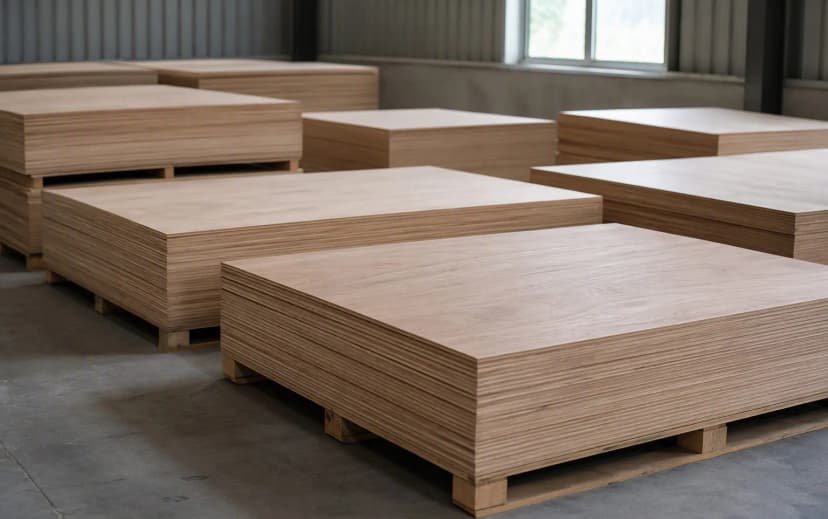
After delivery: stack sheets flat on battens inside the site (never leaning against a wall — they bow within days in Bangalore's humidity), keep them off bare concrete, and let them acclimatise 48–72 hours before the carpenter cuts. If the build runs through monsoon, our plywood care guide covers moisture protection during and after construction.
Your Bangalore plywood buying checklist
Screenshot this. It's the whole article in one pass.
- Before: fix the grade per zone (MR dry / BWR kitchen / BWP sink & bath) and the thickness schedule (18 mm carcass, 12 mm shutters, 6 mm backs) — before any dealer hears your budget.
- Before: shortlist 2–3 brands and find their authorised dealers on the brand websites; add one timber-market quote (J.C. Road / BVK Iyengar Road) for reference.
- At the shop: verify ISI mark + CML number on bis.gov.in or the BIS Care app; scan the brand's QR code.
- At the shop: inspect stack edges — 9–13 even plies, no voids; caliper-check thickness at 4–5 points (±0.5 mm); knock test; lift for weight.
- At the shop: look at the godown — flat, palleted, covered, dry. No visit, no deal.
- Payment: pay the dealer directly (not via the carpenter); insist on an itemised GST invoice naming brand, grade, thickness, and quantity.
- Delivery: be present; check count, batch print on every sheet, edges, flatness, moisture; photograph problems before signing.
- Storage on site: flat on battens, indoors, off concrete; acclimatise 48–72 hours before cutting.
Frequently asked questions
What are the most common mistakes when buying plywood in Bangalore?
The nine that cause the most damage: shopping by price alone, using MR grade in kitchens, judging the face instead of the core edge, accepting "trade size" sheets thinner than labelled, ignoring dealer storage conditions, skipping ISI/CML verification, taking a single quote, letting the carpenter buy unsupervised, and signing the delivery receipt before inspecting the stack.
Which plywood grade should I use for a Bangalore kitchen?
BWR (boiling-water-resistant, IS 303) as the minimum for all kitchen cabinetry, and BWP/marine (IS 710) for the sink unit and any utility area with direct water contact. MR grade in a kitchen typically shows swelling and laminate failure within 2–4 years — sooner in monsoon humidity.
How do I check if plywood is genuine or fake?
Three layers of verification: (1) the sheet must carry the ISI mark, the IS standard number (303 or 710), and a CML licence number (CM/L-XXXXXXX); (2) enter that CML number on bis.gov.in or the BIS Care app and confirm the licence is valid and belongs to that manufacturer; (3) scan the sheet's QR code with the brand's official verification app (CenturyPromise, Greenply, etc.). A printed ISI logo alone proves nothing.
Is "18 mm" plywood actually 18 mm thick?
Often not. Unbranded "trade size" sheets sold as 18 mm in Bangalore commonly measure 16.5–17.2 mm. Branded calibrated lines hold ±0.5 mm. Carry a digital caliper and measure at 4–5 points; thickness shortfall directly reduces screw-holding and rigidity.
Where should I buy plywood in Bangalore?
Start with authorised dealers listed on the brand's official website — they have the freshest stock and genuine billing. For price benchmarking, take quotes from the wholesale timber markets around J.C. Road and BVK Iyengar Road. Whichever you choose, visit the godown to check storage, and verify the CML number yourself.
What does plywood cost in Bangalore?
For an 8×4 ft, 18 mm sheet: roughly ₹1,800–₹3,000 for branded MR/commercial, ₹2,400–₹3,800 for BWR, and ₹3,200–₹5,500 for premium BWP/marine. Prices vary 10–20% between dealers, which is why the three-quote rule matters. See our detailed Bangalore plywood price guide for what drives the spread.
Should I let my carpenter buy the plywood?
Let your carpenter advise on quantities and sizes — that's genuine expertise. But choose the brand and grade yourself, and pay the dealer directly. Dealer commissions of 5–10% are routine in the trade, and the incentive points toward the brand that pays, not the one that lasts. If your carpenter insists on "his" dealer, apply the same verification routine there.
What should I check when plywood is delivered?
Count and sizes against the invoice; brand/grade/CML printing on every sheet (not just the top one); edge and corner damage; flatness of a few sheets including mid-stack; damp patches or musty smell; and a proper itemised GST invoice. Photograph any problem before signing the receipt, and note exceptions on the delivery challan.
Buy it right the first time.
Visit our Bangalore studio for verified, ISI-marked plywood across MR, BWR, and BWP grades — transparent billing, calibrated thickness, and honest guidance on what your project actually needs.
Talk to Us