
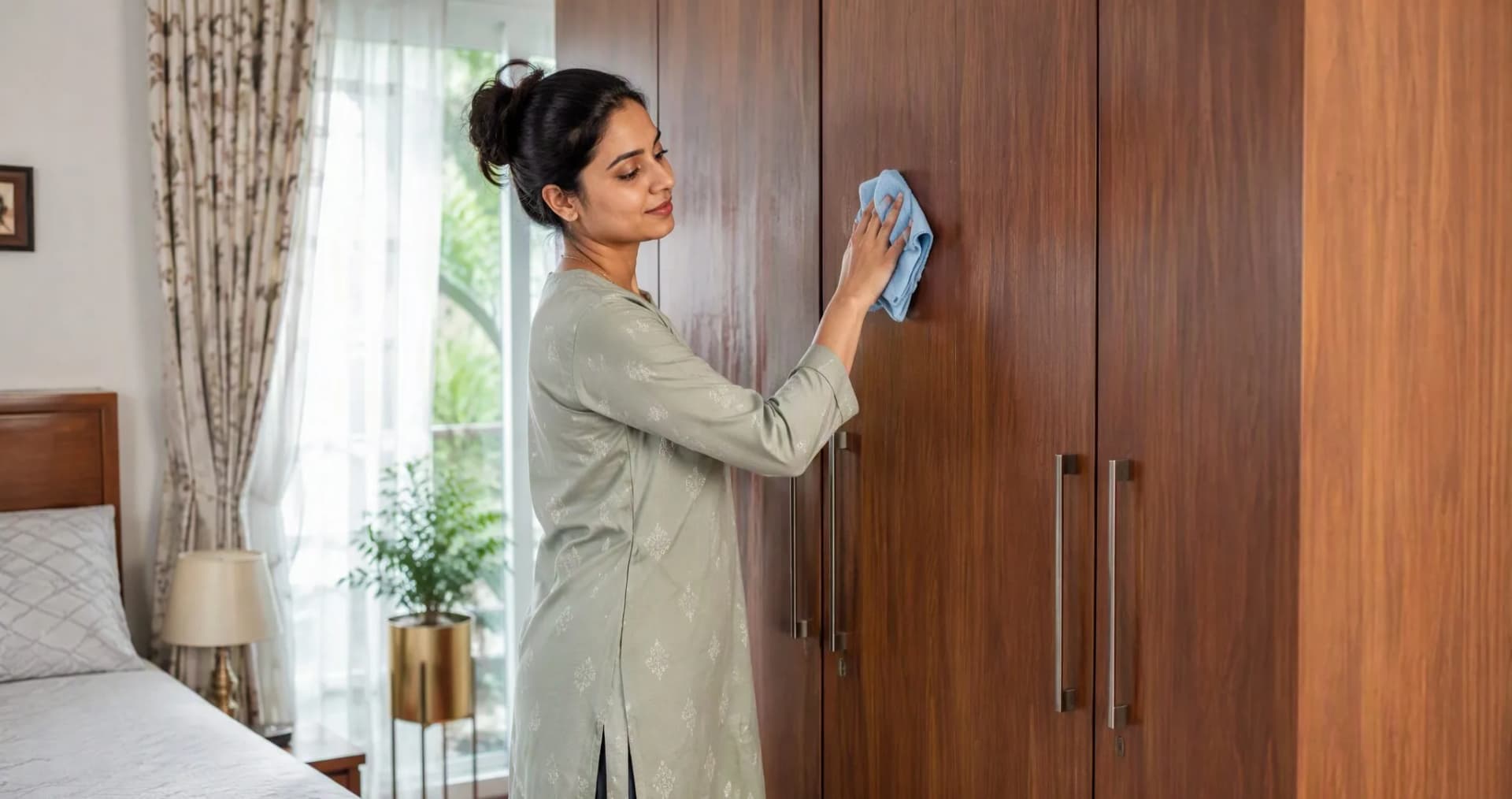
How to Maintain Plywood Furniture for Long-Lasting Durability
Good plywood furniture is built to last 15–25 years — but it only gets there on a maintenance routine, not on luck. Here is the complete care system for Indian homes: the weekly habits, the monsoon defence, the termite checks, and the yearly calendar that keeps wardrobes, kitchens and TV units running like new.
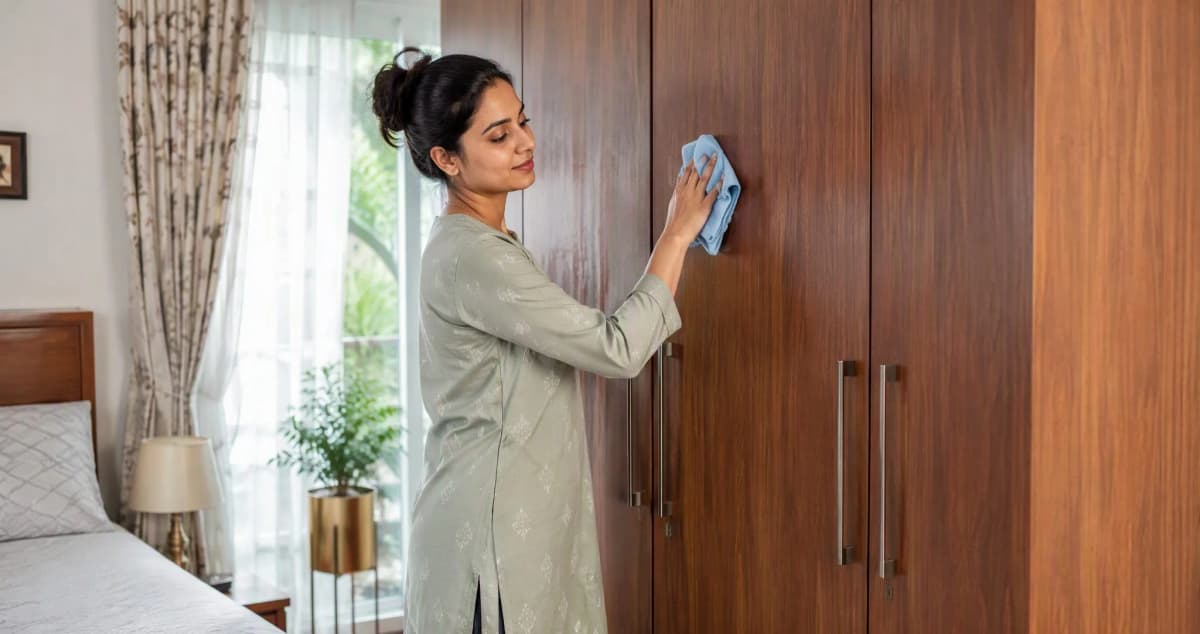
Plywood furniture lasts on five habits: dust weekly with a dry microfiber cloth, wipe spills immediately — water at a raw edge is the fastest killer, keep pieces 25–50 mm off external walls so damp can't wick in, tighten hinges and channels twice a year, and run a pre-monsoon check — fresh silica gel in wardrobes, chips sealed, hardware serviced. Clean laminate with mild soap and water only — never ammonia, vinegar or abrasives. Do this and a well-built plywood interior routinely crosses 15–25 years. The full routine, the monsoon playbook and the repair-vs-replace rules are below.
1. The weekly routine: five habits that do 90% of the work
Furniture rarely dies from one big accident. It dies from a hundred small neglects — the spill that sat overnight, the damp wall the wardrobe leaned against, the hinge that loosened a quarter-turn a month. Five habits cover almost all of it:
- Dust weekly with a dry microfiber cloth. Dust is mildly abrasive; left to build up, it dulls laminate and veneer surfaces every time they're wiped. A dry weekly pass takes two minutes a room.
- Wipe spills immediately. Water, dal, coffee, oil — whatever lands on a surface, lift it now. Liquids that sit find the seams, the edges and the laminate joints, and that is where swelling starts.
- Never let water pool near cabinet edges or plinths. Kitchen and utility units meet mopping water daily. Wipe the floor line dry after mopping, and never rest a wet mop against a cabinet side.
- Distribute weight; don't overload shelves. An 18 mm shelf has a load rating, not an invitation. Stack heavy items low and spread across shelves; concentrated loads in the middle of a span are how permanent bows form.
- Use coasters, mats and trivets. Hot vessels blister laminate and polish; wet glasses leave rings; dragged utensils scratch. A ₹50 coaster prevents a ₹5,000 regret.
None of this is complicated, and none of it needs products. It needs only to happen on schedule. If your furniture was specified well in the first place — the right board grades for each zone, per the material selection guide — these five habits are genuinely most of the maintenance it will ever need.
2. How to clean laminate, veneer and polish safely
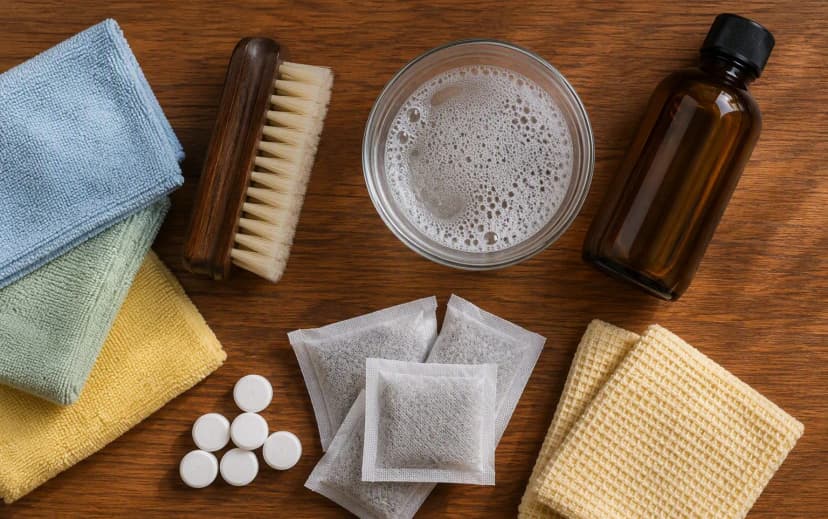
Most damage done in the name of cleaning comes from the wrong chemistry. The rules differ by finish — and laminate and veneer are not the same animal.
| Finish | Clean with | Never use |
|---|---|---|
| Laminate | Damp microfiber + few drops of mild dish soap; dry immediately | Ammonia glass cleaners, bleach, vinegar, abrasive pads, wax, polish |
| Veneer | Damp microfiber + mild soap, wiped along the grain; dry immediately; occasional wood polish | Excess water, ammonia, silicone sprays, circular scrubbing |
| PU / duco / melamine polish | Soft dry cloth; damp cloth for grime; re-polish when the sheen fades | Abrasives, solvents, wet mopping |
| Acrylic / high-gloss | Dry or barely-damp microfiber only — it scratches if you look at it wrong | Anything abrasive, paper towels, dry dusting with rough cloth |
| Raw / unpolished interiors | Dry brush or cloth; vacuum crevices | Water of any kind on raw ply edges |
Three rules apply to every finish. Dust before you wet-clean — wiping a dusty surface drags grit across it and creates micro-scratches. Wring the cloth properly — damp, not wet; the surface should dry within seconds of the cloth passing. And never spray cleaner directly onto the furniture — spray the cloth. Liquid that pools at edges and seams is how swelling and delamination begin, even on a laminate that shrugs off a wiped spill.
For stubborn stains on laminate — turmeric, coffee, hair dye — make a paste of baking soda and water, apply with a soft-bristled brush, ten light strokes, rinse and dry. If that fails, the stain is into the print layer and no household cleaner will lift it; that's the limit, and scrubbing harder only makes it permanent.
3. The monsoon and humidity defence
Indian monsoons push indoor humidity past 80% in many cities for weeks at a stretch. Wood is hygroscopic — it breathes moisture in and out — and that cycle of swelling and shrinking is what loosens joints, sticks drawers, lifts laminate and breeds mould. The defence is air, distance and desiccant — not expensive gear.
Air and distance
Pull wardrobes, beds and sideboards 25–50 mm off external walls — walls absorb rain and seepage, and furniture pressed against a damp wall drinks moisture through its back panel all season. Keep pieces on legs or a plinth, never flat on a floor that gets mopped. And ventilate: open windows on dry days, and open closed cabinets and wardrobes regularly so trapped humidity can escape.
Desiccants inside closed storage
Every closed wardrobe and cabinet is a humidity trap. Drop 2–3 silica gel packets into each section, plus camphor tablets or neem leaves — they absorb moisture and double as mild pest deterrents. Recharge silica gel in sunlight monthly or replace it when it stops working. In coastal cities — Mumbai, Chennai, Kochi, Kolkata, Goa — a dehumidifier or AC on dry mode in the wettest weeks is the single highest-value appliance for furniture longevity.
Seal the entries before the rains
Moisture enters through damage, not through intact surfaces. Before the monsoon, walk the house and seal every chipped laminate edge, cracked polish and bare cut edge with touch-up, edge banding tape or a coat of polish. Check walls behind furniture for seepage stains and fix the source. And never wrap furniture in plastic covers for the season — plastic traps humidity against the surface and grows mould faster than open air ever would.

Why wet zones need different rules: Kitchen sink units and bathroom vanities live with daily water, not seasonal damp. If yours were built in BWP marine ply with machine-sealed edges — the spec in the modular kitchen guide — they only need the weekly wipe-down and dry floor line. If they were built in MR ply or particle board, no maintenance routine will save them; that's a specification failure, not a care failure.
4. Termites and borers: spot them early, treat them professionally
Termites hollow out a wardrobe leg or a bed frame from the inside while the surface still looks perfect. The damage is silent — which is why the check has to be scheduled, not reactive.
The four early signs, in order of appearance:
- Mud tubes — pencil-thick earthen trails running up legs, walls or backs. This is the subterranean termite's covered highway; break one open and you'll often see live insects.
- Frass — fine, sawdust-like powder collecting under or beside wooden pieces. Dry-wood termites and borers push this out of their tunnels.
- Pinhead holes — tiny exit holes on surfaces, often in clusters.
- Hollow sound — tap legs, backs and built-in bases with a knuckle. Solid wood answers with a thud; hollowed wood answers with a papery echo.
Run a torch-and-knuckle check twice a year — once before the monsoon, once after. Legs, backs, built-in bases, skirting. One sign anywhere means check everything nearby; termites rarely colonise a single piece. Shed wings on windowsills after the first monsoon showers are swarming season — the moment new colonies are founded — so that week deserves an extra look.
Prevention is homeowner work; treatment is not. Buying boro-treated BWR/BWP plywood at the build stage, keeping wood off damp floors and walls, and ventilating closed storage will prevent most infestations. An active infestation is licensed pest-control work — anti-termite chemicals are regulated, and improvising with agricultural or unlabelled products indoors is a health hazard, not a hack.
5. Hardware maintenance: the moving parts
Plywood panels don't move; hardware does — thousands of times a year. The hinges, channels and handles are where furniture actually wears, and a ten-minute service twice a year is the difference between a door that closes true for 15 years and one that sags in five.
| Component | Service | How often |
|---|---|---|
| Hinges | Tighten all screws; a drop of silicone lubricant on the pivot | Twice a year |
| Drawer channels | Remove drawer, brush out dust and crumbs, wipe runners, silicone spray on ball races | Twice a year |
| Handles & knobs | Tighten fixing screws from inside; check for play | Twice a year |
| Lift-up & sliding mechanisms | Wipe tracks; check mounting screws; never force a stiff unit | Yearly |
| Locks & catches | Graphite powder (not oil) in sticky locks | As needed |
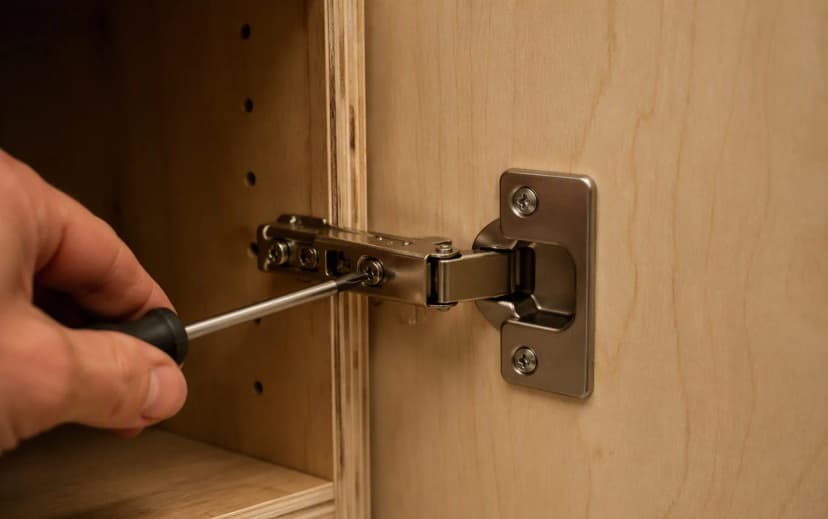
The most common fix is a screw that spins freely — the hole has worn, and tightening achieves nothing. Remove the screw, fill the hole with wood filler or a glued matchstick, let it set, and re-drive the screw. It will hold like new, because this is the plywood advantage: the cross-grain core takes a re-driven screw again and again, where particle board crumbles on the second attempt. That repairability is one of the core arguments in the engineering case for plywood.
One caution on lubricants: use silicone spray or light machine oil, a drop at a time, wiped clean. Petroleum grease and heavy oils attract dust and turn into grinding paste within months. And if a soft-close hinge has lost its damping, the hydraulic cartridge has failed — no lubricant revives it. Hinges are a ₹150–400 part; replace, don't nurse.
6. Repair or replace: the honest line
Not every damaged panel is a lost panel — and not every damaged panel is worth saving. The line is the difference between surface damage and core failure.
| Damage | Verdict | Why |
|---|---|---|
| Chipped or lifting laminate edge | Repair | Re-glue with Fevicol SH and clamp, or re-band with matching edge tape — a ₹100 fix |
| Scratches on veneer or polish | Repair | Oil polish massaged in with a soft cloth fades most; deep ones take a touch-up pen |
| Sagging shelf | Repair | Flip it, add a centre support, or replace the single shelf — the carcass is untouched |
| Loose hinges, worn screw holes | Repair | Matchstick-and-glue fix; plywood takes re-driven screws for decades |
| Localised water swelling at one edge | Repair (if caught early) | Dry fully, sand the swell, reseal — only works before the glue lines fail |
| Water-swollen carcass | Replace | Swollen boards don't un-swell; joints and glue lines are permanently compromised |
| Termite-hollowed panels | Replace | Structural strength is gone; treat the infestation first, then rebuild the piece |
| Widespread delamination | Replace | Once the bond between plies fails across a panel, no adhesive restores it |
The pattern is simple: surface damage is repairable; core failure is not. This is plywood's structural advantage over particle board and MDF — a scratched, chipped, loose-hinged plywood wardrobe is a weekend of fixes away from new, while the same failures in particle board are usually terminal. The durability guide explains the mechanics of why ply survives repairs that fibreboard can't.
7. The yearly maintenance calendar
Tie the habits to the Indian calendar and maintenance stops depending on memory. This is the whole system on one card:
- Weekly — dry microfiber dusting; wipe spills the moment they happen
- Monthly — damp-cloth clean of high-touch surfaces (kitchen shutters, wardrobe handles); recharge silica gel in sunlight
- May–June (pre-monsoon) — pull furniture off external walls, fresh desiccants and camphor, seal chips and bare edges, service all hardware, termite torch-check
- July–September (monsoon) — dehumidifier or AC dry mode in the wettest weeks, air out closed cabinets on dry days, dry the floor line after mopping
- October (post-monsoon) — check for mould, stuck drawers, loose joints, shed wings and frass; re-tighten everything the swelling loosened
- Yearly — polish veneer and PU finishes; deep-clean drawer channels; review the repair-vs-replace list for anything that crossed the line
Run this calendar and the furniture does the rest. And if you're still at the planning stage rather than the maintenance stage — choose well now and maintain cheaply forever. The plywood selection guide and the shop-floor verification guide cover the buying half of that equation.
Frequently asked questions
How do I maintain plywood furniture so it lasts longer?
Five habits cover almost everything: dust weekly with a dry microfiber cloth, wipe spills immediately, keep furniture 25–50 mm off external walls, tighten hinges and channels twice a year, and run a pre-monsoon check — fresh desiccants in wardrobes, sealed chips, serviced hardware. Good plywood maintained this way routinely lasts 15–25 years.
Can I use water to clean plywood furniture?
Use a damp — never wet — microfiber cloth with a few drops of mild dish soap, then dry the surface immediately. Standing water is the enemy: it swells exposed edges, lifts laminate and veneer, and leaves rings. Never soak a cloth on the surface, and never let spills sit.
Which cleaners are safe for laminate and veneer finishes?
Safe: mild dish soap diluted in warm water, applied with a microfiber cloth and dried immediately. Avoid: ammonia-based glass cleaners, undiluted vinegar, bleach, abrasive pads and steel wool — all of them etch the melamine or veneer surface and leave permanent dull patches. Never wax laminate.
How do I protect plywood furniture during the monsoon?
Before the rains: pull furniture 25–50 mm off external walls, put silica gel and camphor inside wardrobes, seal any chipped edges, and oil hinges. During the monsoon: run a dehumidifier or AC on dry mode in the wettest weeks, air out closed cabinets on dry days, and wipe any damp immediately. After the monsoon: check for mould, loose joints and shed termite wings.
How do I know if my plywood furniture has termites?
Four early signs: mud tubes on legs or walls behind furniture, fine sawdust-like powder (frass) under wooden pieces, tiny pinhead holes, and wood that sounds hollow when tapped. Check legs, backs and built-in bases with a torch twice a year. One sign means check everything nearby — and call a licensed pest-control operator rather than improvising chemicals.
How often should I polish plywood furniture?
Veneer and polished-wood finishes benefit from a quality wood polish or wax once before the monsoon and optionally mid-season in very humid cities. Laminate should never be polished or waxed — it is a sealed melamine surface; soap-and-water cleaning is all it needs, and wax only builds a smeary film.
Why are my wardrobe hinges getting loose and how do I fix them?
Daily opening and closing gradually backs out hinge screws, and each loose swing stresses the hole further. Tighten all hinge and handle screws twice a year. If a screw spins freely, remove it, fill the hole with wood filler or a glued matchstick, let it set, and re-drive the screw — it will hold like new.
When is damaged plywood furniture worth repairing versus replacing?
Repair when the damage is on the surface: chipped laminate edges, scratches, loose hinges, a sagging shelf — all fixable in an afternoon. Replace when the core has failed: a carcass swollen from water, termite-hollowed panels, or widespread delamination. Plywood's repairability is one of its biggest advantages over particle board, whose swollen or crumbled panels are rarely salvageable.
Planning interiors that are easy to maintain?
The cheapest maintenance is the right material on day one. Bring us your room list and we'll spec the boards, finishes and hardware that match each zone — so the care routine above is all your home ever needs.
Get a free material consultation




