
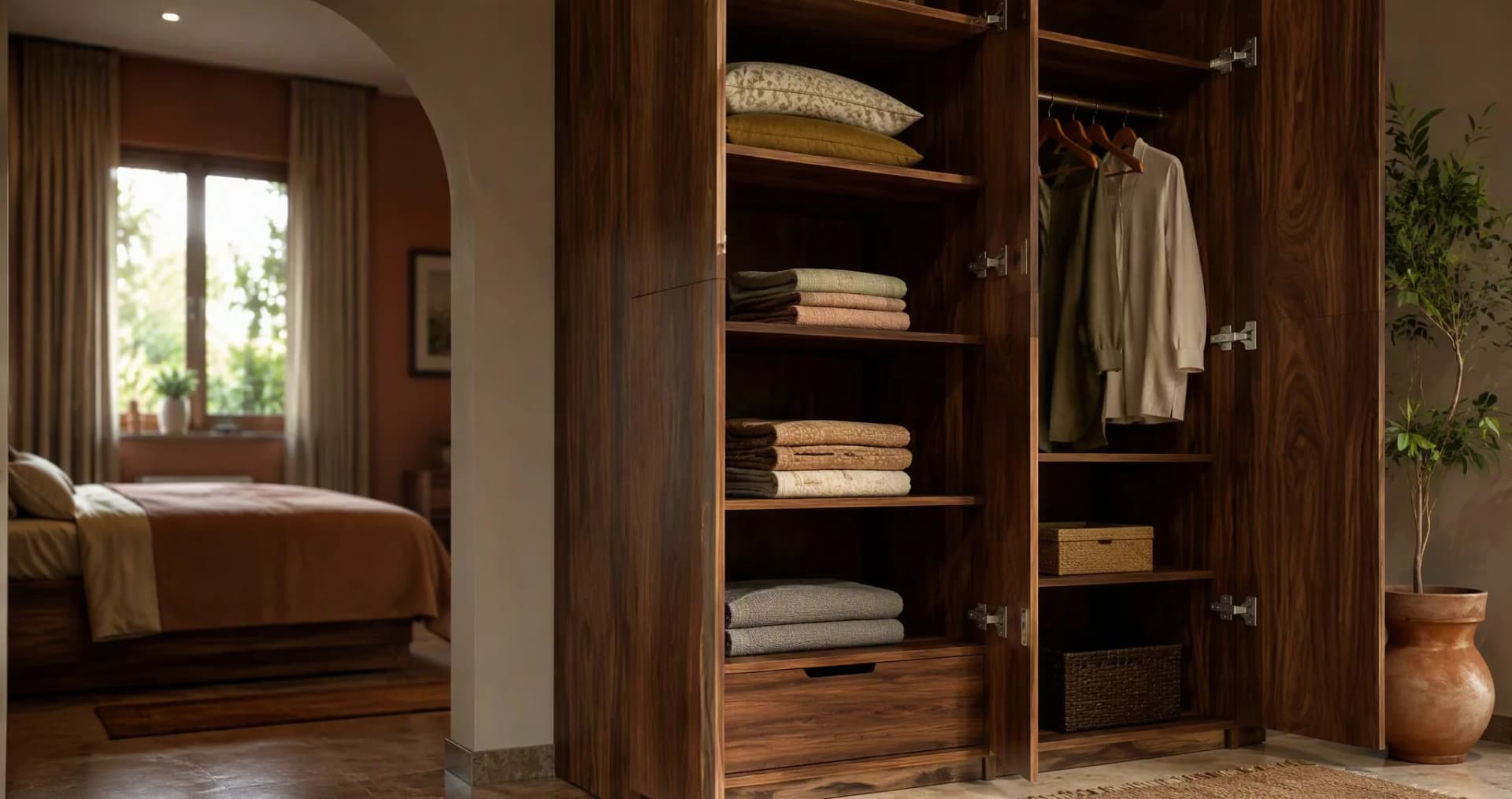
How Plywood Improves the Durability of Modular Furniture: The Engineering Behind 20-Year Kitchens
Two identical-looking wardrobes are installed on the same day. Fifteen years later, one is still tight and true; the other was thrown out in year seven. The difference is almost never the laminate or the brand of hinge — it's the board underneath. Here's the engineering.
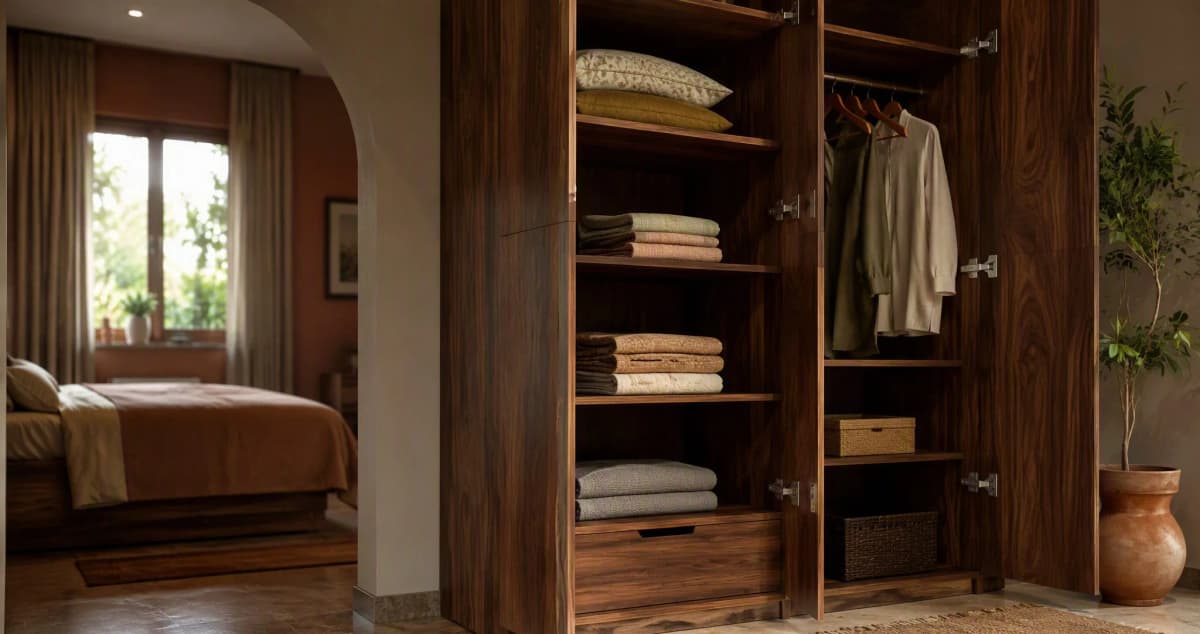
Plywood improves modular furniture durability through five engineering properties: (1) cross-laminated veneers that cancel warping, (2) superior screw and hinge holding in both face and edge, (3) 2–3x the load capacity of particle board without sagging, (4) BWR/BWP grades that survive the humidity and water that destroy particle board in 2–3 years, and (5) joints that survive dismantling and reassembly when you move. The result: plywood modular furniture lasts 15–25 years versus 5–10 for particle board — and costs less per year despite the higher upfront price.
Where Modular Furniture Actually Fails First
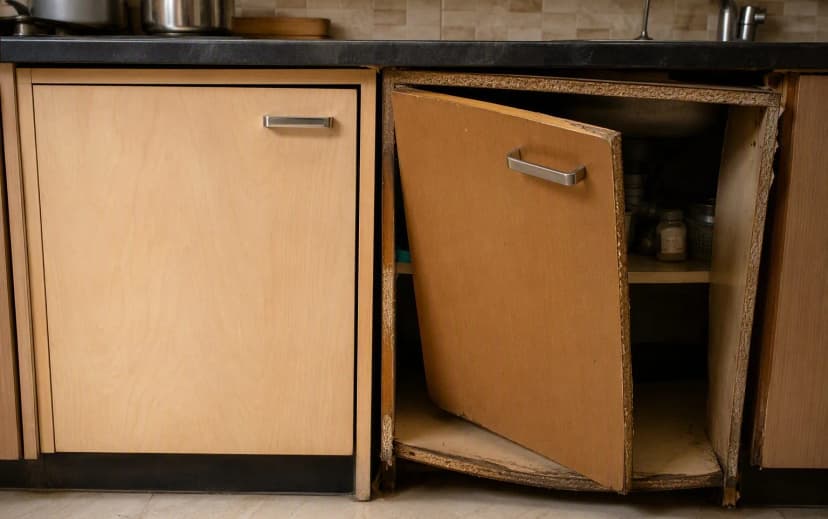
Modular furniture almost never fails in the middle of a panel. It fails at the joints, the hardware, and the edges — the hinge screw that pulled out of a crumbling cabinet side, the shelf that bowed under books, the swollen under-sink unit whose doors won't close after two monsoons.
This matters because it tells you exactly what to look for in a material. A board's pretty laminate face is nearly irrelevant to lifespan. What decides whether your kitchen lasts 6 years or 25 is: how tightly the board holds a screw, how flat it stays across seasons, how much weight it carries without bending, and what happens when water touches it.
Those four properties are precisely where plywood's construction — thin veneers of real wood, glued in alternating grain directions — beats particle board (wood chips in resin) and MDF (wood fibre in resin). Not by a little. By multiples.
The 5 Engineering Reasons Plywood Lasts Longer
Cross-grain construction kills warping
Every sheet of plywood is built from thin veneers with each layer's grain rotated 90° to its neighbour. Wood expands and shrinks across its grain with humidity — but when half the layers run one way and half the other, each layer physically restrains the next. The movement cancels out.
That's why an 18mm plywood wardrobe shutter stays flat for two decades of monsoon-to-summer cycles, while solid wood twists and particle board bows. Research on indoor plywood panels shows they typically retain 84–100% of bending strength and 78–97% of elasticity even after 10 years of service — the material barely ages indoors.
What it means in your home: shutters that still align, drawers that still slide, panel gaps that stay even — year 1 and year 15
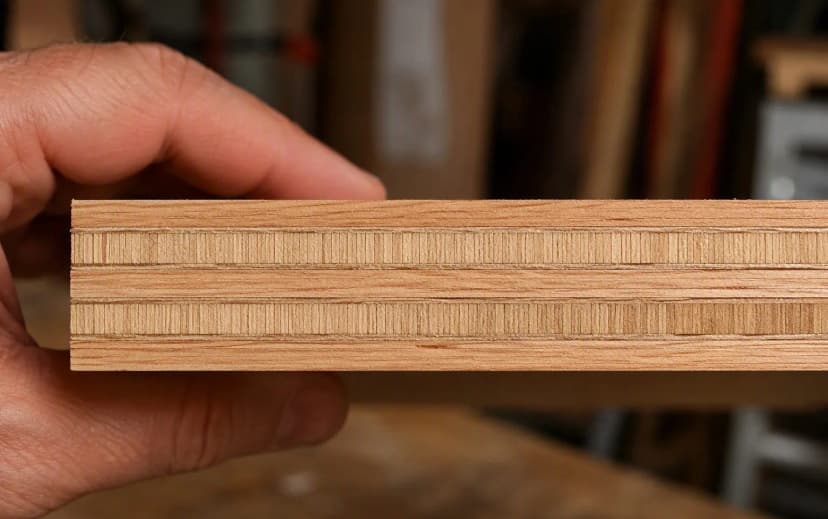
Screws and hinges grip solid wood, not crumbs
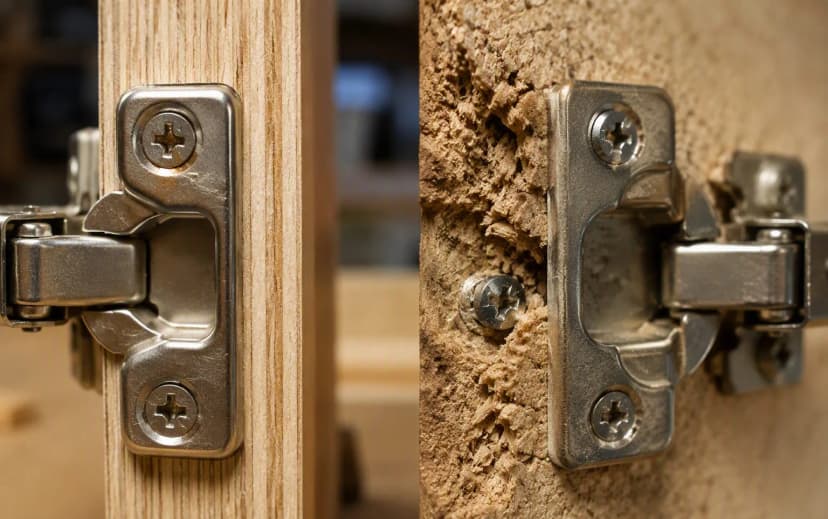
A wardrobe door opened 20 times a day cycles its hinges over 100,000 times in 15 years. Every one of those cycles loads the four small screws holding each hinge — usually into the edge of the board. In plywood, those screws bite into continuous wood fibres that compress and grip back, and hold even when re-tightened or re-driven after a repair. In particle board, the same screws crush chips and resin; each re-tightening strips the hole a little more, until the hinge hangs loose with nothing solid to grip.
This is also why modular furniture survives a house move. Plywood units can be dismantled, transported and reassembled — cam-locks and screws bite fresh wood again. Particle board rarely survives one disassembly; the fastener holes crumble.
What it means in your home: hinges stay tight for decades · furniture survives moving house · repairs are actually possible
2–3x the load capacity — no sagging shelves
Plywood is roughly 2–3 times stronger than particle board in bending, and significantly stiffer than MDF. The visible consequence: a 3-ft plywood shelf loaded with books or a 40kg crockery set stays flat; the same span in particle board bows visibly within a year or two, and sag is permanent — the chips don't spring back.
Load capacity also protects the structure itself: granite countertops, hydraulic bed mechanisms, wall-hung TV consoles and stacked loft storage all concentrate weight on a few panels. In plywood, those panels carry it for decades.
What it means in your home: bookshelves that don't bow · beds that don't creak · wall units that stay on the wall
BWR/BWP grades survive monsoon, steam and mopping
Indian homes are hard on board material: 70–90% monsoon humidity, daily floor mopping, kitchen steam, and water splashes around every sink. Particle board and MDF absorb moisture at edges and screw holes and swell permanently — studies of kitchen environments show measurable degradation within a few years, and under-sink particle board cabinets typically fail in 2–3 years.
Plywood's layered construction resists water penetration, and the resin decides how much: BWR (melamine-fortified) shrugs off humidity and steam; BWP/marine (phenol-formaldehyde, IS 710) survives 72-hour boiling-water tests. Even basic MR plywood outlasts particle board in damp air — but kitchens deserve BWR minimum.
What it means in your home: the under-sink cabinet still closes properly after 15 monsoons
Plywood can be repaired and refinished; particle board can't
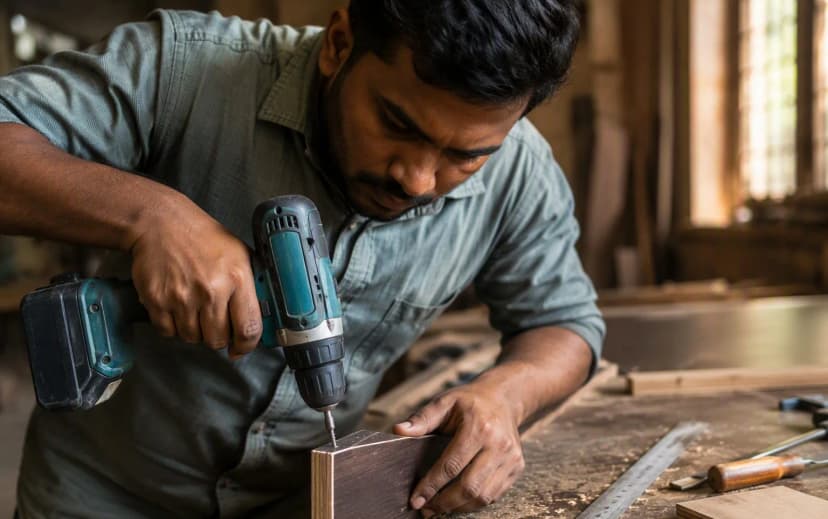
When life happens — a chipped corner, a scratched surface, a loose joint — plywood responds like wood: it can be re-glued, re-screwed into fresh material, filled, sanded and re-laminated or repolished. A 15-year-old plywood kitchen can get new shutters and look new again. Particle board damage is terminal: swollen areas never shrink back, stripped screw holes have nothing to grip, and broken corners crumble further. Its only repair is replacement.
What it means in your home: refresh the finish at year 12 instead of replacing the kitchen at year 7
Plywood vs MDF vs Particle Board: The Full Durability Comparison
Here's the honest scorecard for modular furniture in Indian conditions — including where the cheaper boards genuinely make sense.
| Property | Plywood (BWR/BWP) | MDF | Particle Board |
|---|---|---|---|
| Typical lifespan (modular furniture) | 15–25+ years | 8–12 years (dry zones) | 5–10 years; 2–3 in kitchens |
| Screw & hinge holding | Excellent — face and edge, re-tightenable | Fair on face, poor on edge | Poor — strips with use |
| Load / shelf sag | High capacity, stays flat | Moderate, creeps over time | Low — permanent bowing |
| Moisture & monsoon | BWR: humid-proof · BWP: waterproof | Swells; MR variants only slow it | Swells fast; failure is permanent |
| Survives dismantling/moving | Yes, repeatedly | Rarely | No |
| Repairable / refinishable | Yes — re-glue, re-screw, re-laminate | Limited | No |
| Surface finish quality | Good under laminate/veneer | Best — smoothest for paint/CNC | Needs laminate/melamine always |
| Indicative cost (18mm) | ₹115–265/sq ft | ₹40–80/sq ft | ₹30–60/sq ft |
| Right role | Carcasses, shelves, kitchens, beds, shutters | Painted/CNC shutters in dry rooms | Budget, temporary, dry-zone furniture |
The honest exception: MDF earns its place for painted or CNC-routed decorative shutters in dry rooms — its surface is smoother than any plywood face. And particle board is a rational choice for rental interiors you plan to replace. The mistake isn't using them; it's using them where moisture, load or hardware will find them.
The Cost-per-Year Math
Durability is a financial argument, not just an engineering one. Run the numbers on a modular kitchen at typical rates:
| Plywood (BWR/BWP) | Particle Board | |
|---|---|---|
| Initial cost | ₹3.0 lakh | ₹1.9 lakh |
| Expected lifespan | 20 years | 7 years |
| Replacements in 25 years | 1 refresh (new shutters/laminate ≈ ₹60,000) | 2 full replacements (2 × ₹1.9 lakh + demolition) |
| Total 25-year spend | ≈ ₹3.6 lakh | ≈ ₹5.7 lakh + disruption |
| Cost per year | ≈ ₹14,400 | ≈ ₹22,800 |
The "expensive" plywood kitchen is roughly 35–40% cheaper per year — before counting the two kitchen-less weeks, the demolition debris, and the re-do decisions that every replacement forces. Particle board's discount is a loan you repay with interest.
Durability Needs the Right Grade — Not Just "Plywood"
A durable result needs durable material in the right place. Three rules cover almost every modular project:
- Kitchens: BWP/marine (IS 710) for base cabinets and under-sink units; BWR (IS 303) for wall units; 18–19mm carcasses, 16mm calibrated shutters. MR in a kitchen fails in 2–3 monsoons regardless of brand.
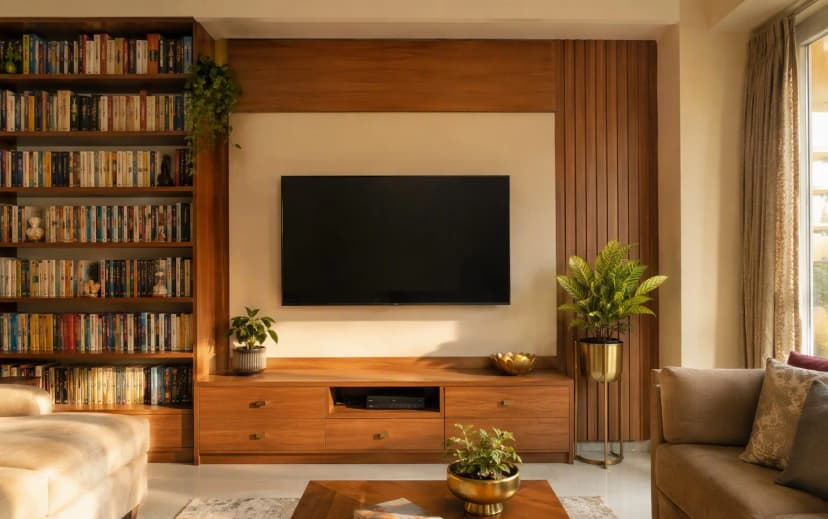
- Wardrobes, beds, TV units: MR/BWR is sufficient in dry rooms — but 18–19mm for structure and honest thickness throughout. A "18mm" sheet that measures 16.5mm is a durability downgrade you paid full price for.
- Bathrooms, utility, balconies: BWP only, with every cut edge sealed. The edge is where water enters — laminate on faces doesn't protect it.
And the durability traps that no grade can fix: untreated termite zones (specify treated ply — ground floors in older buildings see real termite pressure), counterfeit branded sheets (check the ISI stamp on the edge), and skipped edge banding around sinks.
The Durability Specification Checklist
Hand this to your designer or carpenter before work starts. Each item targets a real failure point:
- Carcasses in 18–19mm plywood — no 16mm substitution on load-bearing boxes
- BWP (IS 710) under every sink and around the hob; BWR minimum everywhere else in the kitchen
- 16mm calibrated ply for shutters — so doors align at year 10, not just on install day
- All cut edges edge-banded or sealed, especially within 1 metre of water
- Anti-termite treated plywood for ground floors and older buildings
- ISI mark checked on the sheet edge — IS 303 or IS 710, with the standard number visible
- Shelves over 2.5 ft span in 18mm+, bookshelves in 25mm — sag is permanent
- Hinges mounted into plywood edges, not MDF/particle board — reject mixed-material carcasses
- Written material specification in the quote — brand, grade, thickness per component
Frequently Asked Questions
How does plywood make modular furniture more durable?
Through five engineering properties: cross-laminated veneers that cancel warping, screws gripping solid wood layers so hinges stay tight for decades, 2–3x particle board's load capacity without sagging, BWR/BWP grades that survive humidity and water, and joints that tolerate dismantling and reassembly when you move house.
How long does plywood modular furniture last compared to particle board?
Well-built plywood modular furniture lasts 15–25 years in Indian homes (30+ for quality BWP installations). Particle board lasts 5–10 years in dry conditions and 2–3 years in kitchens or humid rooms. MDF sits between at roughly 8–12 years in dry, low-stress use.
Why do hinges and screws hold better in plywood?
Screws bite into continuous solid-wood veneer fibres that compress and grip the thread — including from the edge where hinges mount. Particle board screws crush chips and resin, and the hole strips after a few re-tightenings. A door used 20 times daily for 15 years needs ~100,000 hinge cycles, which only plywood's edge screw-holding survives.
Is plywood furniture worth the extra cost?
On cost per year, yes. A ₹3 lakh plywood kitchen lasting 20 years costs ≈₹14,400/year including a mid-life refresh. A ₹1.9 lakh particle board kitchen lasting 7 years costs ≈₹22,800/year over 25 years — plus two replacement cycles and their disruption. Plywood also supports the home's resale and rental value.
Which plywood grade is most durable for modular kitchens?
BWP/marine (IS 710) for base cabinets, under-sink units and hob-adjacent cabinets; BWR (IS 303) for wall units; 18–19mm carcasses and 16mm calibrated shutters. Never MR grade in a kitchen — its urea resin fails in steam within 2–3 monsoons.
Can particle board furniture be made durable with good laminate?
No. Laminate protects only the two faces. Particle board fails from edges and screw holes, where laminate doesn't reach. Edge banding helps, but any unsealed cut edge or drilled hole admits humidity, and swelling is permanent. Laminate changes appearance, not structural lifespan.
Does plywood furniture need maintenance to stay durable?
Very little: tighten hinges once a year, wipe spills promptly, avoid soaking edges while mopping. Termite-treated plywood plus laminate or PU finish handles the rest. No polishing or seasoning like solid wood, and no hidden swelling to watch for like particle board.
What is the weakest point in modular furniture and how does plywood fix it?
The joints — every unit is held together by screws, dowels and cam-locks gripping the board. Plywood's layered fibres hold fasteners in face and edge, tolerate re-assembly, and resist cyclic loading. Particle board joints loosen first, which is why that furniture falls apart rather than wearing out.
Want furniture that outlasts the decade?
Share your floor plan and we'll specify every panel — grade, thickness, core and finish — so your kitchen and wardrobes are still tight and true at year 20.
Get a Free Material Specification




