How to Select Reliable Interior Material Suppliers in Bangalore
The right plywood bought from the wrong shop is still the wrong plywood. Here is how Bangalore's supplier landscape actually works — dealers, yards, distributors and apps — plus the seven checks that separate a genuine supplier from a substitution artist, and the price spreads that should make you walk away.
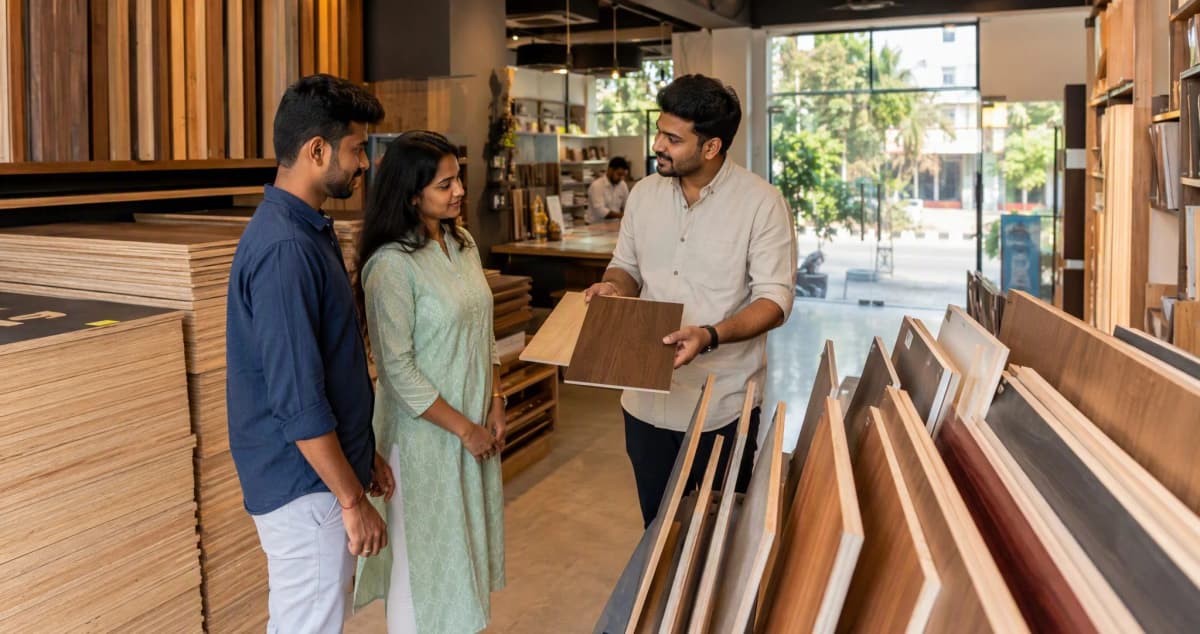
Buy from a brand-authorised dealer you have verified yourself — never on a carpenter's word alone. Find dealers through the brand's own locator, confirm the authorisation certificate in the shop, and test the material chain: CM/L number on the BIS Care app, brand QR scan, GST invoice naming brand + grade + thickness per line. Expect a 10–15% price spread between authorised dealers as normal; anything cheaper by 20%+ is almost always a different grade, old stock, or a fake stamp. Wholesale timber yards are fine for experienced buyers who verify sheet-by-sheet; first-time homeowners should treat them as high-risk.
1. Why the supplier matters as much as the material
Most Bangalore homeowners spend weeks researching BWR vs BWP and laminate brands — then hand the actual purchase to a carpenter's "regular guy." That handover is where projects quietly go wrong.
A supplier controls three things your research cannot:
- Authenticity. The same stamp, the same face veneer, a different core. Grade substitution (MR sold as BWR) and fake ISI stamps are volume businesses in the unorganised trade — industry estimates consistently put a large share of yard-sold "branded" sheets as mis-marked or counterfeit.
- Condition. Plywood stored in a leaking godown or under direct sun degrades before you buy it. Laminates past their shelf life lose bonding strength. A supplier's warehouse discipline decides whether the spec you paid for still exists at delivery.
- Timeline. Interior work runs on a labour clock. A supplier who promises three days and delivers in twelve leaves carpenters idle at ₹1,500–2,500 per day each — the "cheap" yard price evaporates in a week of delays.
The encouraging part: verifying a supplier takes one shop visit and about twenty minutes. The checks in Section 3 are the same ones we run before adding any vendor to a project.
Already chose your materials? If you are still finalising specs, read our guides on selecting durable materials for home interiors and modular kitchen materials for Bangalore homes first — this article assumes you know what you want and need to buy it safely.
2. Bangalore's supplier landscape: 4 ways to buy
Every material purchase in the city flows through one of four channels. Each has a distinct risk profile — and a distinct type of buyer it suits.
| Channel | Price level | Authenticity risk | Warranty & paperwork | Best for |
|---|---|---|---|---|
| Brand-authorised dealer (showrooms & multi-brand shops in Yeshwanthpur, JP Nagar, Whitefield, Banaswadi) | Full retail | Low — brand-audited supply chain | Full GST invoice, brand warranty card, replacement support | First-time homeowners, anyone prioritising certainty |
| Wholesale timber markets (the traditional yard clusters contractors use) | 10–20% below retail | High — mixed lots, grade swaps, fake stamps | Basic bill, often without grade/brand detail; warranty "from company, not us" | Experienced contractors who verify sheet-by-sheet |
| Online material platforms (verified-supplier marketplaces with site delivery) | Retail, sometimes sharper on volume | Low — platform vets suppliers, digital trail on everything | Proper GST invoices, easy returns, delivery tracking | Homeowners who want transparency without yard visits |
| Distributor / direct-from-depot | Lowest (wholesale) | Low on authenticity, high on suitability | Proper paperwork, but no retail hand-holding | Large projects (full villa, multi-flat) buying 100+ sheets |
The dealer vs distributor distinction matters. Distributors buy from manufacturers and supply dealers across a territory — they are a wholesale layer, not a retail service. A single-home order (25–40 sheets) gets neither their attention nor their best price. Homeowners belong at authorised dealers or verified platforms; leave distributor negotiations to builders.
About the wholesale yards: they are not villains — they are simply optimised for buyers who can inspect. Contractors walk a stack, sight edges, tap faces, and reject sheets on the spot. If you cannot yet do that confidently, the yard's discount is tuition fees for a lesson you did not want. Our plywood quality signs guide teaches the full inspection routine — with it, a yard visit becomes survivable; without it, stick to authorised dealers.
3. The 7 verification checks that actually work
None of these require trust. Each one produces evidence you can hold, photograph or look up. A reliable supplier passes all seven without flinching — resistance to any one of them is your answer.
1. The authorisation certificate
Ask directly: "Are you an authorised dealer for this brand?" Genuine dealers produce the certificate immediately — usually framed at the counter. Then verify independently: every major brand (Century, Greenply, Kitply, Merino, Hettich) runs a dealer locator on its website or confirms dealers via customer care. A certificate that the brand itself does not recognise is wall decoration.
2. The BIS Care check on the material
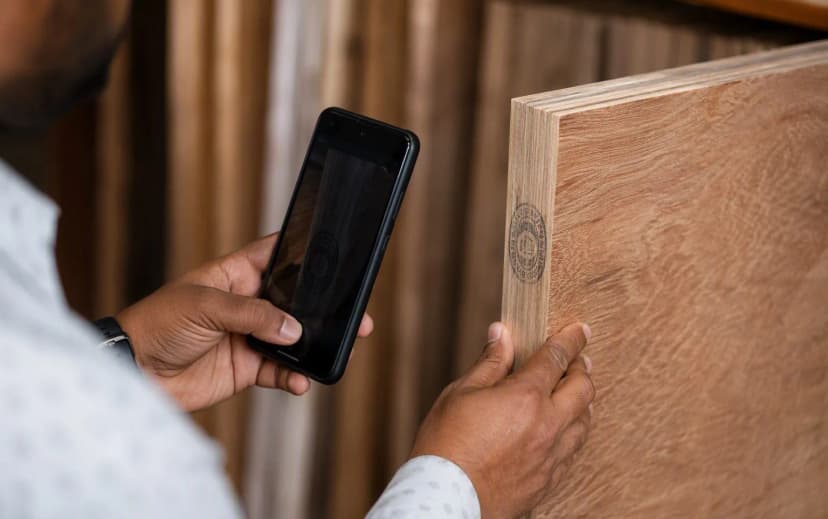
Every ISI-marked sheet carries an ink stamp: the IS standard (303 or 710), the ISI logo and a CM/L licence number. Enter that number in the free BIS Care app. A genuine licence returns the manufacturer's name, the standards covered and an active status. If the number returns nothing — or returns a company that is not on the sheet — you are holding a fake stamp, regardless of how good the veneer looks.
3. The brand's own QR verification
Layer two: brands now mark sheets with scannable codes — CenturyPromise for CenturyPly, similar systems for Greenply and others. The BIS check verifies the licence; the brand app verifies the physical board came from that factory. Use both. A dealer who sells genuine stock will happily let you scan sheets in the shop.
4. The GST invoice test
Ask before ordering: "Will the invoice name the brand, grade and thickness on each line?" The answer you want looks like Century Club Prime, IS 710 BWP, 18 mm — 8 nos. The answer that protects no one looks like plywood 18 mm — 8 nos. The detailed invoice is your only enforceable evidence if material fails within warranty — dealers selling genuine stock never hesitate on this, because it costs them nothing.
5. The warehouse condition check
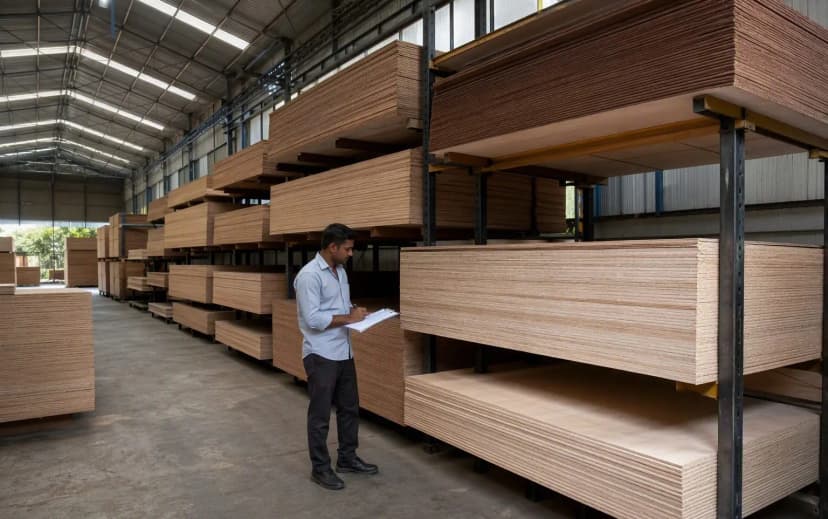
Look at how stock is kept. Sheets should sit flat, off the floor, under cover, away from direct sun and damp. Yellowing edges, warped display pieces or a musty godown smell tell you how your order has been ageing. Good dealers treat inventory as an asset; bad ones treat it as a pile.
6. The technical knowledge test
Ask two questions you already know the answer to: "What's the difference between BWR and BWP?" and "What thickness for a kitchen carcass?" A competent supplier answers crisply (8-hour vs 72-hour boil test; 18–19 mm). Vague deflection — "all same sir, only price difference" — tells you the shop cannot advise you, and probably cannot tell its own stock apart either.
7. The warranty card read
Ask to see the actual warranty card for the product, not a verbal "lifetime warranty, sir." Read what it covers: replacement or money-back? Delamination only, or borer and termite too? What documentation does a claim need? A supplier who knows their warranty terms can also process your claim later — which is the entire point of buying branded.
4. Pricing reality: what spreads are fair
Price is the easiest thing to compare and the least reliable signal of value. Here is how to read Bangalore quotes like someone who has seen a few hundred of them.
The normal band. For the same branded product, authorised dealers in Bangalore quote within a 10–15% band of each other. The spread comes from purchase volumes, payment terms with distributors, and location overheads — a prime-road showroom simply costs more to run than a godown-front shop. Inside this band, pick on service and stock freshness, not on the last ₹3 per sq ft.
The suspicious zones. A quote 20%+ below the authorised-dealer average has a short list of possible explanations: different grade stamped to look the same, B-stock or old-batch sheets, a brand name on the quote that will not survive to the invoice, or outright counterfeit. None of them save you money. Similarly, a quote 20%+ above with no service difference is simply a margin test you failed.
Benchmark before you bargain. As of, indicative Bangalore retail for 18–19 mm plywood runs roughly ₹62–98 per sq ft (commercial/MR), ₹110–176 (BWR) and ₹256–349 (marine/BWP), with branded product commanding a 40–60% premium over unbranded yard ply — a premium that buys consistent thickness, real treatment chemicals and a claimable warranty. Laminate (1 mm) sits around ₹20–62 per sq ft depending on brand and finish. Know the band for what you are buying; a quote outside it is information.
Delivery and extras: most Bangalore dealers deliver within the city for ₹500–2,000 depending on distance and load, and many offer sizing/cutting at ₹10–20 per sq ft. Get delivery charges, unloading responsibility and replacement policy for transit-damaged sheets agreed before payment — "we'll see at the time" becomes your problem at the time.
5. Red flags that disqualify a supplier instantly
Some problems are negotiable. These are not. Any one of them ends the conversation — politely, but ends it.
"Bill mein brand likhne se GST zyada lagta hai"
Any version of "we'll write a simple bill." A detailed GST invoice costs the dealer nothing extra. Refusing one means the paper trail is the product's biggest enemy.
VERDICT: walk away — no exceptions
Discounts that need secrecy
"Don't tell the company," "cash price, no bill price." Material that cannot survive daylight will not survive your kitchen's third monsoon either.
VERDICT: walk away — cheap today, replaced in year three
Won't let you verify on the spot
Impatience when you open the BIS Care app, scan a QR code, or sight a sheet edge. Genuine sellers treat verification as routine — it happens in front of them daily.
VERDICT: walk away — resistance IS the answer
"This local brand is same as Century"
The unbranded-to-branded pivot at the billing desk. If you specced a branded sheet, a "same-same" substitute at 30% less is a downgrade with a story attached.
VERDICT: buy what you specced, or re-spec deliberately
Stock stored badly
Sheets leaning against walls, warped display pieces, damp floors, direct sun on stacks. Storage is a preview of your material's pre-delivery life.
VERDICT: grade the godown before the goods
Pressure to decide "today only"
Expiring prices and artificial urgency are the oldest tells in material retail. Real dealers hold quotes for days; their price survives a second visit.
VERDICT: urgency is a product feature — of a bad deal
For a deeper yard-level checklist aimed specifically at plywood procurement — authorised-dealer verification, batch checks, invoice hygiene — see our plywood supplier buyer's checklist.
6. Beyond plywood: laminates, hardware, adhesives
A plywood-first buying strategy leaves three categories exposed. Each has its own counterfeiting pattern and its own reliable channel.
Laminates and veneers
Buy by brand and catalogue code (Merino, Greenlam, Royale Touche), not by "this design." The catalogue code on the invoice is what makes a shade re-orderable months later for that extra shutter. Physically check sheet flatness and surface under raking light — ripple and orange-peel on a laminate sheet telegraph through any finish. Keep 0.8 mm for verticals and 1 mm for worktops and shutters as your minimum spec; 0.6 mm economy sheets delaminate early.
Hardware
Hinges, channels and tandem boxes are the most counterfeited category in Indian interiors — fake Hettich and Hafele packaging is a mature industry. Buy hardware only from the brand's authorised distributor network, check the hologram and batch marking on every box, and keep the boxes until installation is complete and tested. The price difference between genuine and fake soft-close hardware is 40–60%; so is the lifespan difference.
Adhesives and consumables
Fevicol, edge-banding tape, silicone — low ticket, high consequence. Date-check every adhesive pack (adhesives lose bond strength on the shelf), and buy from the same authorised channel rather than the nearest hardware bin. A ₹400 saving on adhesive is how a ₹4 lakh kitchen starts bubbling at the edges.
If you are speccing a kitchen specifically, the material-grade side of this — carcass, shutters, counters and hardware that survive Bangalore conditions — is covered in our modular kitchen materials guide and kitchen plywood selection guide.
7. From order to site: protecting the purchase
Verification does not end at billing. The last kilometre — loading, transport, unloading, stacking at your site — is where good material gets damaged and good paperwork gets ignored.
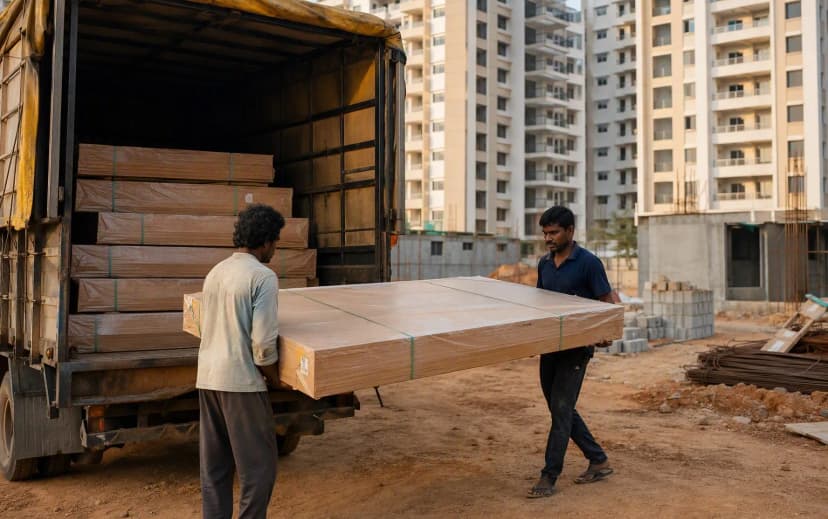
Specify packing and handling. Sheets should travel strapped in bundles, edge-protected, and be carried flat by two people — never dragged, never flexed end-to-end by one loader. Say this when ordering, not after the truck arrives.
Inspect at the gate, not in the bedroom. Match the delivered sheets against the invoice line by line: brand, grade, thickness, count. Run the stamp-and-caliper spot check from our quality signs guide on a random sample. Note any transit damage — chipped corners, moisture stains, broken strapping — on the delivery challan before signing.
Stack right on site. Sheets go flat, on level supports, indoors, off the floor, away from wet plastering zones. A week leaning against a damp wall undoes everything your supplier did right. Keep invoices, warranty cards and challan copies in one folder — that folder is your warranty claim kit for the next decade.
The 10-point supplier scorecard
- Authorisation verified independently — certificate seen in shop AND confirmed via the brand's own locator or customer care.
- BIS Care check passed — CM/L number from an actual sheet returns the right manufacturer and active status.
- Brand QR verification works — CenturyPromise or equivalent scan confirms the physical board, in the shop, in front of you.
- Invoice commitment given in advance — brand, grade, IS standard, thickness and quantity per line, GST invoice, no negotiation.
- Warranty card shown and read — coverage terms, duration and claim process explained by the seller without prompting.
- Technical test passed — BWR vs BWP and thickness questions answered crisply; no "all same" deflection.
- Storage inspected — flat stacks, off the floor, covered, no warped or yellowed stock on display.
- Price within the 10–15% band — competitive but not suspiciously cheap; discounts explained, not secretive.
- Delivery terms agreed upfront — charges, timeline, unloading responsibility, and replacement for transit damage in writing.
- References check out — two recent customers or one designer/contractor who buys there regularly and would go back.
Frequently asked questions
How do I find a reliable interior material supplier in Bangalore?
Start with the brand's own dealer locator or customer care to find authorised dealers, then verify the shop in person: check the dealership certificate, test their technical knowledge, inspect stock condition, and confirm they issue GST invoices naming brand, grade and IS standard per line item.
What is the difference between an authorised dealer and a wholesale timber yard?
Authorised dealers are appointed by brands, carry genuine certified stock with warranty documentation, and charge roughly 10–15% more than yards. Wholesale timber markets offer lower prices and bulk stock but mix grades, rarely give brand warranty papers, and suit experienced contractors rather than first-time homeowners.
How do I verify that a plywood dealer is authorised?
Ask to see the brand's authorisation certificate, then cross-check by calling the brand's customer care or using the dealer locator on the brand website. For the material itself, verify the CM/L licence number stamped on each sheet in the free BIS Care app and scan brand QR codes like CenturyPromise.
How much price difference between suppliers is normal?
A 10–15% spread between authorised dealers for the same branded product is normal, driven by purchase volumes and overheads. Differences beyond 20% deserve investigation — either the cheaper source is not authorised or is selling a different grade, or the expensive one is overcharging.
Should I buy interior materials online or from a physical shop in Bangalore?
Both work if the seller passes verification. Online material platforms offer transparent pricing and verified suppliers with site delivery; physical authorised dealers let you inspect sheets before paying. Avoid any seller — online or offline — that cannot provide a GST invoice with brand, grade and IS standard named.
What should a proper material invoice include?
A GST invoice listing each line item with brand name, product name, grade or IS standard (e.g. IS 710 BWP), thickness, quantity, rate, and the dealer's GSTIN. Vague entries like "plywood 18mm — 30 nos" make later warranty claims and substitution disputes nearly impossible to win.
Is it safe to buy plywood from Bangalore's wholesale timber markets?
Only with strong verification skills. Wholesale yards offer competitive prices but carry a high risk of mixed or downgraded stock and limited warranty clarity. If you buy there, verify every sheet's ISI stamp and CM/L number, inspect edges sheet by sheet, and get a detailed GST invoice.
What questions should I ask a supplier before placing an order?
Ask: Are you an authorised dealer for this brand? What is the difference between BWR and BWP? Can I see the warranty card terms? Will the invoice name brand, grade and thickness? What is the lead time and delivery charge? Competent suppliers answer all five clearly; vague or deflecting answers are a red flag.
Skip the verification marathon
Evospace sources materials for Bangalore homes through pre-verified authorised channels — every sheet documented with brand, grade and invoice trail, so your specification survives all the way to installation.
Get a Free Material Consultation