
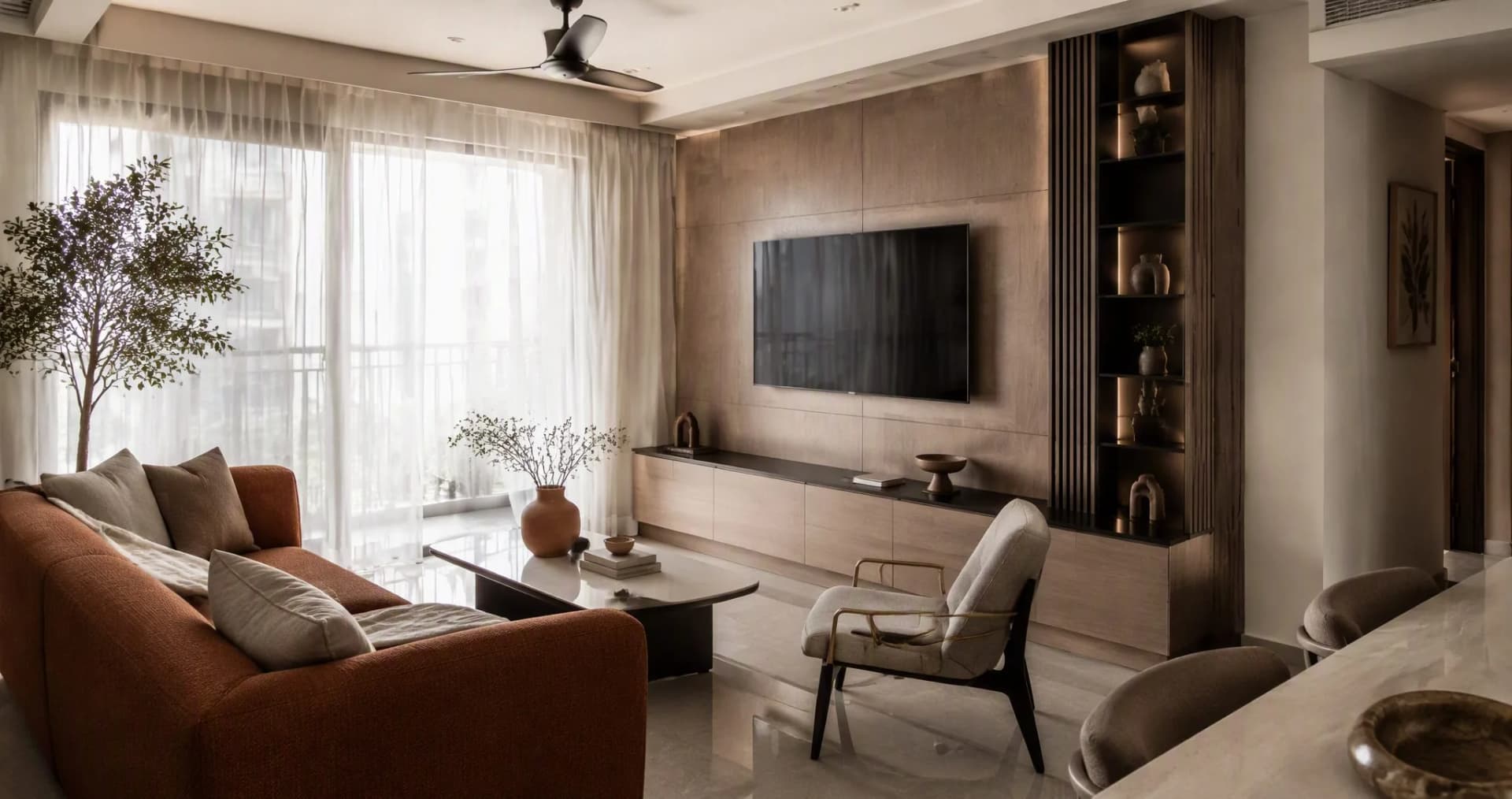
How to Select Durable Materials for Modern Home Interiors
Most interiors don't fail because of bad design — they fail because a ₹30-per-sheet saving on plywood, a 0.2 mm thinner laminate, or a ₹40 hinge gave way in year four. Here is the complete durability playbook: match materials to usage zones, get the base right, choose finishes that survive Indian cooking and climate, and never skimp on hardware.
The quick answer
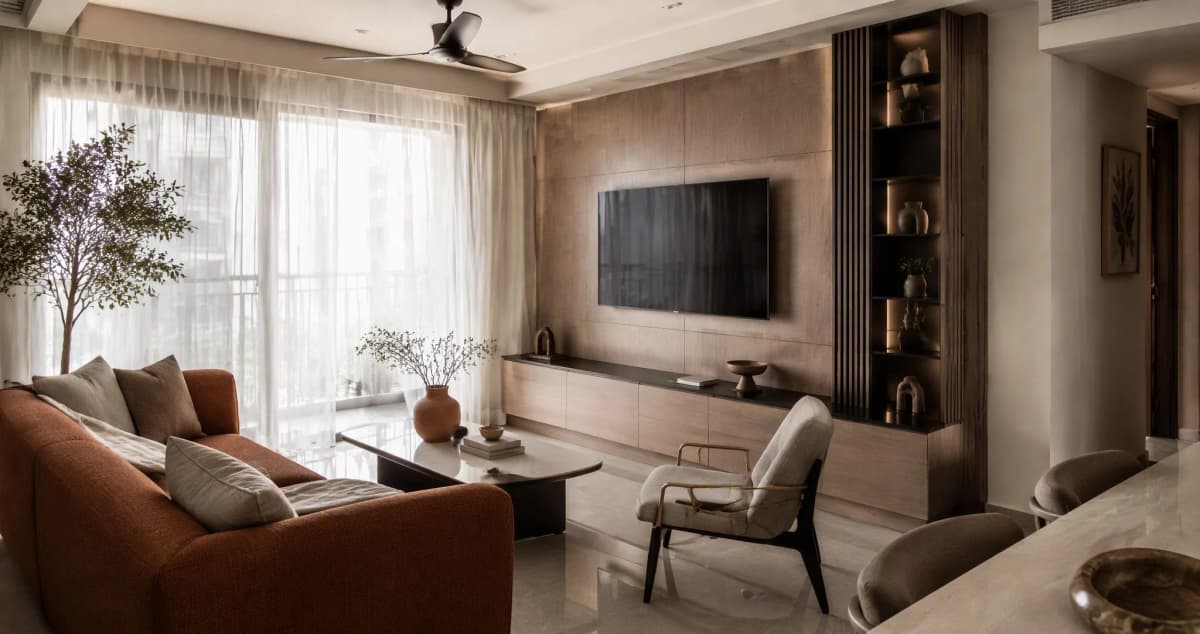
Durable interiors come from five decisions, in this order: (1) map every room into wet, heavy-use and dry zones before choosing anything; (2) buy the right plywood grade — BWR (IS 303) as default, BWP/marine (IS 710) for wet zones, MR only for dry furniture; (3) use 1 mm high-pressure laminate on working surfaces and engineered quartz or granite on counters; (4) specify branded hardware rated for 50,000+ cycles with written warranty; and (5) pick finishes your household will actually maintain. Follow these and a modern Indian interior should serve 15–20 years without a redo.
Section 01
Start with usage zones, not catalogues
The single biggest durability mistake Indian homeowners make is choosing materials room by room from a catalogue, instead of zone by zone from real life. The same kitchen contains a sink cabinet that faces standing water every day and an overhead loft that barely gets touched — they should not be built from the same board.
Before you look at a single shade card, walk through your floor plan and label every surface into one of three zones:
ZONE A
Wet & high-heat
Sink units, bathroom vanities, utility counters, the 60 cm band behind the hob, balcony-facing shutters. Water, steam and oil attack these daily.
ZONE B
Heavy daily use
Kitchen cabinets and drawers, wardrobe shutters, study tables, TV units, kids' rooms. Opened, leaned on and wiped down constantly.
ZONE C
Dry & low-touch
Lofts, headboards, wall panelling, bookshelves, display units in living and bedrooms. Mostly visual, rarely stressed.
This one exercise immediately shows where money matters and where it doesn't. Spending on BWP plywood for a bedroom loft is waste; saving with MR plywood under a kitchen sink is a ₹60,000 mistake waiting for the first pipe leak. If you are also planning finishes, our matte vs glossy laminate guide pairs well with this zoning exercise.
Rule of thumb
In a typical 2–3 BHK interior budget, only about 25–30% of the built area falls in Zone A and B combined. Concentrate your durability spend there, and you can comfortably economise on the rest without touching the home's lifespan.
Section 02
Base materials: where durability is actually decided
Nobody sees the inside of your cabinets — which is exactly why the base material is where corners get cut. But the hidden carcass determines whether shutters stay aligned, screws keep holding, and shelves don't sag. The laminate is the face; the board is the skeleton.
Understand plywood grades by their glue
Plywood durability in India comes down to the synthetic resin that bonds the veneers. The grade names on the sheet (MR, BWR, BWP) are really a statement about adhesive chemistry:
| Grade | BIS standard | Adhesive resin | Survives | Use for |
|---|---|---|---|---|
| MR (Moisture Resistant) | IS 303 | Urea-formaldehyde (UF) | Indoor humidity, occasional wipes — not water contact | Wardrobes, TV units, beds, dry panelling |
| BWR (Boiling Water Resistant) | IS 303 | Melamine-urea-formaldehyde (MUF) | Steam, splashes, humid coastal air, monsoon swings | Kitchen cabinets, dining, most heavy-use furniture |
| BWP / Marine (Boiling Water Proof) | IS 710 | Phenol-formaldehyde (PF) | Prolonged water exposure, 72-hour boiling test | Sink units, bathroom vanities, utility, semi-outdoor |
For most Indian homes, BWR is the sensible default for anything in Zone A or B, with BWP reserved for genuinely wet spots. Be sceptical of "100% waterproof ply" marketing at MR prices — genuine BWP costs meaningfully more because phenolic resin is expensive.
How to read a sheet in the shop
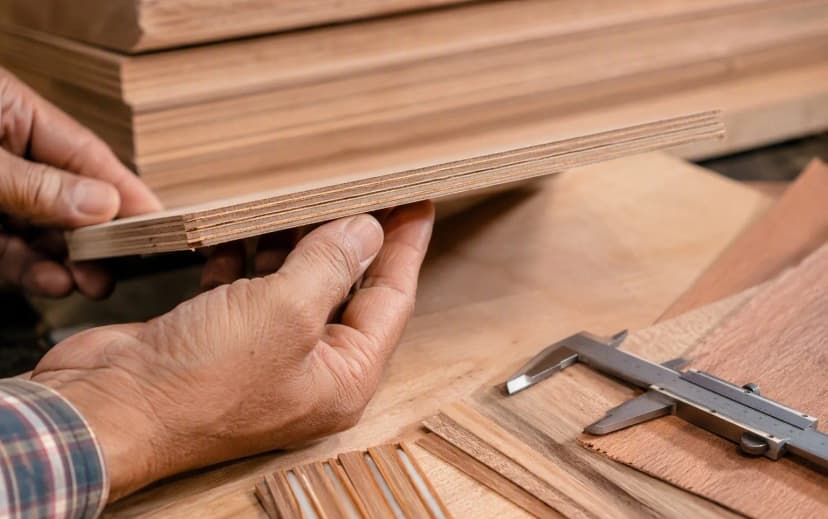
Whichever grade you buy, inspect the sheet edge before it leaves the shop:
- Core gaps: sight along the cut edge — voids and overlaps between core veneers become weak spots where screws lose grip and borers settle in.
- Thickness: a "19 mm" sheet should actually measure 19 mm with a caliper (±5% is the accepted tolerance); undersized sheets sag on shelves and feel tinny on shutters.
- Face quality: no patches, bubbles or waviness on the face veneer — these telegraph through even 1 mm laminate over time.
- Calibration: for factory-finish wardrobes and modular work, calibrated plywood (uniform thickness across the sheet) is worth the premium.
- Termite and borer treatment: in most of India this is non-negotiable — confirm the sheet carries a documented preservative treatment, not just a verbal assurance.
Where MDF and HDHMR fit
Engineered boards earn their place when used honestly. MDF is dimensionally stable and gives the smoothest painted and membrane finishes — excellent for Zone C shutters and decorative panels, but it swells irreversibly with water, so keep it out of kitchens and bathrooms. HDHMR (high-density high-moisture-resistant board) bridges the gap for shutter profiles in humid cities, though plywood still wins for load-bearing carcasses. Whatever the board, edge sealing decides its fate: laser or PUR edge-banding on all four edges is what keeps moisture out of the core.
Section 03
Surface finishes that survive daily life
The surface is what your hands, vessels, keys and turmeric-stained fingers meet every day. Durability here means three things: scratch resistance, stain resistance, and a bond that doesn't peel at the edges after five monsoons.
WORKING SURFACES
1 mm high-pressure laminate
The Indian interior workhorse for a reason: scratch-, stain- and heat-tolerant, hundreds of textures, wipes clean. Insist on 1 mm for kitchens, wardrobes and tables; 0.8 mm economy grade dents and chips visibly faster.
PREMIUM SHUTTERS
Acrylic & super-matte
Acrylic gives a mirror-deep finish; super-matte (anti-fingerprint) laminates hide smudges. Both look premium, but acrylic scratches show — keep it for adult-use kitchens and tall units, not kids' rooms.
COUNTERTOPS
Quartz & granite
For Indian cooking, these two outlast everything. Granite handles hot kadhais directly; quartz resists haldi and oil stains better. Skip marble (etches and stains) and solid-surface acrylic (scratches) in heavy kitchens.
WALLS & CEILINGS
Washable emulsion, done right
Paint durability is 70% preparation: quality putty, proper primer, then a washable interior emulsion. Dark accent walls in low-touch areas, washable mid-sheen in corridors and kids' rooms.
FLOORING
Vitrified & engineered stone
Full-body or double-charge vitrified tiles shrug off decades of footfall, furniture drags and wet mopping. Avoid soft natural stones like marble in high-traffic zones unless you accept patina as character.
USE WITH CARE
Veneer, PU & membrane
Beautiful but higher-maintenance: natural veneer needs periodic polishing, PU paint chips at corners, membrane wraps can peel near heat. Lovely in master bedrooms and living rooms; risky in rental or rough-use homes.
Two bonding details matter as much as the finish itself. First, adhesive: factory-pressed laminate (hot-pressed or membrane-pressed) outlasts hand-pasted work, especially on shutters that flex daily. Second, edge banding: 2 mm PVC or ABS edge band on all exposed edges — not just the visible front — is what stops monsoon humidity from creeping under the laminate. Our plywood vs laminate vs veneer comparison goes deeper on finish selection for humid climates.
Section 04
Hardware: the small parts that fail first
Ask any carpenter what breaks first in a five-year-old kitchen and the answer is never the plywood — it's the ₹40 hinge. Hardware is roughly 3–5% of an interior budget but causes most of the day-to-day failures: sagging shutters, grinding drawers, doors that won't stay shut. This is the worst possible place to economise.
The three questions that reveal hardware quality
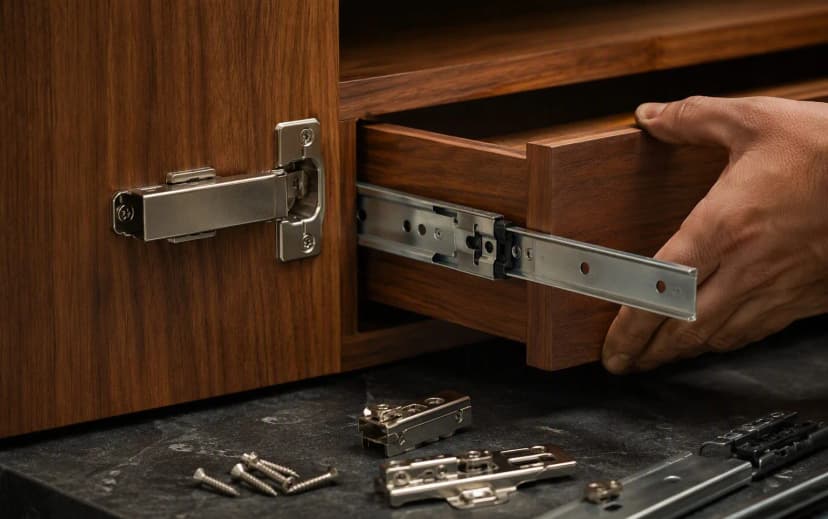
- Cycle rating: quality concealed hinges and drawer channels are tested to 50,000–200,000 open-close cycles. A kitchen shutter used 20 times a day crosses 7,000 cycles a year — unbranded hardware with no stated rating often starts failing around 10,000.
- Material grade: for kitchens and bathrooms, insist on 304-grade stainless steel or branded zinc-alloy mechanisms. Cheaper 202-grade steel and thin mild-steel fittings rust within two monsoons, especially in coastal cities.
- Written warranty: established brands back hinges and channels with 5–15 year warranties. A dealer who can't name the brand of the hardware in your quote is telling you something.
Physical checks work too: a good soft-close hinge engages smoothly and silently in the last 15–20 degrees, and a ball-bearing drawer channel should glide evenly with a 15–20 kg load without a metal-on-metal grind. Budget roughly ₹150–450 per quality hinge pair and ₹600–1,800 per soft-close tandem channel — the premium over local hardware across an entire 3BHK is usually under ₹25,000, and it is the best-value durability money in the whole project.
Section 05
Match materials to the maintenance you'll actually do
Durability isn't only what a material can survive — it's what your household will keep up. A silk-finish veneer in a home with toddlers and no time for polishing is a short-lived material, no matter what the brochure says. Be honest about your maintenance appetite and choose accordingly.
| If your household… | Choose | Avoid |
|---|---|---|
| Has kids, pets, or heavy daily cooking | 1 mm matte/textured laminates, quartz counters, vitrified floors, SS304 hardware | High-gloss acrylic at kid height, marble counters, unsealed veneer |
| Is a working couple, out all day | Super-matte anti-fingerprint finishes, closed storage over open shelves, dark-grout tiles | Open shelving everywhere, glass-front cabinets, light grout |
| Employs daily domestic help | Finishes that tolerate vigorous wiping — textured laminates, granite, full-body tiles | Delicate lacquers and French polish that scratch under rough cloths |
| Enjoys upkeep as a hobby | Natural veneer with PU polish, solid wood accents, lime-wash walls | — (you can live with anything) |
The universal low-maintenance kit for Indian homes is boringly consistent: laminates over polish, quartz or granite over marble, vitrified over soft stone, uPVC or powder-coated aluminium over painted mild steel, and closed cabinets over open display. None of this limits design — it just means the home looks the same in year eight as it did at handover. Our renovation materials checklist maps these choices room by room.
The two-minute weekly habit
Whatever you choose, one habit extends the life of every surface: a weekly wipe with a damp microfibre cloth and mild dish soap, dried immediately. It prevents the grease film that degrades laminate glue lines and the hard-water spotting that dulls quartz — and it costs nothing.
Section 06
Buy smart: verification beats brand names
The durability chain breaks at the point of purchase more often than anywhere else — a genuine brand name printed on a counterfeit sheet, an "ISI mark" that isn't registered, hardware swapped between quote and delivery. Two habits close this gap.
Verify every ISI mark. A genuine ISI-marked plywood sheet carries the IS number (IS 303 or IS 710) plus the manufacturer's CM/L licence number and the BIS logo. Check the licence free on the BIS Care app or bis.gov.in — it shows the licence holder's name and the exact products the licence covers. No CM/L number, or a licence belonging to a different manufacturer, means the mark is decoration, not certification.
Buy where verification is easy. Authorised dealers maintain batch traceability, issue proper GST invoices naming the brand and grade, and have a replacement policy in writing. That paper trail is your warranty — a cash-bill bargain sheet has no comeback when it delaminates. Our guide to evaluating material suppliers covers the ten questions professionals ask before trusting a store, and the Evospace studio follows the same playbook: authorised sourcing, on-site verification, and grade-specific recommendations per zone.
Finally, use expertise. A good interior designer or an experienced dealer has watched materials age across hundreds of homes — they know which "premium" finish peels near a west-facing window and which budget laminate outlasts its price tag. That pattern recognition is free if you ask for it, and it's worth more than any catalogue.
The durability checklist — screenshot before you buy
- Zoned the home: every surface labelled wet / heavy-use / dry before selecting materials
- Base grade matched: BWP for wet zones, BWR for kitchens and heavy use, MR only in dry zones
- ISI verified: CM/L licence number checked on the BIS Care app, brand name matches
- Sheet inspected: edge checked for core gaps, caliper-measured thickness, termite treatment confirmed
- 1 mm laminate on all working surfaces, edges banded on all four sides
- Countertop chosen for Indian cooking: granite or quartz, not marble or solid surface
- Hardware specified by brand: 50,000+ cycle rating, SS304 near water, written warranty collected
- Maintenance matched to household: no finish your family won't realistically care for
Section 07
Frequently asked questions
Which plywood grade is most durable for home interiors in India?
Is MDF durable enough for Indian homes?
What laminate thickness lasts longest?
How do I check if hardware is good quality before buying?
Which countertop is most durable for Indian cooking?
Do durable materials cost a lot more?
How can I verify that plywood is genuinely ISI marked?
What maintenance do laminate interiors actually need?
Build it once. Build it to last.
Evospace stocks ISI-verified plywood, 1 mm laminates, branded hardware and engineered stone — with zone-wise recommendations for your floor plan and proper GST invoicing on every sheet.
Visit the Evospace Studio




