
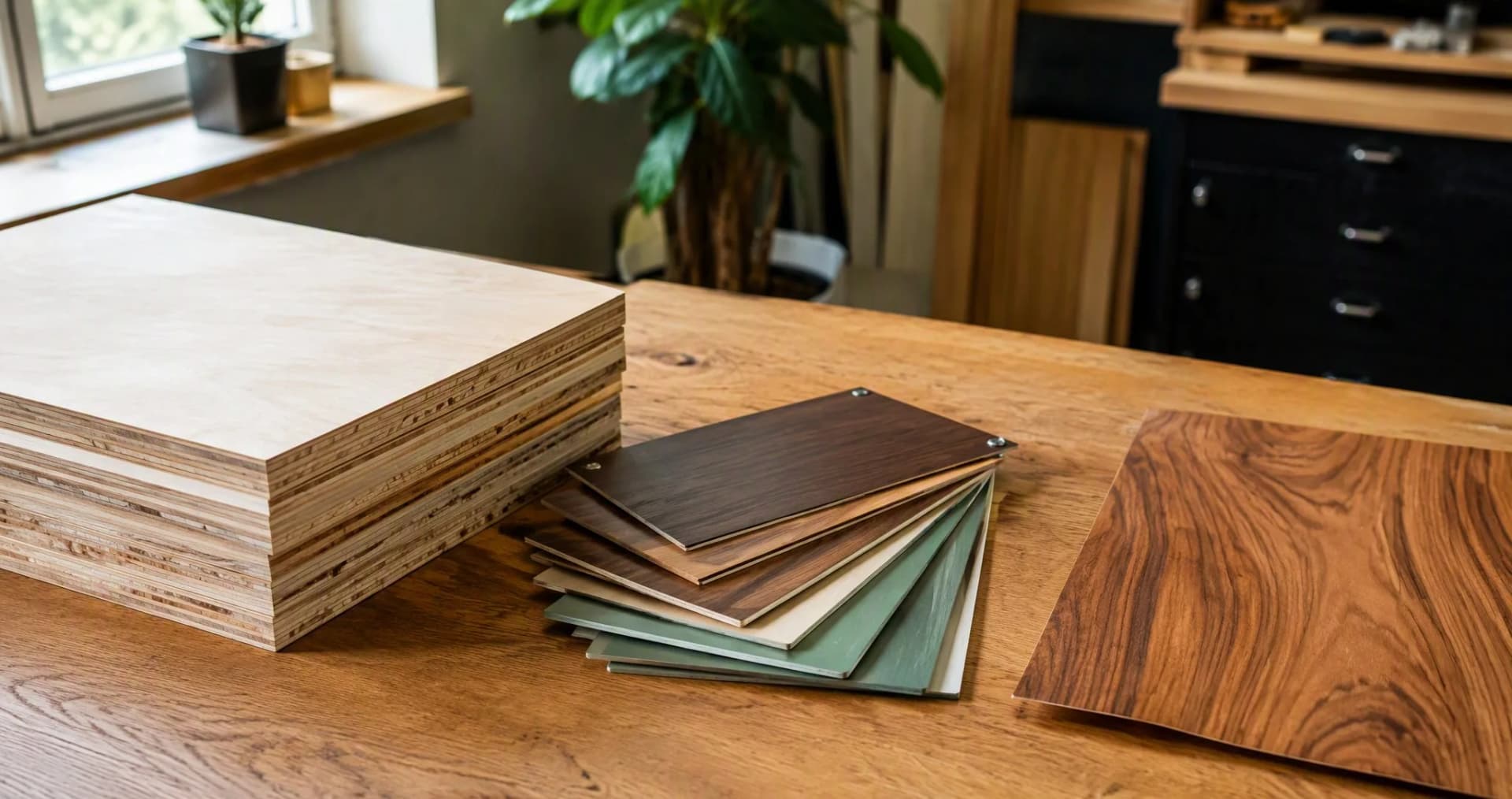
Plywood, Laminates or Veneers: Which Interior Material Is Best for Bangalore Homes?
Here's the secret the question hides: these three aren't competitors. Plywood builds the furniture, and laminate or veneer finishes it. Once you see the system, the right choice for every room in a Bangalore home becomes obvious.
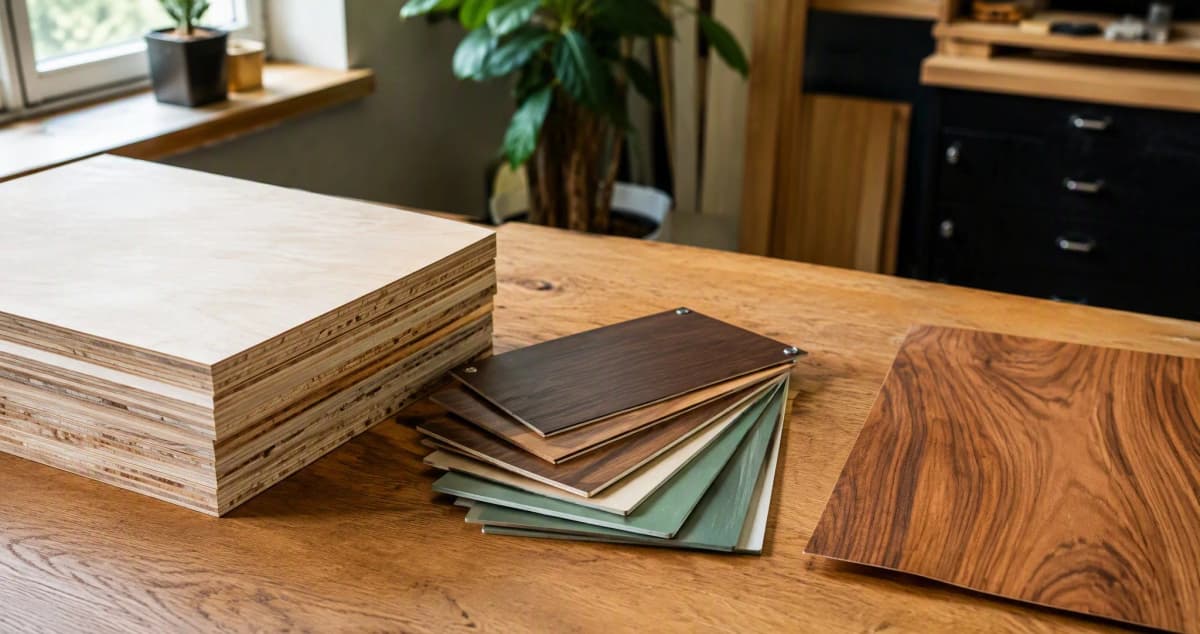
Plywood is not an option against laminates and veneers — it's the base both are glued onto. The real decision: calibrated plywood for every carcass (BWP in kitchens, BWR/MR elsewhere); laminate on every high-touch, moisture-prone surface — kitchens, wardrobes, kids' rooms, desks (₹120–₹350/sq ft installed); veneer on 10–20% of surfaces that deserve natural wood character — TV walls, headboard panels, dining tables (₹500–₹1,000+/sq ft with polish). In Bangalore's humid monsoons, keep veneer out of kitchens and bathrooms, sealed with melamine or PU polish, and away from direct sun.
Section 01 · The fundamentals
The three-layer system: who does what
Most confusion about these materials comes from treating them as rivals. They aren't. Every wardrobe, kitchen cabinet and TV unit in a modern Bangalore home is built as a sandwich: structure + surface + edge.
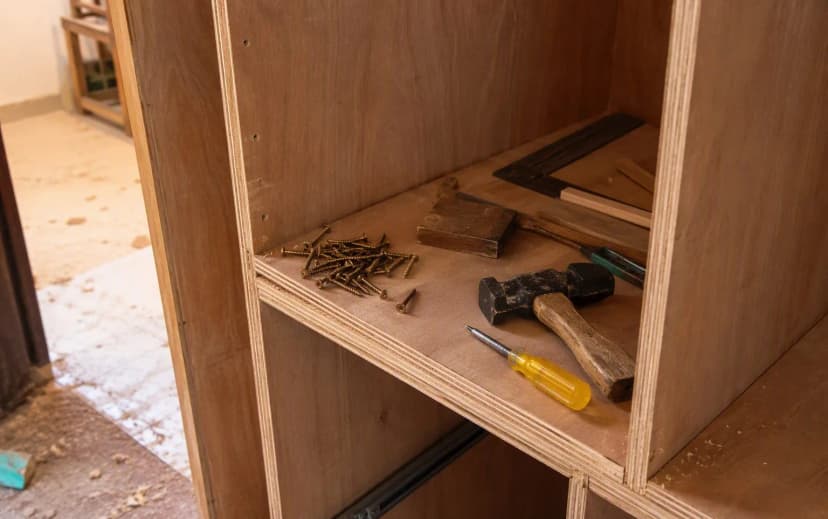
Plywood is the structure. Thin wood veneers (yes — the word is the same) are cross-glued in alternating grain directions to form a board that's strong, dimensionally stable, and holds screws for decades. It's the skeleton: carcasses, shelves, shutters, beds. You almost never see it — but it decides whether your furniture stands straight in year ten. Grade matters by zone: BWP (boiling-water-proof, IS 710) for kitchens and utility, BWR (IS 303) for humid-adjacent rooms, MR grade for dry bedrooms. Our plywood grades guide maps this in detail.
Laminate is the everyday surface. A 0.8–1 mm factory-made sheet — kraft paper, resin and a printed decorative layer fused under high pressure — pressed onto the plywood. It comes in thousands of colours and patterns (including convincing woodgrains), shrugs off scratches, stains, water and heat, and needs nothing but a damp cloth for 10–15 years. This is why it's the default finish for kitchens and wardrobes across India.
Veneer is the luxury surface. A 0.5 mm slice of real wood — teak, walnut, oak, rosewood — pressed onto plywood and then polished. No two sheets share the same grain; it looks, feels and ages like solid wood because it is wood. The price for that authenticity: it's porous, needs polishing at installation and re-polishing every 5–7 years, and dislikes water, heat and direct sun.
Section 02 · The real comparison
Laminate vs veneer: the honest head-to-head
Since plywood is a given, the actual choice is between these two finishes. Here's how they compare on the things that decide real households — not catalogue beauty, but life after installation.
| Factor | Laminate | Veneer | Edge |
|---|---|---|---|
| What it is | Printed decorative paper fused with resin under high pressure (HPL) | 0.5 mm slice of real wood, pressed on ply and polished | — |
| Look | Uniform, consistent; modern woodgrains are very convincing up close | Genuine grain, warmth and depth; every sheet unique | Veneer |
| Water & moisture | Sealed surface; shrugs off spills, steam, kitchen humidity | Porous; moisture can lift or discolour it unless well polished | Laminate |
| Scratches & stains | Highly resistant; oil, turmeric and crayon wipe off | Scratches and stains more easily; marks can become permanent | Laminate |
| Heat & sunlight | Tolerates kitchen heat and window sun well | Heat loosens adhesive; sun darkens or bleaches it unevenly | Laminate |
| Maintenance | Damp cloth. That's the entire routine, for 10–15 years | Polish at install (mandatory); re-polish every 5–7 years; coasters and care forever | Laminate |
| Repair | Cannot be repaired — a chipped sheet gets replaced | Can be sanded and re-polished back to new, repeatedly | Veneer |
| Lifespan | 10–15 years, then replace | 25–30 years if maintained; ages into character | Veneer* |
| Cost (installed) | ₹120–₹350 per sq ft | ₹500–₹1,000+ per sq ft including polish | Laminate |
*Veneer's longer lifespan is conditional — skip the re-polishing and laminate outlives it.
The pattern is clear: laminate wins on everything practical, veneer wins on everything emotional. Laminate is the rational choice for surfaces that work hard; veneer is the justified indulgence for surfaces that are meant to be admired. Almost no home should be all-veneer (cost and upkeep), and few need to be all-laminate (one veneer focal wall transforms a living room).
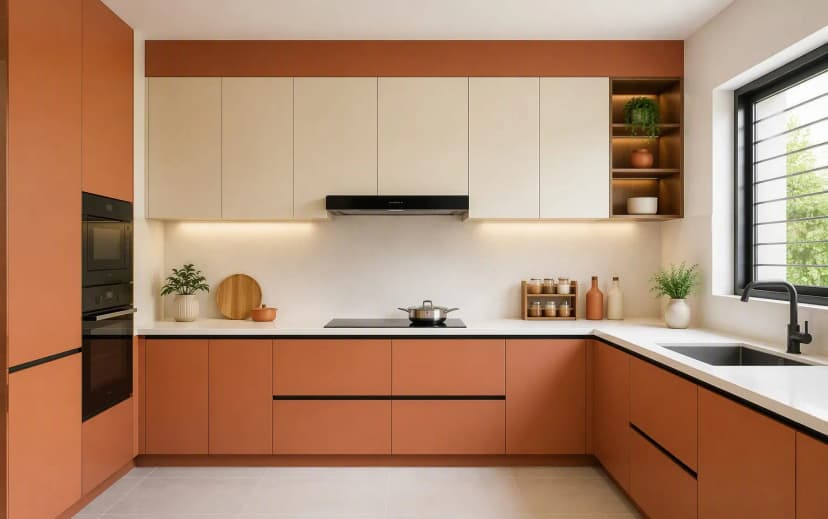
A word on where each one quietly fails. Laminate's weakness is the edge: if edge banding is thin or poorly glued, moisture creeps in at the shutter edge and the sheet lifts — always specify matched banding. Veneer's weakness is the polish: an unsealed or badly polished veneer in Bangalore's monsoon humidity will bubble within a couple of seasons. Both failures are workmanship failures, not material failures — which is why who presses and polishes matters as much as what you buy.
Section 03 · The money
What each costs in Bangalore
Veneer isn't expensive because of the sheet alone — the labour and mandatory polish multiply it. Here's the full picture, per square foot of finished surface.
| Component | Laminate route | Veneer route |
|---|---|---|
| Surface material | ₹1,000–₹3,200 per 8×4 sheet (₹30–₹100/sq ft) | ₹4,000–₹12,000+ per 8×4 sheet depending on species (₹125–₹375+/sq ft) |
| Application labour | Simple pressing — standard carpentry rates | Skilled pressing and grain matching — premium rates |
| Polish | Not needed | Mandatory: melamine ₹80–₹150/sq ft, PU ₹250–₹600/sq ft |
| All-in installed | ₹120–₹350 per sq ft | ₹500–₹1,000+ per sq ft |
| 10-year upkeep | Effectively zero | One re-polish cycle (₹80–₹600/sq ft) plus careful daily use |
Put numbers on a real project: a 3BHK with a kitchen, three wardrobes, TV unit and study has roughly 700–900 sq ft of finished surface. All-laminate: ₹1–3 lakh of finish cost. All-veneer: ₹4–8 lakh. The smart hybrid — veneer on about 15% of surfaces (TV wall, headboard, dining top), laminate everywhere else — lands around ₹1.5–3.5 lakh and looks more expensive than either extreme. The plywood underneath is common to all scenarios; check our Bangalore plywood price guide for board costs.
Section 04 · The spec sheet
Room by room: the spec sheet
Stop choosing per house; choose per surface. One criterion settles almost every decision: does this surface get touched, splashed or scrubbed daily? If yes — laminate. If it's meant to be looked at — veneer is allowed.
BWP ply + laminate
Oil, steam, water and daily scrubbing make this laminate's home turf — on a boiling-water-proof plywood carcass. Matte or textured finishes hide fingerprints best. Veneer has no business here: grease and moisture will punish it within a year.
Spec: 18mm BWP (IS 710) carcass · 1mm matte/textured laminate · matched edge banding
MR/BWR ply + laminate, veneer as accent
The most-touched surfaces in the house deserve laminate's forgiveness — textured woodgrains give warmth without upkeep. Where veneer earns its place: the headboard panel or a single wardrobe accent strip, polished and admired rather than handled.
Spec: 18mm MR/BWR carcass · laminate shutters · optional veneer headboard panel
Veneer's showcase
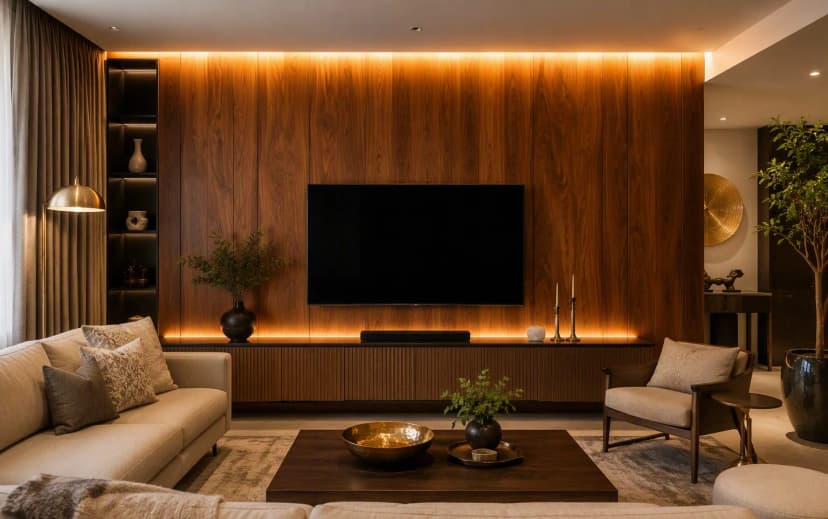
Low touch, dry air, evening light — this is where veneer's grain pays rent. A teak or walnut veneer TV panel or display wall, melamine- or PU-polished, becomes the room's anchor. Flanking storage stays laminate so the unit survives daily use.
Spec: veneer on panels away from windows · laminate on cabinets · PU polish for high-gloss grain depth
Laminate on top, veneer in view
Desk surfaces need laminate — pens, coffee, laptop heat and constant friction kill veneer fast. But a veneer backdrop shelf or wall behind the desk adds warmth to every video call. Work surface practical, backdrop beautiful.
Spec: laminate desktop · veneer or fluted panel backdrop · matte finishes to cut screen glare
Laminate, no debate
Crayons, stickers, toy impacts and sticky hands: laminate wipes clean from all of it. Veneer here converts every accident into a permanent mark. Spend the veneer budget elsewhere — kids won't grade you on grain authenticity.
Spec: laminate everywhere · rounded edge banding · dark or textured shades that hide wear
Veneer where hands are gentle
A polished veneer pooja unit or dining tabletop carries the natural warmth these spaces deserve. Guard the dining surface with a runner or glass top, keep diyas off raw veneer, and it will age beautifully for decades.
Spec: teak/rosewood veneer · melamine polish (matte) · PU polish where spills are likely
Section 05 · Local knowledge
Bangalore-specific advice
Bangalore's climate is kinder than Mumbai's or Chennai's — moderate temperatures, no coastal salt air. But two local realities shape material choices here.
The monsoon test (June–September). Four months of 70–85% relative humidity is where material shortcuts surface. On plywood, this is when cheap MR boards in kitchens swell and delaminate — the reason BWP in wet zones isn't optional. On veneer, humidity cycles cause expansion and contraction; unpolished or thin-polished veneer bubbles and lifts at edges. If you're installing during monsoon, let boards acclimatise indoors 48–72 hours before pressing, and don't polish veneer on heavy-rain weeks — moisture trapped under polish clouds the finish permanently. Our plywood care guide covers the seasonal routine.
The sunlight factor. Bangalore's high-altitude sun is strong year-round. Veneer on walls that catch direct afternoon sun will darken or bleach unevenly within a few years — keep veneer panels to interior walls or shade them with curtains. Dark glossy laminates show the city's fine dust constantly; matte and textured finishes are the low-effort answer for most homes here.
Section 06 · Before you buy
The pre-purchase checklist
Run through this before the material order goes in.
Plywood, laminate, veneer — final checks
- Layers separated: plywood grade decided per zone (BWP kitchen, BWR/MR elsewhere) before any finish discussion — structure first, surface second.
- Finish mapped per surface: laminate on everything touched, splashed or scrubbed daily; veneer only on low-touch focal surfaces.
- Veneer budget counted fully: sheet + skilled labour + polish + one re-polish in year 5–7 — not just the sheet price.
- Veneer placement checked: no veneer in kitchens, bathrooms, or walls with direct afternoon sun.
- Polish specified: melamine for a natural matte look, PU where water resistance and durability matter — written into the quote.
- Edge banding matched: laminate shutters specified with matched colour and thickness banding — the edge is where laminate fails first.
- Shade codes recorded: brand, collection and code for every laminate and veneer sheet in the invoice — essential for matching a replacement panel later.
- Board verified at delivery: ISI mark, brand stamp, thickness and flatness checked before the carpenter cuts — the thickness guide has the per-component schedule.
Section 07 · FAQ
Frequently asked questions
Is plywood better than laminate or veneer?
They're not alternatives — plywood is the structural core, while laminate and veneer are surface finishes glued onto it. Every well-built wardrobe or kitchen uses plywood plus a finish. The real question is which finish belongs on which surface, and that's decided by how much touching, splashing and sunlight the surface gets.
Which is better for Bangalore kitchens — laminate or veneer?
Laminate, clearly. Indian kitchens combine oil, turmeric, steam and daily scrubbing — laminate's sealed surface handles all of it for 10–15 years with just a damp cloth. Veneer is porous, needs periodic polishing and discolours with moisture and heat. Build the kitchen on BWP plywood and finish with laminate; save veneer for the living room.
Is veneer more expensive than laminate?
Yes — typically 2–3× once everything is counted. In Bangalore rates, laminate installs at roughly ₹120–₹350 per sq ft, while veneer runs ₹500–₹1,000+ per sq ft because the sheet costs more, application needs skilled labour, and melamine or PU polish (₹80–₹600/sq ft) is mandatory. Budget for a re-polish every 5–7 years too.
Can veneer survive Bangalore's humidity?
Yes, in dry interior zones, if properly sealed. Bangalore's monsoon humidity makes veneer expand and contract, so it must be polished (melamine or PU) and kept out of kitchens, bathrooms and direct sun. On bedroom and living-room walls in ventilated rooms, well-polished veneer performs beautifully for decades.
Which lasts longer — laminate or veneer?
It depends on maintenance. Laminate gives 10–15 maintenance-free years but can't be repaired — a damaged sheet gets replaced. Veneer can be sanded and re-polished repeatedly, lasting 25–30 years if maintained — but looks tired within a few years if neglected. Veneer is a long-term relationship; laminate is a dependable appliance.
What's the best combination for a full home?
Calibrated plywood throughout (BWP in kitchens/utility, BWR or MR elsewhere); laminate on all high-touch and moisture-prone surfaces; veneer on 10–20% of surfaces as focal points — TV wall, headboard panel, dining table, pooja unit. This hybrid costs a fraction of all-veneer and looks richer than all-laminate.
Can laminate really look like veneer?
Modern textured and synchronised-pore woodgrain laminates are remarkably convincing at normal viewing distance. The real differences: laminate patterns repeat while every veneer sheet is unique, veneer feels warmer and develops patina, and veneer can be re-polished. For most surfaces most people, good woodgrain laminate is the sensible substitute.
Do I still need plywood if I choose veneer?
Absolutely — veneer is a 0.5 mm decorative skin that cannot be used alone. It's always pressed onto a substrate, and calibrated plywood is the best one: it holds screws, stays flat and supports hinges for decades. MDF and particle board are cheaper substrates but sag under heavy shutters and swell in humidity. See our MDF vs plywood comparison for the full picture.
See the grain before you commit.
Plywood grades, laminate swatches and real veneer sheets — compared side by side under honest light, with straight answers on what belongs in your kitchen and what belongs on your TV wall.
Visit the Studio




