
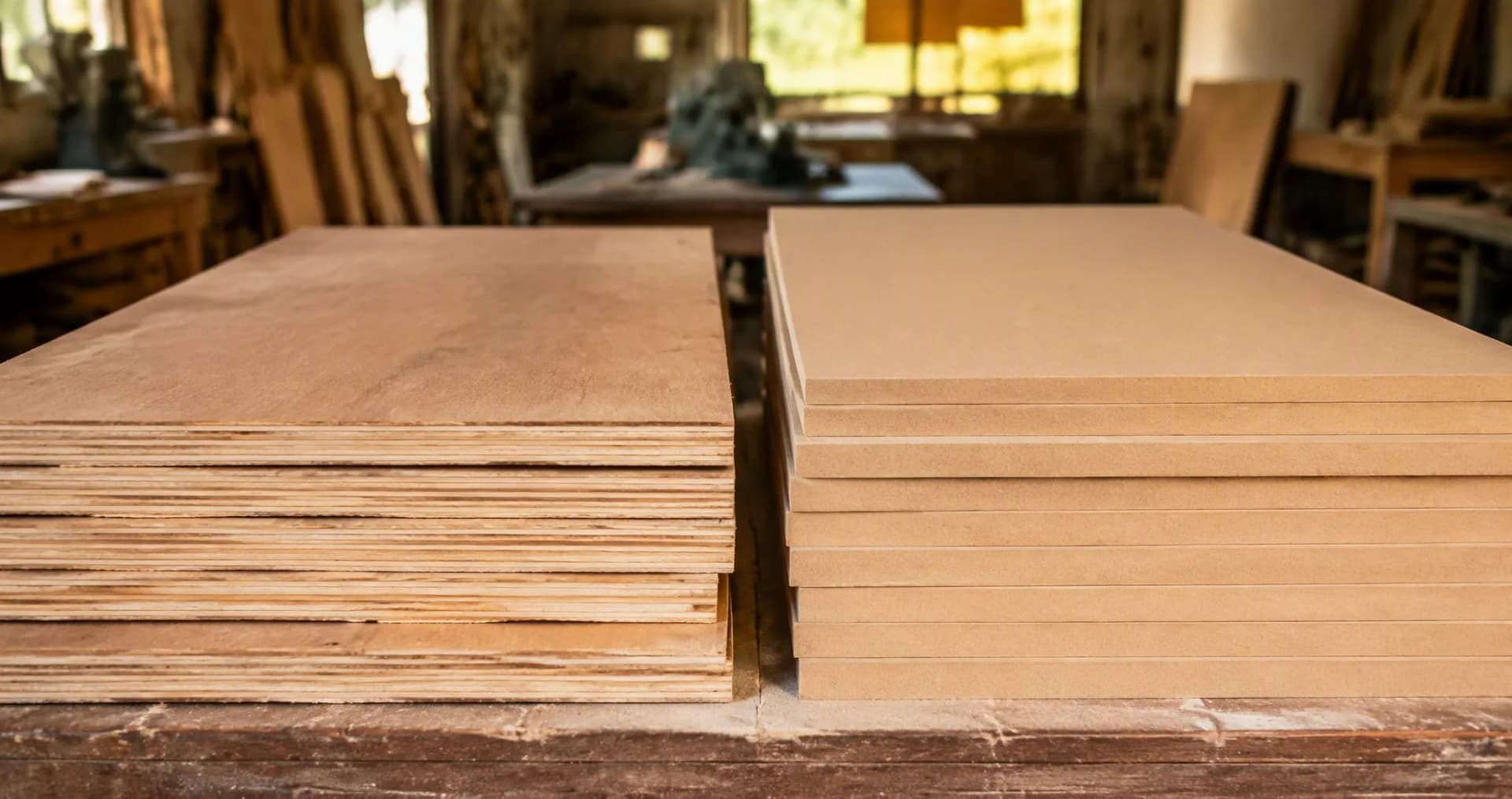
MDF vs Plywood for Furniture: An Honest Comparison for Indian Homes
Neither material "wins" — each owns specific jobs and fails at others. This guide compares them factor by factor, with Indian prices, the truth about HDHMR, and a room-by-room map so you spec each material only where it earns its place.
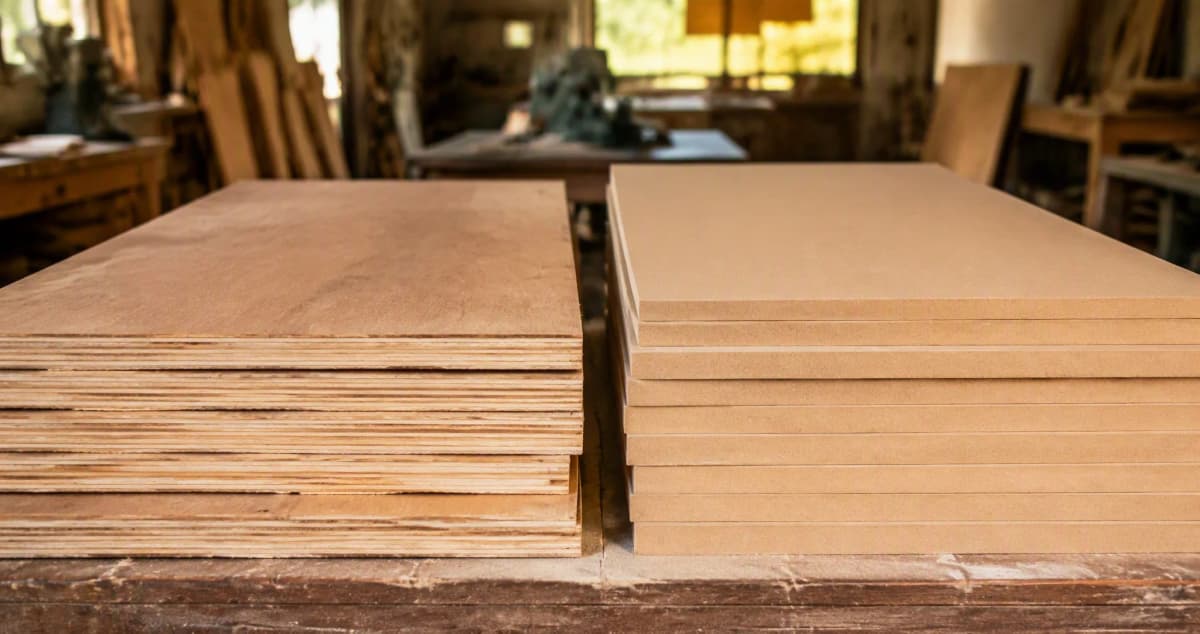
Plywood wins on strength, screw-holding, moisture resistance and lifespan — spec it for kitchen carcasses, wardrobes, beds and any wet or load-bearing furniture. MDF wins on surface smoothness, CNC routing and price (roughly 15–30% cheaper) — spec it for painted shutters, decorative panels and dry, low-load furniture. HDHMR is a tougher MDF, not a plywood substitute: fine for dry-zone shutters and panels, still wrong for kitchen base units and sink cabinets.
1. What Each Material Actually Is
Every behavioural difference between MDF and plywood traces back to how the board is built. Understand the construction and the comparison reads itself.
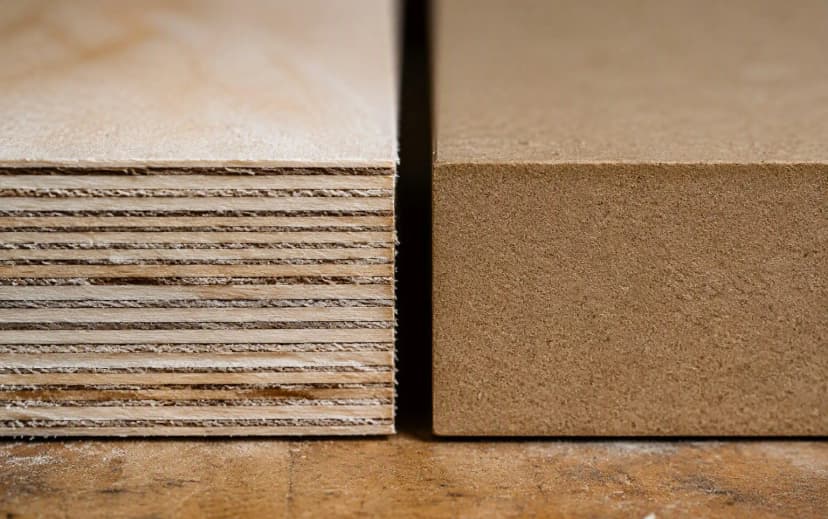
Wood residuals are broken into fine fibres, blended with resin and wax, and hot-pressed into a dense, perfectly uniform board. No grain, no layers, no voids.
- Glass-smooth surface — the best paint substrate in the industry
- Machines beautifully: CNC routing, carved profiles, clean edges
- Same density throughout — predictable, consistent
- But: porous cut edges, weak screw grip, swells irreversibly when wet
Thin veneers are stacked with grain directions alternating 90°, bonded under heat and pressure. The cross-grain structure is what gives plywood its strength.
- High load-bearing and bending resistance
- Excellent screw-holding on faces and edges
- Moisture grades from MR up to boiling-proof marine (IS 710)
- But: grain shows through paint, edges need banding, costs more
If you're deciding between plywood grades rather than between materials, start with our plywood grades guide or the guide to identifying high-quality plywood. This article stays on the bigger question: fibreboard or veneers?
2. Six Factors, Side by Side
Strength & load
Plywood's cross-grain layers distribute load across the full sheet; wardrobes, beds and long shelves stay flat for decades. MDF is dense but flexible — shelves over ~60 cm visibly bow under books, and the deflection is permanent. For anything structural or load-bearing, there is no contest.
Winner: Plywood. Wardrobes, beds, kitchen carcasses, study desks, any shelf longer than two feet.
Screw & hinge holding
Hinges, drawer channels and handles live or die by screw grip. Plywood holds screws firmly in face and edge, and tolerates removal and re-fitting. MDF grips moderately through the face and poorly at edges; repeated cycles loosen holes, which is why MDF cabinet doors start sagging at the hinges after a few years of daily use. Confirmat screws and pilot holes help — they don't close the gap.
Winner: Plywood. Anything with moving hardware: hinged shutters, drawer-heavy units, frequently adjusted shelves.
Moisture & the Indian monsoon
Standard MDF drinks water through its cut edges and swells 10–15% — permanently. Even MR-MDF and HDHMR are humidity-tolerant, not water-tolerant. Plywood scales with grade: MR handles dry interiors, BWR shrugs off kitchen steam and splashes, and BWP/marine survives direct water contact. In coastal cities and through the June–September monsoon, this factor decides most rooms on its own.
Winner: Plywood. Kitchens, bathrooms, utility areas, balcony furniture — and any ground-floor or coastal home.
Finish & design freedom
Here MDF is genuinely superior. Its grain-free surface takes PU paint, duco and membrane foil to a flawless factory finish that plywood — whose grain telegraphs through paint — simply can't match. MDF also routes cleanly into shaker profiles, fluted panels, jaali work and mandir-style carving; plywood splinters under the same cutter.
Winner: MDF. Painted shutters, CNC-cut jaali and decorative panels, fluted TV units, wall mouldings.
Weight & handling
MDF is noticeably heavier than plywood at the same thickness — an 18 mm MDF sheet outweighs its plywood equivalent by roughly 20–30%. For tall wall-mounted cabinets and large wardrobe shutters, that weight stresses both the installer and the wall fixings.
Winner: Plywood. Wall-hung units, tall shutters, large panelled installations.
Price & lifetime value
MDF costs 15–30% less per sheet than comparable plywood. But factor in lifespan — MDF in dry zones lasts 8–12 years, quality plywood 15–25 — and the per-year cost often favours plywood even before counting one swollen-edge repair.
Winner: Split. MDF for budget/decorative/short-horizon projects; plywood for anything you expect to outlive the paint.
3. HDHMR: The Middle Child, Explained Honestly
HDHMR (High Density High Moisture Resistant board) is MDF pressed denser with moisture-resistant resins. Marketing positions it as "better than plywood"; the honest reading is narrower:
- What it genuinely improves: hardness, edge definition for routing, humidity tolerance, and screw grip over standard MDF.
- What it doesn't change: it's still fibreboard. Submersion or standing water still destroys it; edge screw-holding still trails plywood; long shelves still sag.
- Where it belongs: painted or membrane-finish shutters, wardrobe side panels in dry rooms, decorative panels.
- Where it doesn't: kitchen base units, sink cabinets, bathroom vanities — vendors quoting "HDHMR kitchens" for base carcasses are selling a 5-year kitchen at a 15-year price.
The vendor trap: carcass material is the most over-charged hidden upgrade in Indian modular furniture — "premium MDF" sold at plywood prices, or commercial ply sold as BWP. Always ask for the material grade by name on the quotation; "engineered wood" is not a specification.
4. Prices in India, per sq ft (18 mm)
Prices vary by city, brand tier and GST treatment, but these market bands are a reliable negotiation baseline. When comparing quotes, fix thickness, sheet size, grade and tax basis first — a per-sheet quote and a per-sq-ft quote for different thicknesses are not comparable numbers.
| Material | Price / sq ft | 8×4 sheet (approx) | Realistic lifespan |
|---|---|---|---|
| Standard MDF | ₹45–65 | ₹2,200–3,000 | 5–8 yrs (dry zones only) |
| HDHMR / MR-MDF | ₹75–95 | ₹2,800–3,800 | 8–12 yrs (dry/semi-humid) |
| Pre-laminated MDF | add ₹20–35 | ₹3,400–4,800 | as base board |
| Commercial / MR plywood | ₹85–130 | ₹2,800–4,200 | 12–15 yrs |
| BWR plywood | ₹110–160 | ₹4,000–5,500 | 15–20 yrs |
| BWP / marine (IS 710) | ₹150–280 | ₹5,500–7,500+ | 20–25 yrs |
Worked example — a 10-ft kitchen: speccing BWP plywood carcasses over MDF adds roughly ₹25,000–40,000 to a typical modular kitchen. Spread over a 15+ year lifespan versus a 3–5 year failure cycle for MDF base units in wet zones, it is consistently the best money in the entire project. In dry bedrooms the calculus reverses: an HDHMR wardrobe saves ₹15,000–25,000 over BWR ply and, in an AC room, will likely outlast your taste in shutter colours.
5. Room-by-Room Selection Map
| Unit / zone | Spec | Why |
|---|---|---|
| Kitchen base units + sink cabinet | BWP plywood (IS 710) | Mopping water, splashes, steam; MDF fails here in 3–5 years |
| Kitchen wall units | BWR plywood; HDHMR acceptable | Steam and humidity without direct water contact |
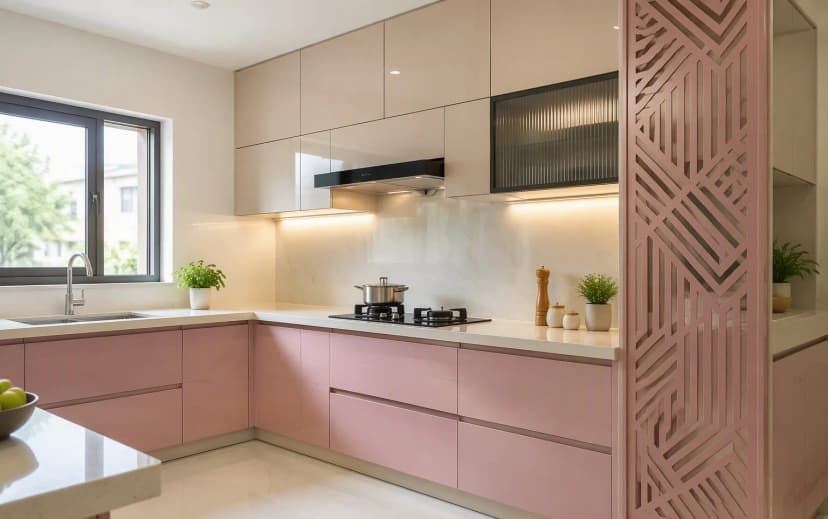
| Painted / membrane shutters | MDF / HDHMR | Grain-free surface = flawless PU, duco and membrane finishes |
| Wardrobe carcass + shelves | BWR/MR plywood | Load, hinges, daily cycles; shelves don't sag |
| Wardrobe in AC bedroom (budget) | HDHMR viable | Controlled humidity removes MDF's main weakness |
| Bathroom vanity | BWP plywood only | Direct humidity and splash; no fibreboard belongs here |
| TV unit / display / panelling | MDF or HDHMR | Low load, dry zone, routed profiles look premium |
| Jaali / CNC / mandir panels | MDF / HDHMR | Plywood splinters; MDF routes cleanly |
| Beds & study desks | Plywood (BWR) | Structural loads and years of hardware stress |
| Rental / short-horizon furniture | MDF / pre-lam board | Cheapest path to a finished look you'll redo anyway |
6. Where Each Material Gets Mis-Sold
- "MDF kitchen, premium finish": beautiful for three years, then swollen sink-unit edges and sagging hinge plates. If a quote doesn't name BWR/BWP for the carcass, ask why.
- "HDHMR is better than plywood": better than standard MDF, yes. It is still fibreboard — don't pay plywood prices for it, and don't put it under a sink.
- "Plywood everything, to be safe": over-spec costs real money. Painted shutters and routed panels are objectively better in MDF; a veneer-grain telegraphing through your pastel PU paint is a visible defect, not a virtue.
- Unsealed MDF edges: if you do spec MDF, every cut edge must get laminate, banding or primer — an unsealed edge is a sponge aimed at your floor-mopping water.
- Grade-free quotes: "engineered wood" or "premium board" on a quotation hides the actual material. Name the grade, get it on the invoice.
The MDF-or-Plywood Decision Checklist
- Wet or humid zone? Kitchen base, sink, bathroom, balcony → plywood (BWP/BWR), no debate.
- Moving hardware? Hinged shutters and drawers in daily use → plywood carcass, whatever the shutter face is.
- Long unsupported shelves? Over ~60 cm under books → plywood, or add a front apron.
- Painted or membrane finish? MDF/HDHMR shutters give the flawless surface paint needs.
- CNC routing, jaali, carving? MDF machines cleanly; plywood splinters.
- Wall-hung and heavy? Plywood's lower weight is kinder to fixings and installers.
- Rental or 5-year horizon? MDF/pre-lam saves money where lifespan isn't the constraint.
- Quote names the grade? BWP/BWR/MR/HDHMR/MDF on paper, or it didn't happen.
Frequently Asked Questions
Is MDF or plywood better for kitchen cabinets in India?
Plywood — specifically BWP for base units and sink cabinets, BWR for wall units. Kitchens combine steam, splashes and daily floor mopping, and standard MDF base units typically fail within 3–5 years as edges swell irreversibly. MDF and HDHMR still have a place in the kitchen: as painted or membrane-finish shutters, where their grain-free surface produces a better finish than plywood.
Is HDHMR better than plywood?
No — HDHMR is a denser, more humidity-resistant MDF, not a plywood substitute. It improves on standard MDF's hardness, routing quality and humidity tolerance, making it excellent for painted shutters and dry-zone panels. But it remains fibreboard: standing water destroys it, edge screw-holding trails plywood, and long shelves sag. Kitchen base units and bathroom vanities still need BWP plywood.
Which is cheaper — MDF or plywood —?
MDF runs roughly 15–30% cheaper. Indicative 18 mm prices: standard MDF ₹45–65 per sq ft and HDHMR ₹75–95, versus MR/commercial plywood at ₹85–130, BWR at ₹110–160 and BWP marine at ₹150–280. The saving is real, but weigh it against lifespan: plywood lasts 15–25 years versus 5–12 for fibreboard, and one moisture failure erases the difference.
Why does MDF swell, and can it be fixed?
Cut edges expose MDF's porous fibre structure, which absorbs water and expands 10–15% — and the swelling is permanent because the compressed fibres don't return to shape. Prevention is the only cure: seal every cut edge with laminate, edge banding or solvent-based primer before the board sees humidity. Once an edge has swollen, the only real fix is replacement.
Which material is better for wardrobes?
For the carcass and shelves, plywood: it holds hinges through years of daily cycles and shelves don't sag under clothes. For the shutters, it depends on finish — laminate-finished shutters can be plywood, but painted or membrane-finish shutters come out better on MDF/HDHMR. In air-conditioned bedrooms with controlled humidity, a full HDHMR wardrobe is a legitimate budget option.
Can MDF be used in bathrooms?
Standard MDF should never be used in a bathroom. Even HDHMR and moisture-resistant MDF are humidity-tolerant, not water-tolerant, and Indian bathrooms combine high humidity with splash and often poor ventilation. For vanities and bathroom storage, BWP/marine plywood (IS 710) raised on legs with sealed edges is the reliable specification.
Which holds screws and hinges better?
Plywood, decisively. Its cross-laminated veneers grip screws on faces and edges, and tolerate removal and re-fitting. MDF grips moderately through the face but poorly at edges, and repeated open-close cycles loosen hinge screws — the reason MDF cabinet doors sag at the hinges after a few years. Confirmat screws, pilot holes and glue improve MDF joints but don't close the gap.
Is MDF safe for health — what about formaldehyde?
MDF is made with urea-formaldehyde resin and emits more formaldehyde than most plywood, which matters in closed bedrooms. Choose boards rated E1 as a minimum and E0 where available, seal all surfaces and edges, and ensure ventilation after installation. When cutting MDF on site, the fine dust also demands extraction and a respirator — a real consideration for carpenter-led projects.
Not sure which material your project needs?
Share your floor plan and unit list — we'll spec the right material for every cabinet, shutter and shelf, so you pay for performance only where it matters.
Get a Free Material Consultation




