
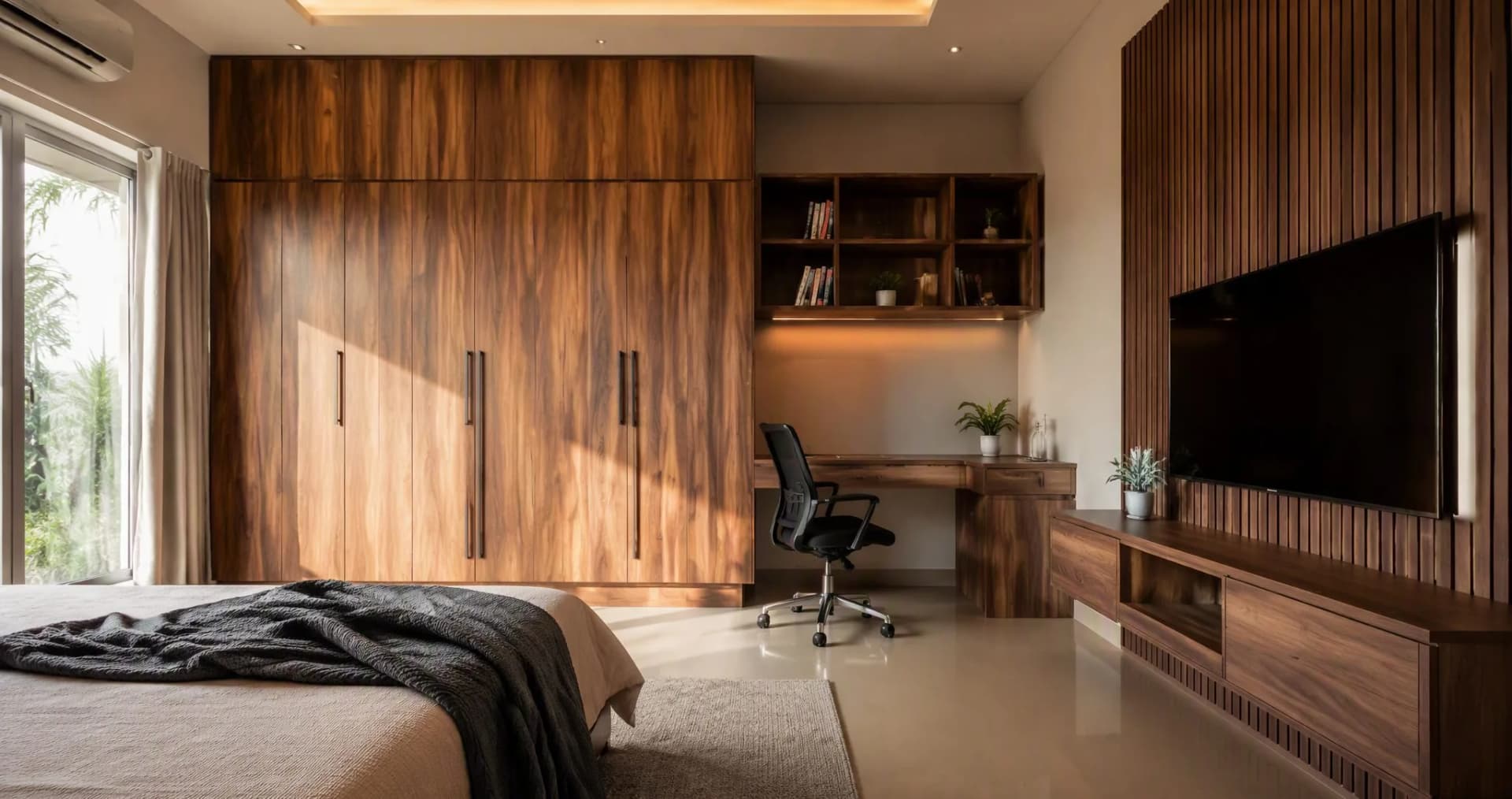
Why Plywood Is Preferred for Modern Home Interiors
Open any wardrobe, kitchen cabinet or TV unit in a modern Indian home and you are almost certainly looking at plywood. That dominance is not fashion — it is engineering. Here is why cross-grain construction beat solid wood and every fibreboard, and the honest list of where plywood is still the wrong answer.
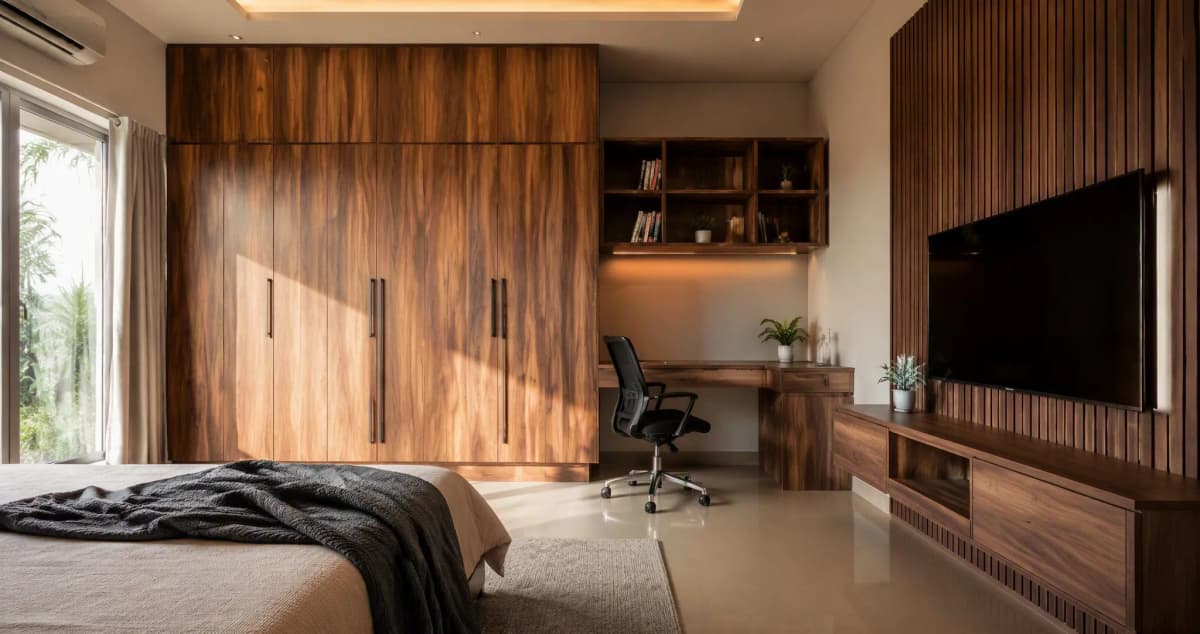
Plywood is thin wood veneers glued in cross-grain layers — each layer restrains the next, so the board is strong in both directions, holds screws for decades, and stays flat through India's 20–90% humidity swings where solid wood warps. It carries BWR and BWP moisture grades no fibreboard can match, takes every finish from laminate to veneer, and lasts 15–25 years — as long as solid wood at roughly half the price. The honest exceptions: painted or CNC-routed shutter faces (MDF), dry decorative panels (particle board), and heirloom furniture (solid wood).
1. The engineering: what cross-grain actually does
Solid wood is strong along the grain and weak across it — it splits with the grain, and it swells and shrinks unevenly as humidity changes. Plywood fixes this with one idea: peel the wood into thin veneers and glue them back together with each layer's grain rotated 90° to the one below, in an odd number of layers.
That single decision produces four properties no competing board fully matches:
- Strength in both directions. Load is distributed across the whole panel, so an 18 mm ply shelf carries what a much thicker MDF shelf cannot — and doesn't develop the permanent bow that particle board shows within a few years.
- Dimensional stability. Each layer restrains its neighbour from swelling or shrinking in any single direction. Across Indian humidity swings — roughly 20% RH in a dry winter to 90% in a coastal monsoon — solid wood cups and splits while plywood barely moves.
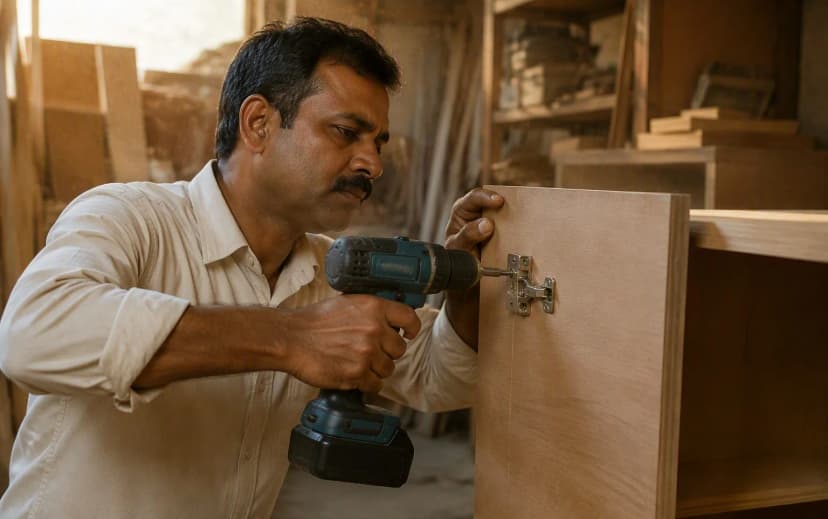
- Screw-holding. A screw driven into ply bites into multiple alternating grain directions. This is the quiet reason hinges stay tight for fifteen years in a plywood wardrobe and loosen in three in a particle-board one.
- Repairability. A damaged plywood edge or corner can be filled, sanded and refinished. A swollen fibreboard corner is powder — the furniture equivalent of a write-off.
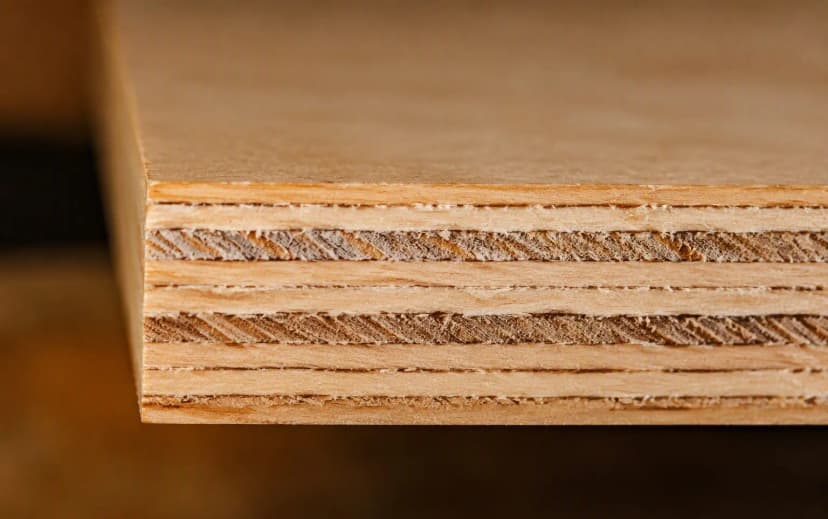
This is also why plywood defeated solid wood in the market, not just in the lab. Sheets come in seamless 8×4 ft panels — a full wardrobe side in one piece, no joints. Plantation species (eucalyptus, poplar, gurjan) are peeled rather than sawn, wasting less timber and costing 40–60% less per square foot than equivalent solid wood. And every sheet performs like the last one — no hidden knots, no weak grain. The plywood types guide covers the variants this construction is sold in.
2. The seven reasons plywood became the default
Strength where furniture actually fails
Furniture fails at three points: shelves that bow, hinges that loosen, corners that crumble. Plywood's layered construction resists all three. It is the only common board where a carpenter will confidently hang a 20 kg shutter on two hinges — and still find those hinges tight a decade later.
Screw-holding: the invisible foundation of modern hardware
Modern furniture is a hardware system — soft-close hinges, telescopic channels, lift-up mechanisms — screwed into a board. Every one of those fittings is only as good as the material it bites into. Plywood's alternating grain gives screws grip in every direction; fibreboards give them fibres to crumble. This is why the same branded hinge lasts its rated 50,000–80,000 cycles in plywood and fails early in particle board.
Moisture grades that fibreboards can't match
Plywood is the only common board family with a tested, standardised moisture ladder: MR (humidity only), BWR (steam and splash, IS 303) and BWP (72-hour boiling-water proof, IS 710). Kitchens, bathrooms and utility areas are survivable territory for BWP — for MDF and particle board they are a countdown. The BWR vs BWP guide maps the grades; the waterproof plywood guide explains why wet zones demand them.
Takes every finish cleanly
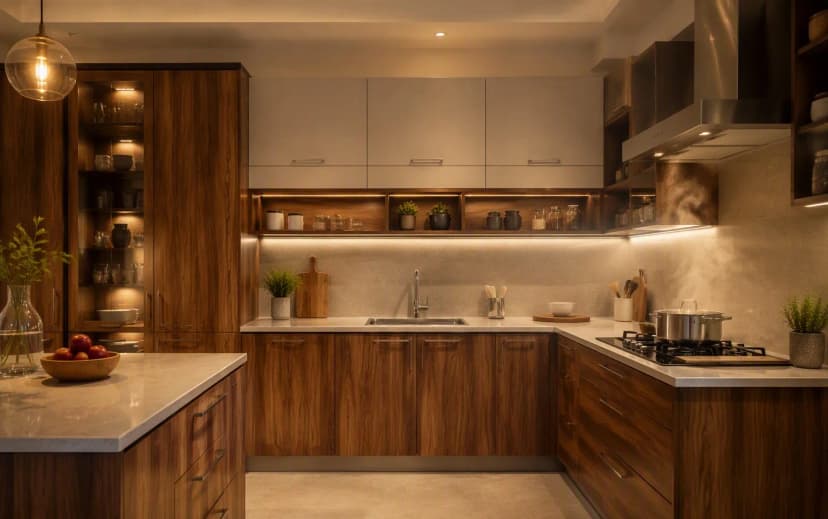
Laminate, veneer, membrane, PU, duco, acrylic-on-ply — plywood's stable, sandable face accepts them all, and its rigidity keeps wide laminated panels flat and true. One substrate, every design language from matte minimal to polished traditional.
15–25 year lifespan at half the price of solid wood
A well-built plywood wardrobe or kitchen carcass routinely crosses 15–25 years — the same bracket as solid wood — at 40–60% lower material cost, with none of solid wood's warping risk. Over the life of a home, that is the best cost-per-year of any common furniture board. The durability guide breaks down the mechanics.
One material, whole-home consistency
Wardrobe carcass, kitchen cabinets, bed base, TV unit, study desk, loft storage, panelling — plywood does them all, in grades matched to each zone. That means one supplier, one invoice trail, one set of quality checks, and furniture that ages at the same pace throughout the house.
Carpenter-friendly and available everywhere
Plywood needs no special tooling — every carpenter in India knows how to cut, edge and fix it — and every town has dealers stocking it. When something needs repair or modification ten years later, that ubiquity is worth more than it sounds. Try finding someone to rebuild a proprietary flat-pack fitting; any carpenter can rebuild a plywood cabinet.
3. Plywood vs solid wood vs MDF vs particle board
The honest comparison, property by property — including the rows plywood loses:
| Property | Plywood | Solid wood | MDF | Particle board |
|---|---|---|---|---|
| Structural strength | Excellent | Excellent | Moderate | Low |
| Screw-holding | Excellent | Excellent | Moderate (edges split) | Weak |
| Warping / shrinking | Minimal | High risk | Low, but swells wet | Swells wet, sags loaded |
| Moisture resistance | Good–excellent by grade (BWR/BWP) | Poor without finishing | Poor (MR variants exist) | Poor |
| Large seamless panels | Yes — 8×4 ft standard | No — glued joints | Yes | Yes |
| Paint / CNC-routed faces | Grain telegraphs | Good | Excellent | Poor |
| Typical interior lifespan | 15–25 years | 20+ years | 8–12 years | 5–8 years |
| Relative cost | Medium–high | Highest | Low–medium | Lowest |
| Repairability | Repairable | Fully repairable, sandable | Limited | Almost none |
Read the table by column and the pattern is clear: solid wood is the heirloom-and-repair play with a humidity problem and a price tag; MDF is the finish specialist; particle board is the budget filler; plywood is the structural all-rounder — which is exactly the job description of a carcass. The MDF vs plywood comparison goes factor by factor if that specific decision is live in your project.
4. Where plywood does the work in a modern home
- Kitchen carcasses: BWP at the sink and base units, BWR in wall units — the highest-stress, highest-moisture zone in the house. The modular kitchen guide specs this zone by zone.
- Wardrobes: BWR or good MR carcasses that hold shelves, hanging rails and 15 years of daily shutter slams without a sag.
- Beds and storage boxes: dynamic loads — people, not plates — demand the board with the best screw-holding and impact resistance.
- TV units, studies, bookshelves: long spans and point loads from equipment and book stacks.
- Bathroom vanities and utility units: BWP territory, full stop — the only common board rated for it.
- Panelling and lofts: lighter grades (MR/commercial) where the load is low and the air is dry.
5. Where plywood is the wrong answer
A guide that claims one material wins everywhere is a sales brochure. Plywood has real limits, and knowing them is part of using it well:
High-gloss painted and CNC-routed shutter faces
Plywood's face veneer has grain, and grain telegraphs through paint — a glass-smooth PU or duco finish on ply shows texture within months. MDF's fibre surface is what painted shutters and routed profiles want. This is why premium kitchens pair a ply carcass with MDF/HDHMR shutters: each material in its correct role.
Dry, decorative, budget-bound work
Wall panelling, display backs, light partitions in dry rooms — pre-laminated particle board does these jobs at a fraction of the price, and the failure modes that make particle board risky (moisture, load, screws) don't apply. Spending BWR money here is specification theatre.
Heirloom furniture and exposed frames
A dining table you want to re-polish in 2045, a chair that gets dragged across floors daily, a carved headboard — solid wood's sandability, joinery strength and character are worth its price and its humidity management. Plywood is the body of a modern home; solid wood is its jewellery.
Unsealed edges anywhere wet
BWP grade is not magic. A raw cut edge on a marine ply sheet still drinks water, swells and delaminates. Grade plus machine edge banding plus sealed cut-outs is the system; the board alone is only two-thirds of it.
The rule that resolves all of it: Match the board to the job, not the project to the board. Plywood for anything structural, wet or screw-loaded; MDF/HDHMR for painted and routed faces; particle board for dry decorative fill; solid wood for frames, legs and heirlooms. No single board wins every job — the craft is in the matching.
The plywood decision rules
- Default to plywood for the carcass of anything that carries load, holds hardware or meets moisture
- Match the grade to the zone: BWP where water stands, BWR where steam lives, MR only in dry rooms
- 18 mm for structure, 6 mm for backs, 25 mm for long shelves — thickness is a spec, not a suggestion
- Verify before it's cut: ISI mark, CM/L on the BIS portal, ply count on the edge, weight in the hand
- Seal every cut edge with machine edge banding — the grade means nothing at a raw edge
- Use fibreboards deliberately: MDF/HDHMR for painted shutter faces, particle board for dry decorative work — never for carcasses
- Get brand, grade, IS number and thickness on the invoice — "marine-type" is not a grade
The shop-floor verification routine for every rule above lives in our plywood quality field guide and the buying mistakes guide; the grades explainer decodes MR, BWR and BWP if the labels are still fuzzy.
Frequently asked questions
Why is plywood preferred over solid wood for Indian interiors?
Solid wood moves with humidity — it cups, warps and splits across Indian seasons — and wide panels are expensive and joint-prone. Plywood's cross-grain veneers restrain each other, so it stays flat in 20–90% humidity, comes in seamless 8×4 ft sheets, costs 40–60% less, and wastes less in fabrication. Solid wood still wins for legs, frames and heirloom pieces.
Why is plywood better than MDF or particle board for furniture?
Structure. Cross-laminated veneers give plywood the best screw-holding, load-bearing and impact resistance of any engineered board, plus moisture behaviour in BWR/BWP grades that fibreboards can't match. MDF and particle board last 5–12 years versus plywood's 15–25. MDF still wins for painted and CNC-routed shutter faces — that's its one home ground.
What makes plywood so strong?
Cross-grain construction: thin veneers glued in odd layers with each layer's grain rotated 90° to the one below. Solid wood is strong along the grain and weak across it; plywood spreads strength in both directions, and each layer restrains the next from swelling or shrinking. That's why an 18 mm ply shelf carries a load a much thicker MDF shelf cannot.
Which plywood grade should I use for a modular kitchen?
BWP (marine, IS 710) for the sink unit and base cabinets — it survives standing water and a 72-hour boiling test. BWR (IS 303) for wall units and dry tall units. Never MR (commercial) ply anywhere in a kitchen — it is moisture-resistant, not water-resistant, and the sink cabinet will find that out for you.
How long does plywood furniture last?
In Indian conditions, good-grade plywood furniture lasts 15–25 years with sealed edges and decent hardware — comparable to solid wood at roughly half the price. Failures are almost never the ply itself but the finish, the edge sealing, or hardware screwed into a downgraded core. Grade selection is the single biggest lifespan factor.
Is plywood waterproof?
Only one grade truly is: BWP/marine (IS 710), which passes a 72-hour boiling-water test. BWR resists steam, humidity and splashes; MR resists ambient humidity only. And no grade is waterproof at a raw, unsealed cut edge — which is why machine edge banding matters as much as the stamp on the sheet.
Where should I not use plywood?
Not for high-gloss painted or CNC-routed shutter faces (grain telegraphs through paint — use MDF/HDHMR), not needed for dry decorative panels (particle board is cheaper), and not the answer for exposed heirloom furniture (solid wood's repairability and character win). Match the board to the job.
How do I make sure I'm getting good plywood?
Verify the ISI mark and CM/L licence number on manakonline.in or the BIS Care app; count 11–13 void-free plies on the edge; tap for a uniform solid sound; an 18 mm hardwood BWP sheet should feel 40–55 kg; and get brand, grade, IS number and thickness on a GST invoice. A dealer who discourages checking is telling you something.
Choosing ply for a project right now?
Bring us your material list or your carpenter's quote — we'll tell you which sheets deserve BWP money, which don't, and what each grade should cost in your city.
Get a free material consultation




