8 Common Mistakes to Avoid When Buying Plywood in India
Most Indian homeowners spend more time choosing a laminate shade than the plywood beneath it — and that's exactly how kitchens delaminate, wardrobes sag and hinges give way within five years. Here are the eight mistakes that ruin interiors, and the simple shop-floor tests that catch them before you pay.
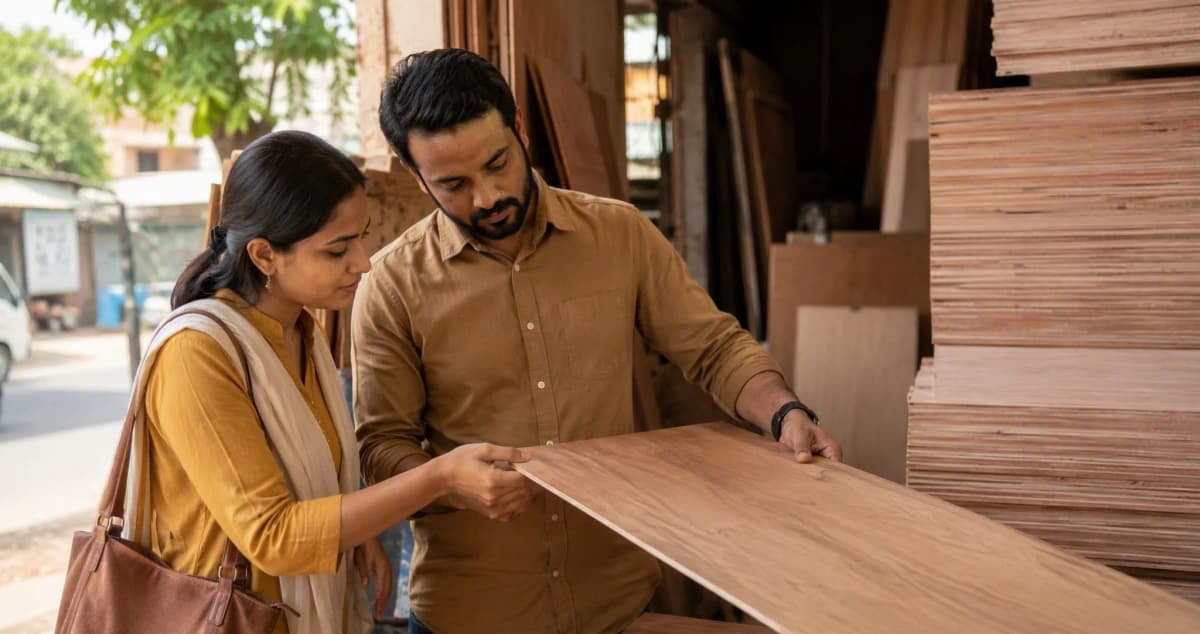
The eight mistakes are: buying on price alone, using MR 'commercial' ply in kitchens and bathrooms, trusting the label '18 mm' without measuring it, ignoring core voids you can see on the sheet's edge, falling for counterfeit branded boards, skipping the termite-treatment check, ignoring your climate zone, and leaving without a GST invoice and warranty card. Genuine 18 mm BWP marine plywood costs roughly ₹90–160 per sq ft in most Indian cities — any 'marine ply' offered 25–30% cheaper is a red flag, not a bargain. Before paying, verify the 7-digit CM/L licence number printed beside the ISI mark on services.bis.gov.in, tap the sheet for a solid thud, and measure the edge with a tape. These three checks take five minutes and catch most bad boards.
Why plywood buying goes wrong in India
Plywood is the single largest material cost in an Indian interior project — a typical 2BHK modular kitchen-and-wardrobe package uses 30–45 sheets — and it is also the least understood. You cannot see the glue, the core species, or the pressing quality from the face of the sheet. All you see is a smooth surface and a stamp.
That information gap is exactly what the market exploits. Industry estimates suggest 20–30% of 'branded' plywood sold in India is counterfeit or lookalike stock, and even genuine boards are routinely sold a grade up: MR passed off as BWR, BWR passed off as marine. The buyer, who will open the sheet's edge only when the carpenter cuts it two weeks later, has almost no recourse — unless they checked the right things at the shop.
The good news: every common trick leaves a visible or audible trace. The eight mistakes below cover what goes wrong and why; the 5-step on-site check that follows shows you how to catch it in five minutes at the dealer's godown.
Mistake 1: Choosing the lowest price
Mistake 01 · The price trap'Sabse sasta dikhao' is the most expensive sentence in plywood
Plywood has no MRP printed on it, and dealers quote per sq ft or per sheet with wide room to manoeuvre. So homeowners do the rational thing: collect three quotes and pick the lowest. The problem is that two boards quoting '18 mm BWP' can differ wildly inside — one a 13-veneer hardwood core at 18.4 mm, the other a 9-veneer poplar core at 16.8 mm with the same stamp photocopied onto it.
As a benchmark, genuine branded 18 mm MR runs ₹45–70/sq ft, BWR ₹70–110, and BWP marine ₹90–160 in most Indian cities (Bangalore, Mumbai, Delhi NCR, Chennai, Hyderabad). Any quote 20–40% below these bands is not a discount — it's a different product wearing the same label.
The fix: Never compare quotes without comparing specifications. Ask every dealer to write brand, grade, BIS standard, actual measured thickness, core species and warranty on the quote itself. The cheapest quote almost always loses something on that list.
Mistake 2: The wrong grade for the room
Mistake 02 · Grade mismatchMR 'commercial' ply in a kitchen fails in 2–3 monsoons
The three grades differ in one thing: the glue. MR (IS 303) uses urea-formaldehyde that softens with sustained moisture — it begins delaminating after just 2–3 hours of soaking. BWR (IS 303) uses a phenolic blend that survives roughly 8 hours of boiling in lab tests. BWP marine (IS 710) uses undiluted phenol-formaldehyde and must survive 72+ hours of boiling.
Yet the most common spec in Indian kitchens is still MR, because it's ₹20–40/sq ft cheaper. Steam from daily cooking, sink splashes and monsoon humidity do the rest: shutter edges bubble, cabinet floors sag under wet vessels, and by the third monsoon the laminate starts lifting at the corners. The saving of ₹8,000–12,000 on a kitchen becomes a ₹60,000+ rebuild.
The fix: Zone your home before you shop: MR for bedroom wardrobes, TV units and studies; BWR for kitchens, dining and utility; BWP for sink units, bathrooms, balcony furniture and any coastal-city wet area. If the budget is tight, downgrade the laminate, never the ply grade.
Mistake 3: Trusting '18 mm' without measuring it
Thickness cheating is the plywood trade's quietest profit centre. A sheet sold as 18 mm routinely measures 16–17 mm. Each missing millimetre is usually a full veneer removed from the core — and with it goes screw-holding strength, shelf rigidity and door-hinge life. Carpenters report that hinges anchored in 16 mm boards loosen noticeably sooner, and wardrobe shelves begin to sag years earlier.
The fix is embarrassingly simple: carry a steel tape or a ₹300 digital caliper and measure the sheet edge at three points before the lot is loaded. BIS tolerances allow minor variation, so a genuine board reads close to nominal — not 2 mm under it.
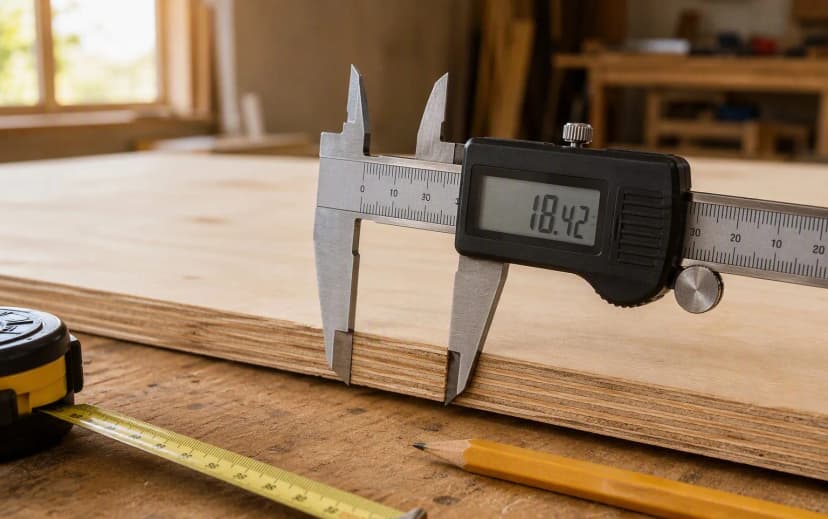
| Sold as | Genuine range | Red flag below | What the missing mm costs you |
|---|---|---|---|
| 6 mm | 5.4–5.8 mm | 5.0 mm | Back panels drum, warp and pop out of grooves |
| 12 mm | 11.2–11.8 mm | 10.5 mm | Shelves sag; drawer bottoms give way under load |
| 18 mm | 17.0–17.8 mm | 16.5 mm | Screw-holding drops 10–20%; hinges loosen early |
| 25 mm | 23.5–24.6 mm | 22.5 mm | Study desks and counters flex noticeably |
Mistake 4: Ignoring the core — voids and overlaps
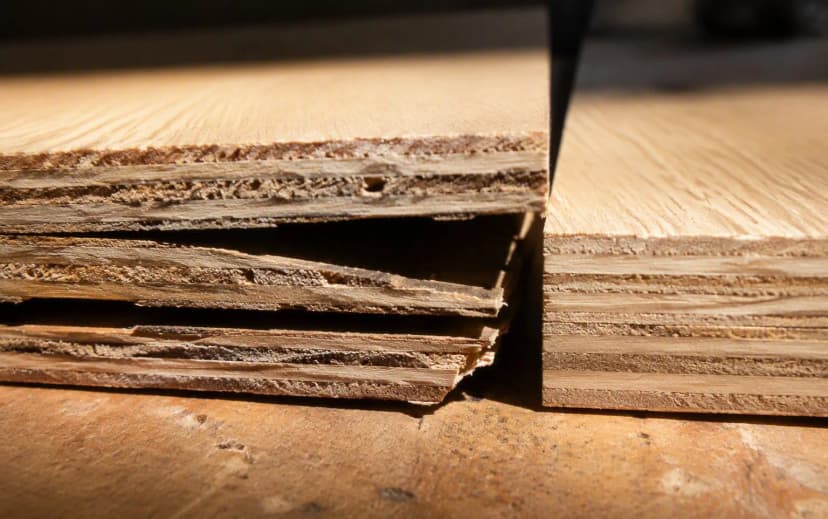
Face veneer is makeup; the core is the bone. Cheap boards hide gaps between veneers (voids), doubled-up veneers (overlaps) and sawdust filler in the middle layers. These defects telegraph through within months: laminate dents over voids, screws find air instead of wood, and the sheet sounds hollow when tapped.
You don't need to cut the sheet to check. Sight along the factory-cut long edge: you should see an even sandwich of continuous veneers. Gaps wider than 1 mm, dark filler patches, or two veneers fused together mean the board failed calibrating at the factory and was pushed into the market anyway. Then do the knock test — rap your knuckles across the face. A dense board answers with a solid, uniform thud; a hollow, papery rattle anywhere on the sheet marks a void beneath.
Mistake 5: Falling for fake 'branded' plywood
Walk into any timber market — Bangalore's KG Road, Delhi's Kirti Nagar, Mumbai's Oshiwara — and you'll find 'Century', 'Green' and 'Kit' boards at suspicious prices. Counterfeiters copy the face print and the ISI stamp; some run entire lookalike brands a letter away from the real thing. With an estimated 20–30% of branded stock in circulation being fake, trusting the stamp alone is not a strategy.
Real verification takes two minutes:
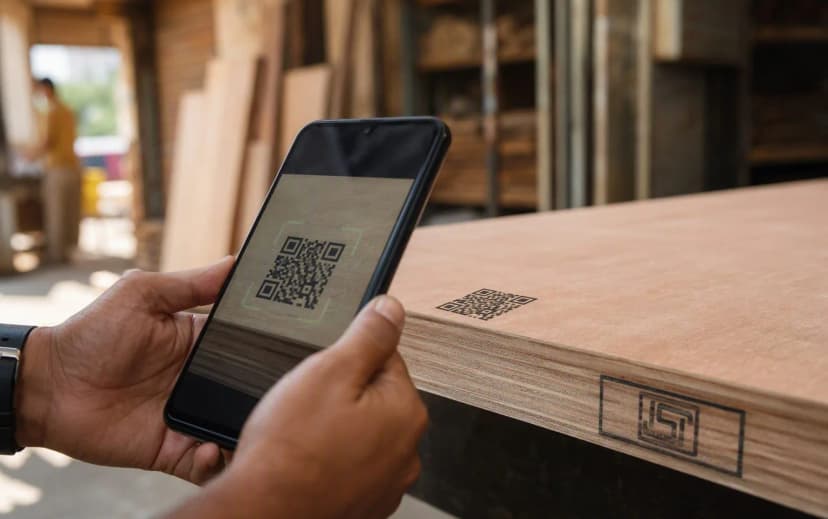
- CM/L number: every genuine ISI-marked sheet prints a 7-digit licence number (format CM/L-XXXXXXX) beside the mark. Enter it on services.bis.gov.in or the BIS Care App — it must resolve to that exact manufacturer and product standard.
- Brand QR code: major brands now print a unique QR on every sheet. Scan it with the brand's own app (e.g. CenturyPromise for CenturyPly) — genuine sheets pull up the plant, batch and grade. Fakes scan to nothing, or to a PDF.
The fix: Buy from the brand's authorised dealer (lists are on brand websites), scan the QR in the shop itself, and make the dealer watch you do it. Genuine dealers welcome the check; the others suddenly remember a cheaper 'same quality' option.
Mistake 6: Skipping the termite-and-borer check
Termites don't eat laminate, they eat what's under it — and India's subterranean termites are active in virtually every city, worst in coastal and high-rainfall belts. Quality plywood is protected two ways: treated veneers (the wood itself is impregnated) and glue-line poisoning (insecticide blended into the resin). Cheap untreated boards are a food source stacked flat inside your walls.
Once termites enter a wardrobe carcass, no surface spray reaches them — the standard cure is drilling, injecting and often replacing the unit. A ₹15/sq ft saving at purchase becomes a full-room refit.
The fix: Ask specifically: are the veneers treated, and is the treatment covered under the written warranty? Premium branded lines carry 25-year to lifetime termite warranties — but only if the brand, grade and batch are on your invoice. 'Termite proof' said out loud, with nothing in writing, is worth exactly nothing.
Mistake 7: Ignoring your climate zone
A spec that survives fifteen years in Jaipur can fail in four in Kochi. Coastal and high-humidity cities — Mumbai, Chennai, Kochi, Goa, Mangalore, Kolkata — keep wood above its safe moisture content for months at a stretch. MR glue lines creep apart, cores absorb moisture and swell, and fungal stains creep out from under laminates.
Climate also changes what 'dry zone' means. In a coastal city, even bedroom wardrobes on external walls see condensation during monsoon; in dry-interior cities like Jaipur, Indore or Nagpur, MR is genuinely adequate there.
The fix: Rule of thumb: coastal and high-rainfall cities — BWR as the floor, BWP for all wet-adjacent furniture, including wardrobes on external walls. Dry-interior cities — MR for bedrooms and living areas, BWR for kitchens. And everywhere in India, ground-floor furniture near bathrooms and utility areas deserves BWP.
Mistake 8: Walking out without an invoice, warranty and batch number
The plywood trade still runs on cash and trust — which is precisely why warranties so often can't be claimed. No GST invoice means no proof of what grade you bought, no batch number means the brand can't trace your sheets, and no warranty card means the '25-year warranty' the dealer mentioned is just conversation.
The fix: Insist on a GST invoice listing brand, grade, BIS standard, thickness and quantity; note the batch number printed on each sheet before the carpenter cuts them; and register the warranty on the brand's website or app the same week. If a dealer won't bill it properly, that tells you what they're actually selling.
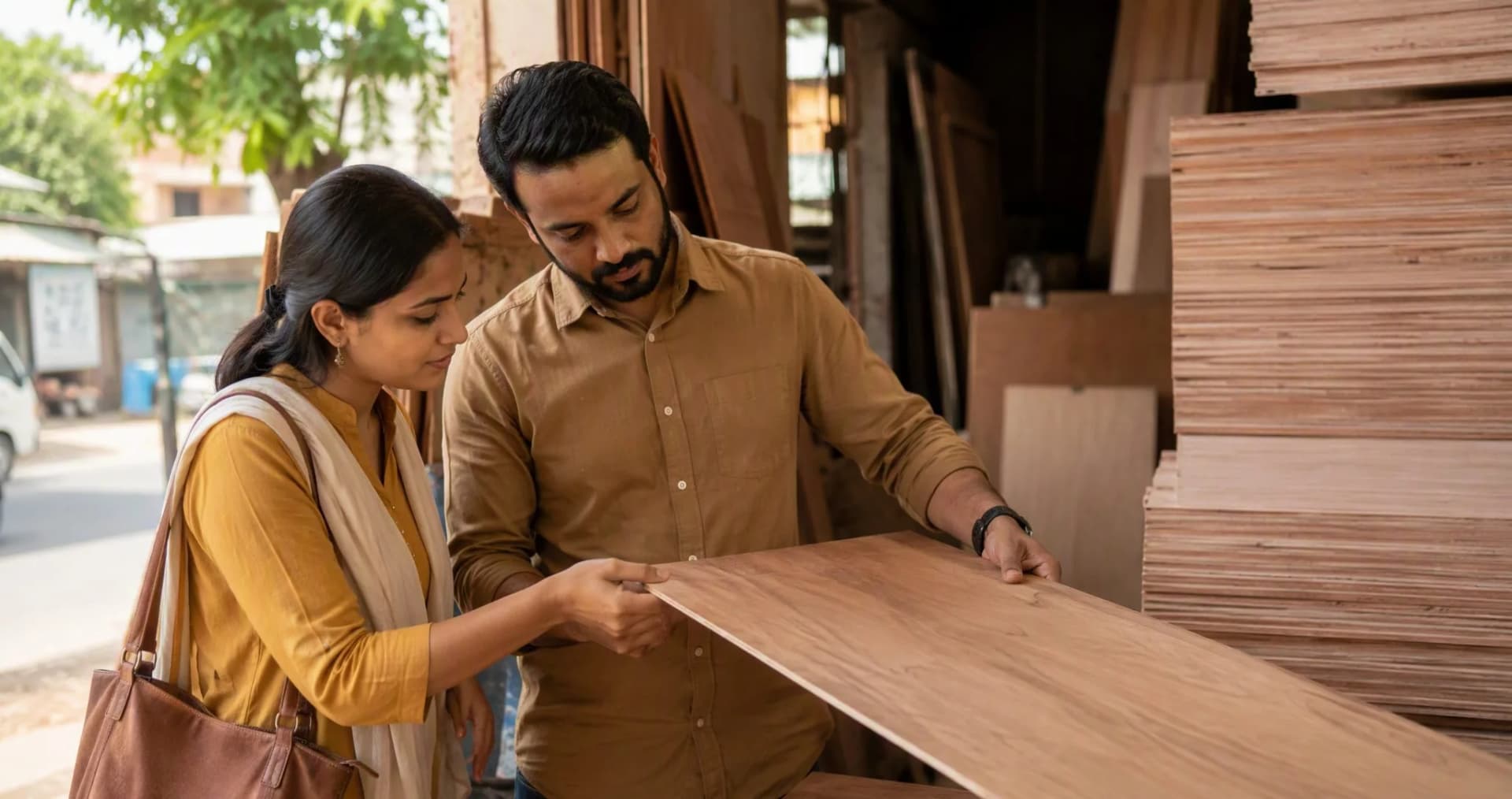
The 5-step on-site authenticity check (five minutes, zero tools beyond a tape)
Do all five at the dealer's shop, on the actual sheets you'll take home — not the display piece on the counter.
Verify the ISI mark properly
Find the ISI stamp and read what's next to it: the standard number (IS 303 for MR/BWR, IS 710 for marine BWP) and a 7-digit CM/L licence number. Enter that number on services.bis.gov.in or the BIS Care App. It must return the same manufacturer and the same product standard. A stamp with no number, a blurred number, or a number that resolves to a different company is a fake mark.
Scan the brand QR code
Every genuine sheet from major brands now carries a unique QR code. Scan it with the brand's official app — CenturyPromise, Greenply's app, and similar — and check that the grade and plant shown match what you're buying. No scan, no sale.
Read the edge like a book
Sight along the factory-cut edge in good light. You want an even sandwich of continuous veneers with gaps under 1 mm and no doubled or missing layers. Dark putty-like patches are filler hiding factory defects.
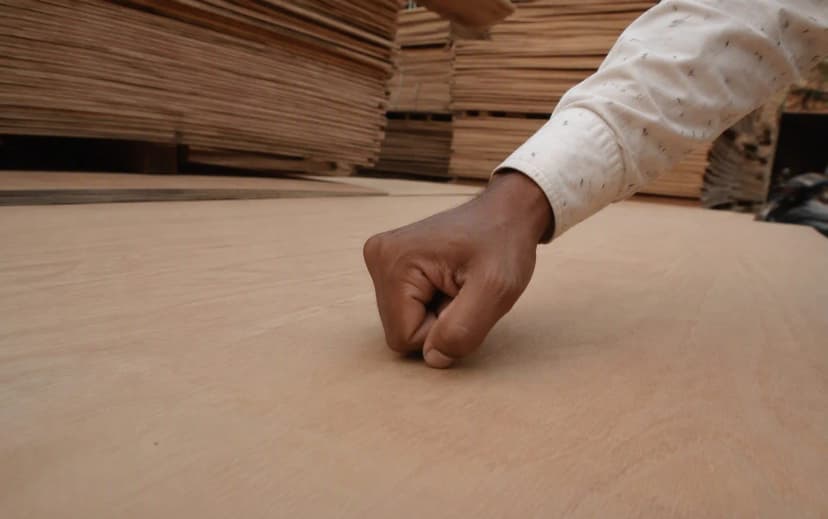
Knock it, then lift it
Rap your knuckles across the face — centre, corners, edges. A solid thud everywhere is good; a hollow papery rattle marks a void. Then lift one corner of the sheet: a genuine 18 mm hardwood 8×4 sheet weighs roughly 40–55 kg. Suspiciously light usually means poplar cores, voids, or an undersized board.
Take home an offcut and soak it
Ask for a 6×6 inch offcut from the same lot (dealers keep cut pieces) and drop it in a bucket of water overnight. MR starts swelling and peeling within 2–3 hours; BWR should look untouched; BWP is built to survive 72+ hours of boiling. If the 'marine' sample bubbles overnight, return the lot while you still can.
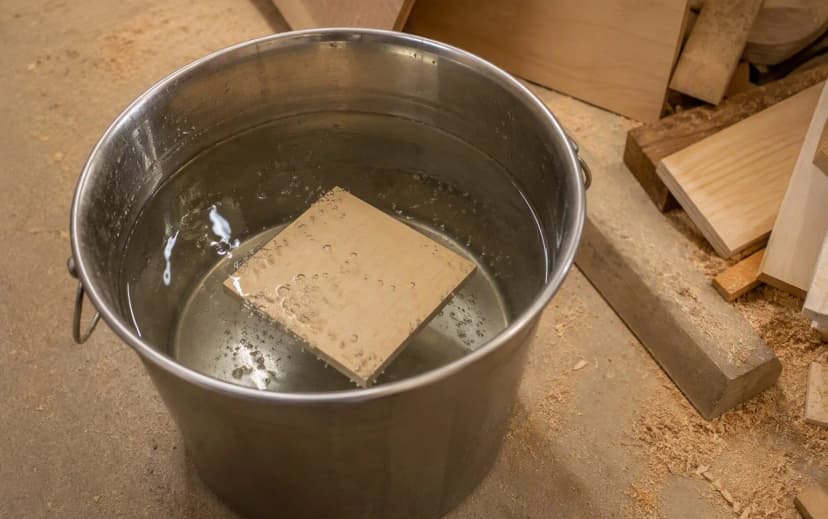
Pro tip: Smell the sheet too. Genuine phenolic BWP has a sharp, resinous smell at a fresh cut; boards reeking of harsh chemical solvent or — worse — smelling of nothing at all when sold as 'marine' deserve suspicion. And press a thumbnail into the face veneer: if it dents easily, the face is poplar, not hardwood.
- Prices 20–40% below every other quote for the 'same' brand and grade
- Verbal-only ISI claims — 'yeh ISI hi hai' with no CM/L number on the sheet
- Refuses to let you scan the QR or verify the licence number on the spot
- Edge of the stack doesn't match the display sheet — check the sheets actually being billed
- 'Company seconds' or 'export reject' offered at a discount with no warranty
- No GST invoice, or an invoice that says just 'plywood 18mm' without brand, grade and standard
- Pushes you to decide today because 'rates change tomorrow' — real dealers hold a written quote for a week
Dealer red flags: when to walk away
The seven signs above, seen at any dealer, mean it's time to leave and buy elsewhere.
Frequently asked questions
How can I check if plywood is genuine at the shop?
Run the 5-step check: verify the ISI mark's 7-digit CM/L licence number on services.bis.gov.in or the BIS Care App; scan the sheet's QR code in the brand's official app; sight along the cut edge for gaps under 1 mm; knock across the face for a solid, uniform thud; and lift the sheet — a genuine 18 mm hardwood 8×4 board weighs roughly 40–55 kg. Five minutes, no tools beyond your phone.
Is the ISI mark alone enough to guarantee plywood quality?
No — the ISI mark is routinely faked. A genuine mark always appears with the BIS standard number (IS 303 or IS 710) and a 7-digit CM/L licence number. That number must resolve to the same manufacturer and product on services.bis.gov.in. A stamp without a verifiable licence number is decoration.
What is the actual thickness of an 18 mm plywood sheet in India?
A genuine 18 mm sheet should measure about 17.0–17.8 mm. Many market boards sold as '18 mm' actually measure 16–17 mm — the missing millimetre is a full veneer, and it costs you 10–20% of screw-holding and sag resistance. Measure the edge at three points with a tape or caliper before paying.
MR, BWR or BWP — which grade for which room?
MR (commercial, IS 303) for dry zones only: bedroom wardrobes, TV units, studies. BWR (IS 303) for kitchens, dining and utility areas. BWP marine (IS 710) for sink units, bathrooms, balconies and any wet-adjacent furniture in coastal cities. Using MR in a kitchen is the costliest grade mistake in Indian interiors.
How much should genuine 18 mm BWP plywood cost per sq ft?
Roughly ₹90–160 per sq ft for branded BWP marine in most Indian cities (BWR ₹70–110, MR ₹45–70). 'Marine ply' at ₹60–70 per sq ft is almost always thinner stock, a lower grade, or a counterfeit — a 20–40% below-market price is the loudest red flag in the trade.
Can I test waterproof plywood at home before using it?
Yes — take a 6×6 inch offcut from the same lot and soak it in a bucket overnight. MR begins swelling and delaminating within 2–3 hours; genuine BWR survives about 8 hours of boiling in lab tests; BWP (IS 710) must survive 72+ hours of boiling. If your overnight sample bubbles or peels, return the lot immediately.
What questions should I ask my plywood dealer before buying?
Five: Which BIS standard is this, and what is the CM/L number? Can I scan the QR code in your shop right now? What is the actual measured thickness? Is the core 100% hardwood, or poplar/rubberwood? And will you write brand, grade, standard, batch number and warranty terms on a GST invoice? Hesitation on any of these is your answer.
Is cheap 'commercial plywood' good enough for wardrobes?
Branded MR plywood is genuinely adequate for a dry bedroom wardrobe and saves real money. The mistake is buying unbranded 'commercial' boards at ₹40–45 per sq ft — poplar cores, visible gaps, undersized thickness and no termite treatment mean sagging shelves and loose hinges within 3–5 years. Save with the grade, not with the brand.
Buying plywood for a renovation?
Bring this checklist to the shop — or let us help you spec the right grade, thickness and brand for every room, with verified dealers and proper invoices.
Get a free material consultation