
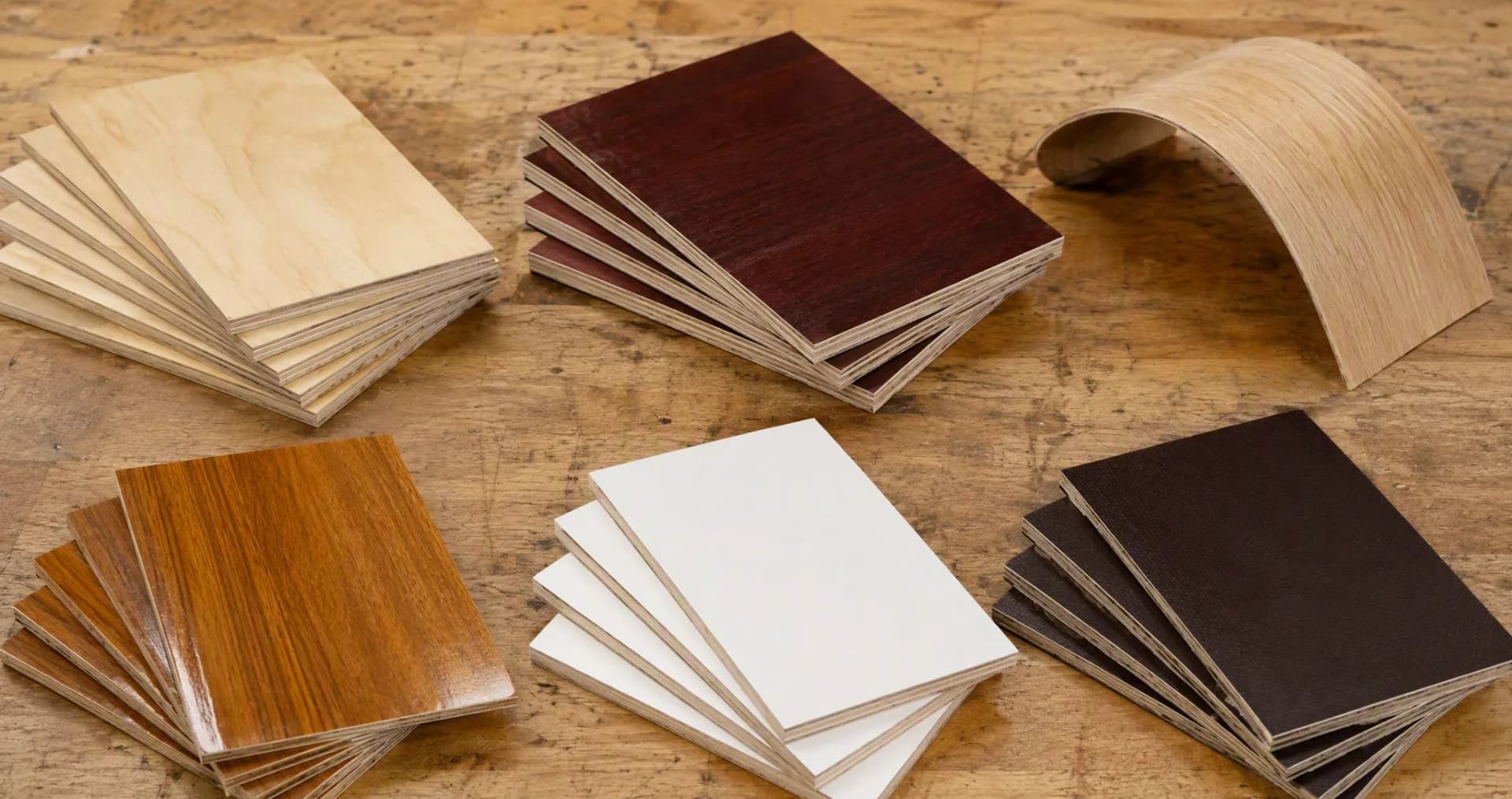
Different Types of Plywood Used in Interior Design Projects
"Plywood" at an Indian timber yard is not one material — it's a family of nine. Picking the right member for each cabinet, wall and curve is the difference between an interior that lasts 15 years and one that needs repairs in three. Here's the full family, what each type is actually for, and what it costs.
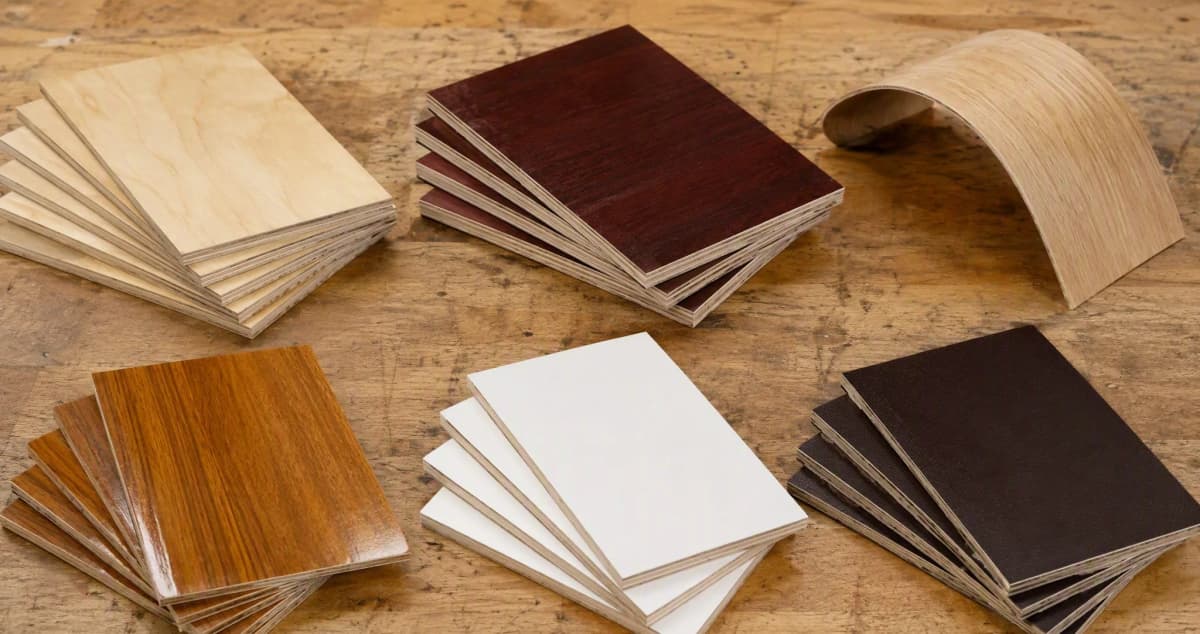
Indian interiors use: commercial MR ply (dry rooms, ₹73–100/sq ft for 18 mm), BWR (kitchens and humid zones, ₹83–140), BWP marine (bathrooms, balconies, ₹116–250), hardwood-core (eucalyptus/gurjan — strength and screw-holding), softwood-core (poplar — light, cheap, dry use only), calibrated ply (machine-uniform thickness — mandatory for modular furniture), flexible ply (curves and arches), decorative veneered ply (real-wood showpiece surfaces), and pre-laminated ply (factory-finished, no on-site lamination). A sensible home mixes all of these by zone — buying a single type for everything either wastes money or builds in failures. Rule: match the type to the moisture, the load, and whether the surface will be seen.
First, Understand the Two Axes Every Plywood Sits On
Most confusion about "types of plywood" comes from mixing up two independent ways plywood is classified. Every sheet you buy has a position on both.
Axis 1 — Moisture grade (the glue): MR, BWR or BWP. This is decided by the adhesive and certified under IS 303 and IS 710. It answers: how wet will this get?
Axis 2 — Construction type (the build): the core species (hardwood/softwood/mixed), the ply count, calibration, flexibility, and the face finish (raw, veneered, pre-laminated, film-faced). This answers: how strong must it be, how precisely will it be machined, and will anyone see it?
A sheet can be BWP and calibrated and hardwood-core and veneered — these are layers of specification, not rivals. When a dealer says "this is commercial ply", he's only told you the moisture grade. Ask about the second axis before you pay.
Already covered in detail: we keep the moisture-grade recap here brief — our detailed guides on plywood grades go deeper into the glue chemistry and boil tests. This article focuses on everything else: cores, calibration, flexibility and finishes.
The Moisture Grades: MR, BWR, BWP Marine
Commercial plywood (MR, IS 303) — the dry-zone workhorse
The default sheet of Indian interiors. Urea-formaldehyde glue, poplar-to-mixed cores, the widest price spread in the market. Perfectly adequate for wardrobes, TV units, study tables and beds in dry rooms; fails within 2–3 years if steam or splashes reach it.
Use it for: Bedroom wardrobes, TV units, studies, beds, partition panelling — dry zones only. 18 mm: roughly ₹45–100/sq ft depending on brand and core.
BWR plywood (Boiling Water Resistant, IS 303) — kitchens and humid zones
Phenol or melamine-fortified glue rated to survive about 8 hours of boiling-water testing. Handles steam, condensation, wet hands and splashes — the full reality of an Indian kitchen — as long as water doesn't sit on it for weeks.
Use it for: Kitchen cabinets and shutters, dining crockery units, utility lofts, external-wall wardrobes in coastal cities. 18 mm: roughly ₹83–140/sq ft.
BWP / marine plywood (Boiling Water Proof, IS 710) — wet zones and outdoors
Undiluted phenol-formaldehyde glue rated for 72+ hours of continuous boiling, with stricter hardwood-veneer rules. "Marine ply" and "BWP" are the same product; the "710" on the stamp is the standard number.
Use it for: Sink units, bathroom vanities, balcony and utility furniture, coastal-city kitchens. 18 mm: roughly ₹116–250/sq ft.
Core Types: Hardwood vs Softwood vs Mixed
The core is 60–70% of the sheet. Same stamp, same face — completely different furniture depending on which tree is inside.
Hardwood-core plywood (eucalyptus, gurjan, acacia)
Dense veneers pressed into a board that runs 20–30% heavier than softwood equivalents. The density buys screw-holding (hinges stay tight for a decade) and sag resistance (shelves stay flat under books). The premium core for kitchens, wardrobes, beds and anything with hinges.
How to spot it: Lift a corner of the 8×4 sheet — genuine hardwood-core 18 mm is noticeably heavy. Sight the edge: thick, even, dark-toned veneers, no pale filler bands.
Softwood-core plywood (poplar, pine) — light and cheap, dry use only
Fast-growing plantation poplar makes the lightest, cheapest boards in the market. The trade: weak screw-holding, faster swelling in humidity, and high termite appetite if untreated.
Use it for: Back panels, drawer bottoms, temporary partitions, exhibition and event structures. Never for hinges, shelves or kitchens.
Mixed-core plywood — the honest middle
Alternating hardwood and softwood veneers balance cost and performance: better screw-holding than pure poplar, cheaper than full hardwood. Most mid-range branded boards are mixed-core.
Use it for: Wardrobes, beds, TV units and general furniture in dry-to-moderate zones — the value pick for most bedrooms.
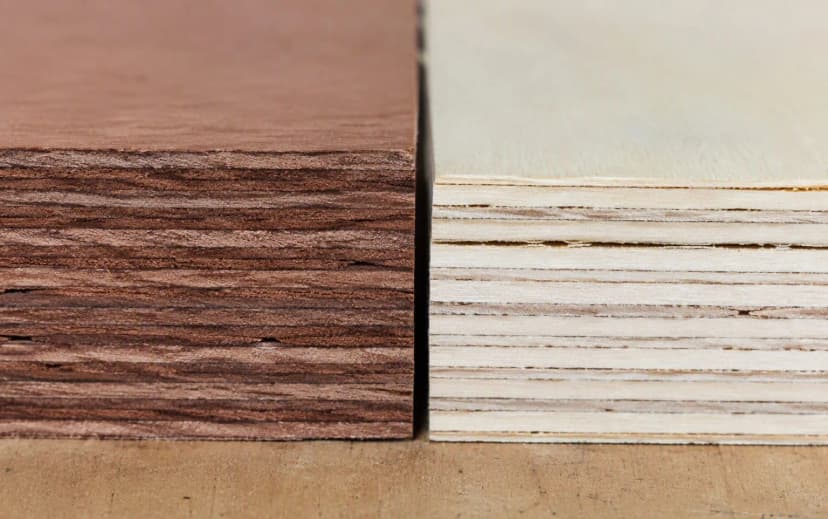
Calibrated Plywood: The Modular-Furniture Grade
Type 07. Ordinary plywood leaves the press with thickness that wanders — up to a millimetre across a single sheet. Carpenters with hand tools absorb that variation; machines can't. Calibrated plywood is sanded after pressing to a uniform thickness, typically within ±0.2–0.3 mm across the whole sheet, so that CNC routers cut precise joinery, edge-banding machines seat the band without gaps, and laminate presses bond without air pockets.
If your kitchen or wardrobes are being made by a modular factory, calibrated ply is not an upgrade — it's the spec the machinery assumes. Skipping it shows up as edge-band lines you can catch a fingernail on, and shutters that never quite align. Most premium branded lines (9–11 thin plies rather than 7 fat ones) are calibrated by default; budget boards rarely are.
Ply count matters too: more, thinner plies beat fewer, thicker ones. An 18 mm board with 11–13 veneers is stiffer, more stable and less gap-prone than one with 7–9. Count the layers on the edge — it takes ten seconds and tells you more than the price tag.
Flexible Plywood: The Type That Bends
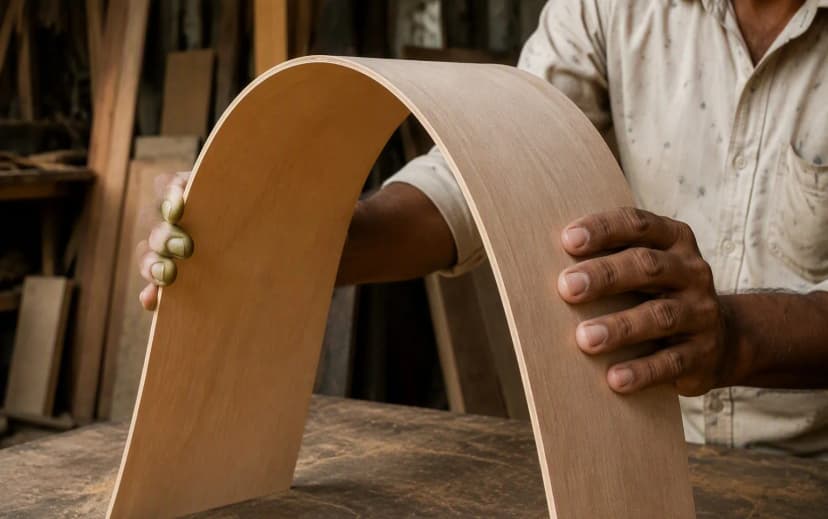
Type 08. Every other plywood alternates veneer grain direction layer by layer — that's what makes it stiff. Flexible ("bendy") plywood does the opposite: all its veneers run the same way, so the sheet rolls into a smooth curve without cracking, typically down to a 25–50 cm radius depending on thickness (3–8 mm is standard).
Interior designers reach for it wherever the drawing isn't straight: curved reception counters, rounded wardrobe end panels, arched niches, barrel ceilings, column cladding, wave-form feature walls. The technique: bend it onto a framework, glue or pin it in position, then laminate or veneer it in place — it holds the curve permanently once fixed.
Practical note: flexible ply is a structural skin, not a carcass material — it has almost no stiffness on its own. It always works over a frame or as a second layer over a curved substrate. Budget roughly 1.5–2× the price of commercial ply per sheet, plus the carpenter time to build the frame.
Decorative Veneered & Pre-Laminated Plywood
Veneered plywood — real wood, plywood stability
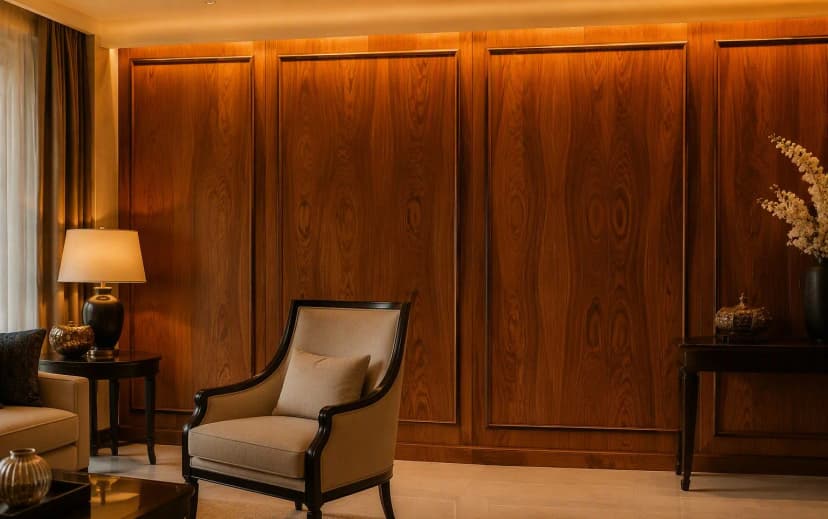
A calibrated board pressed with a face of genuine sliced timber — teak, walnut, white oak, steam beech. You get the grain, depth and ageing of solid wood without its warping and cracking, at a fraction of solid-teak cost. It can be polished, re-polished and repaired like real furniture.
Use it for: Premium visible surfaces meant to be seen and touched. Not for kitchens — cooking grease and steam belong on laminate.
Pre-laminated plywood — factory-finished, zero site mess
Plywood that leaves the factory with decorative laminate already pressed on one or both faces. For site carpentry it eliminates the dustiest, most skill-sensitive step, cuts a week off timelines, and the factory press bond is stronger than hand-applied adhesive.
Use it for: Wardrobe carcasses, office and commercial fit-outs, rental-property furniture, any project on a tight timeline.
Film-Faced, Fire-Retardant & Other Speciality Types
Film-faced plywood — the construction brute
Coated in phenolic film for concrete formwork: extremely water-resistant, high-density, built for 10–20+ reuse cycles on site. Some designers use it deliberately for industrial-style furniture and heavy workbenches. For regular home furniture it's the wrong buy — utility veneers, limited finishes, and a price close to BWP.
Fire-retardant plywood — for compliance and peace of mind
Pressure-impregnated with fire-retardant salts so it chars instead of flashing over, and self-extinguishes once the flame source is removed. Standard spec in commercial interiors, restaurants, hospitals and high-rise common areas. Expect a 20–40% premium over the equivalent standard grade.
Structural, chequered & LVL
Structural plywood (load-rated, for mezzanine floors and lofts), chequered/anti-skid plywood (embossed face for ramps and stages), and LVL — laminated veneer lumber (engineered for beams and long spans) round out the family. You won't spec these for a wardrobe, but knowing they exist stops you from buying BWP for a loft floor.
Ply Count, Thickness and Sheet Sizes: The Numbers That Matter
Two sheets of the same "type" still differ by how they're built. Three numbers to check on every quote:
- Ply count: an 18 mm board should show 11–13 thin veneers on the edge. Fewer, thicker plies (7–9) mean more core gap risk and less stiffness.
- Actual thickness: measure it. 18 mm boards genuinely run 17.0–17.8 mm; anything at 16.5 mm is cheating you of a veneer.
- Sheet size: 8×4 ft (2440×1220 mm) is standard; 8×3, 10×4 and 6×4 exist. Modular factories often prefer 8×4 calibrated; odd sizes can save cutting waste on specific designs.
| Thickness | Typical use | Notes |
|---|---|---|
| 4–6 mm | Cabinet back panels, drawer bottoms | Never load-bearing; nails and pins only |
| 9–12 mm | Drawer sides, internal partitions, light shelves | 12 mm shelves need support every 45–60 cm |
| 16–19 mm | Carcasses, wardrobe sides, kitchen cabinets, beds, hinged shutters | The workhorse size; 18/19 mm is the hinge-holding minimum |
| 25 mm | Study desks, long unsupported shelves, counters | Also the right core for dining-table tops |
| 3–8 mm flexi | Curved panels over a frame | Skin only — always backed by a structure |
Room-Wise Selection Map
| Space / unit | Grade | Core & build | Face |
|---|---|---|---|
| Kitchen carcass + shutters | BWR | Hardwood, calibrated, 18 mm | Laminate / acrylic |
| Sink unit | BWP marine | Hardwood, 18 mm | Laminate; edges sealed |
| Bathroom vanity | BWP marine | Hardwood, 18 mm, on legs/granite base | Laminate / PU |
| Wardrobes (dry city) | MR | Mixed or hardwood, 18 mm; 6 mm backs | Laminate or veneer |
| Wardrobes (coastal, external wall) | BWR | Hardwood, 18 mm | Laminate |
| Beds & study desks | MR / BWR | Hardwood, 18 mm; 25 mm desk tops | Laminate |
| Living-room showcase wall | MR | Calibrated, 12–18 mm | Decorative veneer + polish |
| Curved panels / arches | MR flexi | 3–8 mm flexible over frame | Veneer / laminate in situ |
| Balcony furniture | BWP marine | Hardwood, 18 mm + exterior PU | PU / exterior laminate |
The Buyer's 60-Second Type Checklist
- Name both axes on your quote: moisture grade (MR/BWR/BWP) and core (hardwood/mixed/softwood).
- Modular project? Add "calibrated". Machine cutting and edge-banding assume uniform thickness.
- Count the plies on the edge: 11–13 thin veneers beat 7–9 thick ones at 18 mm.
- Measure actual thickness at four points — genuine 18 mm reads 17.0–17.8 mm.
- Curves in the design? Specify flexible ply — don't let anyone force flat ply around an arc.
- Seen-and-touched surfaces deserve veneer; hard-working surfaces deserve laminate.
- Verify the ISI stamp's CM/L number on services.bis.gov.in and scan the brand QR before loading.
Frequently Asked Questions
How many types of plywood are used in interior design in India?
Nine common types: commercial MR (dry zones), BWR (kitchens, humid zones), BWP marine (wet zones), hardwood-core, softwood-core, calibrated (modular furniture), flexible (curves), decorative veneered (premium visible surfaces) and pre-laminated (factory-finished). Film-faced shuttering ply is a tenth, occasionally repurposed for industrial-style interiors.
What is the difference between hardwood and softwood core plywood?
The core species. Hardwood cores (eucalyptus, gurjan, acacia) are 20–30% heavier, hold screws far better and resist sagging — right for kitchens, shelves and hinged shutters. Softwood cores (poplar, pine) are lighter, cheaper and easier to cut, but weaker in screw-holding — suitable only for light, dry use like back panels and partitions. Mixed cores alternate both for a price-strength balance.
What is calibrated plywood and why do modular kitchens need it?
Calibrated plywood is factory-sanded to uniform thickness (±0.2–0.3 mm across the sheet). Modular furniture is CNC-cut and machine edge-banded on the assumption of exact thickness; ordinary plywood varies up to a millimetre, causing edge-band gaps and misaligned shutters. For machine-made modular work, calibrated ply is effectively mandatory.
What is flexible plywood used for?
Curved work: rounded counters, curved wardrobe ends, arched niches, barrel ceilings, column cladding and wave-form walls. All its veneers run one direction, so it bends smoothly (3–8 mm thick, down to roughly a 25–50 cm radius). It's a skin, not a structure — it goes over a frame, then gets laminated or veneered in position.
Is veneered plywood better than laminated plywood?
Different goals. Veneered plywood is real sliced wood — it looks and ages like timber, can be re-polished, and suits showcase surfaces, but costs more and needs care. Laminated plywood is a printed decorative sheet — tougher, cheaper, zero-maintenance, but cannot be re-polished and repeats the same pattern. Veneer for showpieces; laminate for kitchens, wardrobes and heavy use.
Can shuttering (film-faced) plywood be used for home interiors?
It can — it's extremely water-resistant and tough, and its dark phenolic face suits industrial-style furniture, garage storage and workbenches. But the veneers are utility-grade, finishes are limited, and the price is close to BWP marine. For normal home furniture, interior grades are the better buy.
What thickness of plywood is used for different furniture in India?
4–6 mm for back panels and drawer bottoms; 12 mm for drawer sides and light shelves; 16–19 mm for carcasses, wardrobe sides, kitchen cabinets, beds and hinged shutters; 25 mm for desks, long shelves and counters. Sheets are standard 8×4 ft, with 8×3 and 10×4 also available.
Which type of plywood is best for a home interior project in India?
A mix, matched by zone: 18 mm calibrated hardwood BWR for kitchens, BWP for sink units and bathrooms, hardwood MR for wardrobes and beds, 6 mm for backs, 12 mm for drawers, flexible ply for curves, and decorative veneer for showcase surfaces. Buying one type for the whole house either wastes money or builds in future failures.
Not sure which types your project needs?
Share your floor plan and room list — we'll spec the right grade, core, thickness and finish for every unit, so you pay for performance only where it matters.
Get a Free Material Consultation




