
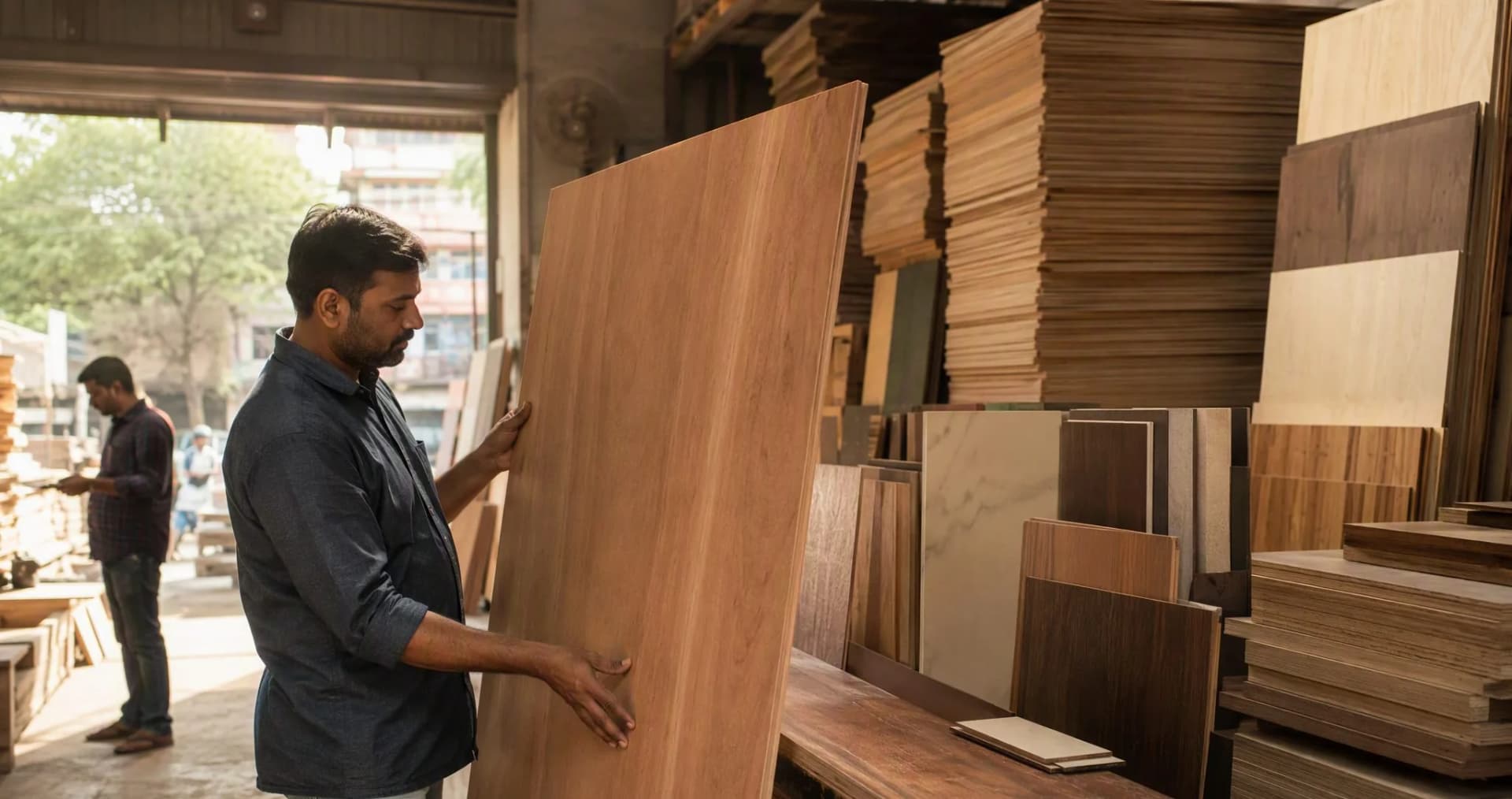
How to Choose Quality Plywood for Home Interiors
Two sheets can look identical on the rack and perform like different materials in your home. This field guide gives you the certification checks, six shop-floor tests and long-term math to tell a 20-year sheet from a 3-year one — before money changes hands.
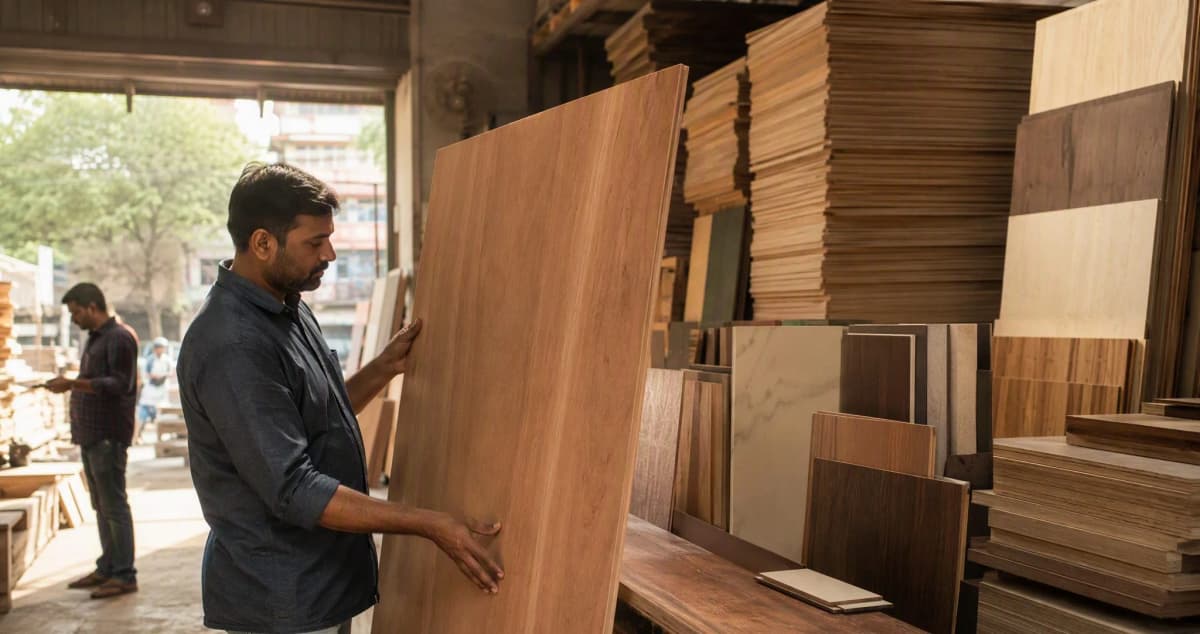
Match the grade to the room (BWR for kitchens, BWP/marine for wet zones, MR for dry bedrooms), then verify quality on the sheet itself: a genuine ISI mark with a CM/L number that checks out on the BIS portal, 11–13 tight plies on the edge with no gaps, a solid sound when tapped, heft when lifted, and consistent thickness (a real 18 mm sheet reads 17.0–17.8 mm). Buy from a dealer who will unbundle sheets for inspection and put the brand and CM/L number on a GST invoice.
1. Start with the zone, not the sheet
The most expensive plywood mistake isn't buying a bad sheet — it's buying a good sheet for the wrong job. Quality is contextual: an MR-grade sheet that lasts 20 years in a bedroom wardrobe can delaminate in 18 months under a kitchen sink. Before you evaluate any board, fix the three numbers that define "quality" for your project:
- Moisture exposure: dry rooms (bedrooms, living areas) → MR/commercial grade; humid rooms and kitchens → BWR; direct water contact (sink units, bathroom vanities, balcony furniture) → BWP/marine.
- Load and hardware: wardrobes, kitchen carcasses and anything with hinges need hardwood-core ply with high screw-holding strength — the sheet is what your hinges and drawer channels actually grip.
- Visibility: surfaces meant to be seen and touched deserve a calibrated sheet with a clean face; carcasses hidden behind laminate can tolerate utility faces.
We've covered grade selection in depth in our plywood grades guide and the BWR vs BWP breakdown — this guide assumes you've picked the right grade and focuses on the next question: given two sheets of the same grade on the rack, which one is actually good?
Rule of thumb: "Quality plywood" is never one product. It's the right grade, the right core, and a genuine, well-made sheet — in that order. A premium marine ply in your bedroom wardrobe is wasted money; a premium MR ply under your sink is a repair bill.
2. Decode the stamp: ISI, CM/L and the fake-mark problem
Every sheet sold in India carries a printed stamp along one long edge. Read it before anything else — it's the only part of the sheet the manufacturer is legally accountable for.
What a genuine stamp contains
- The IS code — IS 303 for commercial/MR/BWR plywood, IS 710 for BWP/marine. A vague "ISI certified" claim without the specific code is a red flag.
- The CM/L number (e.g. CM/L-7123456) — the manufacturer's unique BIS licence. No CM/L number means the ISI mark is decorative, not real.
- Manufacturer name, batch, thickness and size — these must match the sheet you're actually holding.
How to verify it in under a minute
Enter the CM/L number on the BIS Manakonline portal (manakonline.in) or the official BIS Care app — no login needed. A genuine licence shows the manufacturer name, the IS standard and an active status. If the number returns nothing, or belongs to a different company, the sheet is counterfeit regardless of how good it looks. Industry estimates put fake or mis-marked sheets at a significant share of the unorganised market, so this check matters more in local yards than in brand showrooms.
Major brands add a second layer: CenturyPly's CenturyPromise app and similar QR-code systems from Greenply and others let you scan the sheet itself to confirm it's factory-genuine. Use both — the BIS check verifies the licence, the brand app verifies the physical board.
Invoice rule: Insist on a GST invoice naming the brand, grade and CM/L number. It's your only leverage if the sheet fails later — and dealers selling genuine stock never hesitate to provide it.
3. The six shop-floor quality tests
Certification tells you the sheet should be good. These six tests tell you whether this specific sheet is. None requires tools beyond your hands, eyes and — ideally — a tape measure. Any dealer who refuses to let you unbundle and inspect a sheet is telling you something.
Read the face in raking light
Hold the sheet so light skims across both faces. You're looking at the face veneer — the layer that takes polish, laminate adhesive and daily wear.
Good sign: Smooth, even grain; no cracks, patches, filler putty or overlapping veneer strips; consistent colour across the sheet.
Red flag: Bubbles or ripples (early delamination), putty-filled knots, sanded-through thin spots, or a waxy feel that suggests surface dressing to hide defects.
Count the plies on the edge
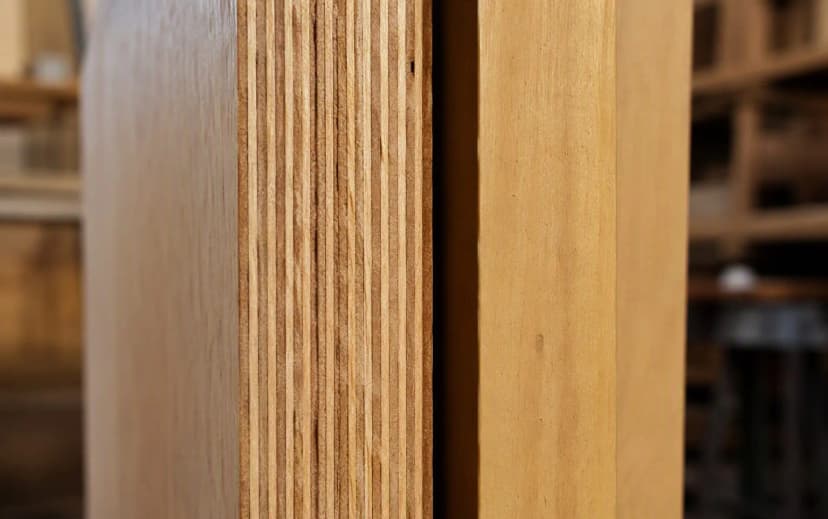
The edge is the sheet's X-ray — it shows the core species, the glue lines and every shortcut the factory took. On an 18 mm board, count the layers.
Good sign: 11–13 thin, even veneers with tight dark glue lines and no visible gaps. More, thinner plies = better stability and stiffness.
Red flag: 7–9 fat plies, visible voids between layers, overlapping cores, or pale soft filler strips sandwiched between darker hardwood faces.
Knock across the whole surface
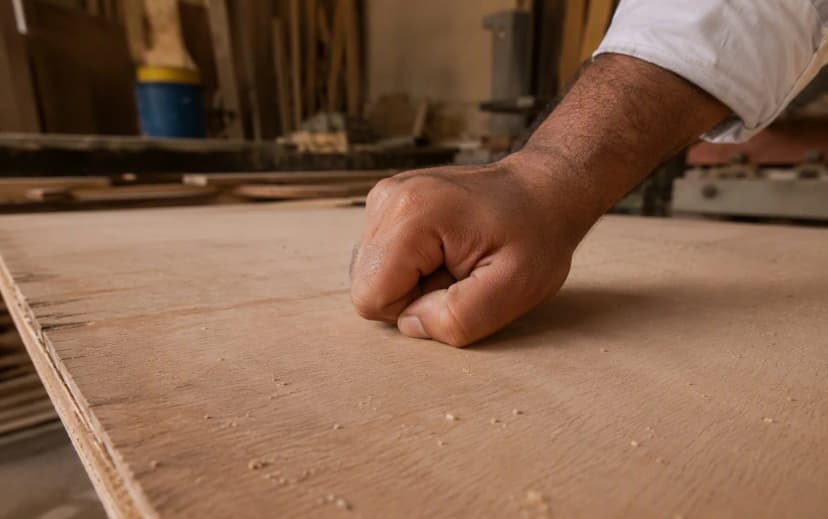
Tap firmly with your knuckles in a grid pattern — centre, corners, midpoints. You're listening for voids: air pockets where veneers never bonded. Voids are invisible from outside but crack under screws and sag under load.
Good sign: A consistent, solid "thock" everywhere on the sheet.
Red flag: Any hollow, papery or drum-like patch — that's a void or delamination, and it will sit exactly where your hinge plate needs to go. Guaranteed.
Lift it — or have it lifted
Density is strength. A genuine 18 mm hardwood-core BWP sheet weighs roughly 40–55 kg; the same size in poplar feels noticeably lighter, and an under-spec sheet with voids feels suspiciously light. Compare two sheets of the same claimed grade and thickness side by side.
Good sign: The heavier sheet of the pair — denser core, more timber, fewer voids.
Red flag: A "BWP hardwood" sheet that lifts like a poplar board is either mislabelled, under-thickness, or hollow.
Measure at four points, not one
Nominal thickness is marketing; actual thickness is engineering. Measure both ends and the middle of both long edges. Genuine 18 mm sheets run 17.0–17.8 mm; more than ~0.5 mm variation across one sheet means poor calibration — a problem that shows up later as rocking shutters and misaligned laminate seams.
Good sign: Readings within 0.3–0.5 mm of each other, and honestly close to nominal.
Red flag: A "18 mm" sheet reading 16.5 mm — you've been quietly short-changed a full veneer. For modular work with machine cutting and edge banding, insist on calibrated ply with ±0.2–0.3 mm tolerance.
Test what the hardware will feel
If the dealer has offcuts, drive a screw into an edge and face: good ply grips without crumbling, and the screw comes out clean. Flex a thin offcut gently: it should spring back without cracking or crackling (that crackle is glue lines failing). This is exactly what hinges and drawer channels will demand of the sheet for the next 15 years.
Good sign: Firm screw grip in both face and edge; flex without noise or cracking.
Red flag: Core crumbs falling out with the screw, or any crackling on a gentle bend — weak core, weak glue, walk away.
4. Core species and emissions: what's actually inside
Two sheets can pass every surface test and still age differently, because of the timber in the middle. Indian plywood cores fall into three camps:
- Hardwood (gurjan, eucalyptus, acacia): dense, heavy, superior screw-holding and moisture behaviour. Gurjan is the traditional gold standard for marine ply; plantation eucalyptus and acacia now dominate quality branded boards. Expect a hardwood-core sheet to run 20–30% heavier than a softwood equivalent.
- Softwood (poplar, pine): light and cheap. Fine for dry, low-load uses; a poor bet for kitchen carcasses or wardrobe sides where hinges work daily.
- Mixed/jungle wood: a blend that performs between the two — acceptable for budget dry-zone furniture if the plies are tight and void-free.
Emissions: the quality you can't see
The glue holding the plies releases formaldehyde, and in a closed bedroom that's an air-quality decision, not just a strength one. Look for E1-rated boards as a minimum, E0 for bedrooms and children's rooms — several premium Indian lines now certify E0. A sharp chemical smell when you unbundle a sheet is informal but useful evidence of high-emission UF resin. Termite and borer treatment (vacuum-pressure impregnation) is the other invisible spec: in most of India it is not optional, and branded sheets usually carry a written anti-termite warranty.
5. Brands, warranties and where to buy
Organised-sector brands — CenturyPly, Greenply, Merino, Kitply, Archidply, Duro and others — exist at different price points, but what you're really buying from any of them is process consistency and accountability: every sheet pressed to the same spec, and a warranty someone will honour. Good unbranded mill ply exists and can be excellent value, but then the six tests above are your only quality system.
- Warranties tell you the expected life: budget lines carry 5–7 years, mid-range 10–15, premium lines 25 years to lifetime against manufacturing defects, termites and borers. Read what the warranty actually covers before paying the premium for the word "lifetime".
- Match the line, not just the logo: every big brand sells entry, mid and premium lines. A premium line from a value brand often beats the entry line of a premium brand at the same price.
- The dealer is part of the product: plywood stored badly (damp floors, leaning stacks, open to monsoon air) warps before you buy it. Choose dealers who store flat, indoors, and who will unbundle sheets for inspection and write full details on the invoice.
We've listed the classic traps — from "commercial" sold as BWP to nominal-thickness games — in 8 common mistakes to avoid when buying plywood, and the full type-by-type map in our plywood types guide.
6. The 15-year math: cheap sheet vs quality sheet
A budget "18 mm BWR-lookalike" might save ₹25–40 per sq ft today. On a typical 2BHK interior using ~45 sheets, that's a saving of roughly ₹35,000–55,000. Now price the alternative: one swollen sink unit rebuild (₹15,000–25,000 with labour and laminate), one sagging wardrobe shutter replacement cycle, and a full rework when carcasses fail at year 6–8 instead of year 15–20. Quality plywood typically costs 15–25% more up front and routinely halves lifetime cost per year of service. The premium isn't for the logo — it's for density, glue and plies you verified yourself.
| Check | Quality signal | Walk-away signal |
|---|---|---|
| Stamp | IS 303 / IS 710 + CM/L that verifies on BIS portal or BIS Care app | No CM/L, sticker "ISI", vague grade claims |
| Face | Smooth, patch-free, no bubbles in raking light | Putty fills, ripples, sanded-through thin spots |
| Edge | 11–13 tight plies at 18 mm, no voids | 7–9 fat plies, gaps, filler strips |
| Sound | Solid, even "thock" across the sheet | Any hollow or drummy patch |
| Weight | ~40–55 kg for 18 mm hardwood BWP; heavy for its size | Suspiciously light for claimed grade |
| Thickness | 17.0–17.8 mm on an "18 mm" sheet, ±0.3–0.5 mm across | 16.5 mm and under; big corner-to-corner variation |
| Screw & bend | Firm grip, no crumble; flex without crackling | Crumbling core, crackling glue lines |
| Paperwork | GST invoice with brand, grade, CM/L; written warranty | Cash-only, "same as branded" verbal promises |
- Grade matches the room: BWR kitchen, BWP wet zones, MR dry rooms — decided before you entered the shop
- CM/L verified on the BIS portal or BIS Care app; brand QR scanned where available
- Face inspected in raking light: no bubbles, patches or filler
- Plies counted on the edge: 11–13 thin, gap-free veneers at 18 mm
- Tapped in a grid: solid sound everywhere, zero hollow patches
- Lifted and measured: heavy for its size; 17.0–17.8 mm actual at four points
- Invoice carries brand, grade and CM/L — with a written warranty
The 90-second shop-floor checklist
Run these seven checks in order and you'll cover certification, construction and paperwork in under two minutes.
Frequently asked questions
How can I check plywood quality before buying in India?
Run six quick checks: verify the ISI mark's CM/L number on the BIS portal or BIS Care app, inspect the face in raking light for patches and bubbles, count 11–13 tight plies on the edge of an 18 mm sheet, tap the whole surface for hollow sounds, lift it to judge density, and measure thickness at four points — genuine 18 mm reads 17.0–17.8 mm. Together these take under two minutes per sheet.
Which plywood grade is best for home interiors?
There is no single "best" grade — quality means matching the grade to the room. MR (IS 303) suits dry bedrooms and living areas, BWR handles humid zones and kitchens, and BWP/marine (IS 710) is for direct water exposure like sink units and bathroom vanities. Using BWP everywhere wastes money; using MR in wet zones guarantees early failure.
How do I know if the ISI mark on plywood is genuine?
A genuine ISI mark always includes the IS code (IS 303 or IS 710) and a CM/L licence number. Enter that number on manakonline.in or the BIS Care app — a real licence shows the matching manufacturer name and active status. Sticker labels, missing CM/L numbers, or numbers that don't verify mean the mark is fake.
Is heavier plywood always better quality?
Weight is a strong proxy, not an absolute rule. For the same size and grade, the heavier sheet almost always has the denser, more void-free core — a genuine 18 mm hardwood BWP sheet weighs roughly 40–55 kg. But compare like with like: softwood ply is legitimately lighter than hardwood ply at the same quality level.
What does the tap test actually detect?
Internal voids and delamination — air pockets where veneers never bonded. Sound travels cleanly through solid material and changes character over a cavity, so a hollow or drum-like patch means a weak zone that will crack under screws or sag under load, even though the surface looks perfect.
Is branded plywood worth the extra cost over local mill ply?
Usually yes for wet zones and load-bearing furniture: you're paying for consistent pressing, verified glue quality, termite treatment and a 10-year-plus warranty someone will honour. Good local ply exists, but with no warranty and no batch traceability, your own inspection — the six tests — is the entire quality system. For dry, low-stakes furniture, a well-inspected mill sheet can be sound value.
What thickness of plywood should I use for wardrobes and kitchens?
18–19 mm for carcasses, wardrobe sides, kitchen cabinets and hinged shutters (it's the hinge-holding minimum), 9–12 mm for drawer sides and internal partitions, 4–6 mm for back panels, and 25 mm for long unsupported shelves or desk tops. Measure actual thickness on delivery — a genuine 18 mm sheet reads 17.0–17.8 mm.
Does plywood emit harmful chemicals, and what is E0/E1?
Plywood adhesives release formaldehyde, which affects indoor air quality in closed rooms. E1 is the minimum emission rating to accept; E0 boards (offered by several premium Indian lines) emit the least and are the right choice for bedrooms and children's rooms. A strong chemical smell when unbundling a sheet is a useful informal warning sign.
Want a second pair of eyes on your quote?
Share your dealer's quotation — brand, grade, thickness and price — and we'll flag the shortcuts, verify the specs and suggest the right sheet for every room.
Get a free material consultation




