
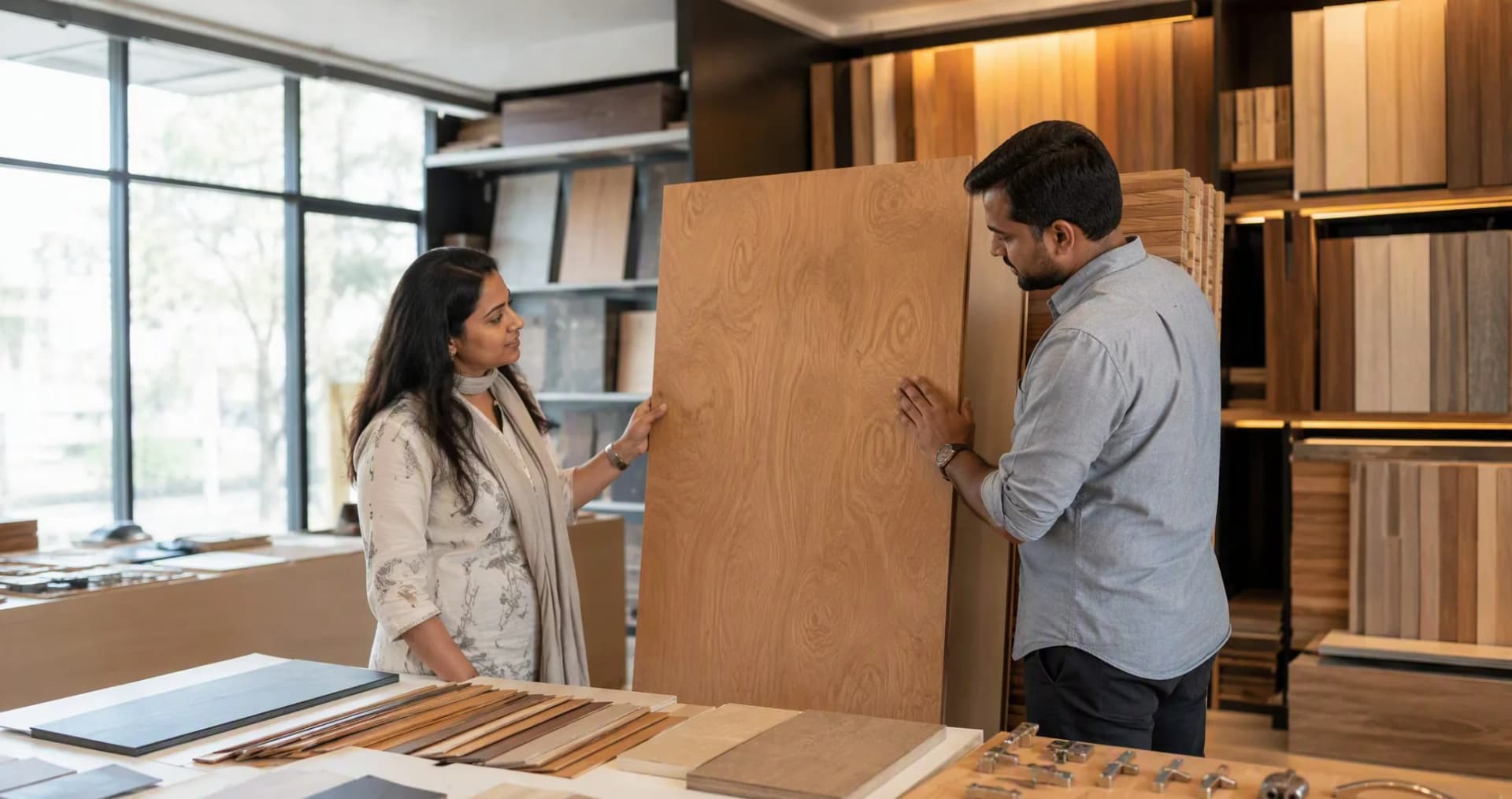
How to Identify Good Quality Interior Materials for Your Home
Every sheet in the shop looks good on day one. The difference between material that lasts twenty years and material that fails in three shows up only to buyers who know what to check. Here is the shop-floor skill set — for plywood, laminates, hardware and boards — that separates a confident purchase from an expensive guess.
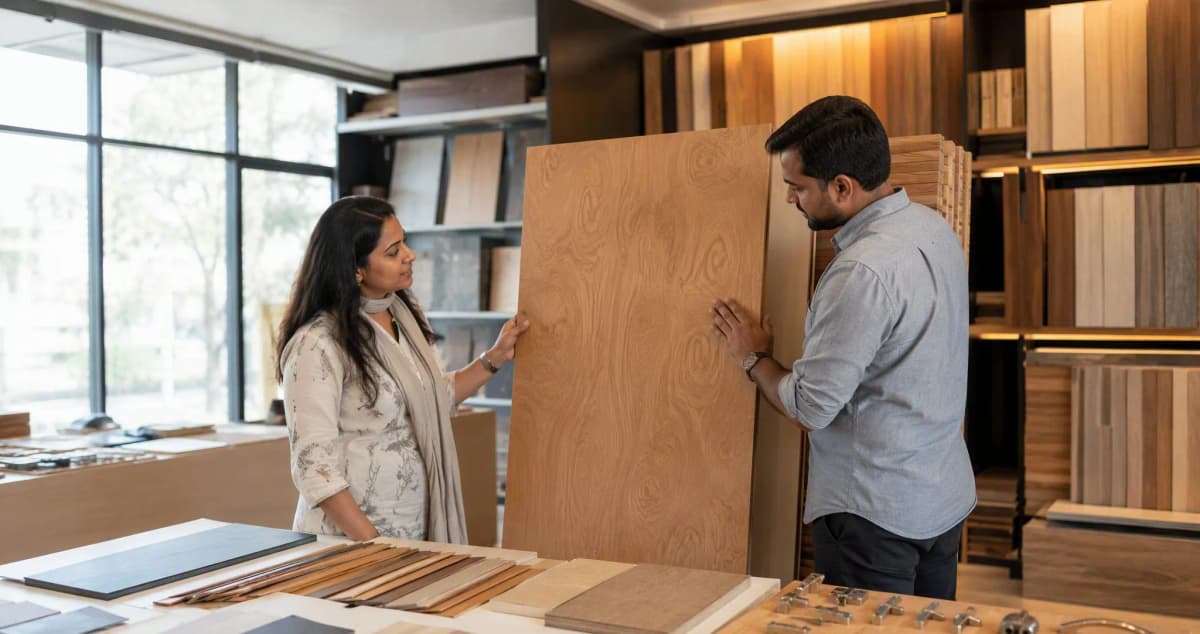
Identify quality materials in 30 seconds
Plywood: ISI mark + verifiable CM/L number, 11–13 plies on the edge, solid tap sound, heavy for its size. Laminate: brand and batch code printed on the brown backing, flexes without snapping, 1 mm HPL for kitchens. Hardware: exact brand and model written in the quote, original packaging at delivery, smooth soft-close. Boards (MDF/HDHMR): dense uniform edge, no crumbly corners. And the master rule: every material on your quote should have a brand, a grade and a number — "premium" is not a specification.
1. Why quality hides until year three
A wardrobe built from MR-grade board wearing an expensive laminate looks identical to a wardrobe built from calibrated BWP plywood — on the day it's installed. The difference announces itself slowly: a hinge screw that won't tighten any more, a shelf that sags in the middle, laminate edges lifting near the sink, a drawer channel that grinds instead of glides.
That delay is exactly why the material market works the way it does. Downgrading the invisible layer — the board inside, the adhesive, the channel behind the drawer — is invisible at handover and expensive at year three. Your only defence is to check materials before they are cut, glued and laminated, because after that, nobody can see inside.
The good news: you don't need a lab or an expert standing next to you. About 80% of material quality in India is checkable with your eyes, your knuckles, a coin and a tape measure. The remaining 20% — glue chemistry, formaldehyde emissions — is covered by buying certified material from authorised dealers with a proper GST invoice. This guide gives you both halves. If you're mid-renovation, our complete renovation materials list shows where each of these materials sits in the full project.
2. Plywood: six shop-floor tests
Plywood is the structural core of almost everything in your home — wardrobes, kitchen cabinets, beds, TV units. It is also the most adulterated material in the market. These six tests, done at the dealer's godown before loading, catch nearly every bad sheet. (Our plywood quality field guide goes deeper into each one.)
ISI mark + CM/L number — and actually verify it
Every genuine BIS-certified sheet carries the ISI mark, the IS number (IS 303 for MR/BWR, IS 710 for BWP marine) and a CM/L licence number printed directly on the face. That CM/L number is verifiable free on the BIS portal (manakonline.in) or the BIS Care app — it takes two minutes on your phone. Counterfeit sheets copy the ISI logo; they almost never carry a licence number that survives the lookup.
Count the plies, look for voids
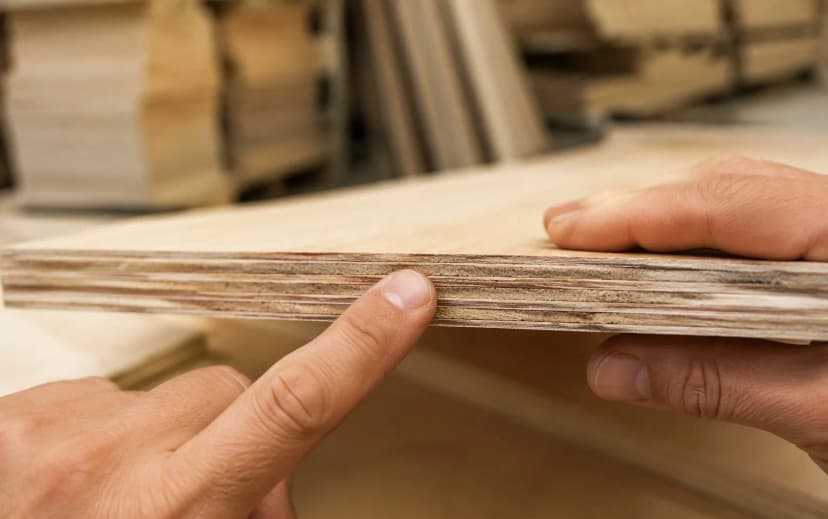
Pull a sheet partially out of the stack and examine the edge in good light. A quality 18–19 mm sheet shows 11–13 plies of even thickness with no gaps, overlaps or dark voids between layers. Budget sheets run 5–7 thick, uneven plies with visible voids — and voids are exactly where screws lose grip and moisture enters.
A solid thud, not a hollow drum
Tap firmly across the whole sheet with your knuckles, in a grid pattern, edges included. Good plywood returns a consistent, solid sound everywhere. A hollow or drum-like patch means an internal void or delamination — invisible from the face, fatal under load. This is the fastest single test a carpenter runs, and it catches problems no amount of laminating can fix.
Weight is a proxy for core density
An 18 mm hardwood-core (gurjan/eucalyptus) BWP sheet typically weighs 40–55 kg. Pick up one end and feel it. A suspiciously light sheet at the same thickness usually means a poplar or filler core — fine for a false ceiling, wrong for a kitchen carcass. One caution: a damp sheet is also heavy, so pair the lift with a dry, even face and the tap test.
Measure thickness at five points
Measure at four corners and the centre. Indian trade practice calls 17.0–17.8 mm "18 mm" — acceptable. But variation within a sheet above 0.5 mm means poor pressing, and it shows up later as rocking shutters, misaligned doors and peeling edge banding. If you're buying for a factory-made modular kitchen, ask for calibrated ply specifically — it holds ±0.2–0.3 mm.
Your nose is a formaldehyde detector
A sharp, chemical, eye-stinging smell means high formaldehyde emission or improperly cured resin — a real concern for bedrooms and kids' rooms where you sleep next to the material for eight hours a night. Quality boards carry E1 or E0 emission ratings and smell of wood, not solvent. Ask for the emission class; E0 is worth the premium for bedrooms.
Storage matters as much as manufacturing: In Indian godowns, sheets warp and delaminate before purchase — open stacking, rain exposure, ground contact. Ask where the stack has been sitting, check batch dates, and never accept a sheet with a bowed face or swollen edges, whatever the brand says. Once home, store sheets flat, elevated off the floor, and let them acclimatise for 48 hours before cutting.
3. Laminates and finishes: the backing-paper test
The laminate market in India is flooded with look-alikes that copy popular designs and fail within two years — scratching, fading, peeling at the edges. The checks below take minutes and catch nearly all of them.
The brown backing paper is the ID card
Every genuine branded laminate has the brand name, logo, product code and often a batch number printed on the brown backing paper — sheet after sheet, consistently. Duplicates have blank backing, smudged prints or missing batch codes. This one check, done before the sheet is cut, is the single most reliable laminate test there is.
Quality laminate flexes; cheap laminate snaps
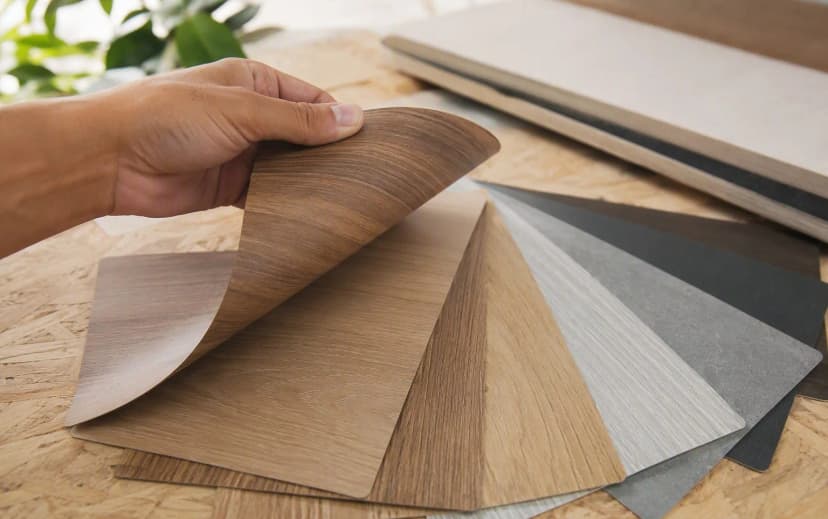
Take a sample and bend it gently. A genuine 0.8–1 mm HPL flexes in a smooth curve without cracking or whitening at the bend. Low-grade laminate snaps, creases or shows a white stress line — the same brittleness that later cracks on your shutter corners.
A coin tells you about the overlay
Scratch lightly with a coin or fingernail on a sample (not the full sheet). Quality HPL with a proper melamine overlay shows little or no mark. Duplicates scratch visibly or whiten — and remember, your kitchen shutters face this test daily from rings, keys and utensils.
1 mm for kitchens — and every sheet identical
For kitchens and wardrobes, insist on branded 1 mm HPL; sub-0.7 mm decorative laminates peel at edges within a few years. And if you're buying multiple sheets of the same design, lay them side by side: colour, grain and gloss must match sheet to sheet. Batch-to-batch consistency is a manufacturing discipline cheap producers don't have.
One more quote-level check: "sunmica" is a brand name that became generic, like "xerox". When a carpenter says "sunmica laga denge", ask which brand, which range, which thickness — the answer tells you whether you're getting ₹40/sq ft laminate or ₹120/sq ft laminate at the same line item.
4. Hardware: where kitchens get quietly downgraded
Hardware is the easiest place to cheat a customer, because the downgrade is invisible at handover. The shutter looks the same with a ₹45 hinge and a ₹250 hinge. The difference arrives in year three: drawers that sag, soft-close that stops soft-closing, hinges that won't hold alignment. Hardware is also a small fraction of the project — which makes downgrading it the worst-value saving in the entire build.
| Component | What to specify | Quick quality check |
|---|---|---|
| Hinges | Brand + model + soft-close + opening angle (e.g. clip-on soft-close, 110°) | Weight in hand; smooth, silent damping; brand stamped on the arm — not a sticker |
| Drawer channels | Full-extension, load rating in kg (45 kg for thali/utensil drawers), soft-close | Pull a display drawer fully out: no sag at full extension, no grinding, self-closes the last 5 cm |
| Handles & knobs | Material (SS 304 / brass / zinc alloy), finish, brand | Weight and finish uniformity; hollow-feeling "steel" handles are usually thin zinc with plating |
| Lift-up systems | Brand + model + door weight range | Door stays put at any angle; no drift down over ten seconds |
| Screws & fittings | Branded chipboard screws, not loose "hardware shop" stock | Consistent threading, no burrs; cheap screws strip the board on the second removal |
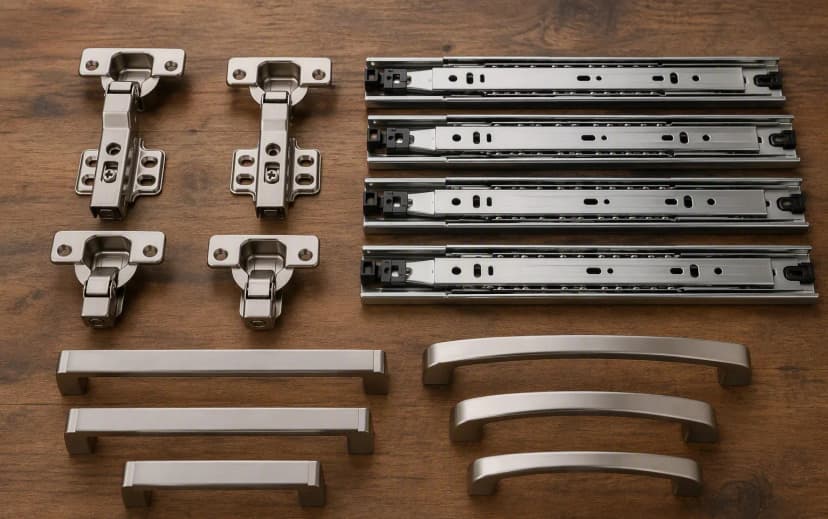
The fake-hardware check that actually works: Ask for brand and model in the written BOQ — "Hettich Sensys 8645i", not "Hettich hinges". At delivery, ask to see the original boxes or labelled packets, and photograph the model numbers before installation. After fitting, test every hinge and drawer yourself. Genuine brands stamp or laser-etch the logo onto the hinge arm or channel body; fakes use printed stickers that rub off. And treat the phrases "German hardware", "premium channels" and "Hettich-equivalent" as what they are: not specifications.
Spend your hardware money in this order: drawer channels first (they carry the heaviest daily loads), hinges second, accessories last. A kitchen with premium channels and mid-range hinges outlives one with premium handles and generic channels every time. Our modular kitchen plywood guide covers how hardware pairs with carcass material.
5. Boards, edge banding and the small stuff
MDF, HDHMR and particle board are legitimate materials in the right places — shutter panels, CNC-cut designs, painted units. The quality check is different from plywood: there are no plies to count, so you read the edge instead.
Dense and uniform beats fibrous and crumbly
Look at a cut edge or corner of the board. Quality MDF/HDHMR shows a dense, fine, uniform core with a visibly denser surface layer. Low-grade boards show coarse fibres, air pockets and crumbly corners — and crumbly corners are exactly where hinge screws fail first. HDHMR should feel distinctly denser and heavier than ordinary MDF at the same thickness; if it doesn't, it isn't.
Machine-applied, 1–2 mm, on every exposed edge
Every cut edge of a board or ply panel is an open door to moisture. Machine-applied PVC or ABS edge banding (1–2 mm) is what separates a 15-year carcass from a 5-year one — the board grade alone doesn't protect a raw cut edge. On your quote, "machine edge banding" should be a written line item, not an assumption. Hand-glued laminate strips on raw edges are a moisture path, not a finish.
The invisible 5% that decides the visible 95%
Nobody checks adhesives, and that's why they're skimped on. Ask which adhesive your carpenter uses for laminate work — a branded synthetic resin adhesive, not unbranded "fevicol-type" stock. For PU and melamine polish, ask for the brand and system (sealer + topcoat) in writing. A premium veneer finished with a cheap topcoat ages exactly like a cheap veneer.
For the full plywood-versus-board decision by application, our MDF vs plywood comparison goes factor by factor; the short version is: boards for shutter faces and painted panels, plywood for anything structural, wet or screw-loaded.
6. The quote test: vague words vs real specs
Most material fraud in India doesn't happen at the shop — it happens on the quote. Vague words create room for the vendor to downgrade after the contract is signed, and "premium marine ply" can legally mean almost anything. The fix is simple: every material line item should carry a brand, a grade and a number.
| The quote says | What it should say | Why it matters |
|---|---|---|
| "Marine ply" | Century/Kitply/Greenply BWP, IS 710, 18 mm, calibrated | "Marine-type" and "waterproof" are unregulated words; IS 710 is a tested standard |
| "Premium laminate" | Brand + range + thickness (e.g. 1 mm HPL, matte) | ₹40/sq ft and ₹120/sq ft laminate are both "premium" until a number appears |
| "German hardware" | Brand + model + soft-close + load rating | Every brand has entry-level and flagship lines; the model is the product |
| "Commercial ply" for a kitchen | BWR IS 303 minimum; BWP IS 710 at the sink | "Commercial" means MR grade — moisture-resistant, not water-resistant |
| "Termite-proof ply" | Grade + treatment chemical + warranty term in writing | Every ply is "termite-proof" until the warranty card is asked for |
| "Engineered wood" | MDF / HDHMR / particle board / plywood — named explicitly | The phrase hides the single most important material decision in your quote |
The pattern: replace adjectives with numbers. Brand, grade, IS number, thickness, model, load rating, warranty term. If a vendor resists writing these down, the resistance is the information. Our plywood buying mistakes guide covers the seven most expensive versions of this pattern, and the plywood price factors guide explains what the honest price bands look like so you can spot a too-cheap quote.
The 60-minute shop checklist
- Plywood stamp: ISI mark + IS number + CM/L verified on the BIS portal before loading
- Plywood edge: 11–13 even plies, no voids you can slip a fingernail into
- Tap + lift: solid uniform sound; 18 mm hardwood BWP feels 40–55 kg
- Thickness: 17.0 mm or more at five points; "calibrated" on the stamp for modular work
- Smell: woody, not chemical; E1/E0 emission class for bedrooms
- Laminate backing: brand + product code + batch printed on the brown paper; bend and coin tests on a sample
- Hardware: brand and model in the BOQ; boxes and labels photographed at delivery; every hinge and drawer tested before final payment
- Boards: dense uniform edge, no crumbly corners; HDHMR noticeably denser than MDF
- Paperwork: GST invoice naming brand, grade and thickness for every line — the invoice is your warranty's backbone
Frequently asked questions
How do I check plywood quality at a shop in India?
Five checks, ten minutes: verify the ISI mark and CM/L number on the BIS portal; inspect the edge for 11–13 void-free plies; tap the surface for a uniform solid sound; lift the sheet (18 mm hardwood BWP should feel 40–55 kg); measure thickness at five points (17.0 mm minimum for "18 mm"). Genuine sheets pass all five; downgraded stock usually fails two or more.
How can I tell if a laminate is original or duplicate?
Flip the sheet: genuine laminates carry the brand name, logo and product code printed on the brown backing paper, with a batch number. Then bend a sample (quality flexes without snapping) and scratch lightly with a coin (quality resists marking). Duplicates have blank or smudged backing, snap under bending, and scratch easily. A price far below market, offered without a GST bill, completes the picture.
What does the CM/L number on plywood mean?
CM/L (Certification Marks Licence) is the unique licence number BIS issues to each certified manufacturer, printed beside the ISI mark in CM/L-XXXXXXX format. Verify it free on manakonline.in or the BIS Care app. A sheet with an ISI logo but no verifiable CM/L number is almost certainly counterfeit — and a dealer who discourages the check is telling you something.
How do I know if my kitchen hardware is genuine?
Three-step verification: the written quote names brand and model (not "German hardware"); at delivery you see original boxes and photograph the labels; after installation you test every hinge and drawer — smooth soft-close, no sag at full extension. Genuine brands stamp or laser-etch their logo on the hinge arm or channel body. Anything with a sticker logo deserves a second look.
What is the difference between HPL and regular laminate?
HPL (high-pressure laminate) is pressed at high pressure over multiple kraft-paper layers, making it 0.8–1 mm thick, scratch-resistant and heat-tolerant — the right choice for kitchens and wardrobes. Cheap sub-0.7 mm decorative laminates scratch with a fingernail and peel at edges within a few years. When a quote says just "laminate", ask for the thickness.
Can I check material quality myself or do I need an expert?
Yourself, mostly. Tap tests, edge inspection, weight checks, backing-paper verification and model matching need no lab — just your senses and a tape measure. The parts you can't test (glue chemistry, formaldehyde emission) are covered by buying ISI-marked, E1/E0-rated material from authorised dealers with proper GST invoices. Verification by senses plus verification by paperwork covers the full risk.
Why do quotes say "premium plywood" instead of a brand and grade?
Because vague words preserve the vendor's option to downgrade after signing. "Premium", "marine-type", "branded" and "German" mean nothing enforceable. A trustworthy quote names the brand, grade, IS number, thickness and model for every line item. Vendors who work with honest material write specs happily; vendors who resist are telling you what they plan to install.
Is heavier plywood always better?
Usually — a dense hardwood core (gurjan, eucalyptus) weighs more than a poplar core at the same thickness, and density drives screw-holding and load strength. An 18 mm hardwood BWP sheet typically runs 40–55 kg. But a waterlogged sheet is also heavy, so pair the lift with a dry, even face and the tap test before you read weight as quality.
Standing in a showroom, unsure what you're looking at?
Bring your quote or your material list — we'll help you read it line by line, flag what's under-specified, and tell you what the honest version costs.
Get a free material consultation




