
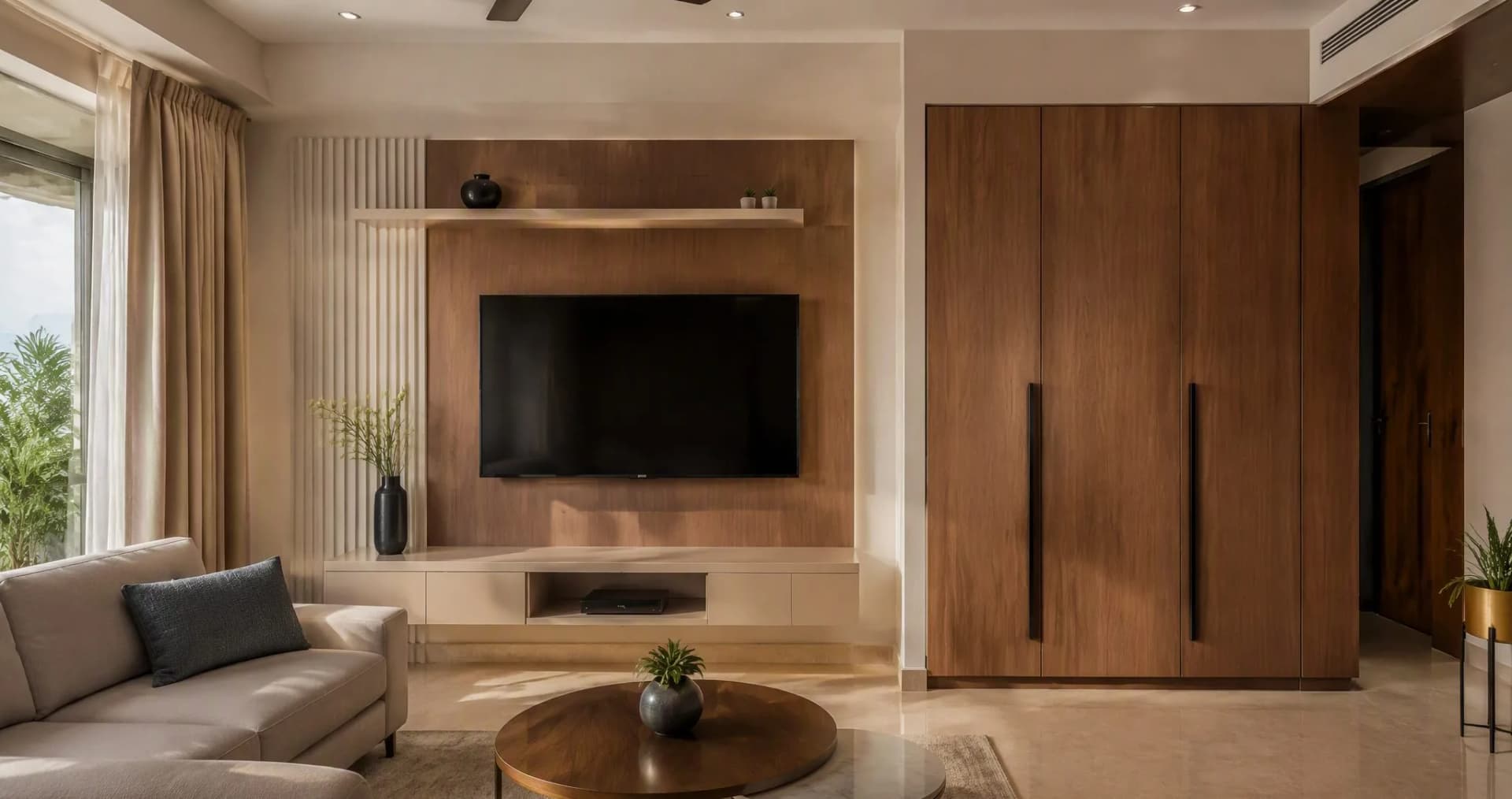
Why Material Quality Matters in Modern Interior Design
The design earns the compliment on day one; the material decides whether the compliment is still true on day 3,000. Here is the case for buying better — in money, in health, in daily use, and in what your home is worth when you sell it.
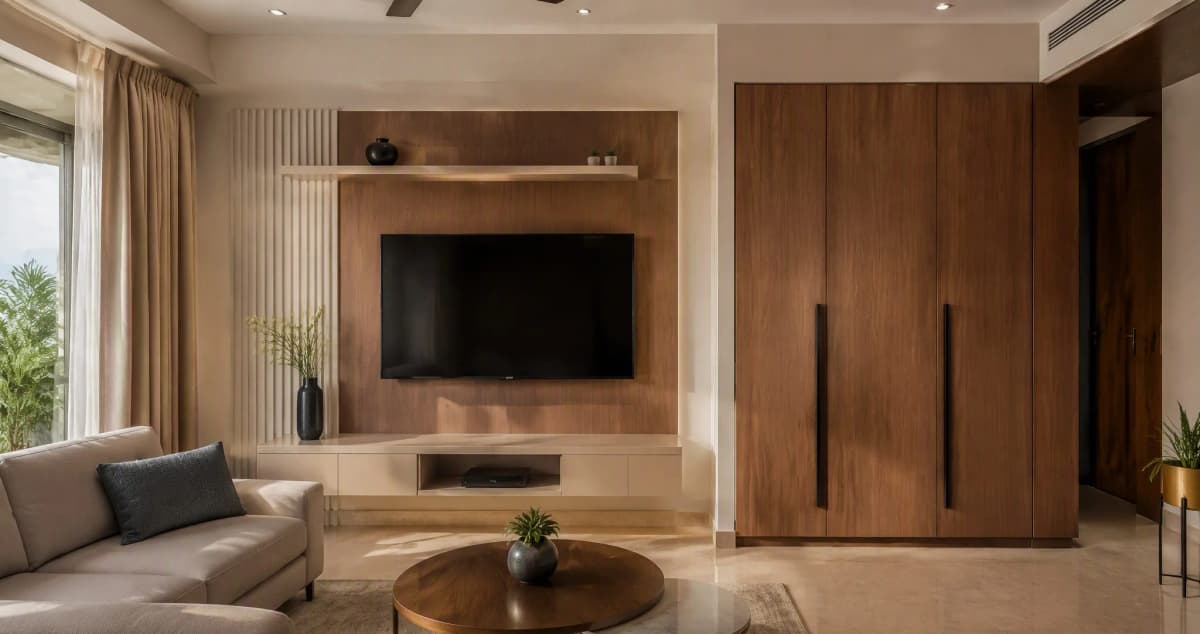
Because interiors are fixed infrastructure, not furniture. Quality materials cost 10–15% more upfront but last 15–25 years instead of 5–8 — over 15 years, a 3BHK built on quality materials is typically ₹8 lakh cheaper than one built cheap, once replacements are counted. Better boards also mean healthier indoor air (E1/E0 emission classes vs unregulated glue), smoother daily function (50,000-cycle hinges vs 5,000), and a home that sells or rents faster. The design is what you see; the material is what you live with.
1. The economics: cheap interiors cost more
Every interior quote is really two prices: the price you pay once, and the price you pay forever. Budget materials win the first number and lose the second — because interiors are not like curtains or cushions. A wardrobe is fixed to your wall, a kitchen has plumbing running through it, and replacing either means carpenters, dust, disruption and new laminate, hardware and labour — not just new board.
Upfront premium
For quality materials over budget-spec alternatives.
Lifespan of quality materials
Versus 5–8 years for budget alternatives.
15-year saving
On a 3BHK, lifecycle basis, once replacement and maintenance are counted.
Take a typical 1,400 sq ft 3BHK. A conventional budget-spec interior might come in around ₹15 lakh; the same design built on quality, durable materials around ₹17 lakh. But the budget interior needs partial replacement around year 8 (₹8 lakh), carries roughly ₹13,000 a year more in maintenance, and costs more to run. Over 15 years, the "cheap" interior totals about ₹32 lakh; the quality one about ₹24 lakh. The crossover happens around year 4–6 — after that, quality is pure savings.
| Cost head | Budget materials | Quality materials |
|---|---|---|
| Upfront build | ₹15 lakh | ₹17 lakh |
| Expected lifespan | ~8 years | 15–20 years |
| Maintenance over 15 yrs | ~₹5.25 lakh | ~₹3.3 lakh |
| Partial replacement (yr 8) | ~₹8 lakh | ₹0 |
| 15-year total | ~₹28–32 lakh | ~₹20–24 lakh |
And this table undercounts the truth, because it prices replacement but not disruption — the two weeks of dust, the packed-up kitchen, the carpenter who never quite matches the old finish. The plywood price factors guide shows how small the per-sheet gap between grades actually is relative to the cost of living through a rebuild.
The one-line version: Furniture is not changed like curtains. Anything fixed to your walls is a 15-year decision — and 15-year decisions deserve 15-year materials.
2. The failure timeline: how budget interiors actually age
Quality failures in interiors are never sudden. They arrive on a schedule so predictable that carpenters can tell you the year:
- Year 1: everything looks identical to the expensive version. This is the year that sells the cheap quote.
- Years 2–3: the sink cabinet floor swells and stains; shelf middles develop a visible bow; the first hinge screw stops holding.
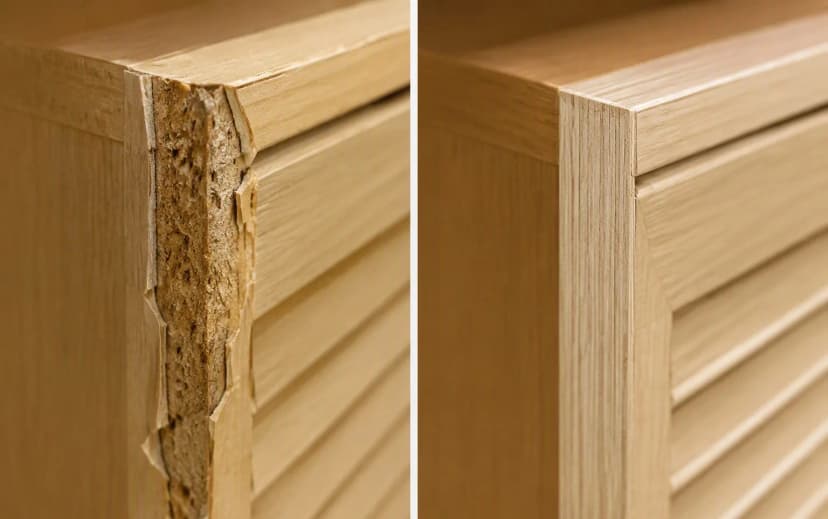
- Years 4–5: laminate edges lift near the hob and sink; drawers grind; shutters won't align no matter how the hinges are adjusted — because the problem isn't the hinge, it's the crumbling board the hinge is screwed into.
- Years 6–8: the conversation shifts from repair to replacement. The saving is spent, plus interest.
Quality materials age differently. Good plywood adjusts to your home's humidity in the first few months and then stabilises — it stops reacting to the seasons and holds its shape year after year. BWP marine ply cabinetry routinely crosses 20 years; BWR wardrobes run 15–20; branded 1 mm laminate stays intact for 12–18. Our durability guide explains the mechanics — glue lines, core density, edge sealing — behind those numbers.
3. The health layer nobody budgets for
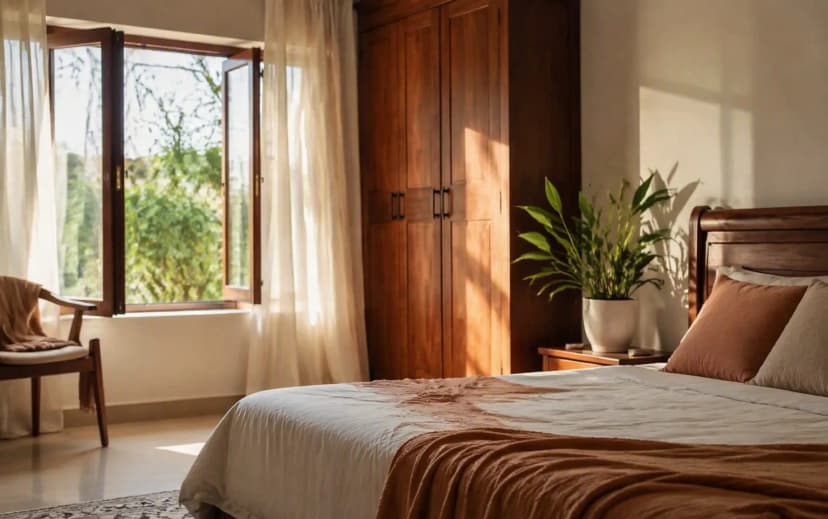
Material quality is not only a durability question — it is an air-quality question. Engineered boards are wood bonded with resin, and the cheapest resins are urea-formaldehyde based: they off-gas into your rooms for years. Solvent adhesives, oil-based enamels and cheap finishes add VOCs on top. Indian homes are typically less ventilated than Western ones, which concentrates whatever your materials emit — right where your family sleeps eight hours a night.
Formaldehyde is classified by IARC as carcinogenic to humans (Group 1), and WHO publishes an indoor-air guideline value for it. This doesn't mean your wardrobe is poisoning you — it means the emission class of your boards is a real specification, not marketing. The fix costs little: ask for E1 or E0 rated boards (E0 is the tighter class), low- or zero-VOC paints with the grams-per-litre printed on the tin, and water-based laminating adhesives. A sharp chemical smell from a fresh board is your free lab test — quality boards smell of wood.
One honest caution: "E0" printed in a brochure means nothing without the certificate. Ask for the declared emission class tied to the exact product on your invoice, and treat odour-free showrooms with suspicion only when the paperwork is missing too.
4. Function: the thousand small interactions
An interior is a machine you use a hundred times a day. Every drawer pull, every shutter swing, every shelf loaded with steel vessels is a stress test. Quality materials are what make those interactions invisible; budget materials are what make them annoying, then broken.
- Hardware: branded soft-close hinges and channels are typically rated for 50,000–80,000 cycles; unbranded fittings are rated for nothing and behave accordingly. A drawer that glides at year ten was specified, not lucky.
- Screw-holding: a dense hardwood-core board grips a hinge screw through years of slams; a soft poplar core or particle board lets go. Re-tightening works once, maybe twice — then the hole is powder.
- Shelf strength: 18 mm calibrated ply carries a shelf of utensils flat; 16 mm soft-core board memorises the load as a permanent bow.
- Finish behaviour: a quality 1 mm HPL shrugs off rings, keys and utensils; a sub-0.7 mm laminate records every one of them.
This is why "functionality" in interior design is really a materials property. The designer decides where the drawer goes; the board and channel decide how it feels to use in year six. If you're speccing a kitchen specifically, our modular kitchen plywood guide maps material grades to zones; for the board-versus-board decision, see the MDF vs plywood comparison.
5. Resale and rental value: the argument nobody makes
Watch what buyers and tenants actually do at a site visit: they open every wardrobe. They pull the kitchen drawers. They press on the sink cabinet floor. They are not admiring your design — they are auditing your materials, whether they know the word "carcass" or not.
A kitchen with swollen shutters and sagging shelves becomes instant negotiation leverage, typically worth far more off your asking price than the material upgrade ever cost. The reverse is also true: wardrobes that close flush, drawers that glide, a kitchen that looks five years old at year ten — these are among the strongest quiet signals of a well-kept home in the Indian resale and rental markets. Quality interiors don't just save you money; they protect the asset.

6. Where quality matters most — and where you can save
"Buy quality" does not mean "buy everything expensive." It means spending where failure is permanent and saving where it is cosmetic. The rule: spend on the skeleton, save on the skin.
| Never compromise (the skeleton) | Why | Safe to economise (the skin) |
|---|---|---|
| Kitchen carcass — BWP IS 710, 18 mm | Water, heat, daily load; the highest-stress zone in the house | Shutter finish — 1 mm laminate looks 90% of acrylic at a third of the price |
| Wardrobe carcass — BWR minimum | Holds weight for decades; replacement means rebuilding the room | Guest-room and study storage — lower stress, MR grade is fine |
| Hardware — branded hinges and channels | The moving parts take the daily abuse; downgrades fail first | Handles and knobs — easy to upgrade later, purely aesthetic |
| Edge banding & adhesives | The seal that protects every cut edge; invisible until it fails | Decorative wall panels — cosmetic, replaceable |
| Waterproofing (bathrooms, balconies) | Failure damages structure, not just finish | Paint brand in low-traffic rooms — mid-range emulsion is fine |
Notice what this map does to a tight budget: it doesn't demand more money, it moves money. A kitchen with a BWP carcass and laminate shutters outlives one with a particle-board carcass and acrylic shutters — and costs about the same. The renovation materials guide places each of these in the full project list, and the quality identification guide gives you the shop-floor tests to verify what you actually bought.
The quality-first decision rules
- Price materials on lifespan, not sheets: cost per year of service is the only honest comparison
- Spec the skeleton first: carcass grade, hardware and edge banding before any finish discussion
- Match the grade to the zone: BWP where water lives, BWR for the rest of the kitchen, MR only in dry rooms
- Ask for emission class in writing: E1 minimum, E0 for bedrooms — tied to the invoice, not the brochure
- Buy hardware by model number: brand + model + load rating; "German" is not a specification
- Verify before it's cut: ISI mark, CM/L number, backing paper, weight and tap test at the godown
- Keep the invoice for every sheet: it is your warranty's backbone and your resale audit trail
Frequently asked questions
Why does material quality matter more than design in interiors?
Design is what you see on day one; material is what you live with on day 1,000. A beautiful design built on the wrong board fails in 3–5 years — swollen shutters, sagging shelves, loose hinges — while a modest design on quality plywood looks good for 15–25. The design earns the compliment; the material decides how long it stays true.
Is buying premium interior materials worth the extra cost in India?
In lifecycle terms, yes. Quality materials add roughly 10–15% upfront but last 15–20 years versus 5–8 for budget alternatives. Over 15 years, a 3BHK built on durable materials typically comes out several lakh rupees cheaper once replacement and maintenance are counted — the premium pays for itself by about year 4–6.
How long do quality interior materials actually last?
In Indian conditions: BWP marine plywood cabinetry 20–25 years, BWR plywood 15–20 years, MR plywood 10–15 years in dry areas only. MDF and particle board manage 7–12 years in dry zones and 3–5 anywhere damp. Branded 1 mm HPL lasts 12–18 years; cheap laminates peel in 2–4. Quality soft-close hardware is typically rated for 50,000–80,000 cycles.
Do interior materials really affect health?
Yes. Boards bonded with urea-formaldehyde glue, solvent adhesives and high-VOC paints off-gas into indoor air for years, and Indian homes concentrate these emissions because they are less ventilated. Formaldehyde is classified as carcinogenic to humans (IARC Group 1). Specifying E1/E0-rated boards, low-VOC paints and water-based adhesives is a health decision, not a luxury upgrade.
Which materials should I never compromise on?
Anything structural, wet or moving: the kitchen carcass (BWP IS 710), wardrobe carcasses (BWR minimum), drawer channels and hinges (branded, load-rated), edge banding and adhesives, and waterproofing. These five carry the whole interior. Decorative surfaces, wall panels and guest-room furniture are where you can safely save.
Does interior material quality affect resale value?
Directly. Buyers and tenants open every wardrobe and pull every drawer during a site visit. Swollen sink cabinets, sagging shelves and grinding drawers become instant negotiation leverage, usually worth more than the upgrade ever cost. Kitchens and wardrobes in visibly good condition are among the strongest quiet value signals in the Indian resale and rental markets.
How do I balance quality and budget on a tight interior budget?
Spend on the skeleton, save on the skin. Put money into carcass boards, hardware, edge banding and adhesives — the layers that decide lifespan. Save on finishes: a quality 1 mm laminate on good ply looks nearly identical to acrylic at a third of the price, and finishes can be changed later. The carcass cannot.
What is the biggest sign a vendor is using poor-quality materials?
Vague language. "Marine-type ply", "premium laminate", "German hardware", "engineered wood" — every adjective without a brand, grade, IS number or model name is room to downgrade after signing. A trustworthy quote reads like a spec sheet. If a vendor resists writing down exactly what goes into your home, that resistance is the answer.
Want a quote that reads like a spec sheet?
Bring us your interior quote — we'll check every line for the brand, grade and number it should carry, and tell you where the money will actually matter in fifteen years.
Get a free material consultation




