

Things to Consider Before Choosing Interior Materials for Your Home
Most interior regret is not a design failure — it is a material decision made in a hurry, on a photo, without a spec. Here is the eight-point framework Indian homeowners should run through before a single sheet is ordered: rooms, climate, core boards, budget, samples and the paperwork that protects you.

Before choosing any interior material, settle eight things: how each room is actually used, your city's climate and moisture load, the core board before the surface finish, durability over day-one looks, honest maintenance appetite, physical samples approved in daylight, written specs — brand, grade, IS code, thickness, and every decision locked before carpentry starts. Get these eight right and the material list practically writes itself. The sections below work through each one, with the zone map, the budget split and the mistakes that cost Indian homeowners the most.
1. Start with the rooms, not the catalogue
The most common way Indian homeowners choose materials is also the worst: walk into a showroom, fall for a finish, and build the whole house around it. Materials should be chosen room by room, because every room in an Indian home has a different moisture load, usage intensity and wear pattern.
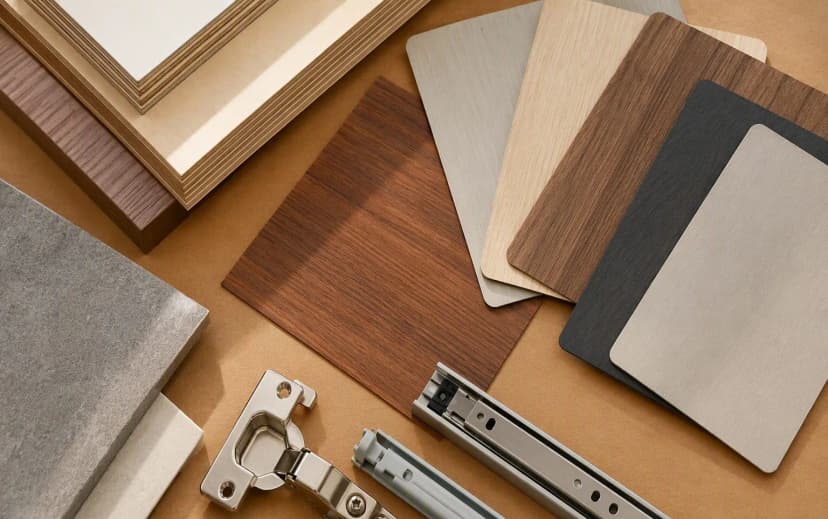
Before you look at a single laminate folder, map your home into four zones:
- Wet zones — kitchen counters and sink units, bathrooms, utility areas. Daily water contact, steam, mopping water. Only moisture-rated materials survive here.
- High-use dry zones — wardrobes, beds, TV units, study desks, shoe racks. No water, but constant opening, closing, loading and slamming. This is where hardware and screw-holding decide lifespan.
- Low-use zones — guest rooms, display units, pooja shelves. Aesthetic-led choices are safe here because nothing works hard.
- Decorative zones — wall panelling, partitions, false-ceiling accents, headboards. No load, no water. This is where budget materials are genuinely appropriate.
Every material decision in the house hangs off this map. The wet zones get the best boards and the best waterproofing; the high-use zones get the best hardware; the decorative zones absorb the savings. A home that treats every zone the same either overspends everywhere or — more commonly — under-specifies the two zones that fail first. The renovation materials list covers the full category-by-category shopping list this zone map feeds into.
2. The eight considerations, one by one
How the room is actually used — not how you wish it was
A family kitchen that runs three meals a day, a toddler's wardrobe, a home office used ten hours daily — each needs materials rated for that reality. A guest room used six nights a year does not. Write down, room by room: who uses it, how often, and what the hardest day looks like. That paragraph decides the spec far better than any catalogue.
Children and pets change the answer too — rounded edges, anti-scratch and anti-fingerprint surfaces, and hardware that survives being hung on. Honesty here saves money twice: once by not over-specifying low-use rooms, and again by not under-specifying the hard-working ones.
Your city's climate and moisture load
India is not one climate. A wardrobe spec that lasts 20 years in Jaipur can fail in five in Kochi. Humid and coastal cities — Mumbai, Chennai, Kolkata, Kochi, Goa — should treat every room as moisture-prone: BWR/BWP boards beyond just the kitchen, SS 304 hardware instead of mild steel, anti-fungal laminates and paints, and machine-sealed edges everywhere.
Hot-dry and composite cities (Delhi, Jaipur, Nagpur) face a different enemy: 20% winter humidity to monsoon saturation swings that make solid wood cup and cheap boards split at the joints. Moderate cities like Bengaluru and Pune get the most flexibility — but even there, a west-facing kitchen near a sink is a wet zone. Match the grade to the city's worst month, not its average one.
The core board before the surface finish
Homeowners spend weeks choosing the laminate everyone will see and minutes on the board underneath that decides whether the furniture survives. That is backwards. The carcass — the plywood or board skeleton — carries the load, holds the screws and meets the water. The laminate is a 1 mm skin.
Decide the core first: BWP marine ply (IS 710) where water stands, BWR (IS 303) where steam lives, MR/commercial ply in dry rooms, HDHMR/MDF only for painted shutter faces. The engineering case for plywood and the BWR vs BWP guide cover this decision in depth. The finish comes after — never before.
Durability over day-one looks
Showroom lighting is flattering and every sample is brand new. The real question is what the material looks like in year five. High-gloss white shows every fingerprint and scratch; matte and mid-tone textures hide a decade of use. Trend-led finishes date in three years; neutral woodgrains and muted solids survive style cycles.
The rule of thumb: put trends in things that are cheap to swap — handles, paint, loose furniture — and put longevity in things that are expensive to replace — carcasses, counters, shutters. The 15-year case for material quality runs the lifecycle math on this.
An honest maintenance appetite
Every finish has a maintenance price: veneers need periodic polishing, high-gloss acrylic needs microfibre discipline, textured laminates hide dust but hold grime in the grooves, and matte laminates wipe clean with a damp cloth. None of these is wrong — the mistake is choosing a high-maintenance finish for a household that will not maintain it.
Ask the question out loud: who cleans this, how often, and with what? A kitchen that gets wiped down daily can carry gloss; a rental or a busy family home cannot. Choose the finish that matches the household's real habits, and the interior stays good-looking without a maintenance schedule nobody follows.
Samples in your hand, in daylight, in the actual room
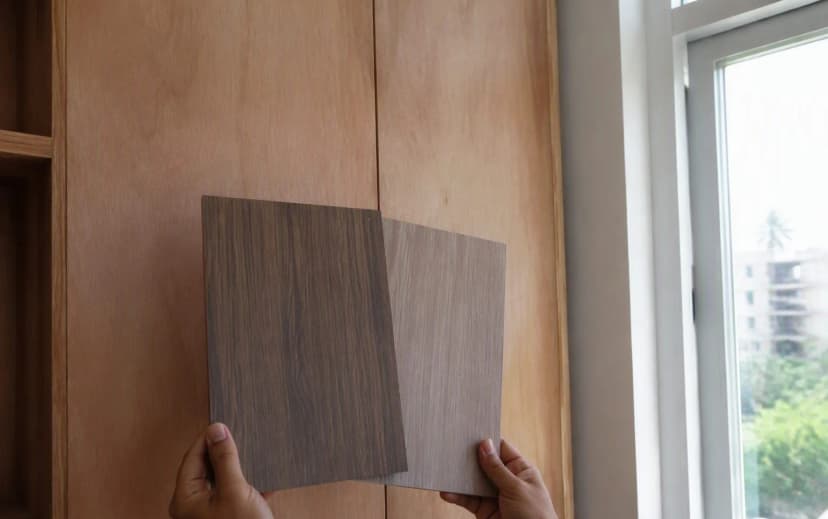
Phone screens lie about colour; showroom spotlights lie about gloss. Approve every finish as a physical sample held against the actual core board, in daylight, ideally in the room where it will live. North light and south light render the same laminate differently, and a shade that reads warm walnut in the showroom can read grey in a north-facing bedroom.
Sign and date the approved sample, and keep it until the material is delivered and cut. Batch variation between laminate lots is real, and the signed sample is your only objective reference if the delivered sheets differ. The shop-floor quality guide covers the full sample-verification routine.
Written specs: brand, grade, IS code, thickness
"BWR ply" in a quote is not a specification — it is a category that spans ₹1,800 to ₹4,500 a sheet. A real spec names the brand, the grade, the IS code and the thickness: 18 mm BWP plywood, IS 710, brand named, ISI mark verified on the sheet. The same goes for laminates (1.0 mm vs 0.8 mm is invisible once pasted), hardware (branded soft-close vs "equivalent") and adhesives.
Vague words are where substitutions hide. If the quote says "premium ply" or "branded equivalent," that line is unpriced and unenforceable. The buying-mistakes guide lists the substitution tricks this protects you from.
Everything decided before carpentry starts
Material decisions have an order, and the order is physical: board grade and thickness drive the cutting list; laminate batch consistency requires ordering the full requirement in one lot; toughened glass cannot be cut after tempering; and soft-close channels, lift-up mechanisms and hinge types change the internal dimensions of cabinets.
Decide all four categories — core board, surface, glass, hardware — before the first sheet is cut. A hardware decision made mid-build either compromises the design or forces rework, and rework is the most expensive material of all.
3. The zone-by-zone material map
Pull the considerations together and the material list writes itself. Here is the map most Indian homes should start from:
| Zone | Core board | Surface | Hardware |
|---|---|---|---|
| Kitchen — sink & base units | BWP marine ply, IS 710 | 1 mm laminate or acrylic, anti-fingerprint | SS 304 soft-close, branded |
| Kitchen — wall units | BWR ply, IS 303 | 1 mm laminate, matte or textured | Soft-close hinges + lift-ups |
| Bathroom vanity | BWP marine ply, IS 710 | Laminate or PU; all edges machine-sealed | SS 304 only — no mild steel |
| Wardrobes & beds | BWR or good MR ply (humid cities: BWR) | 1 mm laminate outside, 0.8 mm inside | Branded soft-close on daily doors |
| TV unit, study, bookshelves | MR/commercial ply, 18 mm + 25 mm shelves | Laminate or veneer | Standard channels, branded hinges |
| Guest room & low-use units | MR/commercial ply | 0.8–1 mm laminate | Standard branded hardware |
| Wall panelling & partitions (dry) | Pre-lam particle board or MDF is fine here | Pre-laminated or paint | Minimal |
| Painted / CNC-routed shutters | HDHMR or MDF — not plywood | PU or duco paint | Branded soft-close |
Read the map by zone and two patterns emerge. First, the wet zones are where premium is mandatory — this is the 20% of the house that causes 80% of failures. Second, the decorative rows are where the savings legitimately live. The modular kitchen guide specs the kitchen rows zone by zone, and the MDF vs plywood comparison explains why the painted-shutter row is the one place plywood is the wrong answer.
The one-line version: Premium boards and hardware where water and daily use live; standard spec where they don't; fibreboards only where nothing structural or wet happens. Print the map, take it to the showroom, and let the zones — not the sales pitch — drive the order.
4. Budget: spend where the material works hard
Budget regret is rarely about the headline number — it is about allocation. Money put where the material works hard returns value for 15 years; money put where it merely photographs well is gone the day the trend turns.
| Invest (never compromise) | Standard spec is fine | Save deliberately |
|---|---|---|
| Plywood grade in kitchens & bathrooms — BWP/BWR, IS-marked | Dry-room boards — MR/commercial ply for wardrobes, TV units | Loft shutters and internal shelves — 0.8 mm laminate, standard board |
| Hardware on daily-use doors and drawers — branded soft-close | Wardrobe exteriors — 1 mm matte laminate | Decorative panelling and display backs — pre-lam boards |
| Kitchen counter surfaces — anti-scratch, heat-tolerant | Bedroom and living-room finishes | Trend-led accents — handles, paint, loose furniture (cheap to swap later) |
| Edge banding and sink-unit waterproofing | Internal hardware — standard channels in low-use drawers | Guest-room everything |
Two budget disciplines complete the picture. First, hold 10–15% of the total as contingency from day one — every project meets a surprise, and a contingency spent on day five is a corner cut on day fifty. Second, tie payments to delivered milestones, not dates. The Bangalore plywood price guide gives the per-sheet benchmarks to sanity-check the quote against.
5. The mistakes that cost the most
The wrong material rarely fails on day one — it fails on month eight, when replacing it means dismantling everything built on top of it. These are the failures Indian homeowners report most, and what each one costs:
| Mistake | What it costs you | The fix |
|---|---|---|
| Particle board / MDF in wet zones | Swollen, crumbling carcasses in 1–2 years; full kitchen rebuild | BWP/BWR ply in kitchen and bath — no exceptions |
| Cheap hardware on daily-use joinery | Sagging hinges, jamming drawers, doors that never close true | Branded soft-close where you open things daily |
| Choosing finishes by photo | Colour and texture that don't match the promise; no recourse | Physical sample approved in daylight, signed, kept |
| Lump-sum quote, no BOQ | No way to compare quotes; substitutions invisible until delivery | Itemised BOQ — brand, grade, IS code, thickness per line |
| Glossy white everywhere | Every fingerprint, scratch and water spot shows, forever | Matte and mid-tones in high-touch areas |
| No contingency | Panic cuts when the first surprise appears | Hold 10–15% from day one; spend it last |
| Premium everywhere "to be safe" | Blown budget, no better lifespan in low-use zones | Premium where it works hard; standard where it doesn't |
Notice what is not on the list: choosing the cheaper board in a dry room, skipping veneer for laminate, or buying standard hardware for a display cabinet. Matched to the zone, those are smart savings. The mistakes are all mismatches — the wrong material in the wrong zone, or no paperwork to hold anyone to the promise. The plywood buying-mistakes guide and the plywood selection guide go deeper on the board-side errors.

6. The pre-order checklist
Run this list before any material is ordered. If every box ticks, the project is protected against the mistakes above.
- Zone map done — every room classified wet / high-use / low-use / decorative
- Climate check done — spec matched to your city's worst month, not its average
- Core boards specified by grade and IS code — BWP (IS 710) wet, BWR (IS 303) steam, MR dry
- Finishes approved as physical samples — in daylight, against the actual board, signed and kept
- Hardware chosen before carpentry — channels and hinges change internal dimensions
- BOQ is itemised — brand, grade, thickness and quantity on every line; taxes, transport and installation explicit
- 10–15% contingency held — untouched until the surprises arrive
- Payments tied to milestones — never to dates, never fully in advance
When the materials arrive, the shop-floor verification guide walks you through checking every sheet against the BOQ — ISI marks, ply counts, batch codes — before the carpenter's blade touches anything.
Frequently asked questions
What should I consider before choosing interior materials for my home?
Eight things, in order: how each room is actually used, your climate and moisture zone, the core board before the surface finish, durability over day-one looks, honest maintenance appetite, physical samples approved in daylight, written specs with brands and IS codes, and every decision locked before carpentry starts.
Which interior material is best for Indian homes?
There is no single best material — it depends on the zone. BWP plywood for wet zones, BWR ply for steam-prone areas, MR/commercial ply for dry rooms, HDHMR or MDF for painted shutters, and branded soft-close hardware for anything opened daily. The right material is the one matched to the room's moisture, load and usage.
How do I choose materials for a humid or coastal city in India?
Assume every room is moisture-prone: upgrade wet-zone boards to BWP marine ply (IS 710), use BWR in bedrooms, choose anti-fungal laminates and paints, specify SS 304 hardware instead of mild steel, and machine-seal every cut edge. In coastal air, mild-steel fittings corrode and unsealed board edges wick moisture year-round.
How should I split my interior materials budget?
Spend where the material works hard: invest in wet-zone boards, daily-use hardware and kitchen counter surfaces; standard-spec dry-room boards and internal laminates; save deliberately on lofts, panelling and guest rooms. Hold 10–15% of the total as contingency and tie payments to delivered milestones.
Is it really necessary to see material samples before buying?
Yes. Screens distort colour and showroom spotlights flatter gloss. Approve every finish as a physical sample in daylight — ideally in the room itself — sign it, and keep it until delivery. Batch variation between laminate lots is common, and the signed sample is your only objective reference if the delivered sheets differ.
What is a BOQ and why does it matter for interior materials?
A BOQ (bill of quantities) is an itemised material list — brand, grade, thickness, size and quantity for every unit. It matters because lump-sum quotes hide substitutions: "BWR ply" without a brand and IS number can become any board on delivery day. The BOQ is what turns a sales promise into an enforceable spec.
Should hardware be decided before carpentry starts?
Yes. Soft-close channels, lift-up mechanisms and hinge types change the internal dimensions of cabinets, so the carpenter needs the hardware decision before cutting the first sheet. Hardware chosen late either compromises the design or forces expensive rework.
What are the most expensive material mistakes homeowners make?
Particle board or MDF in wet zones (swollen carcasses within 1–2 years), cheap hardware on daily-use joinery, finishes chosen from photos without samples, lump-sum quotes with no BOQ, glossy white in high-touch areas, no contingency, and premium specs in low-use zones where standard would have lasted just as long.
Choosing materials for a project right now?
Bring your floor plan and room list — we'll map your zones, spec the boards and finishes for each one, and build you an itemised material list with brands, grades and IS codes you can take to any showroom.
Get a free material consultation




