How to Choose the Right Interior Materials for Your Dream Home in India
Quick Answer: How Do You Choose the Right Interior Materials?
The right interior material for your Indian home depends on four things: where it will be used (zone), how much moisture and wear it will face, your budget, and how much maintenance you are willing to do. As a rule of thumb: use vitrified tiles for most floors, washable emulsion paint for walls, BWP (IS 710) plywood or WPC for kitchen and bathroom carcasses, laminate for daily-use shutters, and granite for heavy-use countertops. This guide gives you the exact prices, comparisons and a printable checklist to make every decision with confidence.
Why Material Choice Matters More in India Than Anywhere Else
If you are building or renovating a home in India, the materials you choose will decide whether your interiors last 20 years or start failing in 2. Indian conditions are uniquely demanding: monsoon humidity frequently crosses 80% in most regions, and research cited by the Indian Council of Agricultural Research indicates termite activity rises by around 60% during monsoon months. Add daily tadka cooking, heavy utensil use, frequent wet mopping and dust — and it becomes clear why a material that works beautifully in a European catalogue can fail badly in a Mumbai or Kochi apartment.
The financial stakes are equally high. Full-home interiors in India typically cost ₹1,200–₹4,500+ per sq ft depending on the grade of materials you select — and material choice alone can double your per-square-foot rate. Choosing the wrong material in the wrong place rarely fails on day one; it fails on month eight, when replacing it means dismantling everything built on top of it. That is why this guide compares every major category with real Indian price benchmarks, so you can decide once — and decide right.
The 7-Factor Material Decision Framework
Before looking at any catalogue, score every material option against these seven factors. This is the same process professional interior designers follow, and it removes 90% of the confusion.
- Zone & exposure: Is the surface dry (bedroom wall), semi-wet (kitchen shutters) or wet (sink base, bathroom)? Match the material grade to the zone, never the other way round.
- Wear & traffic: Floors, kitchen counters and main-door areas face the highest abuse. Bedrooms and display units face the least.
- Moisture & climate: Coastal and high-humidity cities (Mumbai, Chennai, Kochi, Kolkata) need waterproof or moisture-resistant boards and anti-fungal paints.
- Maintenance appetite: Marble, veneer and high-gloss acrylic look stunning but demand regular care. Vitrified tiles and laminates are nearly zero-maintenance.
- Budget — total cost of ownership: Compare 10-year cost, not sticker price. Marble's polishing and sealing can make it the most expensive flooring over a decade, even before its higher purchase price.
- Safety & health: Check IS/BIS certification, E0/E1 formaldehyde emission ratings for boards, and anti-skid ratings for wet-area flooring.
- Longevity of look: Trendy finishes date quickly. Keep your base palette neutral and express trends through cheap-to-swap accents like cushions, art and a single textured wall.
Flooring: Vitrified Tiles vs Marble vs Granite vs Wood
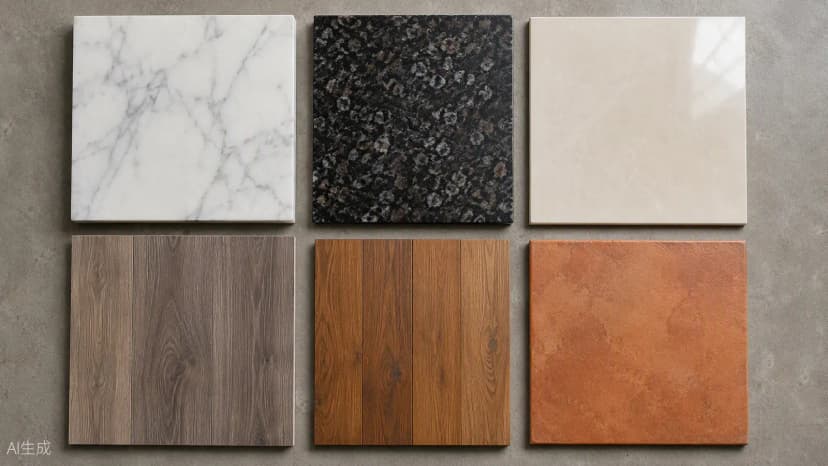
Flooring is the single largest surface in your home and the hardest to change later. Here is how the four most popular options in India compare:
| Factor | Vitrified Tiles | Granite | Marble | Wooden / Laminate Flooring |
|---|---|---|---|---|
| Price (per sq ft) | ₹50 – ₹300+ | ₹80 – ₹400+ | ₹100 – ₹3,000+ (depends on origin) | ₹80 – ₹500+ |
| Durability | High — scratch & stain resistant | Very high — dense & strong | Moderate — softer, scratches & etches | Moderate — scratches, moisture-sensitive |
| Maintenance | Very low — no polishing or sealing | Low — occasional sealing | High — regular sealing & polishing | Moderate — keep away from water |
| Best for | All rooms, living areas, wet zones | Kitchens, staircases, outdoors | Luxury living rooms, feature areas | Bedrooms, AC rooms, low-moisture zones |
| Indian-condition fit | Excellent — handles mopping & humidity | Excellent — heat & heavy-use friendly | Stains with turmeric, oil, acids | Risky in humid/coastal cities |
Our recommendation: For most Indian homes, large-format vitrified tiles (800×1600mm or bigger) offer the best balance of cost, durability and zero maintenance — modern marble-look vitrified slabs now deliver a near-seamless luxury look without marble's upkeep. Reserve real marble for a statement area if you love it, use granite for stairs and utility areas, and keep wooden or laminate flooring strictly to air-conditioned bedrooms in drier cities. Whatever you pick, remember installation matters: natural stone needs skilled labour, multiple rounds of polishing and stronger base support — costs that often surprise homeowners mid-project.
Wall Finishes: Distemper, Emulsion, Texture & Wallpaper
Walls set the mood of every room and are the cheapest surface to change — which makes them the perfect place to balance budget and style. Interior painting in India ranges from ₹8 to ₹50 per sq ft depending on the paint type.
| Finish | Approx. Cost (per sq ft) | Durability | Best Use |
|---|---|---|---|
| Distemper | From ₹8 (2 coats) | Low — not washable, strong odour | Rental homes, very tight budgets |
| Plastic Emulsion | From ₹15 (2 coats) | High — washable, anti-fungal variants available | Almost every room — the safe default |
| Texture Paint | ₹80 – ₹250 | High, but hard to repair patches | One accent wall per room, max |
| Wallpaper | ₹60 – ₹300+ (material + install) | Moderate — peels in humidity | Dry, air-conditioned rooms only |
Three rules save most homeowners money here. First, never skip primer — skipping it is the most common painting mistake in India, and it makes even premium emulsion look dull and patchy. Second, match paint to the room: use washable, stain-resistant emulsion in kitchens and kids' rooms. Third, use texture or wallpaper as an accent, not the whole house — a 100 sq ft textured feature wall costs roughly ₹8,000–₹25,000, while doing every wall would multiply your painting budget several times over. For a 1,000 sq ft wall area, a fresh emulsion coat works out to roughly ₹15,000 — one of the highest-impact, lowest-cost upgrades in any home.
Kitchen: Carcass Boards, Countertops & Shutter Finishes
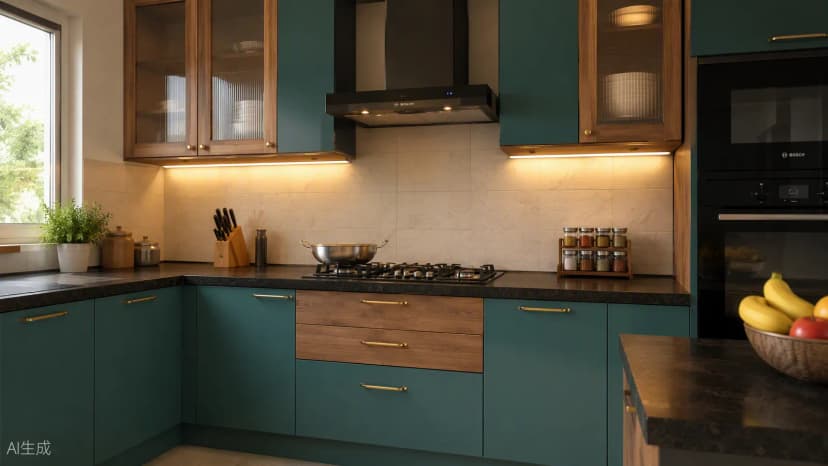
The kitchen is the most material-intensive room in an Indian home — it faces steam, oil, turmeric stains, hot tawas and daily water exposure. A modular kitchen typically costs ₹2,200–₹6,000 per sq ft, and the decisions below drive both that cost and its lifespan.
Step 1 — Choose the Carcass (the hidden board inside)
| Board | Water Resistance | Approx. Price | Where to Use |
|---|---|---|---|
| MR Plywood (IS 303) | Low — humidity only | ₹40 – ₹90/sq ft | Never in kitchens; dry furniture only |
| BWR Plywood (IS 303) | Moderate — occasional splashes | ~20% above MR | Wall cabinets in dry kitchens |
| BWP / Marine Plywood (IS 710) | High — survives boiling-water tests | ₹90 – ₹300/sq ft | Sink bases, all wet zones — the gold standard |
| HDHMR Board | High (not fully waterproof) | ₹55 – ₹85/sq ft | Shutters, wall units, wardrobe carcasses |
| WPC / PVC Board | 100% waterproof + termite-proof | Mid-premium | Under-sink units, bathroom vanities |
| MDF / Particle Board | Poor — swells irreversibly | Cheapest | Avoid in kitchens entirely |
The smartest kitchens use a zone-wise mix rather than one board everywhere: BWP plywood for base cabinets near the sink and hob, HDHMR for wall cabinets and shutters (its smooth surface bonds laminate and acrylic beautifully), and WPC under the sink. Using MDF or particle board in a kitchen is the single most expensive "saving" you can make — swollen, crumbling carcasses typically show up within 1–2 monsoons, and replacement means rebuilding the entire kitchen.
Step 2 — Choose the Countertop
| Countertop | Approx. Price (per sq ft) | Strengths | Watch Out For |
|---|---|---|---|
| Granite | ₹80 – ₹400+ | Best heat resistance; handles hot tawas; unique natural patterns | Porous — needs periodic sealing |
| Quartz | ₹250 – ₹700+ | Non-porous, zero sealing, consistent premium look | Costs more; can scorch under direct high heat |
| Corian / Solid Surface | ₹300 – ₹800+ | Seamless joints, repairable scratches | Scratches and burns easily; weaker for heavy Indian cooking |
| Marble | ₹150 – ₹1,000+ | Beautiful | Avoid in kitchens — etches with lemon, tamarind, vinegar |
Verdict: For most Indian kitchens, dark granite remains the most forgiving, heat-proof and value-for-money countertop. Choose quartz if you want a brighter, uniform premium look and are disciplined about using trivets. Whatever you choose, inspect full slabs before fabrication — colour and fissures vary between slabs.
Step 3 — Choose the Shutter Finish
| Finish | Price (per sq ft) | Look | Maintenance Reality |
|---|---|---|---|
| Laminate (HPL) | ₹120 – ₹350 | Matte, textured, woodgrain or gloss | Easiest to live with; textured hides fingerprints |
| Acrylic | ₹350 – ₹700 | Deep, mirror-like gloss | Shows fingerprints & scratches; best on upper shutters |
| PU Paint | ₹600 – ₹1,200 | Any custom colour, seamless | Chips on impact; colour-matching repairs is tricky |
| Veneer | ₹500 – ₹1,000+ | Real wood grain warmth | Needs periodic polishing; keep away from splash zones |
A proven hybrid used by top Indian designers: textured laminate on base cabinets (where wear is highest) + acrylic on upper shutters (where gloss shows best). For rental properties, laminate throughout is the safest, most forgiving choice.
Wardrobes & Furniture: Plywood Grades Explained
Wardrobes cost roughly ₹1,800–₹4,500 per sq ft, and the grade of plywood inside them decides whether they survive a decade of monsoons. India regulates plywood through Bureau of Indian Standards (BIS) norms — always check the stamp:
| Grade | IS Standard | Water Resistance | Right Application |
|---|---|---|---|
| MR (Commercial) | IS 303 | Resists humidity, not water | Bedroom wardrobes, TV units, study tables |
| BWR | IS 303 (higher spec) | Resists boiling water up to ~8 hours | Kitchen wall cabinets, semi-wet furniture |
| BWP / Marine | IS 710 | Fully waterproof grade | Kitchen bases, bathroom vanities, utility |
| Fire-Retardant | IS 5509 | Depends on base grade | Kitchens near gas lines, commercial spaces |
Practical tips that separate a good wardrobe from a regret: choose calibrated plywood for factory-finished modular furniture (uniform thickness means better laminate bonding and cleaner edges); insist on E0/E1 low-emission boards for bedrooms, especially kids' rooms; and always verify the IS stamp on the board edge at delivery — the laminate surface can hide a cheaper carcass underneath. Reputed Indian brands offer termite- and borer-resistant, warranty-backed options in every grade, so there is no reason to accept unmarked local ply for a home you plan to live in for decades.
Bathroom Materials: Waterproofing First, Looks Second
Bathrooms fail from the inside out — seepage behind tiles is the most common and most expensive interior defect in Indian apartments. Get the sequence right: waterproof the slab and walls first, then choose surface materials.
- Floor: Use certified anti-skid vitrified or ceramic tiles (matte or textured finish). Porcelain tiles with water absorption below 0.5% are ideal for shower zones. Glossy tiles on a bathroom floor are a slip hazard, especially for elders.
- Walls: Full-height ceramic/vitrified tiles remain the durable classic — but note that grout lines absorb moisture and grow mould, so use epoxy grout. Modern PVC wall panels are a 100% waterproof, seamless, budget-friendly alternative that installs directly over existing surfaces — popular for quick renovations.
- Vanity cabinets: Only IS 710 BWP plywood, WPC or PVC — never MDF or MR ply anywhere in a bathroom.
- False ceiling: Use moisture-resistant gypsum board or PVC panels, never POP in wet bathrooms.
- Fixtures: In coastal cities, salt air corrodes cheap fittings fast — choose 304-grade stainless steel or brass with proper plating.
Region-Wise Advice: One Country, Four Climates
India is not one climate. The right material in Jaipur can be the wrong material in Kochi:
| Region | Climate Challenge | Material Strategy |
|---|---|---|
| Coastal (Mumbai, Chennai, Kochi, Goa) | Humidity 75–95%, salt air, heavy monsoon | WPC/PVC in wet zones, anti-fungal emulsion, 304-grade steel hardware, avoid veneer & wallpaper, extra sealing for wood |
| Southern humid interiors (Bengaluru, Hyderabad) | Moderate humidity, mild temperatures | Standard specs work well; BWP ply in kitchens; engineered wood flooring possible in AC bedrooms |
| Northern plains (Delhi NCR, Punjab, UP) | Extreme heat + 2–3 months of 75–95% monsoon humidity | No MDF in kitchens; dust-friendly matte finishes; regular oiling of solid wood; avoid dark gloss in high-touch areas |
| Dry west (Rajasthan, Gujarat interiors) | Heat, dust, termites in irrigated zones | Pre-construction anti-termite treatment essential; heat-tolerant finishes; stone flooring stays naturally cool |
Budget Planning: Real Costs & Hidden Charges
Knowing the going rates protects you from both overpaying and from suspiciously cheap quotes that hide inferior materials:
| Interior Tier | Cost per sq ft (carpet area) | What You Get |
|---|---|---|
| Basic | ₹1,200 – ₹1,800 | Pre-laminated boards, basic hardware, flat finishes |
| Standard | ₹1,800 – ₹2,800 | BWP plywood, branded hardware, soft-close systems |
| Premium | ₹2,800 – ₹4,500 | Marine ply, acrylic/PU finishes, designer lighting |
| Luxury | ₹4,500 – ₹8,000+ | Imported stone, veneer, smart-home integration, bespoke millwork |
For context, a well-finished 3BHK in a metro city typically runs ₹12–₹25 lakhs in total, with the kitchen alone accounting for ₹2–6.5 lakhs depending on tier. City matters too: Mumbai interiors average ₹3,000–₹6,000 per sq ft while Kolkata averages ₹1,800–₹3,500. Three budgeting habits prevent 90% of disputes:
- Demand an itemised Bill of Quantities (BOQ) — with brand names, grades, IS codes and quantities — instead of a lump-sum quote. This is the single best protection against material substitution.
- Check what the per-sq-ft rate excludes: loose furniture, appliances, curtains and civil work are usually extra. Add 8–12% contingency on top of every quote.
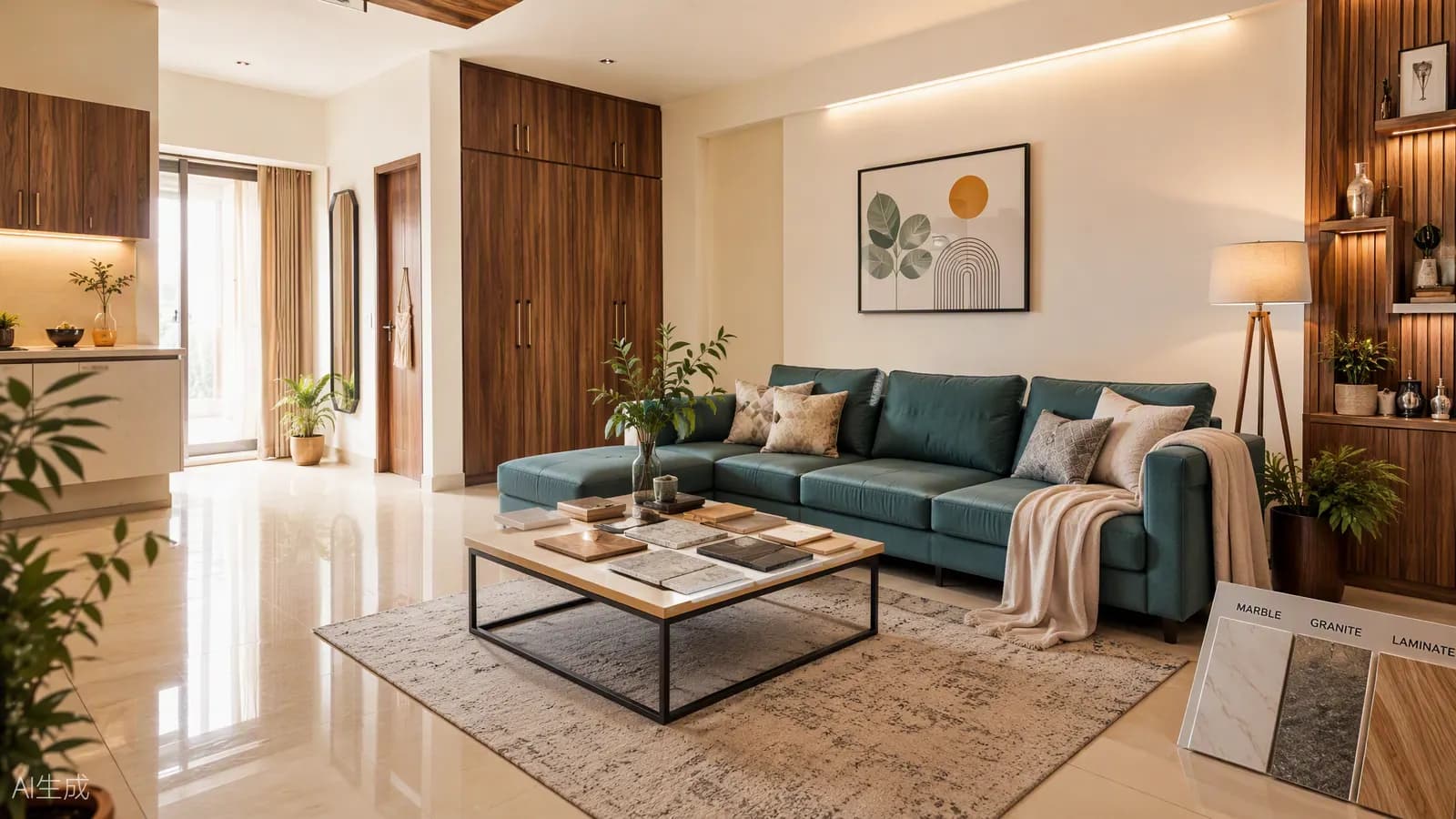
- Approve physical samples in writing before any bulk order — showroom lighting and catalogue photos routinely misrepresent colour and texture.
7 Costly Material Mistakes Indian Homeowners Make
- Particle board or MDF in kitchens and bathrooms — swollen, crumbling carcasses within 1–2 years. The fix: BWP ply (IS 710) or WPC in every wet zone.
- Choosing on looks alone — high-gloss white everything shows every fingerprint, scratch and water spot. Matte and mid-tones age far better in high-touch areas.
- Buying finishes, ignoring the carcass — a ₹700/sq ft acrylic shutter on MR plywood is money wasted. The hidden board decides the lifespan.
- Chasing trends in permanent materials — a trendy floor or countertop looks dated in three years. Keep big surfaces neutral; express trends in cheap-to-swap accents.
- Cheap hardware on daily-use joinery — sagging hinges and jamming drawers within months. Use branded soft-close hardware on anything you open daily.
- Skipping primer and surface prep in painting — the most common painting error in India; it ruins even premium emulsions.
- Approving materials from photos — always approve a physical sample of every finish, in writing, before the bulk order.
The Final Material Selection Checklist
Print this or save it on your phone — tick each item off before you sign any material order:
- Every wet-zone carcass specified as BWP (IS 710), WPC or PVC — in writing in the BOQ
- IS/BIS code and brand name written next to every board in the quotation
- Termite/borer treatment confirmed for all wooden elements (and pre-construction treatment for ground floors)
- Anti-skid rating verified for bathroom and balcony floor tiles
- Physical samples approved in writing for every finish (laminate, paint, stone, fabric)
- Full granite/stone slab inspected in person before fabrication
- Itemised BOQ checked for inclusions: hardware, taxes, installation, polishing, wastage
- E0/E1 emission rating confirmed for bedroom and kids' room boards
- Warranty terms collected for plywood, hardware and appliances
- 8–12% contingency added to the final budget
Frequently Asked Questions
Which flooring is best for Indian homes?
Vitrified tiles are the best all-round flooring for most Indian homes. At roughly ₹50–₹300 per sq ft, they are scratch- and stain-resistant, need no polishing or sealing, and handle mopping and monsoon humidity well. Granite suits heavy-use and outdoor areas, while marble gives a premium look but needs regular sealing and polishing.
Which plywood is best for a modular kitchen in India?
BWP (Boiling Waterproof) plywood conforming to IS 710 is the safest choice for kitchen base cabinets and sink zones, typically priced around ₹90–₹300 per sq ft for 18mm sheets. HDHMR boards work well for shutters and wall cabinets, while WPC is fully waterproof and termite-proof for wet zones. Avoid standard MDF and particle board in kitchens.
Is granite or quartz better for an Indian kitchen countertop?
For heavy Indian cooking, granite (₹80–₹400+ per sq ft) is the most practical choice — it tolerates hot tawas and kadais far better than engineered surfaces. Quartz looks more premium and never needs sealing, but costs more and can discolour under direct high heat. Choose granite for durability and budget, quartz for aesthetics and low maintenance.
How much does home interior material cost per square foot in India?
Full-home interiors in India typically cost ₹1,200–₹1,800 per sq ft for basic, ₹1,800–₹2,800 for standard, ₹2,800–₹4,500 for premium and ₹4,500+ for luxury finishes. Material selection alone can double the per-sq-ft rate, so always compare itemised bills of quantities, not lump-sum quotes.
Laminate vs acrylic vs veneer — which finish is best for wardrobes and kitchens?
Laminate (₹120–₹350 per sq ft) is the most practical and low-maintenance finish for daily-use cabinets and wardrobes. Acrylic (₹350–₹700) gives a deep glossy look but shows fingerprints and scratches. Veneer (₹500–₹1,000+) offers real wood grain but needs periodic polishing. A popular hybrid is acrylic on upper shutters and laminate below.
How do I protect interior materials from termites and monsoon humidity in India?
Choose ISI-marked termite- and borer-treated plywood, use WPC or PVC in wet zones, seal all cut edges with edge banding, and fix leaks before carpentry. During monsoon months, when humidity often exceeds 80%, ensure ventilation, run a dehumidifier in closed rooms, and consider pre-construction anti-termite treatment for ground-floor homes.
What is the difference between MR, BWR and BWP plywood?
MR (Moisture Resistant, IS 303) plywood suits dry areas like bedroom furniture and wardrobes. BWR (Boiling Water Resistant, IS 303) handles occasional moisture and costs about 20% more than MR. BWP (Boiling Waterproof, IS 710), also called marine plywood, withstands prolonged water exposure and is the right grade for kitchens and bathrooms.
Which wall finish is best for Indian homes — paint, texture or wallpaper?
Washable plastic emulsion paint (from around ₹15 per sq ft including two coats) is the best default for Indian walls — durable, wipeable and available with anti-fungal properties. Texture paint (₹80–₹250 per sq ft) works best for one accent wall. Wallpaper looks premium but can peel in humid, non-AC rooms, so use it only in dry, air-conditioned spaces.
Conclusion: Choose Once, Choose Right
Choosing interior materials for your dream home in India is not about picking the most expensive option — it is about matching the right grade to the right zone. Vitrified tiles on floors, emulsion on walls, BWP plywood and granite in the kitchen, MR ply in dry wardrobes, waterproof everything in bathrooms, and climate-aware choices for your city: follow this zone-wise logic and your interiors will still look and perform beautifully a decade from now. Use the checklist above before signing any order, insist on an itemised BOQ with IS codes and brand names, and approve every finish as a physical sample. Your dream home deserves materials chosen with your head — so your heart can enjoy them for years.
Planning Your Home Interiors?
Get a zone-wise material plan and an itemised quote for your home — no hidden costs, no vague lump sums.
Get a Free Material ConsultationDisclaimer: All prices mentioned are indicative market ranges and vary by city, brand, grade and dealer. Verify current prices, IS certifications and warranties with your supplier before purchase. This article is for general informational purposes and does not substitute professional advice for your specific site conditions.