
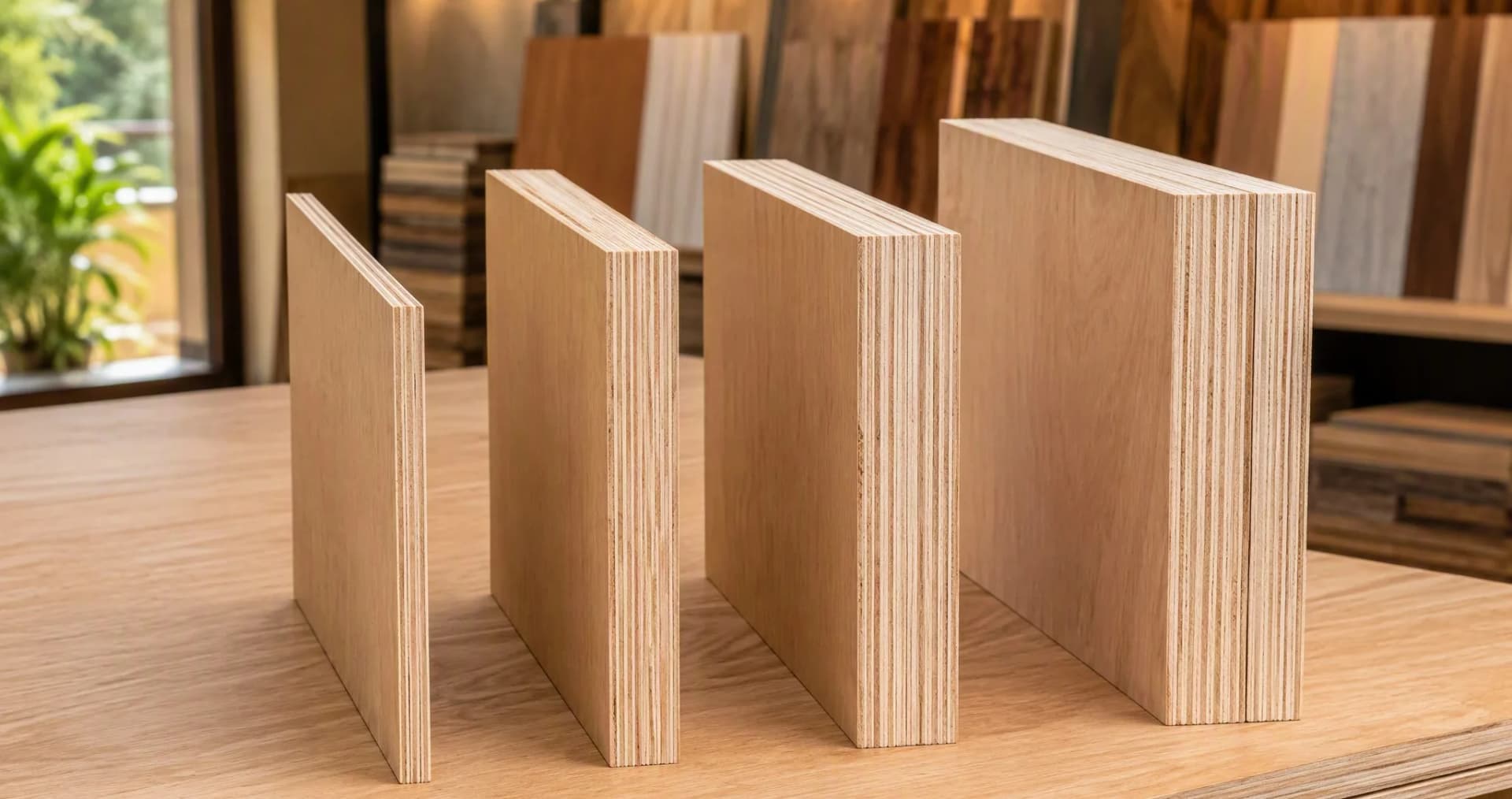
What Thickness of Plywood Is Best for Wardrobes and Furniture?
18mm for the carcass, 12mm for the drawers, 6mm for the back — that's the short answer. But the right number changes with every component, every shelf span, and every load. This guide gives you the exact thickness for each part of a wardrobe, bed, or table — and the span rules that decide when to go thicker.
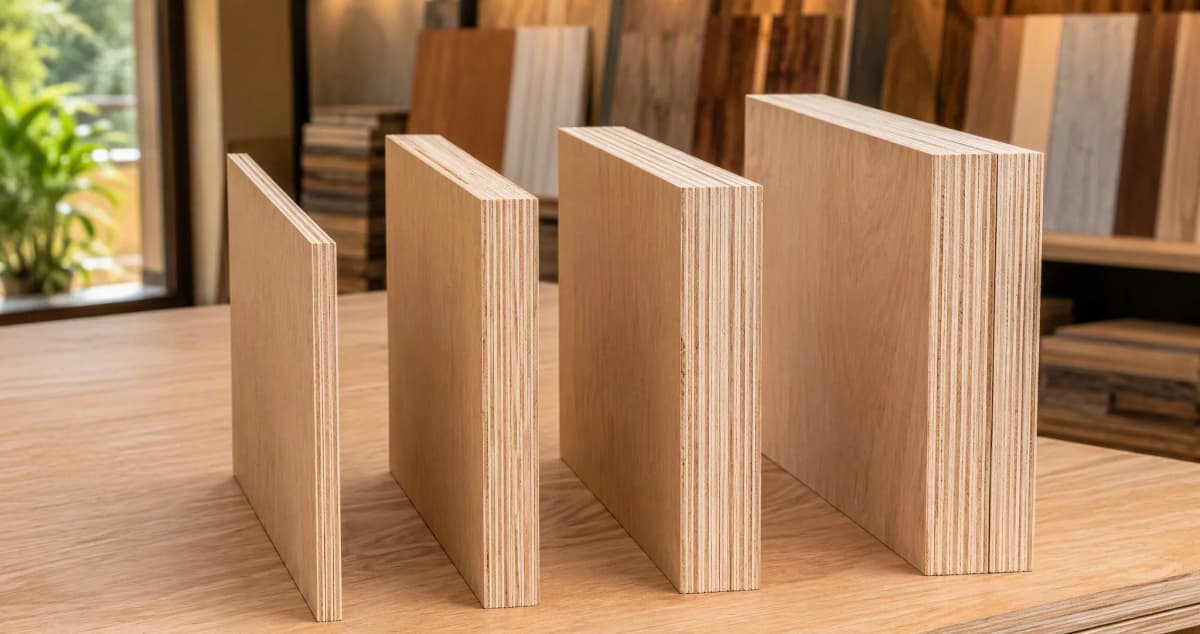
18mm for wardrobe carcasses, shelves, shutters, bed frames and kitchen cabinets — the workhorse. 12mm for drawer sides, internal partitions and light, short-span shelves. 6mm for wardrobe backs and drawer bottoms. 25mm for tabletops and long unsupported spans. The one rule that overrides all of it: any shelf spanning more than 600mm without a centre support should not drop below 18mm. And remember — thickness controls bending, but grade controls moisture: 18mm MR in a wet kitchen still fails.
1. Why Thickness Matters — The Physics in Plain English
Two forces decide whether your furniture lasts: bending under load, and how well the board grips screws and hardware. Thickness drives both.
Bending: a board's stiffness scales with the cube of its thickness. That means 18mm plywood is roughly 3.4 times stiffer than 12mm — not 1.5 times. This is why a 12mm shelf bows visibly under books while an 18mm shelf of the same span stays flat for decades. It's also why going from 18mm to 25mm buys you a further ~2.7× jump — which you pay for, and only need for long spans or heavy tops.
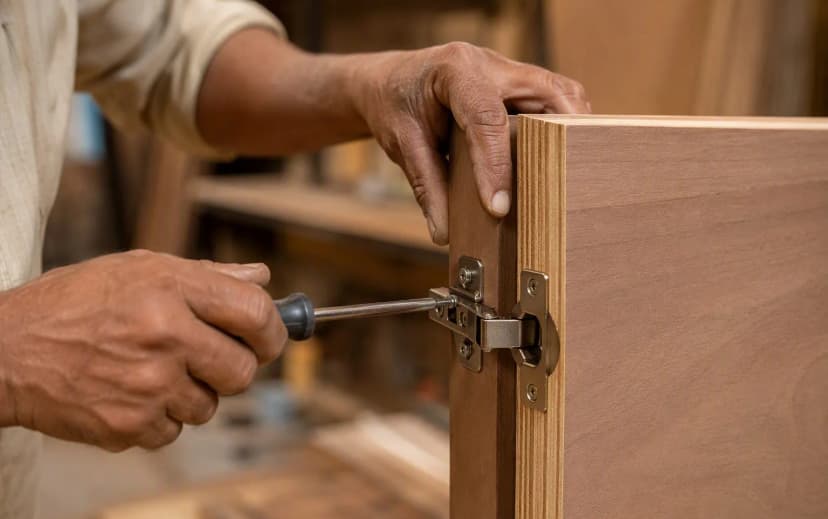
Screw-holding: every hinge, drawer channel, and connector in your furniture anchors into the board's edge or face. A 12mm panel gives a screw ~12mm of bite; an 18mm panel gives it half again as much. Over ten years of doors swinging and drawers slamming, that difference decides whether hinges stay tight or pull out.
The other half of the equation: thickness controls bending and screw grip — grade controls moisture survival. An 18mm MR sheet in a kitchen still swells and delaminates. Specify both together: 18mm BWR/BWP for kitchens, 18mm MR/BWR for dry bedrooms. See our plywood grades explained guide.
2. Wardrobe Thickness, Component by Component
A wardrobe is not one board — it's nine different jobs. Using one thickness throughout either wastes money or guarantees failure. Here's the schedule carpenters and modular factories in India actually follow.
| Component | Thickness | Why |
|---|---|---|
| Side panels (carcass) | 18mm | Carries all racking forces and hinge loads; the structural spine of the unit |
| Top & bottom panels | 18mm | Ties the carcass; bottom panel carries the full stacked load of shelves above |
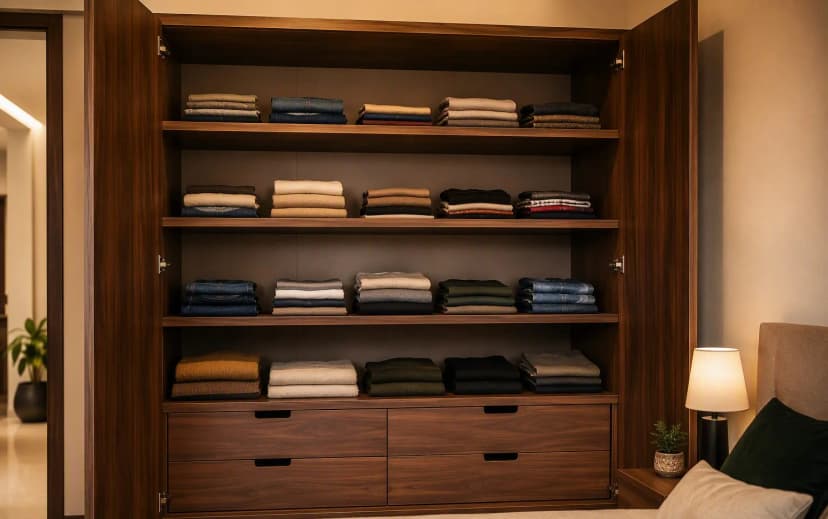
| Shelves | 18mm | Resists sag under folded clothes, linen, luggage — see the span rule below |
| Hinged shutters | 16–18mm | Stays flat, holds hinges; heavier shutters need more hinges per the maker's chart |
| Tall shutters (7 ft+) | Blockboard or 18mm ply | Blockboard's batten core resists warping at lighter weight on very tall doors |
| Sliding shutters | Per system spec | Track and rollers have a rated door weight — follow the hardware, not habit |
| Internal partitions | 12–15mm | Non-structural dividers; 12mm saves weight and cost safely here |
| Drawer sides | 12–15mm | The channel carries the load; sides just box the drawer |
| Drawer bottom & back panel | 6mm | Non-load-bearing skins; anything thicker is wasted money and weight |
3. When Shelves Sag and When They Don't
Shelf sag is the single most common thickness failure in Indian furniture — and it's almost always a span problem, not a quality problem. The shelf looked fine on installation day; the bend crept in over months of loading.

| Unsupported span | Light load (folded clothes) | Heavy load (books, appliances) |
|---|---|---|
| Up to 600mm | 12mm works | 18mm |
| 600–900mm | 18mm | 18mm + front stiffener (lipping) |
| 900–1200mm | 18mm + centre divider | 25mm, or 18mm with centre support |
| Over 1200mm | Add a vertical partition — don't solve with thickness | Add a vertical partition — don't solve with thickness |
The cheap fix nobody uses: a vertical divider or a solid front lipping stiffens a shelf more than jumping a thickness — and costs less. Before you pay for 25mm shelves, ask your carpenter whether a centre partition does the same job. For very long display shelves, a concealed metal stiffener under the front edge is the professional solution.
4. Beds, Tables, and Other Furniture
The same logic — span, load, hardware — sets the thickness for every other piece in the house.
| Furniture | Component | Thickness |
|---|---|---|
| Bed | Frame, side rails, headboard | 18mm (BWR — beds take daily dynamic loads) |
| Bed | Mattress platform | 18mm; 25mm if slat/support spacing is wide |
| Study / office table | Top | 18mm standard; 25mm for spans over 900mm without a modesty panel |
| Study / office table | Legs / side supports | 18mm |
| Dining / heavy tabletop | Top | 25mm (or 18mm double-ledged) — long span + heavy daily use |
| TV / display unit | Carcass & shelves | 18mm |
| TV / display unit | Back / decorative panel | 6–9mm |
| Kitchen cabinets | Carcass, shelves, shutters | 18mm BWR; sink unit 18mm BWP (IS 710) |
| Crockery / shoe rack | All parts | 12–15mm — light loads, short spans |
5. The Five Thickness Mistakes That Ruin Furniture
All-12mm wardrobes
The budget shortcut. Looks fine on day one; the carcass racks, shelves bow, and hinges loosen by year two or three. A 12mm wardrobe saves maybe 15–25% on sheet cost — and costs a ₹20,000+ rebuild.
18mm everywhere
The over-correct. 18mm back panels and drawer bottoms add dead weight and cost with zero benefit — and over-heavy shutters strain hinges and sliding tracks into early failure.
Ignoring the span
Specifying "18mm shelves" without checking the span. An 18mm shelf across 1.2 metres still sags under books. Span is the deciding factor — thickness is how you answer it.
Right thickness, wrong grade
18mm MR in a kitchen or against a damp wall. Thickness won't save a board from moisture — that's the grade's job. Match both, always.
Trusting the label, not the caliper
"18mm" sheets in the unbranded market routinely measure 16.5–17.2mm — thinner, weaker, and cheaper to make. Measure before you pay.
Your Thickness Spec Sheet — Hand This to Your Carpenter
- Wardrobe: 18mm carcass + shelves + shutters · 12mm partitions + drawer sides · 6mm back + drawer bottoms · grade: BWR (BWP if damp wall).
- Kitchen: 18mm BWR everywhere · 18mm BWP sink unit · all edges banded.
- Bed: 18mm frame and platform · 25mm platform if support spacing is wide.
- Tables: 18mm tops up to 900mm span · 25mm beyond that.
- Shelves: check the span table before approving any shelf over 600mm.
- Verify: caliper every sheet at delivery — labelled thickness is a claim, not a fact.
Frequently Asked Questions
What thickness of plywood is best for a wardrobe?
Use 18mm plywood for the wardrobe carcass (sides, top, bottom, shelves) and shutters, 12mm for internal partitions and drawer sides, and 6mm for the back panel. The 18mm carcass holds hinges and channels securely and resists sagging over 10–15 years of use.
Is 12mm plywood enough for wardrobe shelves?
Only for short spans under about 600mm with light loads (folded clothes). For spans of 600–900mm or heavier loads, use 18mm. Beyond 900mm, use 18mm with a centre support or front stiffener. Sag develops slowly — a shelf that looks fine on day one can bow within months.
Is 18mm and 19mm plywood the same?
Effectively yes. 18mm and 19mm are the same nominal carcass thickness; manufacturing tolerance and sanding mean a sheet labelled 19mm often calipers around 18mm. Always measure the actual sheet with a caliper if your hardware or joinery needs precision.
What thickness should wardrobe shutters be?
16–18mm for hinged shutters, following the hinge manufacturer's load chart for hinge count. For very tall shutters (above 7 feet) or wide sliding doors, quality blockboard is often preferred because its batten core resists warping at lighter weight. Sliding systems have their own panel weight limits — check the hardware specification.
Does thicker plywood prevent shelf sag?
Thicker helps a lot — stiffness scales with the cube of thickness, so 18mm is roughly 3.4 times stiffer than 12mm. But shortening the span, adding a centre divider, or adding a front stiffener can be more effective than thickness alone. Match both.
What thickness of plywood is best for beds?
18mm for bed frames, side rails and headboards; 18mm or 25mm for the mattress platform depending on slat or support spacing. Beds take dynamic loads — jumping, sitting on edges — so never drop the platform below 18mm.
Is thicker plywood always better for furniture?
No. Over-thick sheets add cost and dead weight without benefit — 18mm for a back panel is wasted money when 6mm does the job, and over-heavy shutters strain hinges and sliding tracks. Match thickness to each component's span, load, and hardware.
Does thickness matter as much as plywood grade?
They do different jobs. Thickness governs bending and screw-holding; grade (MR/BWR/BWP) governs moisture resistance. A thick MR sheet in a wet kitchen still fails. Specify both: 18mm BWR or BWP for kitchens, 18mm MR or BWR for dry bedroom wardrobes.
Get the spec right before you buy a single sheet.
Visit our Bangalore studio for calibrated, ISI-marked plywood in every thickness — 6mm to 25mm — with honest, component-wise guidance on exactly what your wardrobe and furniture need.
Talk to Us




