
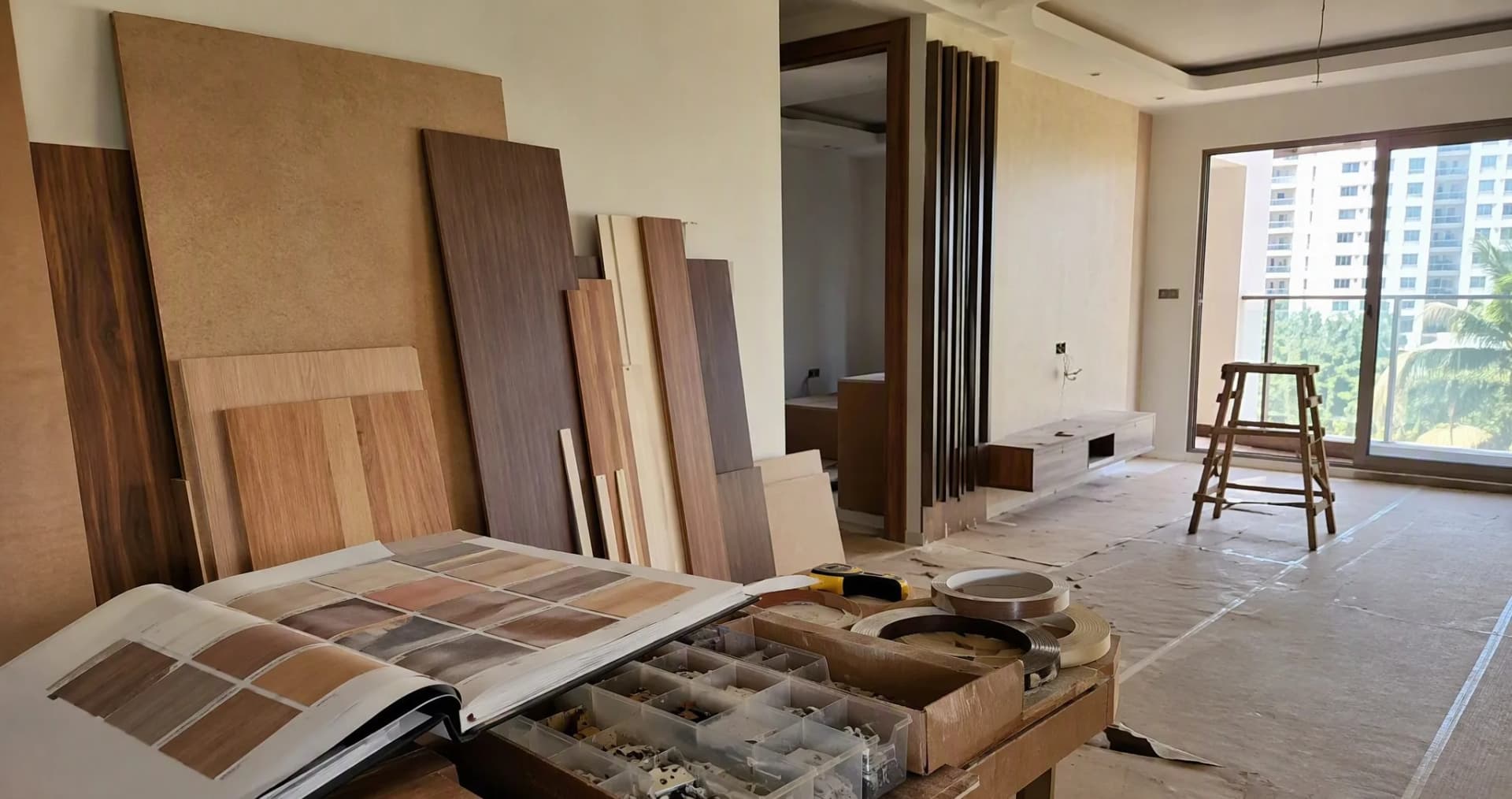
Essential Interior Materials Every Home Renovation Needs
A renovation succeeds or fails on its material list — not the mood board. Here are the nine material categories every Indian home renovation needs, what to specify in each, what order to buy them in, and how the budget should actually split across them.
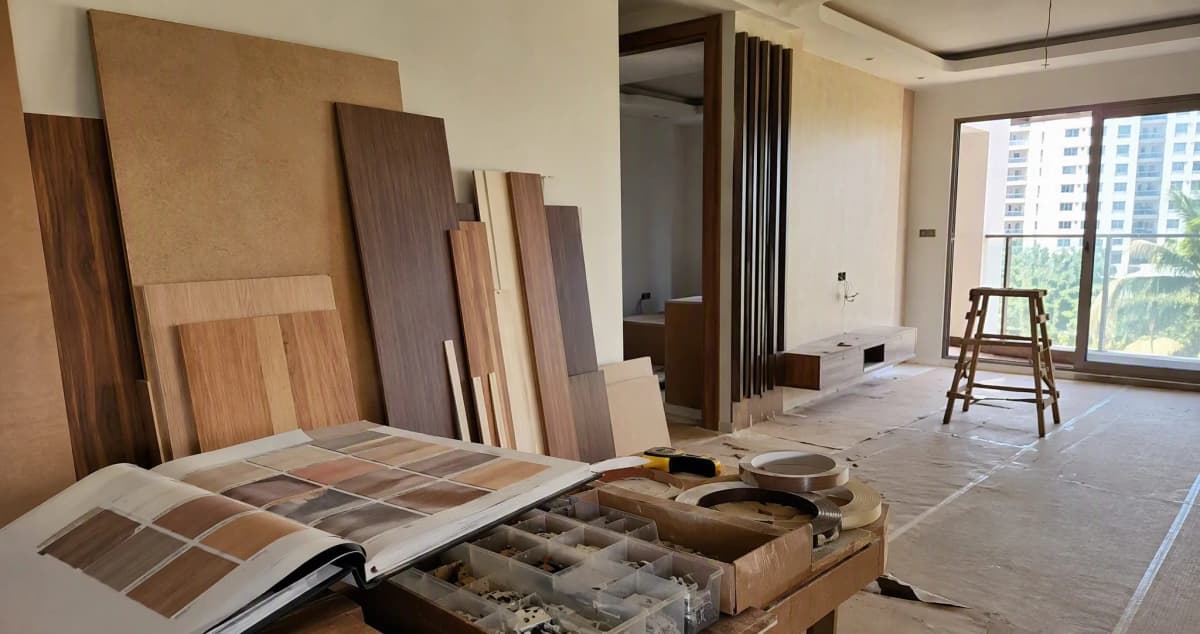
The nine categories, in one breath
Every Indian home renovation needs: core boards (plywood/HDHMR/MDF), surface finishes (laminates, veneer, paint), hardware & fittings (hinges, channels, handles), adhesives & edge banding, countertops (quartz/granite), wall & ceiling finishes, doors & panels, glass & mirrors, and sealants & consumables. Buy structural items first, finishes second, accessories last — and split the budget roughly: boards 30–35%, finishes 15–20%, hardware 15–20%, counters 10–15%, consumables 5%, contingency 10%.
The nine material categories — what to specify in each
Miss any one of these and the renovation stalls mid-project or ages badly. Here's each category with the specs that matter. (Deep dives on boards: plywood grades explained and plywood thickness guide.)
Core boards — the structure
Plywood is the backbone of wardrobes, kitchens, and storage. HDHMR suits profiled/painted shutters; MDF works for decorative panels in dry zones; blockboard for tall shutters. This is the single biggest material decision — and budget line — in the whole project.
Specify: MR grade (IS 303) for dry zones, BWR for kitchens/utility, BWP (IS 710) for sink units and damp-wall wardrobes. 18mm carcass, 12mm partitions/drawer sides, 6mm backs. ISI mark + CML number verified on bis.gov.in.
Surface finishes — the visible skin
Laminates cover 80% of a typical home's furniture — durable, wipeable, huge design range. Veneer brings real-wood warmth to statement surfaces. Paint (PU/DUCO) finishes profiled shutters. Pick finishes after boards and counters so tones actually match.
Specify: 1mm laminate for exteriors, 0.8mm for interiors; matching edge banding. Veneer only with polish budgeted. Check physical samples in your home's daylight, never just catalogue images.
Hardware & fittings — the moving parts
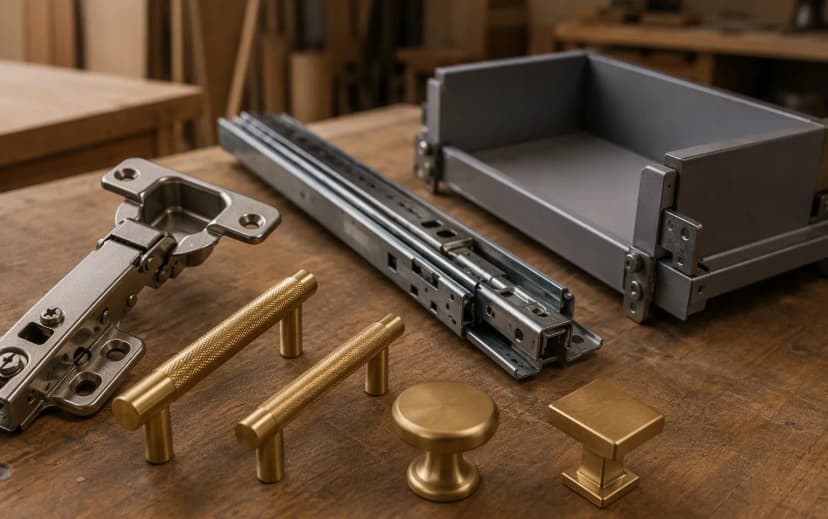
Hinges, drawer channels, handles, locks, sliding systems, kitchen baskets and corner solutions. Hardware is what you touch 50 times a day — and the first thing cheap renovations fail on. Branded hardware is rated for 50,000+ cycles (~12 years); unbranded is unrated.
Specify: soft-close hinges and telescopic/tandem channels from Hettich, Hafele, Blum, Ebco, or Godrej — brand and product line named in the work order, no "or equivalent" clause. Keep packaging on site until handover.
Adhesives & edge banding — the invisible glue
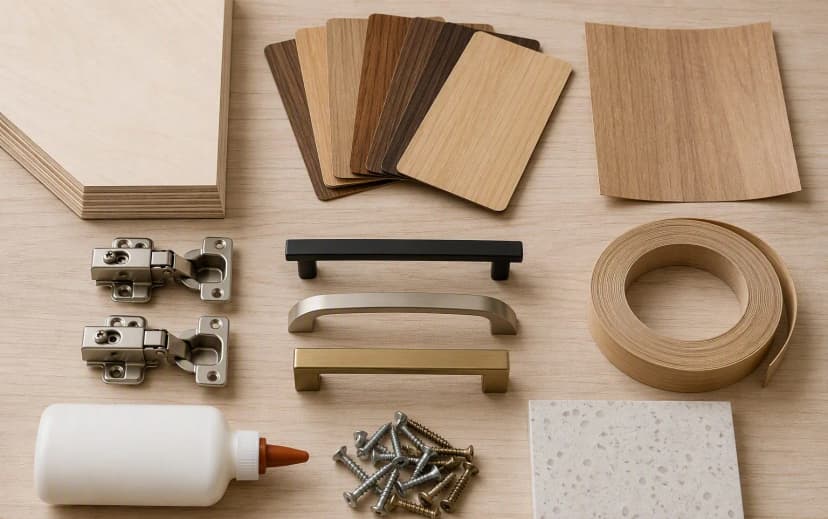
Nobody photographs these, but they decide whether laminates stay stuck and edges stay sealed. Quality wood adhesive, contact adhesive for laminates, hot-melt edge banding matched to the laminate shade, and silicone sealant for every wet-zone edge.
Specify: branded adhesive (Fevicol SH/Pro or equivalent), 1mm+ edge banding on all shutter edges, anti-fungal silicone around sink and counter junctions. Non-negotiable in Bangalore's monsoon humidity.
Countertops — the work surface
The kitchen counter takes heat, oil, knife work, and daily wiping. Granite is the value workhorse; quartz is the premium, non-porous, uniform-colour option; marble stains and etches too easily for Indian cooking. Choose early — counter thickness and edge profile affect cabinet design.
Specify: granite ₹150–400/sq ft or quartz ₹250–600/sq ft, 18–20mm thick, with the slab hand-picked or batch-matched. Backsplash: tiles, glass, or matching quartz upstand.
Wall & ceiling finishes
Washable emulsion for walls that get touched (corridors, kids' rooms), premium or texture finishes for feature walls, and gypsum/POP for false ceilings with cove lighting. Primer is not optional — it's what makes topcoats last.
Specify: washable paint in high-traffic zones; low-VOC grades for bedrooms; moisture-resistant gypsum board in bathrooms-adjacent ceilings. Sample patches on the actual wall before committing.
Doors & panels
Room doors work hard — privacy, sound, daily slamming. Flush doors with laminate or veneer skins are the standard; solid wood for the main door; moulded or WPC doors where budgets are tight or moisture is high. Wall panels (fluted, veneer, or fabric) handle the décor layer.
Specify: flush doors with IS 2202 certification; WPC/PVC doors for bathrooms; door hardware (hinges, locks, stoppers) budgeted with the door, not as an afterthought.
Glass & mirrors
Wardrobe mirrors, crockery-unit shutters, partition glass, and bathroom mirrors. Toughened glass for anything structural or door-sized; lacquered or fluted glass for shutter inserts; plain float glass only for small, protected panels.
Specify: toughened glass (with the etched toughening mark) for doors and partitions; 5–6mm mirror with safety film backing on wardrobe doors; edge-polished glass for open shelves.
Sealants & consumables — the 5% that protects the 95%
Silicone sealant at every counter-to-wall and sink junction, wall plugs and screws sized to the board, drawer liners, felt pads, skirting and profile trims, and masking materials to protect finished floors during work.
Specify: anti-fungal sanitary silicone in kitchens/bathrooms; SS screws (not mild steel) in any damp zone; floor protection sheets before carpentry begins. Cheap here, expensive to redo.
Buy from one accountable source where possible
Fragmented buying — ply from one shop, laminate from another, hardware from a third — makes warranty claims and shade-matching painful. A single reliable supplier (or your material studio) for the big categories means one throat to choke and consistent advice across categories.
Do: collect a GST invoice naming brand, grade, and quantity for every purchase. It's your only leverage if something fails. See our Bangalore buying-mistakes guide.
What to buy first: the correct purchase sequence
The most common renovation planning mistake is choosing finishes first. Structural and planning-heavy items lock the design — they must come first.
| Stage | Buy / finalize | Why this order |
|---|---|---|
| 1 — Before work starts | Boards (grade + thickness schedule), hardware systems, countertop material | These fix dimensions, hinge boring, and cabinet design. Everything else is sized around them. |
| 2 — During carcass work | Laminates/veneer, edge banding, adhesives, glass and mirror sizes | Finishes must match the fixed boards and counter; edge banding must match the laminate shade exactly. |
| 3 — Finishing stage | Paint, wall finishes, doors and panels, sealants | Applied over finished carpentry; colour sampling happens against installed materials, not catalogue photos. |
| 4 — Final week | Handles, lights, mirrors, accessories, drawer liners | The jewellery — chosen last so it ties the finished space together. Also the easiest layer to upgrade later. |
Bangalore monsoon note: if work runs June–September, schedule board delivery and carpentry under cover, let sheets acclimatise 48–72 hours, and don't paint exterior-facing walls in heavy rain weeks. More: plywood care guide.
How the material budget should split
For a carpentry-heavy renovation (kitchen + wardrobes + storage), this is a healthy material-side split. Use it to sanity-check any quote you're given. (City-level totals: our Bangalore price guide covers board costs in detail.)
| Category | Share of material budget | Where people go wrong |
|---|---|---|
| Core boards (ply/HDHMR/MDF) | 30–35% | Downgrading grade to save 10% — the failure is hidden for 2–3 years |
| Surface finishes (laminate/veneer/paint) | 15–20% | Overspending on veneer everywhere; laminate does 80% of jobs |
| Hardware & fittings | 15–20% | The most under-budgeted line — unbranded hinges die in 3–5 years |
| Countertops | 10–15% | Marble in kitchens (stains); granite/quartz are the sane picks |
| Doors, panels, glass | 8–12% | Untoughened glass in door-sized panels — a safety issue |
| Adhesives, banding, sealants, consumables | ~5% | Forgotten entirely until the carpenter sends a mid-job shopping list |
| Contingency | ~10% | Renovations always surface surprises — budget for them instead of borrowing from quality |
The small materials everyone forgets
These five cost almost nothing and decide whether the renovation looks and lasts like professional work.
| Forgotten item | Why it matters | Cost impact |
|---|---|---|
| Edge banding matched to laminate | Unmatched or thin banding peels and screams "budget job" on every shutter edge | ₹10–40 per metre — trivial |
| Anti-fungal silicone sealant | Seals sink/counter junctions; without it, water creeps into the carcass within a year | ₹250–500 per tube |
| Correct screws & wall plugs | Wrong size = hinges loosen, shelves pull out; SS screws in damp zones don't rust | Hundreds of rupees, total |
| Drawer liners & felt pads | Protects drawer bottoms and shutter faces from day one | ₹500–2,000 for the home |
| Floor protection sheets | One dropped hammer on new flooring costs more than the entire protection budget | ₹50–100 per sheet |
The pre-purchase checklist
Run through this before a single rupee moves.
Renovation materials — final checks
- List by category: all nine categories covered — boards, finishes, hardware, adhesives/banding, counters, walls/ceilings, doors, glass, consumables.
- Specs locked: plywood grade per zone (MR/BWR/BWP), thickness schedule (18/12/6mm), hardware brands named, counter material chosen.
- Sequence respected: structural items bought first, finishes second, accessories last.
- Samples seen in daylight: laminate, veneer, and paint checked against your home's actual light.
- Verification done: ISI + CML checked on bis.gov.in, brand QR scanned, caliper check on board thickness. (Full routine: material verification guide.)
- Billing clean: GST invoice naming brand, grade, quantity for every category — no cash memos for big-ticket items.
- Budget balanced: hardware at 15–20%, consumables at 5%, contingency at 10% — not raided to fund a fancier finish.
- Delivery planned: someone present to inspect; boards stored flat indoors, off the floor.
Frequently asked questions
What materials do I need for a home renovation?
Nine categories cover almost every interior renovation: core boards (plywood, HDHMR, MDF), surface finishes (laminates, veneers, paints), hardware and fittings (hinges, channels, handles), adhesives and edge banding, countertops (quartz or granite), wall and ceiling finishes, doors and panels, glass and mirrors, and sealants and consumables. Plan them together, not one at a time.
What should be bought first in a renovation?
Finalize the structural, planning-heavy items first: boards, hardware systems, and countertop material — these lock the design, budget, and dimensions. Surface finishes (laminates, veneer, paint) come next since they must match the fixed choices. Handles, lights, and accessories come last. Reversing this order is the most common renovation planning mistake.
Which plywood grade should I use for renovation work?
MR grade (IS 303) for dry zones like bedrooms and living rooms, BWR for kitchens and utility areas, and BWP/marine (IS 710) for sink units, bathroom vanities, and damp-wall wardrobes. Use 18mm for carcasses and shelves, 12mm for partitions and drawer sides, and 6mm for back panels.
Laminate or veneer — which is better for a renovation?
Laminate for daily-use surfaces: wardrobes, kitchens, TV units — it is scratch-resistant, wipeable, and costs ₹80–250 per sq ft. Veneer for statement surfaces: a living room panel, a headboard, a study desk — real wood warmth at ₹150–400 per sq ft plus polishing, but it needs more care. Most Indian homes use roughly 80% laminate and 20% veneer.
How much should I budget for renovation materials in India?
As a rule of thumb for carpentry-heavy interiors: boards 30–35% of the material budget, surface finishes 15–20%, hardware 15–20%, countertops 10–15%, adhesives/edge-banding/consumables 5%, and a 10% contingency. Hardware is the most under-budgeted line — cheap hinges and channels are the first thing to fail.
Which hardware brands are reliable in India?
Hettich, Hafele, Blum, Ebco, and Godrej are the established names. Branded soft-close hinges and channels are rated for 50,000+ cycles (roughly 12+ years of daily use) and carry lifetime mechanism warranties; unbranded hardware is unrated and typically fails within 3–5 years. Name the brand and product line in your contract without an "or equivalent" clause.
What renovation materials do people usually forget?
The small consumables that hold everything together: edge banding matched to the laminate, quality wood adhesive, silicone sealant for wet-zone edges, wall plugs and screws of the right size, drawer liners, and skirting/profile trims. Individually trivial, collectively they decide whether the finish looks and lasts like professional work.
Should I buy renovation materials myself or let the contractor buy?
Split it: you buy or specify the big-ticket, quality-critical items — boards, laminates, hardware, countertop — paying the dealer directly with a GST invoice. Let the contractor procure consumables (adhesive, screws, plugs) where convenience outweighs choice. Always name brands and grades in the work order.
One studio. Every material on the list.
From calibrated ISI-marked plywood to laminates, veneers, hardware, and counters — explore all nine categories under one roof in Bangalore, with honest advice on what your renovation actually needs.
Plan Your Renovation




