
Top Signs of High-Quality Plywood Every Buyer Should Know
Two sheets can look identical on the rack and perform like different materials in your home — one holds hinges for twenty years, the other swells by the third monsoon. The difference is visible if you know where to look: the stamp, the edge, the sound and the weight. Here are the signs, the two-minute tests, and the price math behind them.
The quick answer
High-quality plywood announces itself in seven places: (1) a genuine ISI stamp with IS 303 or IS 710 plus a CM/L licence number that verifies on the BIS Care app; (2) a smooth, patch-free face in raking light; (3) 11–13 thin, gap-free plies on the edge of an 18 mm sheet; (4) a solid "thock" everywhere you tap — no hollow patches; (5) real heft when you lift it; (6) honest thickness — a true 18 mm sheet measures 17.0–17.8 mm; and (7) clean screw grip in both face and edge. Add the right grade for the room (BWR for kitchens, BWP for wet zones) and a GST invoice naming brand and grade, and the sheet will outlast the furniture fashion cycle.
1. The stamp: ISI, CM/L and the fake-mark problem
Read the printed stamp along the sheet's long edge before anything else — it's the only part of the sheet the manufacturer is legally accountable for. A genuine mark contains three things working together:
- The IS code — IS 303 for commercial/MR/BWR plywood, IS 710 for BWP/marine grade. A vague "ISI certified" claim with no specific code is a red flag in itself.
- The CM/L number (for example CM/L-7123456) — the manufacturer's unique BIS licence. No CM/L number means the ISI mark is decoration, not certification.
- Manufacturer name, batch, thickness and size — and these must match the sheet you're actually holding, not just the bundle wrapper.
Verification takes under a minute and needs no login: enter the CM/L number on the BIS Care app or the Manakonline portal (manakonline.in). A genuine licence shows the manufacturer's name, the IS standard covered and an active status. If the number returns nothing — or returns a different company — the sheet is counterfeit no matter how good it looks. Industry estimates put fake or mis-marked sheets at a significant share of the unorganised market, which is why this check matters most in local timber yards.
Major brands add a second layer: QR-code authentication apps (CenturyPromise and similar systems from other large manufacturers) verify the physical sheet itself and issue an e-warranty certificate. Use both — the BIS check verifies the licence, the brand app verifies the board.
Insist on a GST invoice naming the brand, grade and CM/L number. It is your only leverage if the sheet fails later — and dealers selling genuine stock never hesitate to provide it. A dealer offering a discount for skipping the bill is pricing in the warranty you just lost.
2. A smooth, even face that reads clean in raking light
Hold the sheet so light skims across both faces at a low angle. You're reading the face veneer — the layer that takes laminate adhesive, polish and daily wear, and the layer factories disguise when they're hiding something.
| Good signs | Red flags |
|---|---|
| Smooth, even grain with consistent colour across the whole sheet | Bubbles or ripples — early delamination between face and core |
| No cracks, patches or filler putty anywhere on either face | Putty-filled knots and sanded-through thin spots |
| No overlapping veneer strips or visible joints on the face | A waxy or unusually glossy feel — surface dressing to hide defects |
| Flat reflection running straight along the sheet | Waviness in the reflection — uneven core pressing underneath |
This matters beyond looks. Laminates and veneers bond to the face; a patched or dressed face telegraphs through even 1 mm laminate within a year, and a face with early bubbles becomes visible delamination after the first humid summer. The face test also tells you whether the factory had anything to hide — good veneers don't need putty.
3. The core: count the plies, hunt the gaps
The edge of the sheet is its X-ray — it shows the core species, the glue lines and every shortcut the factory took. This is the single most reliable visual quality sign in the whole guide, and it takes ten seconds.
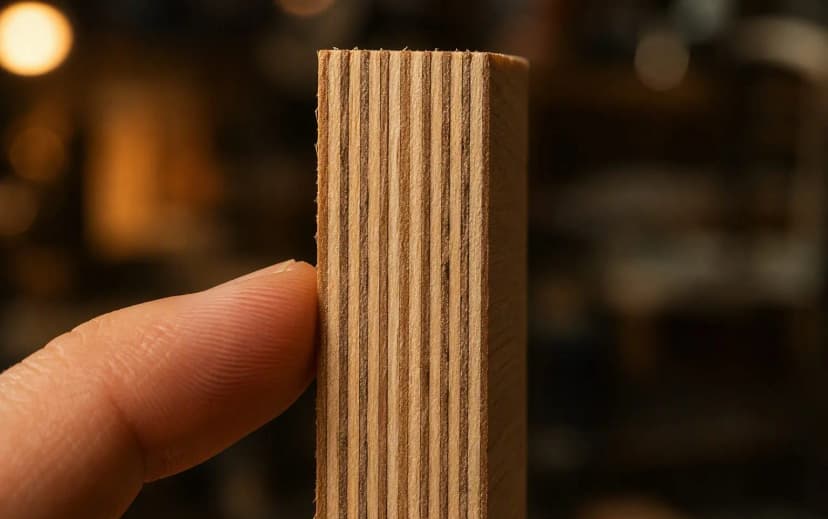
What the edge should show on an 18 mm sheet
- 11–13 thin, even veneer layers. More, thinner plies mean better stability, stiffness and screw grip. A sheet with 7–9 fat plies used cheaper, thicker core veneers — a cost shortcut you'll feel as sagging shelves.
- Tight, dark glue lines running unbroken between every layer. Broken or pale glue lines mean weak bonding that will delaminate under heat and humidity.
- No visible voids. Core gaps — empty slots where veneer pieces didn't meet — are weak spots where screws lose grip, shelves sag and borers settle in. Core overlap (veneers stacked double in one spot) is the opposite defect: it creates high-pressure points during pressing and uneven thickness.
- Consistent core species. Hardwood and eucalyptus cores are dense and dark; pale, soft-looking filler strips sandwiched between darker hardwood faces are a cost-cutting signal. For kitchens, wardrobes and anything load-bearing, hardwood/eucalyptus is what you want; poplar cores suit only dry, low-load panelling.
Better factories joint core veneers on composer machines rather than by hand, which is why branded sheets show near-zero gaps. If the shop has cut pieces, ask to see a fresh-cut cross-section — honest dealers will show you; the edge of the display stack has sometimes been selected for looking good.
4. The tap, the lift and the tape measure
Three physical tests, none needing more than your knuckles and ideally a tape measure. Any dealer who refuses to let you unbundle and inspect a sheet is telling you something.
TEST 04 · TAP
Knock across the whole surface
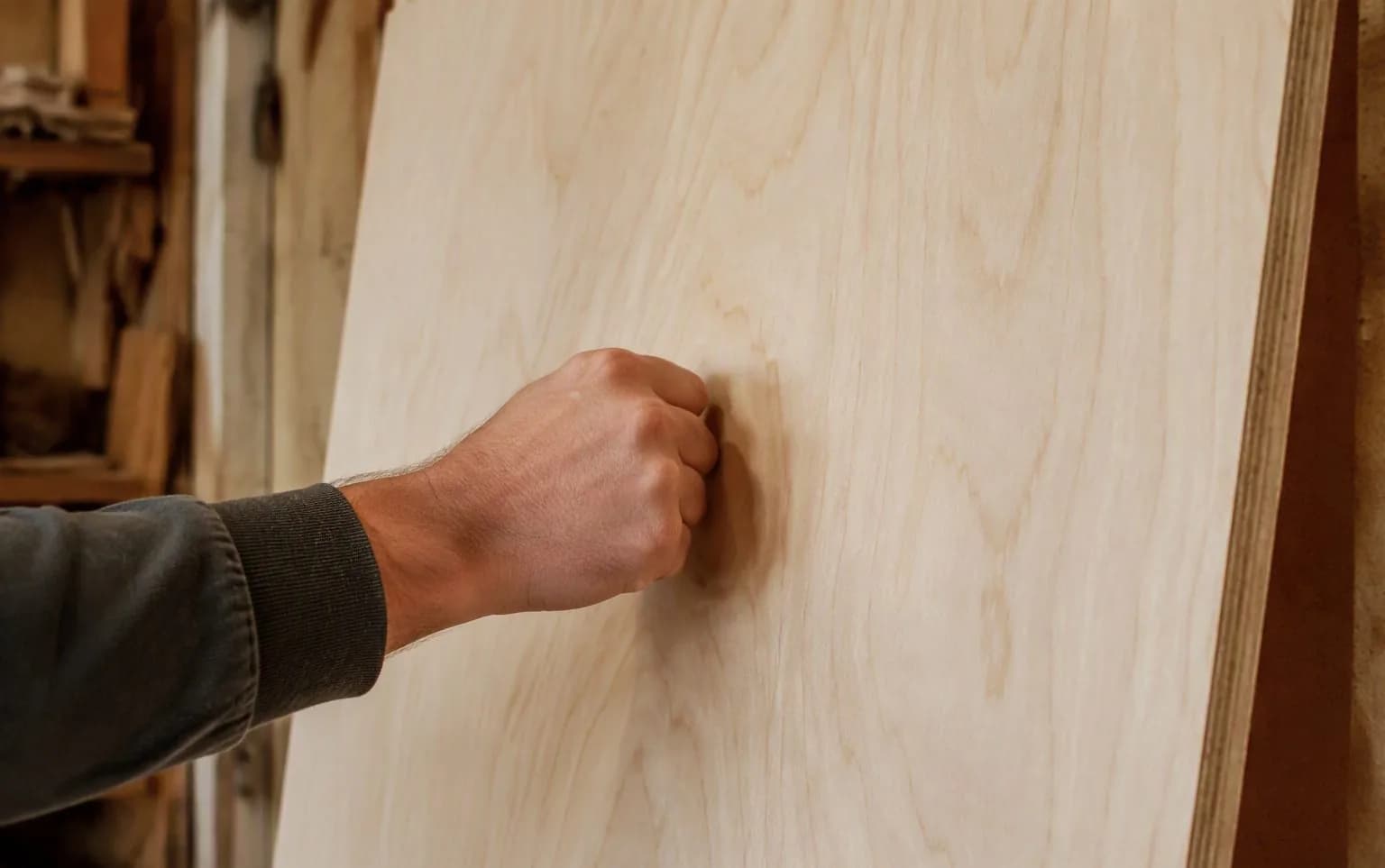
Tap firmly with your knuckles in a grid — centre, corners, midpoints. You're listening for voids: air pockets where veneers never bonded, invisible from outside but fatal under screws and loads.
Good: solid "thock" everywhere
Bad: any hollow, papery or drum-like patch
TEST 05 · LIFT
Feel the density
A genuine 18 mm hardwood-core BWP sheet weighs roughly 40–55 kg; the same size in poplar is noticeably lighter, and an under-spec sheet full of voids feels suspiciously light. Compare two same-grade sheets side by side.
Good: the heavier sheet of the pair
Bad: "hardwood BWP" that lifts like poplar
TEST 06 · MEASURE
Four points, not one
Measure both ends and the middle of both long edges. Genuine 18 mm sheets read 17.0–17.8 mm. More than ~0.5 mm variation across one sheet means poor calibration — later seen as rocking shutters and misaligned laminate seams.
Good: readings within 0.3–0.5 mm
Bad: "18 mm" reading 16.5 mm
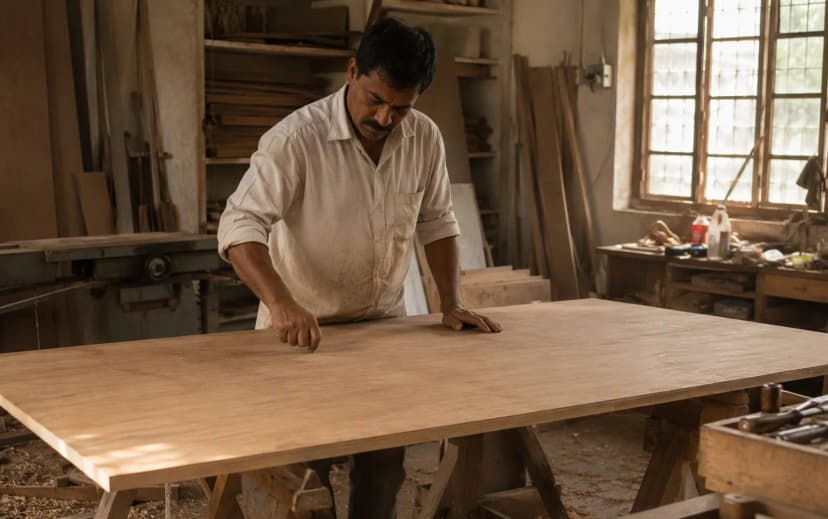
The tap test deserves special respect because of where voids land. A hollow patch will sit exactly where your hinge plate or drawer-channel screw needs to go — not by bad luck, but because a 2.4 m sheet gets cut into standard furniture parts, and undetected voids get distributed through all of them. One hollow patch in the shop is a door that sags in year two.
Thickness honesty matters for the same reason. A sheet sold as 18 mm but measuring 16.5 mm has quietly short-changed you a full veneer — roughly 8% of the material and rather more of the strength. For modular work with machine cutting and edge banding, ask for calibrated plywood with ±0.2–0.3 mm tolerance.
5. Screw-holding: the test that predicts fifteen years
Furniture hardware — hinges, handles, drawer channels, brackets — lives or dies by the plywood's ability to grip a screw through tens of thousands of open-close cycles. This is why carpenters judge a sheet by what a screw feels like going in.
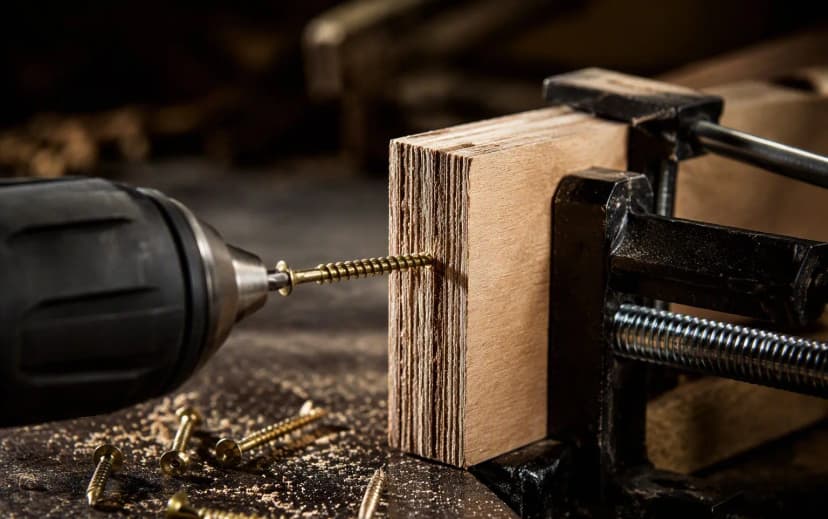
If the dealer has offcuts (any real shop does), drive a screw into an edge and a face: good ply grips firmly without crumbling, and the screw backs out clean. Then flex a thin offcut gently — it should spring back without cracking or crackling. That crackle is glue lines failing.
| Test | Good sign | Walk away if… |
|---|---|---|
| Screw into face | Firm grip, no surface cracking around the head | Face chips or the screw spins freely |
| Screw into edge | Screw bites the layered core and holds | Core crumbs fall out with the screw |
| Gentle flex | Springs back silently | Any crackling — glue lines failing |
| Nail test (1.5" nail, edge) | Nail drives in, layers stay closed | Layers split or open on nailing |
Screw-holding is where core quality, density and glue converge — a sheet that passes the offcut test almost always passed the previous six signs too. Hardware still matters: pair a good sheet with properly rated hinges and channels, because even the best plywood can't save a ₹40 hinge.
6. Grade and moisture resistance: quality includes the right chemistry
A perfectly built MR sheet installed under a kitchen sink is still the wrong material. "Quality" includes matching the glue chemistry to the room — because in Indian homes, water is the number one plywood killer, ahead of termites and loads.
| Grade | BIS standard | The test it passes | Right rooms |
|---|---|---|---|
| MR (Moisture Resistant) | IS 303 | 3-hour warm-water soak + drying, 3 cycles, without delaminating | Bedrooms, living rooms — dry zones only |
| BWR (Boiling Water Resistant) | IS 303 | 8-hour boiling + 16-hour oven drying, 3 cycles | Kitchens, dining, humid coastal rooms |
| BWP / Marine | IS 710 | 72 hours of continuous boiling without delamination | Sink units, bathrooms, utility, semi-outdoor |
You can approximate the lab test at home: soak a small offcut in a bucket for 24–48 hours. Good BWR and BWP pieces emerge intact; weak glue lines start separating within hours. Some buyers go further with the pressure-cooker test — two to three whistles on a submerged offcut is a rough but surprisingly effective bond-strength indicator.
Two related checks belong here. Flatness: lay the sheet on a flat surface — warping or twisting before installation means poor manufacturing or bad storage, and no carpenter can fully correct a banana-shaped sheet. Emissions: adhesives release formaldehyde; look for E1 as a minimum and E0 for bedrooms and kids' rooms, and treat a strong chemical smell when a bundle is opened as an informal warning. For a room-by-room grade plan, our plywood selection guide and the BWR vs BWP comparison go deeper.
The 15-year price math: cheap sheet vs quality sheet
The cheapest option is rarely the smartest, but the most expensive isn't automatically the best either. Here's how the money actually works out.
| Budget unbranded sheet | Quality branded BWR/BWP | |
|---|---|---|
| Sheet cost (per 8×4, 18 mm) | ₹1,800–2,400 | ₹3,200–4,800 |
| Expected service life in a kitchen | 4–7 years (swelling, delamination, hinge pull-out) | 15–20+ years |
| Mid-life redo (materials + labour + disruption) | ₹40,000–80,000 at year 5–7 | — |
| Cost per year of service | Higher, once the redo lands | Effectively half or less |
The premium for quality plywood across an entire 3BHK is typically ₹30,000–60,000 — real money, but less than one premature kitchen redo, and trivial against a ₹15–25 lakh interior budget. Where buyers get burned is paying the premium price for a counterfeit or mislabelled sheet — which is exactly what the CM/L check and the six tests in this guide prevent.
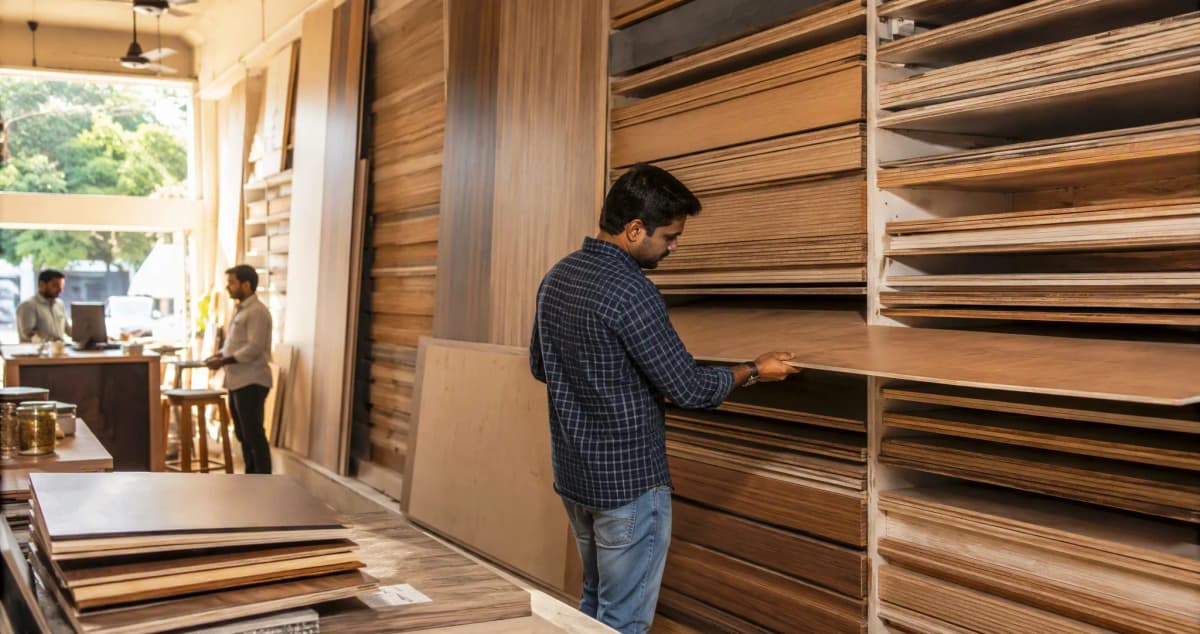
Where you buy closes the loop. Authorised dealers store sheets flat and dry (poor storage warps even good plywood), maintain batch traceability, and will unbundle sheets for inspection without sulking. Our supplier evaluation guide covers what professionals check, and the Evospace studio follows the same playbook — authorised sourcing, verification at the counter, and grade recommendations matched to each room.
The 90-second shop-floor checklist
- Stamp read: IS 303 or IS 710 plus CM/L number printed on the sheet edge
- CM/L verified on the BIS Care app — manufacturer name matches the sheet
- Brand QR scanned where the manufacturer offers one
- Face checked in raking light: no bubbles, patches, filler or waxy dressing
- Plies counted on the edge: 11–13 thin, gap-free veneers at 18 mm
- Tapped in a grid: solid sound everywhere, zero hollow patches
- Lifted and measured: heavy for its size; 17.0–17.8 mm actual at four points
- Grade matches the room: BWR kitchen, BWP wet zones, MR only in dry rooms
- Sheet lies flat: no warp or twist when laid down
- Invoice carries brand, grade and CM/L — with written warranty
Frequently asked questions
How can I check plywood quality before buying in India?
How do I know if the ISI mark on plywood is genuine?
Is heavier plywood always better quality?
What is the boiling water test for plywood?
How many layers should good 18 mm plywood have?
Which plywood core is best — hardwood, eucalyptus or poplar?
What thickness of plywood should I use for wardrobes and kitchens?
Does plywood quality affect formaldehyde emissions at home?
Buy plywood you'd pass these tests on.
Evospace stocks ISI-verified plywood across MR, BWR and BWP grades — every sheet open for edge, tap and thickness checks at the counter, with GST invoicing and brand warranty on every sale.
Get a Free Material Consultation




