If you’re comparing laminates, veneers and decorative panels in Bangalore, here’s where every conversation starts: walk into any plywood shop in India and within five minutes someone will say the word “sunmica.” Ask for veneer and you’ll get a knowing nod and a price that needs a chair and a cup of tea. Mention fluted panels and — well, half of Instagram already has.
Here’s the thing most blogs won’t tell you: these three materials aren’t competitors. They’re more like three different instruments — and a well-designed home usually plays all three. The trick isn’t picking “the best one.” It’s knowing which one belongs where, and why.
So let’s do this properly. We’ll open each material up (literally — we’ll look at the layers), talk money in actual rupees, and finish with a cheat sheet you can screenshot before your next showroom visit.
Table of Contents
Laminates: the workhorse among interior materials in Bangalore
Among laminates, veneers and decorative panels in Bangalore, despite the fancy showroom displays, a laminate is a humble, clever thing: printed paper, made bulletproof. Layers of kraft paper are soaked in phenolic resin, topped with a decorative printed layer in melamine resin and a clear protective overlay, then pressed together at roughly 140°C under pressure exceeding 1,000 psi. What comes out is a hard, sealed sheet that laughs at scratches, stains and the general chaos of a household with children, pets or both.
In India, quality laminates are governed by the Bureau of Indian Standards standard IS 2046 — freshly revised in 2025 into a multi-part standard aligned with the international ISO 4586 series (its European cousin is EN 438, which tests everything from surface wear to impact by falling ball). The standard 8×4 ft sheet you see everywhere comes in thicknesses from about 0.6mm to 1.5mm; anything 2mm and above graduates into “compact laminate” territory — dense, self-supporting slabs used for exterior cladding, restroom cubicles and lab counters.
What’s inside that 1mm sheet
Four layers, one very hot press: a clear melamine overlay on top, the decorative print layer beneath it, a phenolic-soaked kraft paper core for impact strength, and a sanded backing layer for glue grip.
This is why a woodgrain laminate never fades unevenly or needs polishing — the “wood” is a photograph, permanently sealed under resin. Pressed at ~140°C and over 1,000 psi, tested under EN 438 / IS 2046, standard sheet size 8×4 ft.
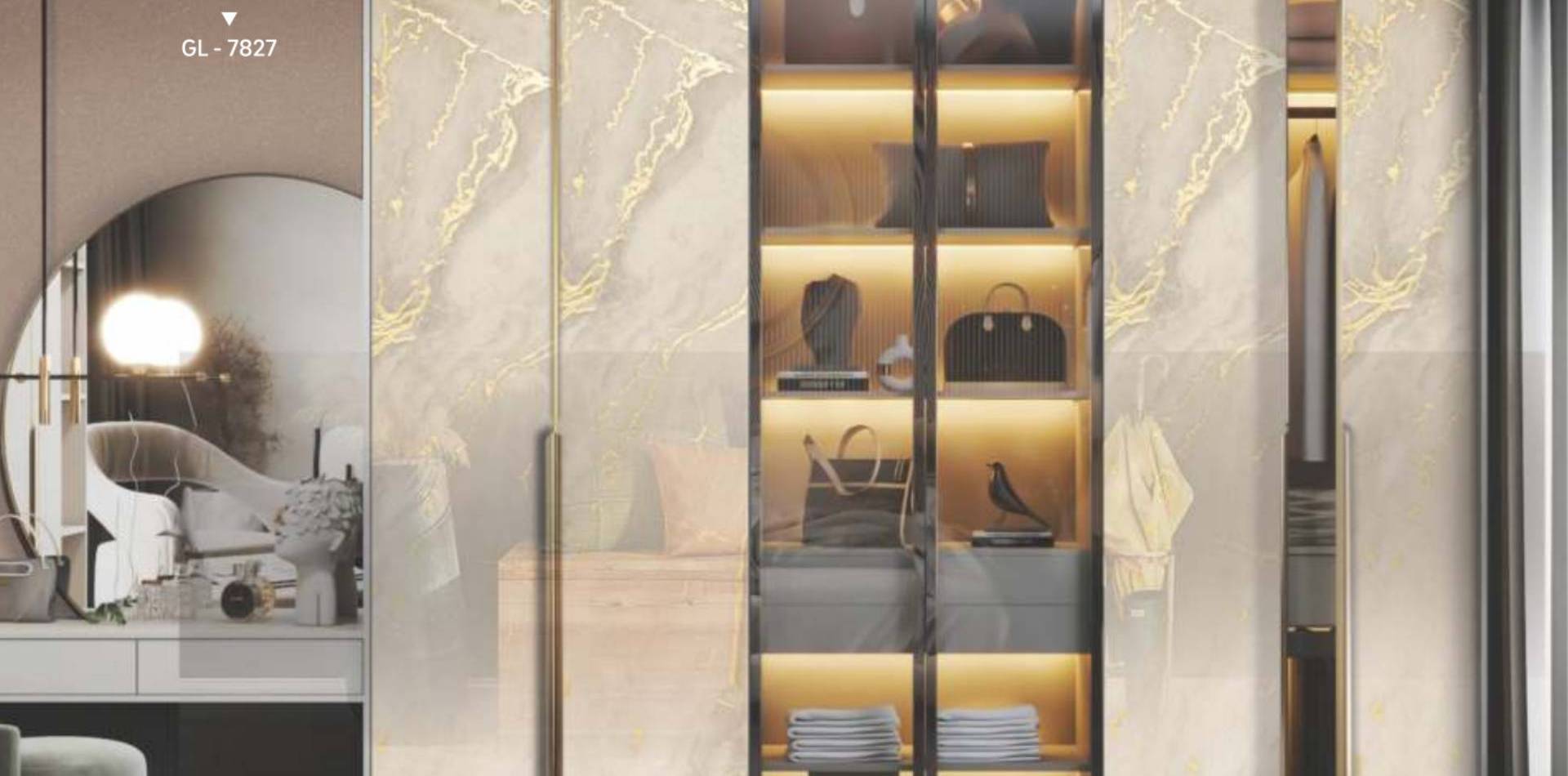
The fun part is the finishes. Today’s laminate catalogues go far beyond plain colours:
- Matte
- High gloss
- Woodgrain
- Stone & marble
- Fabric & suede
- Textured / embossed
- Metallic
- Fluted-look
- Digital prints
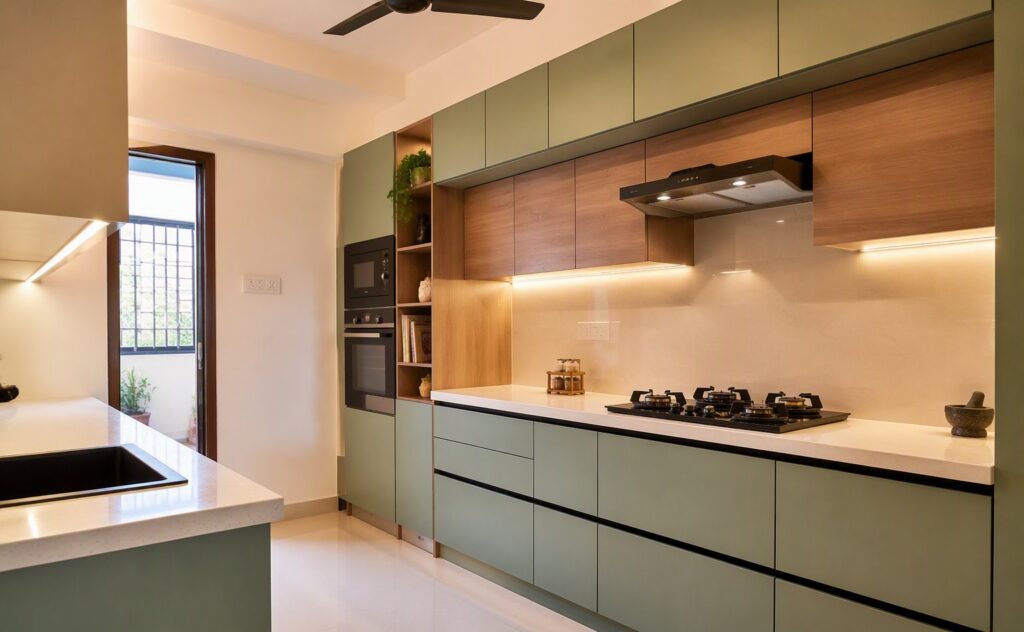
What laminates cost in India (material only, per sq ft)
| Type | Typical price | Where it shines |
|---|---|---|
| Standard decorative (0.7–0.8mm) | ₹40 – ₹70 | Wardrobe carcasses, inner shutters, budget furniture |
| Premium decorative (1mm) | ₹80 – ₹150 | Kitchens, visible shutters, office furniture |
| High-gloss | ₹120 – ₹250 | Statement kitchens, TV units (mind the fingerprints) |
| Textured / special finish | ₹150 – ₹300 | Feature units, premium wardrobes |
| Compact / exterior grade | ~₹350 and up | Facades, cubicles, heavy-duty counters |
Indicative ranges from brand price guides and dealer listings, Aug 2026. A branded 1mm 8×4 sheet typically lands between ₹1,500 and ₹2,900 depending on finish. 18% GST applies.
Why people love it
- Scratch, stain and wear resistant — built for real life
- Thousands of designs, batch after batch identical
- Zero polishing, zero refinishing — just wipe and go
- Most budget-friendly premium look per square foot
Worth knowing
- It’s a printed surface — run a finger over “woodgrain” and the illusion is visual, not tactile
- Deep chips can’t be sanded out; the sheet gets replaced
- Glossy dark finishes show fingerprints within minutes
- Edges depend entirely on the carpenter’s pasting and edge-banding quality
Veneers: for the real-wood romantics
Of the three laminates, veneers and decorative panels in Bangalore homeowners debate most, veneer is the one built on honesty: if laminate is a photograph of wood, veneer is wood — a genuine slice of it, shaved to about 0.5–0.6mm and pressed onto plywood or MDF. Every sheet carries the actual grain of an actual tree, which means two things: nothing looks richer, and no two sheets ever match perfectly. That mismatch isn’t a defect; it’s the entire point.
Teak is the undisputed favourite in India — by some estimates it accounts for around half the decorative veneer market — followed by walnut, oak, sapele, ash and wenge. Sheets come in the familiar 8×4 ft size (sometimes 4×10 ft for long wall runs).
But here’s what the glossy catalogue won’t volunteer: the sheet is only half the story. Raw veneer must be sealed and polished on site, and that polish decision changes both the final look and the final bill.
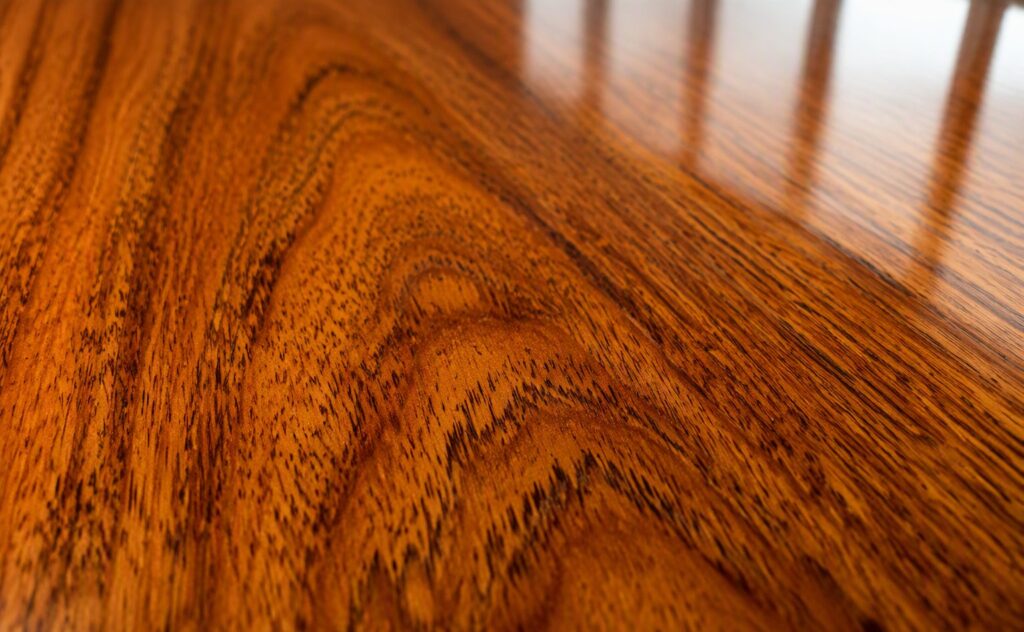
Among laminates, veneers and decorative panels in Bangalore, veneer alone splits into four families you’ll meet in a showroom: Natural veneer is sliced straight from the log, knots and mineral streaks included — choose it for character. Engineered (or reconstituted) veneer is made from fast-growing species like poplar and ayous, dyed and reassembled into consistent sheets — choose it for large projects where every panel must match. Smoked or fumed veneer is darkened with ammonia vapours over several weeks for deep chocolate tones that resist fading. And dyed veneer takes colour all the way through its thickness, so a touch-up never reveals a different shade underneath.
Veneer & polish costs in India (per sq ft)
| Item | Typical price | Notes |
|---|---|---|
| Engineered / reconstituted veneer | ₹75 – ₹150 | Uniform grain, widely available, great value |
| Natural veneer (teak, walnut, oak) | ₹100 – ₹250+ | Unique grain; premium species cost more |
| Dyed veneer | ₹120 – ₹200 | Colour through the thickness |
| Smoked / fumed veneer | ₹150 – ₹300 | Rich dark tones, light-resistant |
| Melamine polish (on site) | ₹100 – ₹150 | Budget tier; lasts ~3–5 years |
| PU polish (on site) | ₹250 – ₹600 | The luxury standard; ~7–10 years, water & UV resistant |
Veneer prices are for the sheet; polish is a separate, mandatory line item. All-in, a veneered and PU-polished surface commonly works out to ₹500–₹1,000+ per sq ft of shutter area.
With veneer, the polish is the product. A great teak sheet under cheap melamine will age worse than an average sheet under good PU.
Site wisdom, overheard at more than one fitting
Why people love it
- Genuine wood grain with depth no print can imitate
- Can be re-polished years later to look brand new
- Ages gracefully — develops a patina, not damage
- Instantly reads as “premium” in wardrobes, beds, dining
Worth knowing
- Needs skilled polishing — budget for it from day one
- Strong direct sunlight shifts colour over time
- A gouge through the 0.5mm face is a repair job, not a sanding job
- Sheet-to-sheet variation means approving your actual flitch, not a catalogue photo
Decorative panels: the drama department
Rounding out laminates, veneers and decorative panels in Bangalore is the wall surface category: laminates and veneers finish furniture. Decorative panels finish rooms. They’re the reason a plain 10-foot wall behind a TV suddenly looks like it belongs in a boutique hotel lobby.
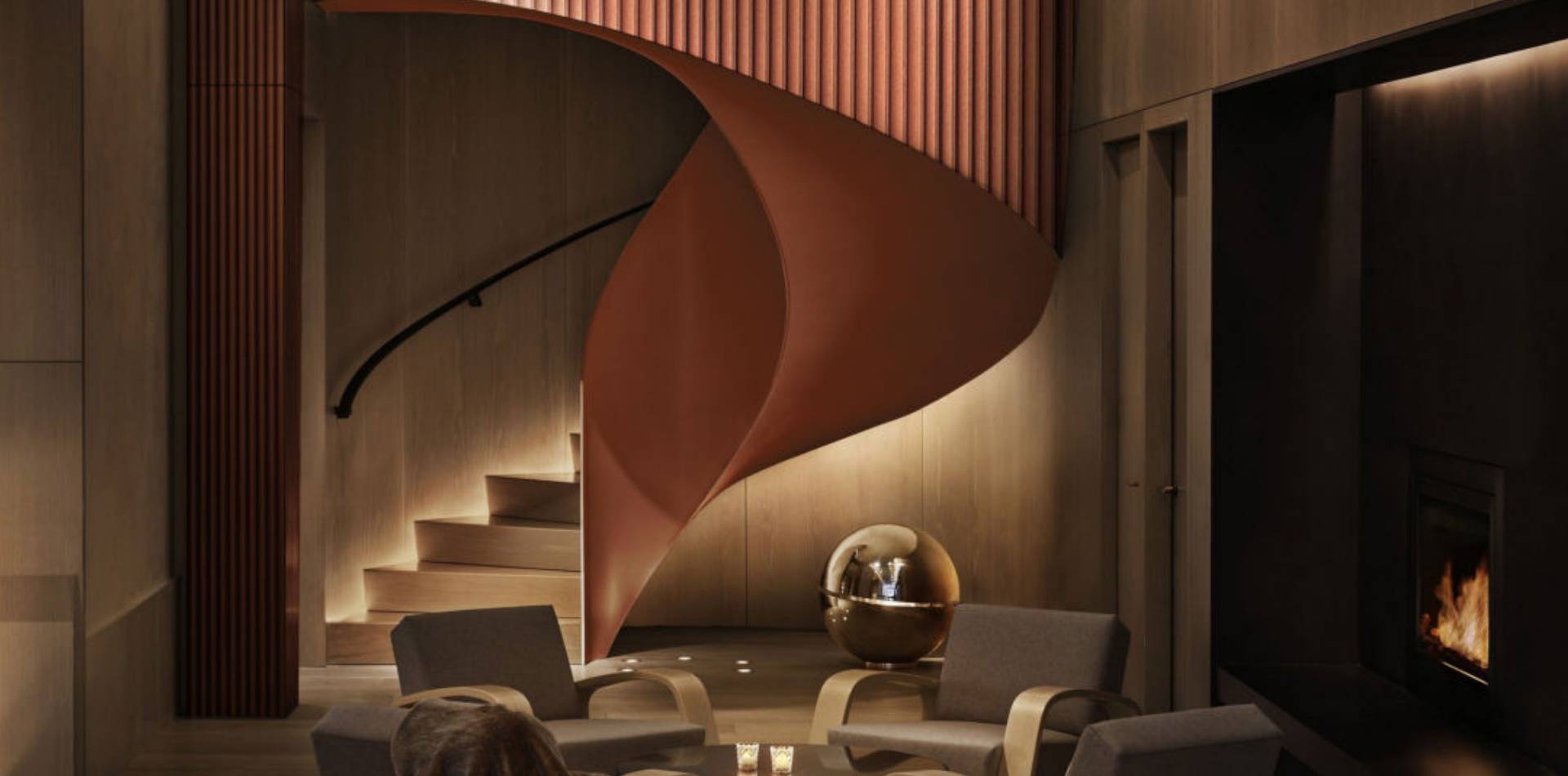
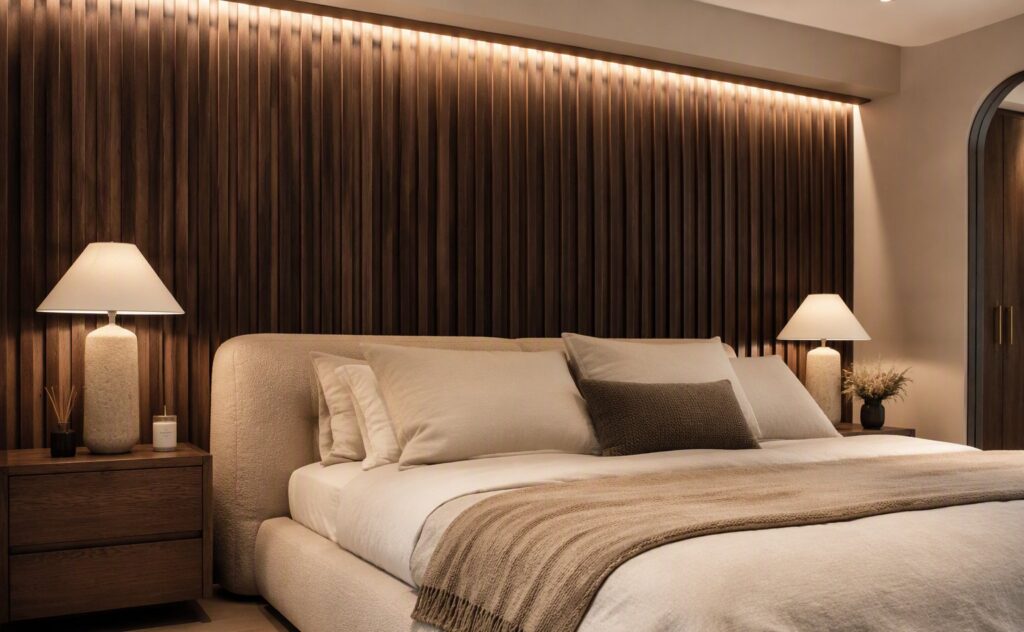
In the world of laminates, veneers and decorative panels in Bangalore, the current stars of the category: fluted panels (vertical ribs in WPC, MDF or wood-look finishes that catch light and shadow beautifully), charcoal panels (lightweight, marble- and stone-look sheets that install fast), PVC panels (the moisture-proof budget option), louver panels, and acoustic panels that absorb echo while looking like designer slat walls.
Pricing is refreshingly accessible: basic PVC panels start around ₹70–₹80 per sq ft, while WPC louvers and 3D wall panels typically run ₹230–₹280 per sq ft at dealer level. The catch, if any, is that panels are a feature, not a finish — one wall per room is drama; four walls is a theatre set.
Why people love it
- Instant texture, depth and a “designed” feel
- Fast installation — often a day per wall
- WPC and PVC variants shrug off moisture and termites
- Hides uneven walls and wiring channels gracefully
Worth knowing
- Best as an accent — restraint is what keeps it premium
- Flutes collect dust; a vacuum brush becomes your friend
- Quality varies wildly between brands — flex the sample before buying
- Trend-driven designs can date faster than a good veneer
Laminates, Veneers and Decorative Panels in Bangalore: The Honest Comparison
Same question, three very different answers. Here’s how the materials stack up on the things that actually matter once the carpenters have left:
| Factor | Laminate | Veneer | Decorative panels |
|---|---|---|---|
| What it really is | Printed paper sealed in resin | A 0.5mm slice of real wood | Textured wall surfacing (WPC, MDF, PVC) |
| Look | Clean, uniform, endless designs | Rich, organic, one of a kind | Sculptural — light and shadow |
| Durability | Excellent — scratch & stain resistant | Good — depends on the polish | Good — varies by material |
| Moisture handling | Very good surface; edges need sealing | Needs PU + ventilation in humid zones | WPC/PVC excellent; MDF poor |
| Maintenance | Wipe and forget | Gentle cleaning; re-polish every few years | Dusting the grooves |
| Repairability | Replace the sheet | Re-polishable, patchable | Replace the section |
| Approx. cost (per sq ft) | ₹40 – ₹300 | ₹75 – ₹300 + polish | ₹70 – ₹280 |
| Best role | Kitchens, wardrobes, workhorse furniture | Beds, dining, statement wardrobes | TV walls, headboards, foyers |
The Room-by-Room Cheat Sheet
When choosing between laminates, veneers and decorative panels in Bangalore room by room, if you remember nothing else from this guide, remember this section. It’s how we actually advise customers on the shop floor:
| Room | Pick | Why |
|---|---|---|
| Kitchen | Laminate | Matte or textured 1mm laminate on base cabinets (they take the beating), acrylic or high-gloss only on upper shutters away from the hob. Keep veneer far from the tadka. |
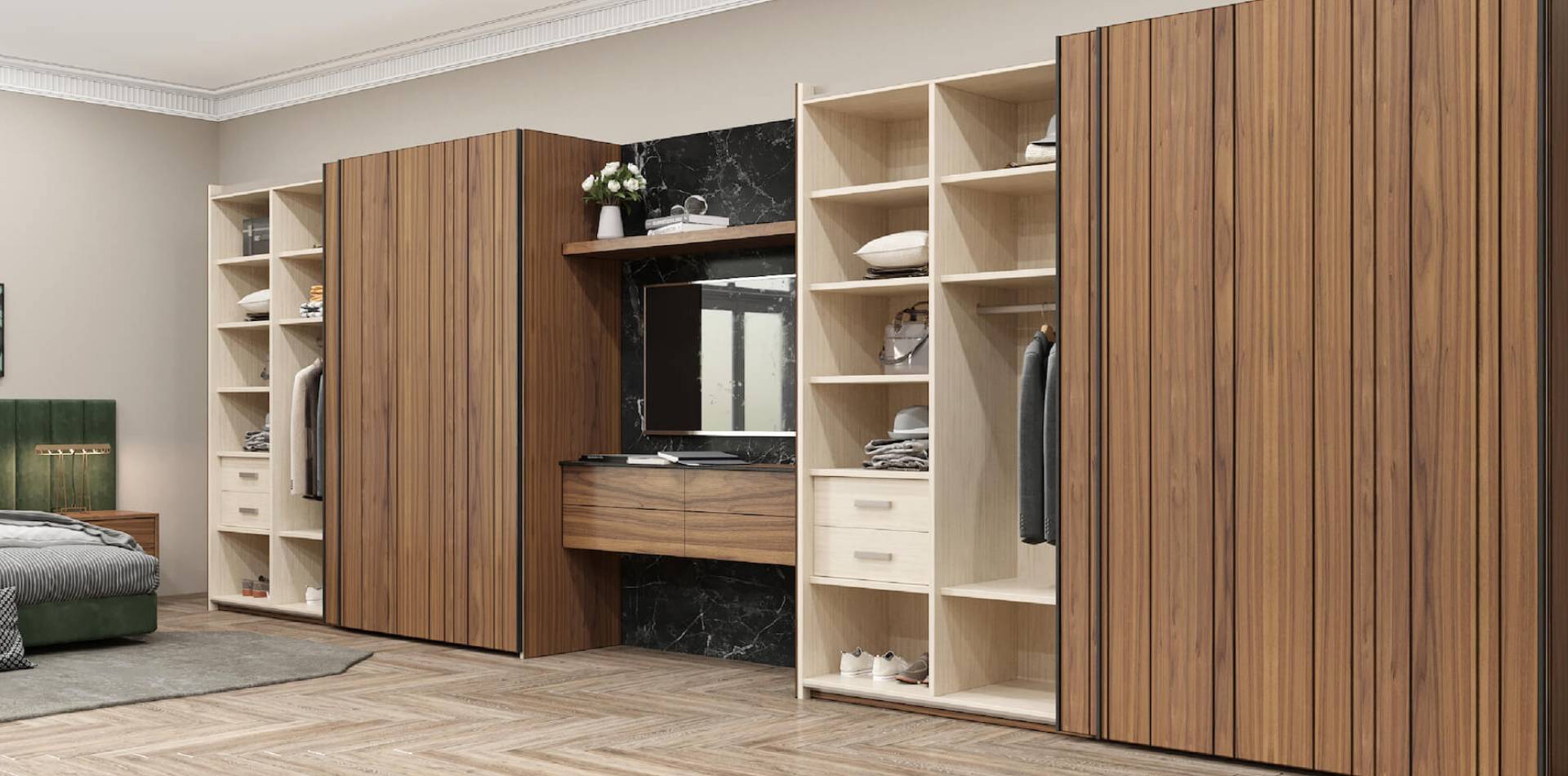
| Wardrobes | Either | Laminate for kids’ rooms and rentals. Veneer with PU for the master bedroom — the grain makes a 10-foot shutter run feel like furniture, not storage. |
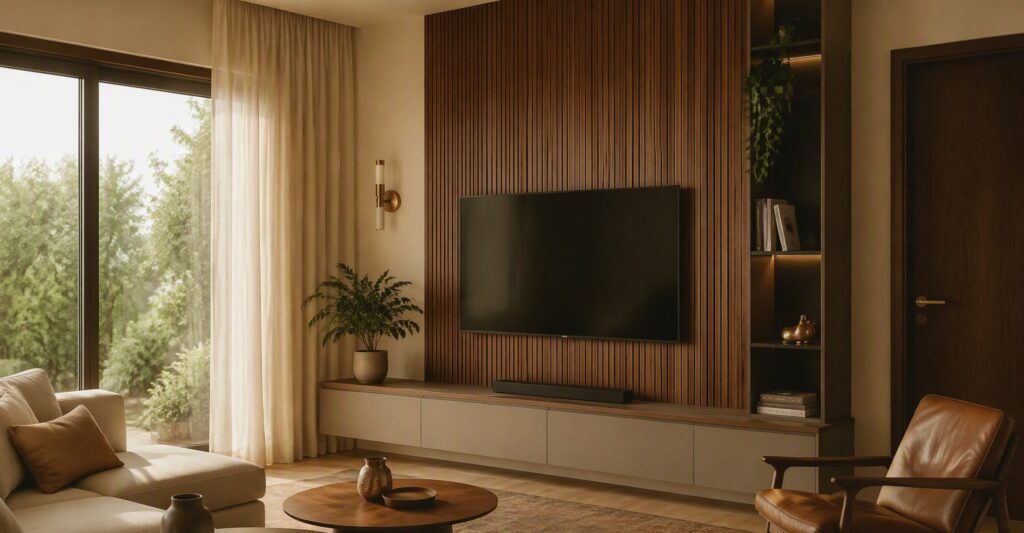
| TV unit & living | Panels + laminate | Fluted panels as the backdrop, laminate on the console. Add a veneer ledge if you want one warm, touchable note. |
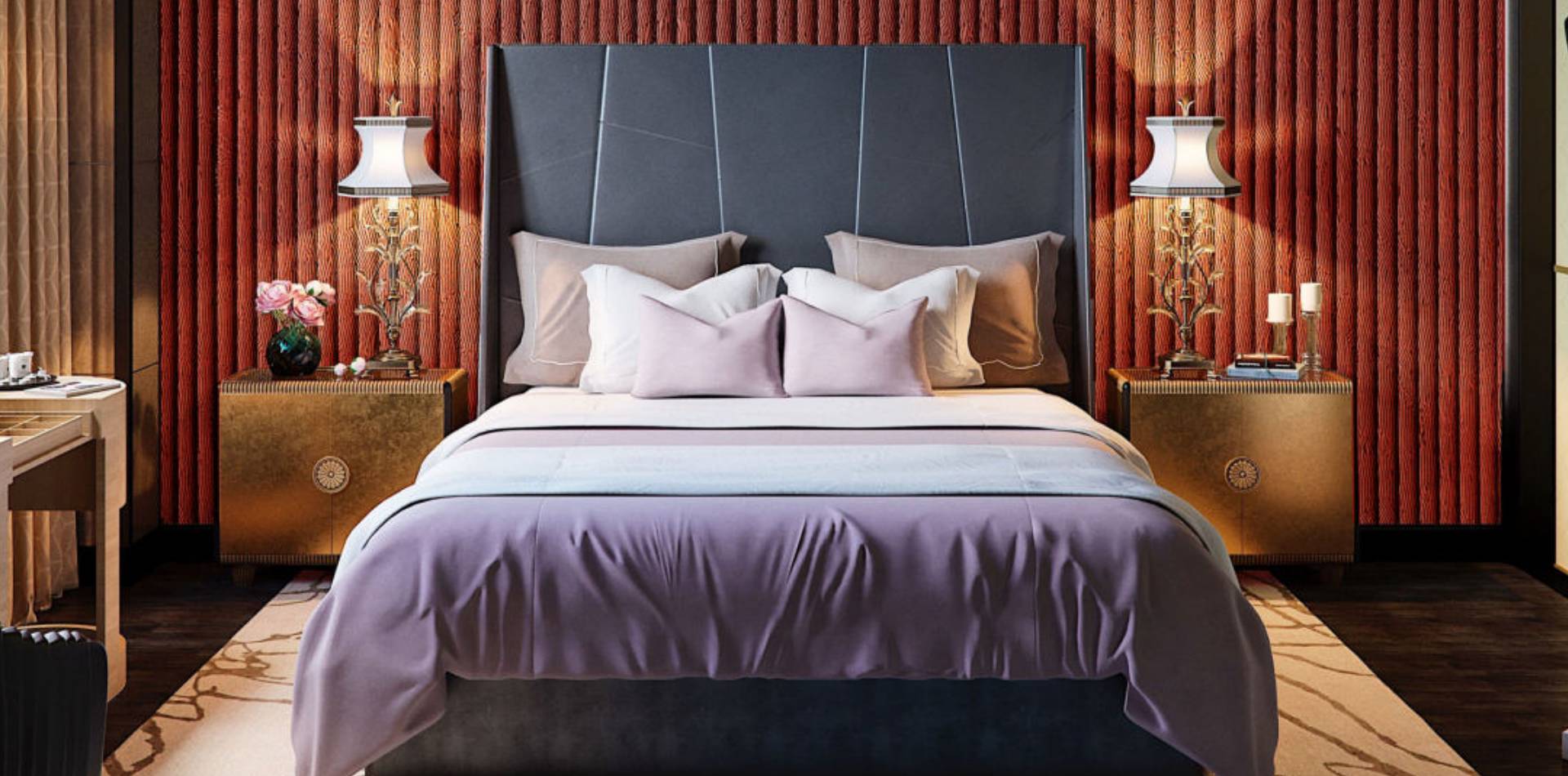
| Bed & headboard | Veneer / panels | A fluted headboard wall with cove lighting is the single highest-impact upgrade in a bedroom. Veneer on the bed frame ties it together. |
| Study & office | Laminate | Desks are scratch magnets — laminate wins. Executive cabins can justify a veneer desk with melamine polish. |
| Bathroom vanity | PVC / WPC | PVC laminates or WPC panels over BWR ply, every edge sealed. Veneer here only with excellent ventilation and PU. |
The Money Maths, Done Honestly
Pricing out laminates, veneers and decorative panels in Bangalore gets concrete fast. Let’s take a standard 6×7 ft wardrobe — roughly 45 sq ft of visible shutter and frame surface — and see what the finish decision actually costs (material and finish labour only, excluding the carcass and carpentry):
| Finish route | Material | Polish / finishing | Approx. total |
|---|---|---|---|
| Premium laminate | ₹3,600 – ₹6,800 | Included (none needed) | ₹4,000 – ₹7,000 |
| Engineered veneer + melamine | ₹3,400 – ₹6,800 | ₹4,500 – ₹6,800 | ₹8,000 – ₹13,500 |
| Natural teak veneer + PU | ₹4,500 – ₹11,000+ | ₹11,000 – ₹27,000 | ₹16,000 – ₹38,000+ |
That gap is real, and it’s why “just do veneer everywhere” is advice nobody with a budget spreadsheet has ever given. The smart play is a mix: laminate where hands and steam live, veneer where eyes and hearts live, panels where the room needs a pulse. A mixed-material home routinely saves 30–40% over an all-veneer brief while looking — honestly — more designed, not less.
Laminate where hands live. Veneer where eyes live. Panels where the room needs a pulse.
The one-line version of this entire guide
Choosing Without Regret
Deciding between laminates, veneers and decorative panels in Bangalore usually comes down to three questions that settle most debates before they start. Who uses this surface daily? Kids, cooks and renters point to laminate. How much sunlight and steam does it see? Harsh exposure favours laminates, WPC and smoked veneers over delicate natural species. And is this a five-year home or a twenty-year one? Veneer’s re-polishability pays off the longer you stay.
Then, before you commit to any of these laminates, veneers and decorative panels in Bangalore, do your homework in person. Screens lie about texture; showrooms don’t.
The showroom checklist
- Flex the sample. A laminate that bends floppy at 1mm won’t survive your kitchen drawer.
- Drag a key — gently — across a corner. Reputable brands expect this test. Do it on the sample piece, not the display.
- For veneer, approve the actual flitch, not a catalogue photo, and ask for the matching pattern (book vs slip) in writing.
- Ask what’s underneath. BWR or BWP ply in kitchens and vanities; the finish is only as good as its substrate.
- Check edge banding samples in the same design — edges are where cheap work announces itself.
- Get the shade code and brand name on the quote. “Walnut finish” is a poem, not a specification.
- Take a sample home overnight. Look at it in your light, next to your flooring, before the final yes.
Quick-Fire FAQ
Is “sunmica” different from laminate?
No — Sunmica is a brand name that became the generic Indian word for decorative laminate, like “Xerox” for photocopies. Formica is another. When someone says sunmica, they almost always mean a standard 0.8–1mm HPL sheet.
Can veneer be used in a kitchen?
Technically yes, with a BWP ply substrate and a full PU coat — but we rarely recommend it for heavy Indian cooking zones. Oil, steam and heat are veneer’s three least favourite things. Use it on a breakfast counter or crockery unit instead, and laminate the working cabinets.
Which lasts longest?
A good laminate easily serves 10–15 years with zero maintenance. Veneer with melamine polish needs attention in 3–5 years, but with PU it goes 7–10 — and unlike laminate, it can be refinished rather than replaced, so its ceiling is arguably longer.
Are fluted panels just a trend?
The profile is having a moment, yes — but ribbed and slatted walls have cycled through design history for decades. Keep them to one accent wall in a finish you genuinely love, and they’ll outlast the hashtag.
What should I ask for to be sure a laminate is genuine?
Buy from an authorised dealer, check the brand marking on the sheet’s reverse, and confirm the design code against the brand’s current catalogue. BIS’s revised IS 2046:2025 standard (aligned with ISO 4586) is tightening compliance across the industry, which is good news for buyers.
Can I mix all three materials in one room?
Mixing laminates, veneers and decorative panels in Bangalore homes is not only possible — you probably should. A fluted TV wall, a laminate console and a veneer open shelf is a combination we see work beautifully week after week. Just keep the wood tones in the same family.
The only way to truly compare laminates, veneers and decorative panels in Bangalore is in person. Bring your floor plan (or just your Pinterest board) to the Evospace studio in Bangalore — laminates, natural and engineered veneers, fluted and WPC panels, all side by side, with people who’ll tell you what we’d pick and why. Plan your showroom visit.