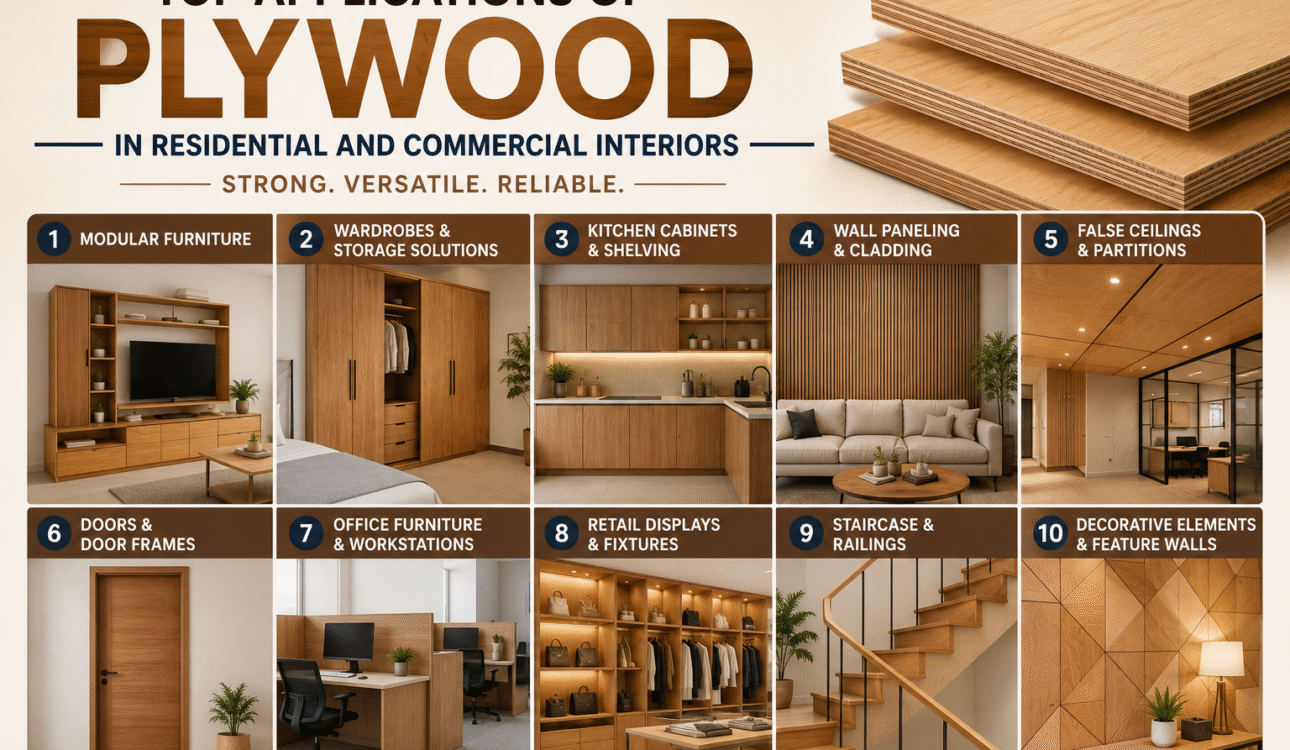
Look around any finished Indian interior and plywood is holding most of it up — the kitchen, the wardrobes, the TV unit, the office desk. Here are all the plywood applications in Bangalore homes and commercial spaces, why plywood beats solid wood and MDF in each role, and the exact grade and thickness professionals specify for every application.
Quick answer: across residential plywood applications in Bangalore, it’s used for modular kitchens (18–19 mm BWR/BWP), wardrobes (18 mm carcass, 15–18 mm shutters), storage beds, TV units and wall paneling, bookshelves, study tables, partitions and door frames. In commercial interiors it builds workstations, reception counters (curved ones use 3–8 mm flexible plywood), retail displays, restaurant seating and wall paneling — typically in BWP grade with 25 mm+ tops for counters, and fire-retardant plywood (IS 5509) where codes demand it. The rule across every application: match the grade to the moisture and the thickness to the load.
Table of Contents
Table of Contents
Why Plywood Became the Default Interior Material
Plywood dominates Indian interiors because it’s the only common board that combines four properties at once: screw-holding strength, dimensional stability through monsoon-to-summer swings, moisture options for wet zones, and compatibility with every finish — laminate, veneer, acrylic, PU paint. This versatility is exactly why plywood applications in Bangalore span everything from kitchens to office reception desks.
Solid wood is beautiful but expensive, heavy and warps without expert seasoning. MDF and particle board are cheaper but lose screws, sag under load and swell permanently with water. Plywood’s cross-laminated veneer construction — each layer’s grain rotated 90° — cancels out wood’s natural movement, which is why a plywood wardrobe shutter stays flat for 20 years while a badly seasoned solid-wood one twists within two monsoons.
The result: whether it’s a 2BHK apartment or a restaurant fit-out, the carpentry almost always starts with a stack of plywood sheets. What changes by application is only which plywood.
1. Kitchen: The Heaviest Plywood Application in the Home
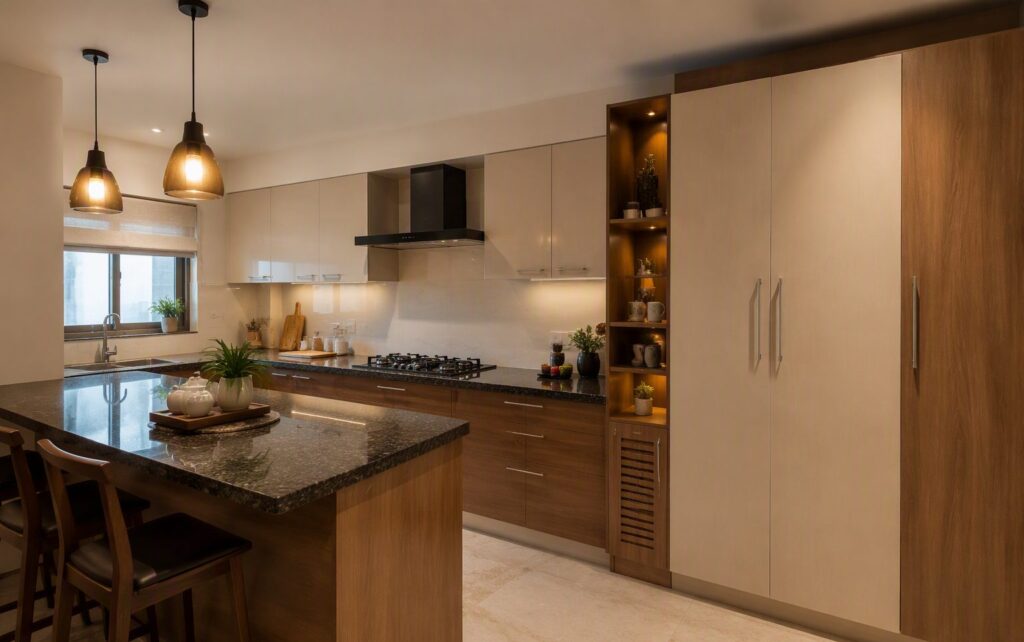
Modular kitchens are the largest of all residential plywood applications in Bangalore homes — a typical 8×10 ft kitchen consumes 10–14 sheets of 18–19 mm board. And it’s the most demanding: steam from daily cooking, water around the sink, oil, cleaning chemicals, plus heavy granite countertops and cookware loads on the shelves.
Base cabinets & under-sink units
The base carcass carries the countertop and all the heavy utensils — this is where cheap plywood fails first. Hinges rip out of swollen MR-grade boards within 2–3 monsoons.
Specify: 18–19 mm BWP/marine (IS 710) · 6–9 mm BWR backs · all cut edges edge-banded or sealed.
Wall units & tall units
Wall cabinets sit directly in the steam line above the hob. They carry less weight than base units but face constant humidity.
Specify: 18–19 mm BWR (IS 303) minimum · BWP if the kitchen has heavy steam cooking or no chimney.
Shutters & drawer systems
Shutters need screw-holding for hinges and soft-close hardware, plus a flat surface for laminate or acrylic finishes. Calibrated (uniform-thickness) plywood matters here — uneven boards leave visible gaps between shutters.
Specify: 16 mm calibrated BWR for shutters · 12–15 mm drawer sides · 6–9 mm drawer bottoms.
Rule that saves kitchens: never allow MR (commercial) grade anywhere in a kitchen, even “just for the back panel.” Steam doesn’t check the price list before it finds the cheapest sheet. See our plywood grades guide for the full MR vs BWR vs BWP breakdown.
2. Bedroom: Wardrobes, Storage Beds & Study Units
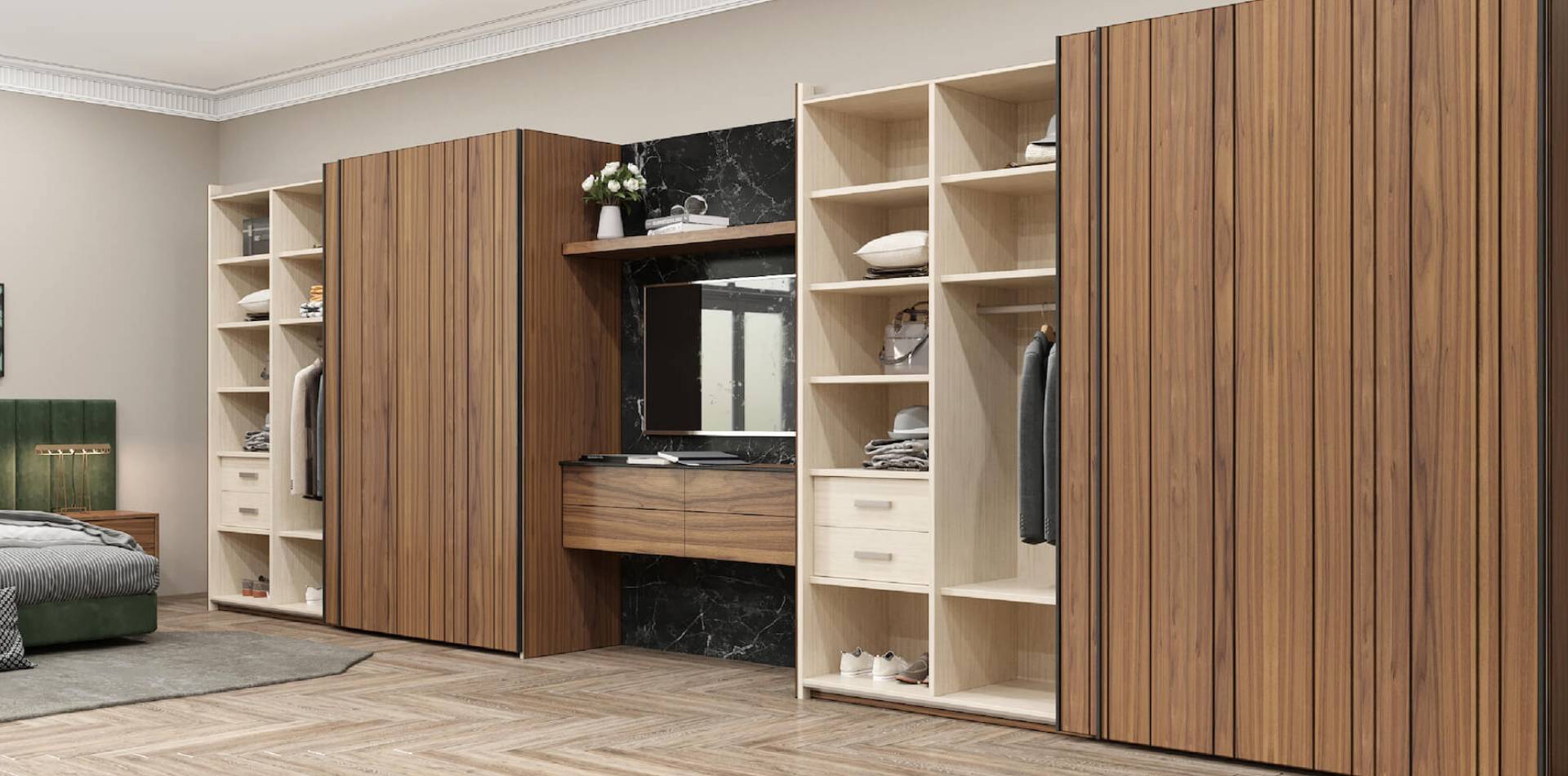
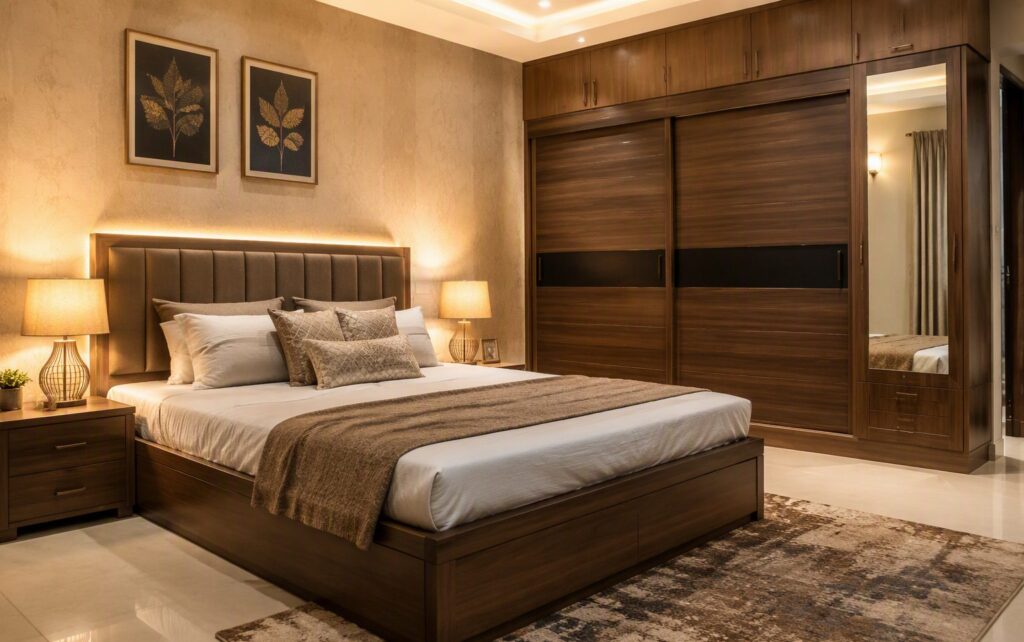
The bedroom is the second-biggest of all residential plywood applications in Bangalore homes — a sliding-door wardrobe plus a hydraulic storage bed typically consumes 12–18 sheets. These are dry-zone applications, so the specification is about strength and span, not waterproofing.
Wardrobes
The workhorse. Carcass sides take the load of shelves, hanging rails and the doors themselves. Shutters need to stay flat across spans of 6–7 ft. For very tall shutters (above 7 ft), blockboard resists bending better than plywood at the same cost.
Specify: 18–19 mm MR/BWR carcass · 15–18 mm shutters (blockboard above 7 ft) · 12–15 mm partitions & drawers · 6–9 mm backs.
Hydraulic storage beds
A queen hydraulic bed must hold two adults, a mattress and the stored contents, plus take daily stress from the lifting mechanism. This is a pure strength application — never downgrade the grade here.
Specify: 18–19 mm BWR (damp floors are common) · 25 mm base frame for king beds · 12 mm for storage compartments.
Study tables, bookshelves & lofts
Bookshelves sag visibly over spans longer than ~2.5 ft unless the shelf is thick enough or supported. Loft storage above wardrobes sits in the hottest, dustiest part of the room but carries luggage loads — both everyday plywood applications in Bangalore bedrooms.
Specify: 18 mm for shelves up to 2.5 ft span · 25 mm (or double 18 mm) for longer bookshelves · 18 mm MR for lofts.
3. Living Room: TV Units, Wall Paneling & Shelves
Living room plywood work is mostly about spans and surfaces: the TV unit hangs on the wall, the paneling covers large areas, and open shelves show every millimetre of sag. These are some of the most visible plywood applications in Bangalore living rooms. Dry-zone grades work, but thickness discipline matters more here than anywhere else.
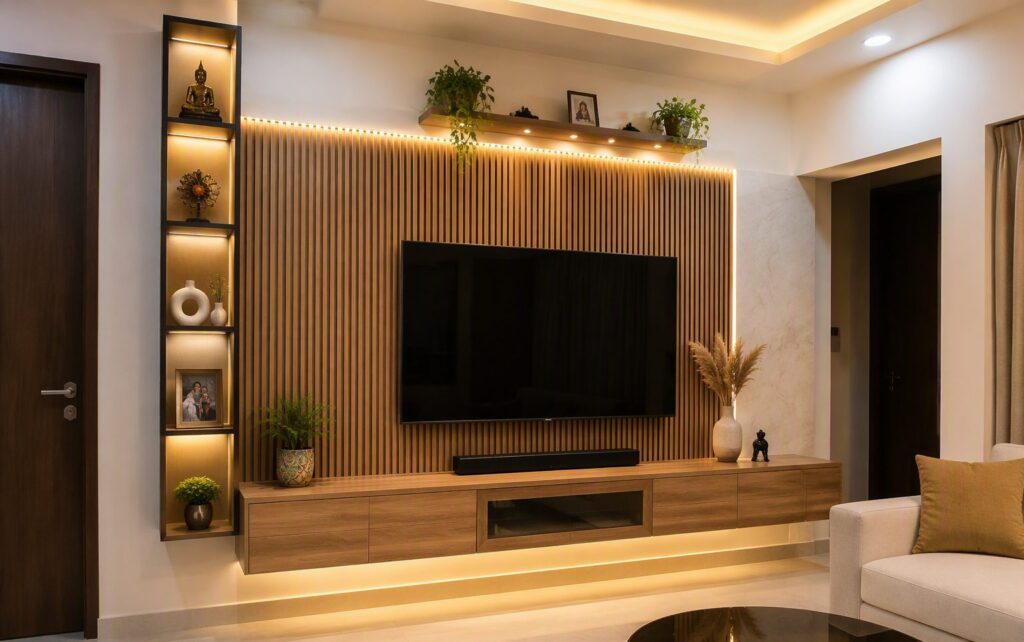
TV units & entertainment walls
Floating TV consoles hang entirely off wall fixings — the plywood’s screw-holding strength is the entire safety margin. Back paneling behind the TV usually doubles as a wire-hiding cavity.
Specify: 18 mm MR/BWR for the console carcass · 12 mm for back paneling · anchor into masonry, never only into the ply.
Wall paneling & wainscoting
Full-height paneling, moulding accent walls and fluted panel backdrops all start with a plywood skin fixed to the wall battens, over which veneer, laminate, fabric or moulding strips are applied — one of the simpler plywood applications in Bangalore living rooms to get right.
Specify: 9–12 mm MR as the paneling skin · BWR for paneling in homes near the coast or with damp walls.
Consoles, crockery units & display shelves
Crockery units carry surprising weight — a full dinner set in glass can exceed 40 kg on one shelf. Open display shelves show sag immediately.
Specify: 18–19 mm for crockery shelves · 25 mm for cantilevered/open shelves over 2.5 ft.
4. Partitions, Doors, Ceilings & Flooring Support
Beyond furniture, plywood plays structural support roles that homeowners rarely see — but which decide whether the visible finishes crack, squeak or stay silent for decades. These behind-the-scenes plywood applications in Bangalore projects are easy to overlook, but skipping them causes the most expensive repairs.
- Partitions & room dividers (9–12 mm both faces): a plywood skin over a timber or metal frame creates lightweight internal walls, pooja enclosures and study nooks without brickwork. Cheaper and faster than blockwork, and easy to dismantle in rentals.
- Flush doors & door frames (25–32 mm): interior flush doors are plywood-faced by construction; frames in BWR resist the damp that creeps up from daily floor mopping.
- False ceiling backing (6–9 mm): plywood forms the curved coffers, cove details and downlighter cut-outs that gypsum alone can’t hold. Flexi ply handles the curves.
- Subfloor under wooden/laminate flooring (18–25 mm): engineered wood and carpet floors need a flat, screw-stable base — plywood is the standard subfloor, especially over old mosaic or uneven slabs.
- Mezzanines & bunk structures (25 mm+): in compact urban homes, plywood decks on steel frames create sleeping lofts and study platforms.
Note: plywood is the support layer for floors, not the walking surface — the visible floor stays tile, stone or engineered wood. Anyone selling “plywood flooring” as a finished surface in a living room is selling maintenance problems.
5. Commercial Interiors: Offices, Retail & Hospitality
Commercial plywood applications in Bangalore follow different rules than homes: heavier daily abuse, cleaning chemicals, fire-safety codes, and surfaces that must look new through thousands of touches. Specifications shift up a grade and up a thickness.
Workstations, conference tables & storage
Office desks take leaning, dragging and decades of reconfiguration. Modular workstations are dismantled and reassembled with every office move — only plywood’s screw-holding survives repeated reassembly, which is why office fit-outs remain one of the most demanding plywood applications in Bangalore commercial projects.
Specify: 18–19 mm BWR for desk carcasses · 25 mm for conference/desk tops · edge-banded all around.
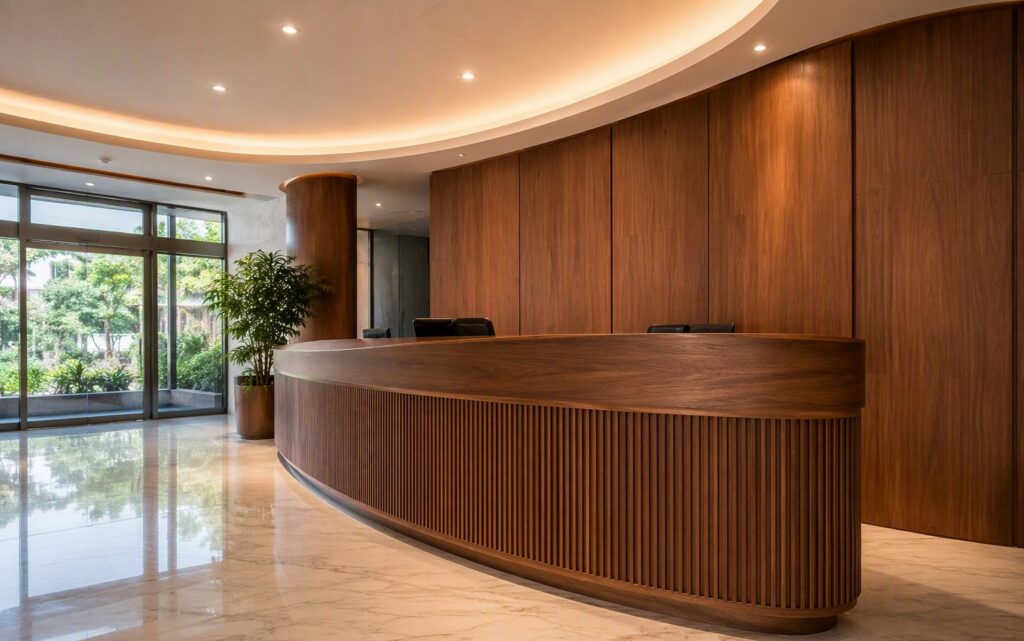
Reception desks & curved counters
The signature piece of most offices. Curved reception fronts are built from flexible plywood wrapped over a CNC-cut rib frame, then finished in laminate, veneer or PU paint. The curve is impossible in any other board material at this cost.
Specify: 3–8 mm flexi ply in 2–3 layers for the curve · 18 mm BWR carcass · 25 mm transaction top.
Display units, counters & shopfitting
Retail fixtures get reconfigured with every season and collection change. Plywood’s re-screwable strength is why shopfitting runs almost entirely on it — garment racks, shoe displays, cash counters, trial-room partitions — all common retail plywood applications in Bangalore malls and high streets.
Specify: 18 mm BWR displays · 25 mm cash/display counters · laminate on all faces for cleaning.
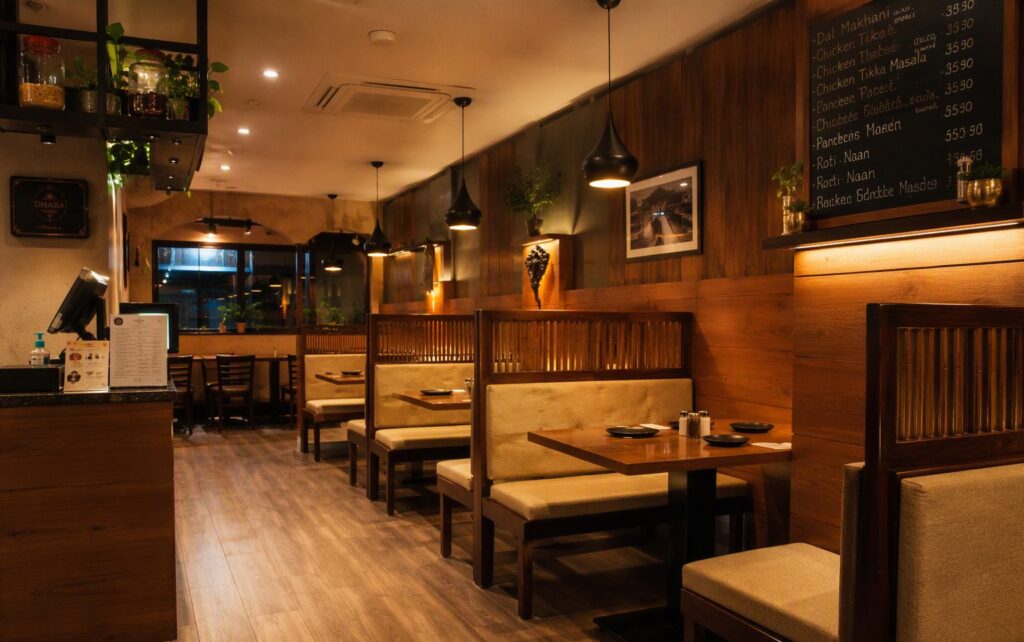
Restaurant seating, paneling & service counters
Booth seating takes sliding bodies, spills and daily chemical wipe-downs. Wall paneling in restaurants doubles as acoustic softening. Hotel casegoods — headboards, luggage racks, minibar units — face suitcase impacts and housekeeping chemicals.
Specify: 18–19 mm BWP for booths & counters · BWR for wall paneling · fire-retardant ply (IS 5509) where fire NOC applies.
Fire-retardant plywood (IS 5509) is not optional in many commercial projects: hospitals, schools, malls, theatres and hotels above certain heights commonly require it for paneling and furniture under fire NOC conditions. It costs roughly 15–25% more than standard ply — budget for it at the design stage, not after the inspection.
6. Specialty Plywood: Flexible, Fire-Retardant & Veneer-Faced
Three specialty variants cover the plywood applications in Bangalore that standard plywood can’t handle.
- Flexible plywood (flexi ply, 3–8 mm, ₹45–120/sq ft): bends in one direction down to a radius of roughly 80–400 mm depending on thickness. Applications: curved reception counters, rounded display gondolas, column wraps, wave ceilings, arched headboards, curved bar fronts. Used in 2–3 glued layers to hold the shape.
- Fire-retardant plywood (IS 5509): treated to slow ignition and flame spread. Applications: hospital and school furniture, mall paneling, hotel corridors and public-area fit-outs, kitchen soffits in commercial kitchens.
- Pre-laminated & veneer-faced plywood: arrives factory-finished with decorative veneer or laminate pressed on. Applications: premium wardrobes and paneling where on-site polishing time isn’t available, office furniture with matching finishes, retail rollout fixtures across multiple stores.
Also worth knowing: shuttering plywood (film-faced, IS 4990) belongs to construction, not interiors — don’t let anyone sell it to you for furniture; and marine plywood beyond IS 710 (genuine boat-building ply) is overkill and mostly a marketing label in the retail market.
7. The Master Specification Table
Screenshot this and hand it to your carpenter or contractor. It covers the application, the zone, the grade and the thickness in one view — a quick reference for every plywood application in Bangalore homes and offices.
| Application | Zone | Grade | Thickness | Notes |
|---|---|---|---|---|
| Kitchen base cabinets / under-sink | Wet | BWP (IS 710) | 18–19 mm carcass | Edge-seal everything; 6–9 mm BWR back |
| Kitchen wall units & shutters | Wet | BWR (IS 303) | 18–19 mm carcass, 16 mm calibrated shutters | Upgrade to BWP near hob without chimney |
| Wardrobes | Dry | MR / BWR | 18–19 mm carcass, 15–18 mm shutters, 6–9 mm back | Blockboard for shutters > 7 ft |
| Hydraulic storage beds | Dry | BWR | 18–19 mm, 25 mm king-bed frame | Floor damp from mopping justifies BWR |
| TV units & consoles | Dry | MR / BWR | 18 mm carcass, 12 mm back panel | Anchor to masonry |
| Wall paneling / wainscoting skin | Dry | MR (BWR in coastal homes) | 9–12 mm | Skin over battens; finish on top |
| Bookshelves & display shelves | Dry | MR / BWR | 18 mm up to 2.5 ft span, 25 mm beyond | Sag is permanent — size up, not down |
| Partitions & dividers | Dry | MR / BWR | 9–12 mm both faces | Over timber/metal frame |
| False ceiling curves & coves | Dry | MR + flexi ply for curves | 6–9 mm | Backing only, finish is gypsum/paint |
| Subfloor under wood/laminate | Dry | BWR | 18–25 mm | Screwed & levelled, not nailed |
| Office workstations & desks | Commercial | BWR | 18–19 mm, 25 mm tops | Built for repeated reassembly |
| Reception counters (curved) | Commercial | BWR carcass + flexi ply | 18 mm + 3–8 mm flexi ×2–3 layers | 25 mm transaction top |
| Retail displays & cash counters | Commercial | BWR | 18 mm displays, 25 mm counters | Laminate all faces |
| Restaurant booths & counters | Commercial wet-clean | BWP (IS 710) | 18–19 mm | Chemical wipe-downs daily |
| Public buildings (hospitals, schools, malls) | Commercial | Fire-retardant (IS 5509) | Per design | Often a fire-NOC requirement |
8. Five Application Mistakes to Avoid
These five mistakes account for most of the failed plywood applications in Bangalore renovations we get called in to fix.
- MR grade in the kitchen or bathroom. The single most common failure. Steam finds the cheapest sheet first. Kitchen minimum is BWR; wet zones are BWP only.
- One thickness for the whole unit. A wardrobe built entirely from 18 mm wastes money; one built with 12 mm shelves sags. Use the layered spec: 18 mm structure, 12–15 mm internals, 6–9 mm backs.
- Skipping edge sealing. Plywood fails from the cut edges inward. Every sink-adjacent edge needs banding or sealant — a 10-minute step that doubles cabinet life.
- Curved work in regular plywood. Kerfing (saw-cut bending) weakens the panel and telegraphs through the finish. Flexi ply exists precisely for this — 3–8 mm, bent over ribs.
- Buying “marine ply” by name, not by stamp. Genuine IS 710 BWP carries the ISI mark with the standard number. Unstamped “waterproof” ply is usually MR with a story. Check the stamp on the sheet edge — our plywood quality check guide covers exactly how.
Frequently Asked Questions
What are the main plywood applications in Bangalore home interiors?
Modular kitchen cabinets, wardrobes, hydraulic storage beds, TV units and wall paneling, bookshelves, study tables, pooja units, partitions, door frames and false-ceiling backing. Typical specs: 18–19 mm BWR/BWP for kitchens, 18 mm for wardrobe carcasses, 6–9 mm for backs.
Which plywood grade is used for modular kitchens?
BWR (IS 303) is the minimum for wall units and shutters; BWP/marine (IS 710) is recommended for base cabinets, under-sink units and hob-adjacent cabinets. Use 18–19 mm for carcasses, 16 mm calibrated for shutters. Never use MR grade in a kitchen.
What thickness of plywood is used for wardrobes?
18–19 mm for the carcass, sides, top, bottom and load-bearing shelves; 15–18 mm for shutters; 12–15 mm for partitions and drawer sides; 6–9 mm for backs and drawer bottoms. For shutters taller than 7 ft, blockboard resists sag better.
Where are the main commercial plywood applications in Bangalore offices and retail?
Office workstations and conference tables, curved reception desks (flexible plywood), retail displays and cash counters, restaurant booth seating and wall paneling, hotel casegoods, partitions and acoustic paneling. Commercial specs typically run BWP grade, 25 mm+ counter tops, and fire-retardant ply (IS 5509) for public buildings.
What is flexible plywood used for?
Curved reception counters, rounded display units, column wraps, wave ceilings, arched wall panels and curved headboards. It’s 3–8 mm thick, bends to an 80–400 mm radius depending on thickness, costs ₹45–120 per sq ft, and finishes like regular plywood.
Can plywood be used for flooring and ceilings?
Yes, as support: 18–25 mm subfloor under laminate/wooden/carpet flooring, and 6–9 mm backing for false-ceiling curves and coves. It is not the finished walking surface — tile, stone or engineered wood goes on top.
Is plywood better than MDF or particle board for furniture?
For most furniture, yes — plywood has far better screw-holding, load capacity, moisture resistance and a 15–30 year lifespan versus 5–10 for particle board. MDF wins only for CNC-routed decorative panels and painted shutters in dry rooms; particle board suits light, budget, dry-zone furniture only.
Which plywood is best for bathroom and wet-area interiors?
BWP/marine plywood (IS 710), with every cut edge sealed, is the right choice for these wet-zone plywood applications in Bangalore homes: bathroom vanities, under-sink cabinets, utility areas and balcony furniture. For extreme wet zones, pair it with WPC boards.
Planning a Plywood-Heavy Project?
Send us your floor plan and we’ll map every one of your plywood applications in Bangalore — kitchen to wardrobe to TV wall — with the right grade, thickness and a sheet-wise estimate before you spend a rupee on material. Get a free material plan.
Sources & further reading
Grade and thickness recommendations here follow the Bureau of Indian Standards — IS 303 (MR/BWR plywood), IS 710 (marine/BWP plywood), IS 5509 (fire-retardant plywood) and IS 4990 (shuttering plywood) — along with manufacturer technical specification sheets and 2025–26 market surveys. Prices and specifications are indicative and vary by city and brand.