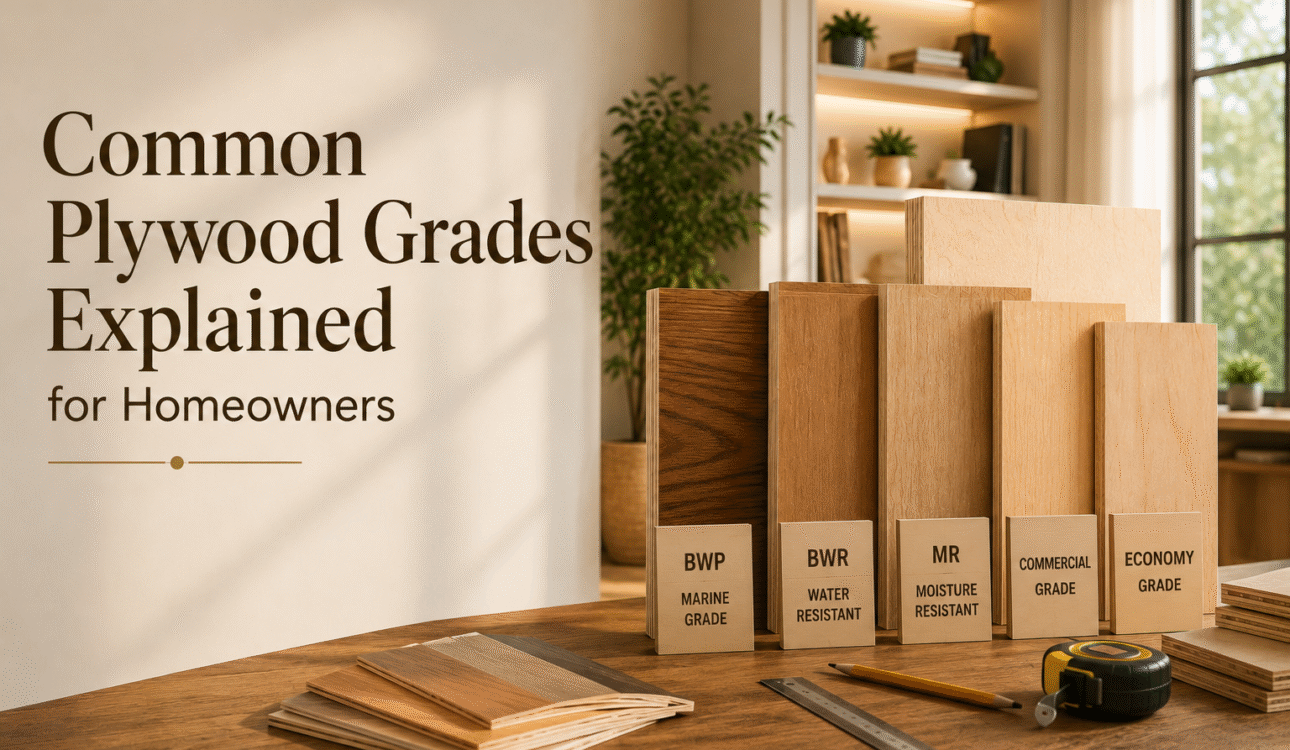
If you’re new to plywood grades in Bangalore, here’s the one thing that trips up almost every homeowner: the grade printed on a sheet has nothing to do with thickness or strength — it’s a water-resistance rating set by the adhesive holding the veneers together. Change the glue, change the grade.
This guide decodes plywood grades in Bangalore the way we explain them on our own shop floor: what MR, BWR and BWP actually mean, how they map to the BIS standards IS 303 and IS 710, what each one costs in 2026, and which grade belongs in which room of an Indian home.
Quick answer: plywood comes in three moisture grades. MR (Moisture Resistant, IS 303) is for dry interiors like wardrobes and beds — ₹55–90 per sq ft. BWR (Boiling Water Resistant, IS 303) handles steam and splashes — the minimum for kitchens, ₹70–125 per sq ft. BWP (Boiling Water Proof, IS 710), also called marine plywood, is fully waterproof — for bathrooms, under-sink units, balconies and coastal homes, ₹90–180+ per sq ft. Simple rule: dry room → MR, steamy room → BWR, wet zone → BWP. When in doubt, go one grade higher.
Table of Contents
Plywood Grades in Bangalore: What They Actually Mean
Plywood grades — MR, BWR and BWP — describe how much water the adhesive bonding the veneer layers can survive. The grade says nothing about thickness, strength class or wood species; it is a water-resistance rating set by the Bureau of Indian Standards (BIS).
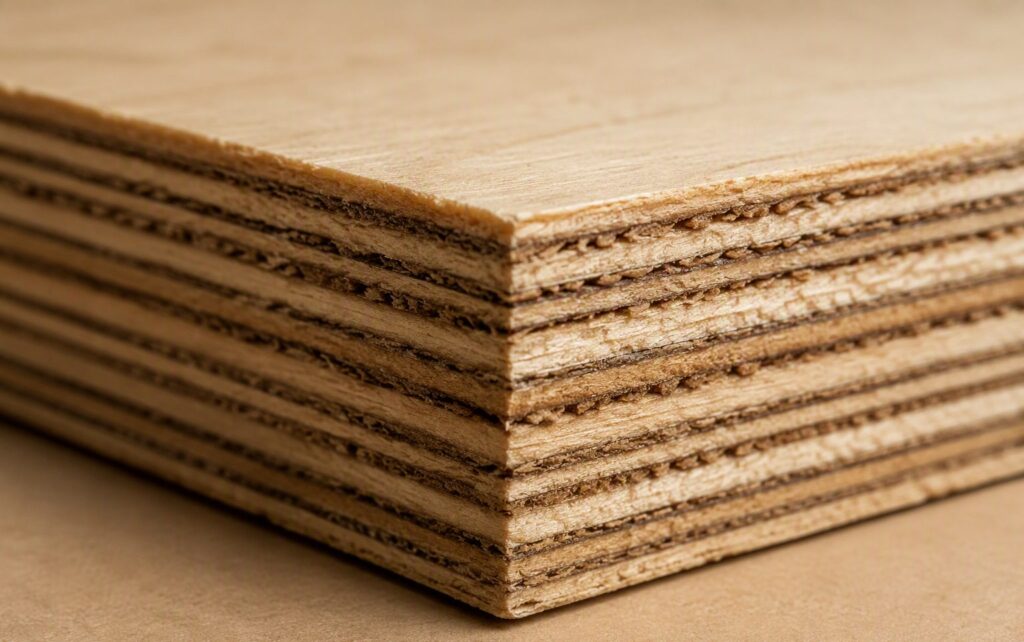
Plywood is thin wood veneers glued together with the grain of each layer rotated 90° (cross-lamination), which makes it far stronger and more stable than solid wood of the same thickness. But when furniture fails early — swollen shutters, bubbling laminates, layers peeling apart — the culprit is almost never the wood. It’s the glue line giving up.
- MR plywood is bonded with urea-formaldehyde (UF) glue: economical, fine for dry interiors, but it softens when wet.
- BWR and BWP plywood use phenol-formaldehyde (PF) — the weather-and-boil-proof adhesive family — which does not dissolve in water.
Understanding plywood grades in Bangalore starts with the paperwork. The numbers stamped on the sheet are BIS standard codes, not marketing: IS 303 is the general-purpose plywood specification covering both MR and BWR grades; IS 710 is the separate, stricter marine plywood standard that BWP must pass — including a prolonged boiling-water test that would delaminate an MR sheet within hours.
MR, BWR and BWP Plywood, Explained
MR Plywood (Moisture Resistant) — IS 303, “Commercial Plywood”
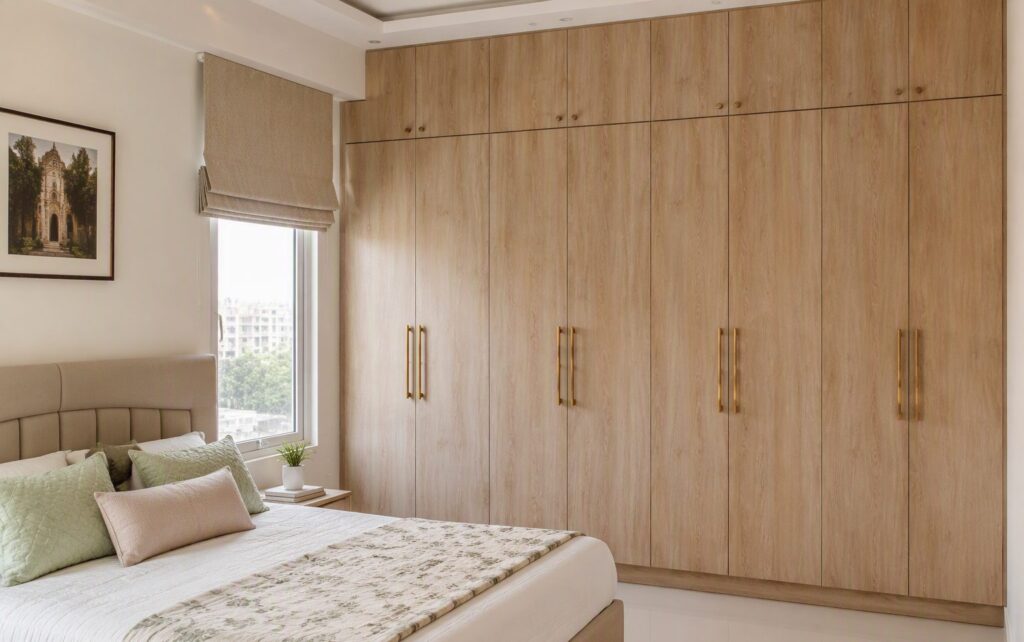
MR is the economy interior grade — the most sold of all plywood grades in Bangalore — made for dry indoor furniture that never meets water. The name is honest about its limits: it resists humidity in the air, not splashes, steam or standing water. Bonded with urea-formaldehyde glue, it’s the right call for wardrobe carcasses, beds, bookshelves, TV units and study tables in dry rooms.
Price: ₹55–90 per sq ft (18 mm); roughly ₹1,700–2,800 per 8×4 sheet.
A common mistake with plywood grades in Bangalore: watch out for using MR in kitchens, bathrooms or balconies. Dealers sometimes push MR as “good enough with laminate” — it isn’t. Laminate protects the face, not the glue inside the edges.
BWR Plywood (Boiling Water Resistant) — IS 303
Among plywood grades in Bangalore, BWR is the practical middle grade and the sensible minimum for kitchens. It uses phenol-formaldehyde glue and passes a cyclic boiling-water test under IS 303, so it copes with steam from daily cooking, monsoon humidity and the occasional splash without delaminating. It is water-resistant, though — not waterproof — so it’s not the grade for anything that stays wet.
Best for: kitchen wall units and shutters, utility areas, bathroom vanities away from direct splash, furniture in humid climates.
Price: ₹70–125 per sq ft (18 mm); roughly ₹2,200–3,600 per 8×4 sheet.
Watch out for: dealers quoting “BWR 710”. BWR belongs to IS 303; only BWP belongs to IS 710. The two numbers are not interchangeable — treat that combination as a red flag.
BWP Plywood (Boiling Water Proof) — IS 710, “Marine Plywood”
The top of the plywood grades in Bangalore ladder: BWP is the top of the BIS moisture ladder — the same product sold as “marine plywood” or “710 plywood” — bonded with fully waterproof phenolic glue and tested against prolonged boiling. Beyond the glue, IS 710 demands tighter core construction and preservative treatment, which is why BWP sheets carry the longest warranties (often 20–30 years from premium brands).
Best for: under-sink cabinets and kitchen base units, bathroom interiors, balcony and semi-outdoor furniture, and anywhere you want to build once and forget.
Price: ₹90–180+ per sq ft (18 mm); roughly ₹2,800–6,000 per 8×4 sheet.
Another pricing trap across plywood grades in Bangalore: watch out for “710-grade” sheets priced like commercial MR. Phenolic resin and marine-grade construction genuinely cost more to make — an implausibly cheap BWP is usually a relabelled MR. Verify the ISI mark and buy from authorised dealers.
| MR (Commercial) | BWR | BWP / Marine | |
|---|---|---|---|
| Full form | Moisture Resistant | Boiling Water Resistant | Boiling Water Proof |
| BIS standard | IS 303 | IS 303 | IS 710 |
| Glue | Urea-formaldehyde (UF) | Phenol-formaldehyde (PF) | Phenol-formaldehyde (PF), highest spec |
| Handles | Dry air, normal humidity | Steam, splashes, humid climates | Prolonged water exposure, outdoor use |
| Best rooms | Bedrooms, living room, study | Kitchen, utility, vanities | Bathroom, under-sink, balcony, coastal |
| Price per sq ft | ₹55–90 | ₹70–125 | ₹90–180+ |
| 8×4 sheet | ₹1,700–2,800 | ₹2,200–3,600 | ₹2,800–6,000 |
| Typical lifespan | 10–15 yrs (dry use) | 12–20 yrs | 20–30 yrs (premium brands warrantied) |
The one-line rule: match the grade to the water the panel will actually meet. Dry room → MR. Steam and splashes → BWR. Constant wet, outdoors or coast → BWP. When in doubt, go one grade higher — upgrading a kitchen from MR to BWR costs a few thousand rupees; replacing a swollen kitchen costs lakhs.
Evospace shop-floor wisdom
Beyond Grades: Core Wood, Calibration & Thickness
Not all plywood grades in Bangalore are decided by the glue alone. Two sheets with the same grade and thickness can behave very differently. Three things separate them.
Core wood species
Core wood matters across every one of these plywood grades in Bangalore. The inner veneers decide screw-holding, weight and price. Gurjan (a dense imported hardwood) is the premium core — typically 20–35% more expensive — with the best screw-holding and longevity. Eucalyptus and other plantation hardwoods sit in the middle. Poplar is light and cheap but softer — fine for budget furniture, weaker under hinges. Ask the dealer what’s inside; a heavier sheet usually signals a denser hardwood core.
Calibrated plywood
Calibration is a cross-cutting upgrade across plywood grades in Bangalore. Calibrated ply is precision-sanded after pressing so every point on the sheet is the same thickness (typically ±0.5 mm). Regular plywood can vary enough that wardrobe shutters misalign and laminates bond unevenly. For modular kitchens, CNC-cut furniture and shutters, calibrated is the professional default — 16 mm calibrated ply is the standard for wardrobe and kitchen shutters. It costs roughly 8–15% more than regular ply and saves more than that in labour and finishing corrections.
Thickness: what to use where
| Thickness | Typical use |
|---|---|
| 4–6 mm | Wardrobe backs, drawer bottoms, panelling, false-ceiling skins |
| 9 mm | Light partitions, small shelves, drawer sides |
| 12 mm | Shelves with support, drawer boxes, table tops with a frame |
| 16 mm (calibrated) | Shutters — wardrobe and kitchen overhead units |
| 18–19 mm | Carcasses — wardrobes, kitchen cabinets, beds, load-bearing shelves |
| 25 mm | Long table tops, heavy-duty counters |
Whatever the grade, plywood grades in Bangalore ship in a standard sheet of 8 ft × 4 ft (32 sq ft). When comparing dealer quotes, always convert to per-sq-ft: sheet price ÷ 32.
Blockboard, MDF & Speciality Plywood — Where They Fit
Plywood isn’t the only panel in the dealer’s shop. Knowing the neighbours helps you spend right on plywood grades in Bangalore, and on the boards that aren’t plywood at all.
Blockboard (IS 1659)
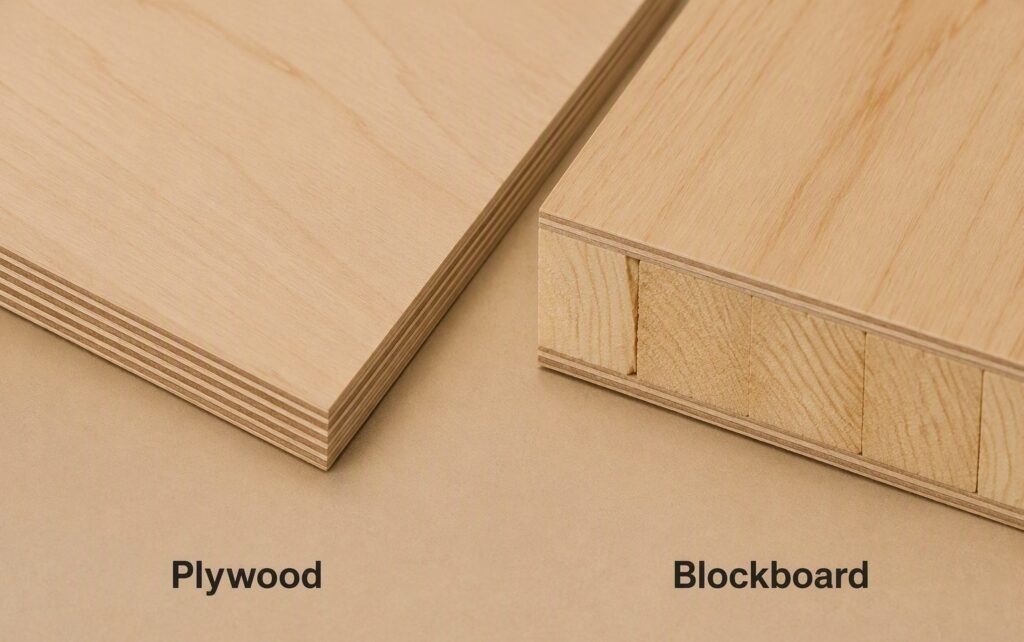
Unlike the plywood grades in Bangalore covered above, blockboard uses softwood strips sandwiched between veneers. Lighter than plywood (a 19 mm 8×4 sheet is ~25–32 kg vs plywood’s 35–45 kg) and resists sagging over long spans — which is why carpenters prefer it for long wardrobe shutters (7 ft+), flush doors, partitions and long shelves. But its softwood core dislikes moisture and holds screws inconsistently at the edges, so never use it in kitchens or bathrooms. The smart hybrid many carpenters use: plywood for the carcass and shelves, blockboard for the tall doors — and it’s 10–20% cheaper.
MDF & particle board
Outside the plywood grades in Bangalore covered above, MDF offers cheaper, factory-smooth boards for shutters and decorative panels in dry rooms — the default in budget factory-made furniture. They machine beautifully but swell permanently with water and hold screws worse than plywood. Fine for dry-room shutters; never for carcasses in humid homes.
Speciality plywood worth knowing
- Beyond the core plywood grades in Bangalore, fire-retardant plywood (IS 5509) — chemically treated to slow flame spread; specified for commercial kitchens, server rooms, theatres and premium homes.
- Shuttering plywood — film-faced phenolic ply made for concrete formwork on construction sites; durable but rough-faced, not a furniture product.
- Flexible (flexi) plywood — bends into curves for rounded counters, arches and column cladding.
Which Plywood for Which Room: The Home Map
Among plywood grades in Bangalore, matching grade to location is the whole game — here’s the room-by-room answer most homeowners actually came for.
| Space / furniture | Recommended grade | Why |
|---|---|---|
| Wardrobe carcass (dry bedroom) | MR, 18 mm | No water contact; save the premium for elsewhere |
| Wardrobe shutters | 16 mm calibrated ply, or 19–25 mm blockboard for 7 ft+ shutters | Calibration keeps hinges aligned; blockboard won’t sag over tall spans |
| Bed, TV unit, study, bookshelf | MR | Dry-zone furniture |
| Kitchen wall units & shutters | BWR, 16–18 mm | Daily steam and humidity |
| Kitchen base units, under-sink cabinet | BWP (IS 710) | Splashes, plumbing leaks, wet mopping |
| Bathroom vanity & storage | BWP | 85–95% humidity during and after showers |
| Balcony / semi-outdoor furniture | BWP, edge-sealed | Rain and weather exposure |
| Interior doors | Blockboard / flush doors | Lightweight, sag-resistant |
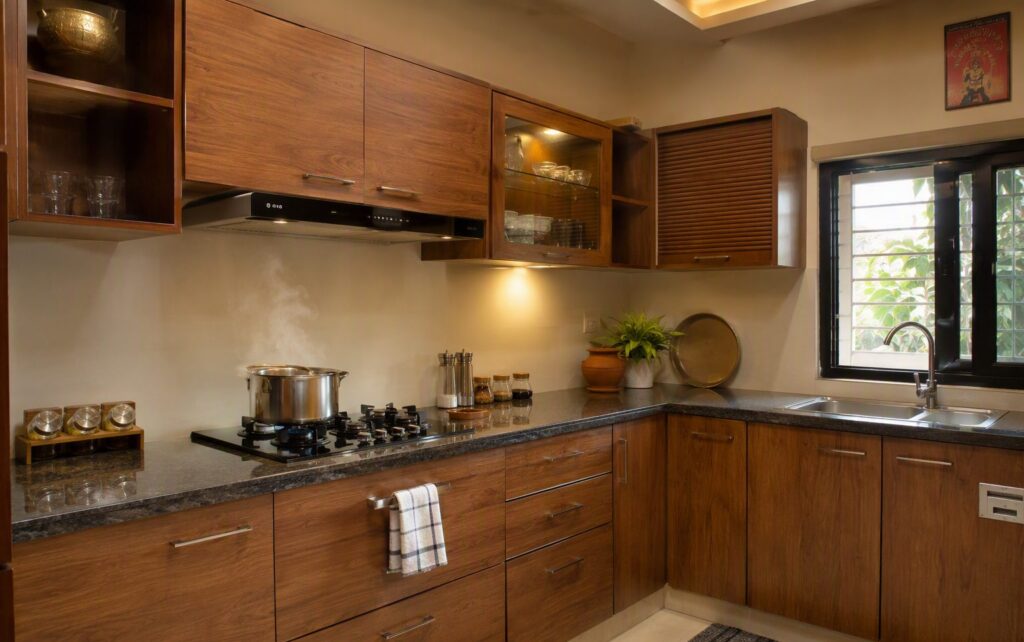
Of all the room-wise plywood grades in Bangalore decisions, kitchens deserve the upgrade: Indian cooking is steam-heavy — pressure cookers, boiling curries, tadka. MR cabinets in Bangalore kitchens typically start swelling within 1–2 years. BWR throughout with BWP base units is the combination most interior professionals specify, and it adds only a few thousand rupees to a full kitchen.
Plywood Grades in Bangalore: 2026 Price Tables
Pricing across plywood grades in Bangalore follows a clear pattern. Expect to pay ₹55–90 per sq ft for MR, ₹70–125 for BWR and ₹90–180+ for BWP in 18 mm — with brand, core species and city moving the number significantly. Premium national brands (CenturyPly, Greenply, Kitply, Duroply and peers) typically command 25–40% more than regional mills, in exchange for consistent glue, genuine calibration and written warranties.
| Grade | 6 mm | 12 mm | 18/19 mm | 25 mm |
|---|---|---|---|---|
| MR (IS 303) | ₹1,400–2,200 | ₹2,100–3,400 | ₹1,700–2,800 | ₹3,800–5,500 |
| BWR (IS 303) | ₹1,800–2,800 | ₹2,800–4,200 | ₹2,200–3,600 | ₹4,800–7,200 |
| BWP / Marine (IS 710) | ₹2,400–3,800 | ₹3,600–5,800 | ₹2,800–6,000 | ₹6,800–9,500+ |
| Fire-retardant (IS 5509) | ₹3,200–4,800 | ₹4,500–6,500 | ₹6,200–9,200 | ₹7,800–11,000+ |
What moves the price
- Thickness — the single biggest factor; each ~3 mm step adds 15–25%.
- Core species — gurjan cores cost 20–35% more than poplar; eucalyptus sits between.
- Calibration — adds 8–15%; worth it for shutters and modular work.
- Brand tier & warranty — national brands charge 15–30% over local mills for the same nominal spec.
- City — metros run 8–15% above tier-2/3 towns; coastal markets price slightly higher on moisture grades.
- Hidden costs — 18% GST (confirm if quotes include it), transport ₹50–200 per sheet, cutting charges ₹10–30 per cut, minimum-order rules for delivery.
The 5-year maths on a modular kitchen (~20 sheets of 18 mm)
| Scenario | Initial cost | 5-yr repairs | Replacement risk | 5-yr total |
|---|---|---|---|---|
| Budget MR (₹1,800/sheet) | ₹36,000 | ₹8,000–15,000 | High (~30%) | ₹44,000–65,000 |
| Mid-tier BWR (₹2,800/sheet) | ₹56,000 | ₹3,000–6,000 | Medium (~10%) | ₹59,000–68,000 |
| Premium BWP (₹4,500/sheet) | ₹90,000 | ₹0–2,000 | Low (~2%) | ₹90,000–95,000 |
All prices are indicative market ranges compiled from Indian dealer and industry sources (2025–26). Actual quotes vary by brand, city and core species — always take written quotes with the full specification.
How to Check Plywood Quality Before Buying
Whichever of the plywood grades in Bangalore you’re buying, the grade on the stamp is only a claim — these seven checks tell you what’s actually in the sheet.
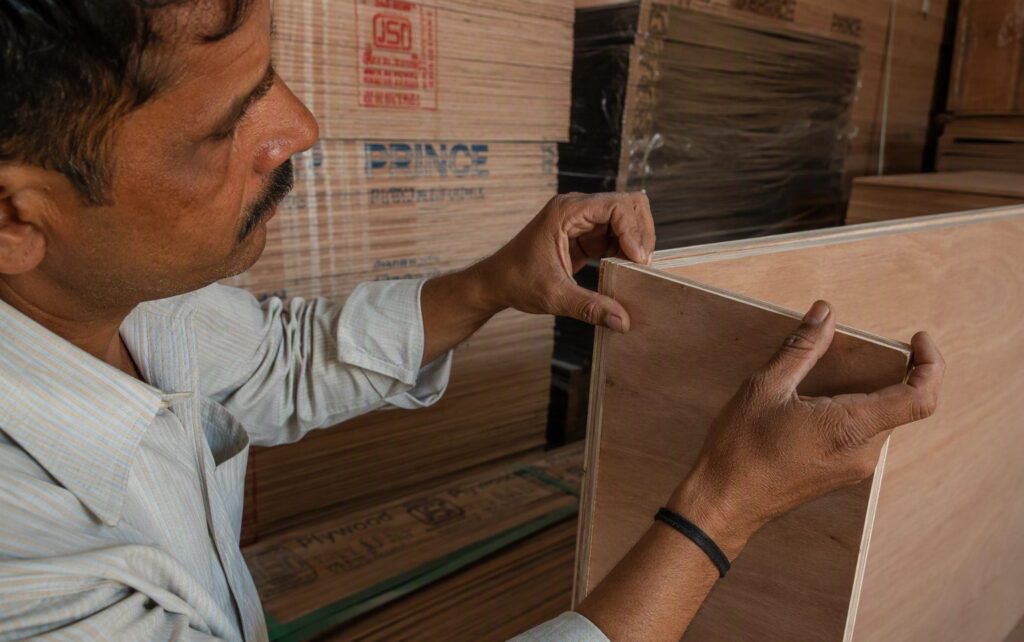
- Read the stamp. Look for the ISI mark with the correct standard code — IS 303 for MR/BWR, IS 710 for BWP/marine — plus the brand name and grade printed along the edge of the sheet. No stamp, no deal.
- Inspect the edge. The core veneers should be even, full and gap-free — no hollows, overlaps or filler patches. Voids inside the core are where delamination begins.
- Check the glue line. The dark glue lines along the edge should be thin, continuous and uniform. Broken or patchy glue lines signal sloppy pressing.
- Lift the sheet. A 19 mm 8×4 plywood sheet should feel dense — roughly 35–45 kg. Suspiciously light sheets usually hide poplar cores or internal voids.
- Ask about the core & calibration. Ask the species (gurjan/hardwood preferred) and whether it’s calibrated (±0.5 mm tolerance) if you’re doing shutters or modular work.
- Check the emission class. Indoor air matters: better brands certify formaldehyde emissions to E1 or the stricter E0 class. Worth insisting on for bedrooms and kids’ rooms.
- Verify termite treatment & warranty. Reputed brands chemically treat against termites and borers and back it with a written warranty (premium BWP lines go up to 30 years). Get the warranty card and bill — they’re your only recourse.
Common mistakes to avoid
- Buying MR for the kitchen “because laminate will protect it.” Laminate protects the face; steam enters through edges and the glue fails anyway.
- Trusting the stamp without the price test. A “710-grade” sheet priced like commercial MR is almost certainly mislabelled — genuine BWP costs more to manufacture.
- Mixing grades blindly. Confirm which grade went into which unit before the carpenter closes up the carcass.
- Skipping edge sealing. Even BWP’s weak point is a raw cut edge — seal all exposed edges, especially around sinks and countertops.
- Ignoring storage. Sheets stored flat and dry before work starts behave; sheets left upright in monsoon damp don’t, whatever the grade.
The 7-Point Plywood Buying Checklist
Whichever of these plywood grades in Bangalore you’re buying, run through this checklist before you place the order:
- Map every unit to a water zone. This is the single most useful habit across plywood grades in Bangalore. Dry (bedroom/living) → MR. Steam/splash (kitchen, utility) → BWR minimum. Wet/under-sink/balcony/coastal → BWP.
- Fix thickness by job. 6 mm backs, 12 mm drawers/shelves, 16 mm calibrated shutters, 18–19 mm carcasses.
- Choose the core deliberately. Gurjan/hardwood for long life; poplar only when budget dominates and loads are light.
- Decide on calibration. Say yes for shutters, kitchens and CNC work.
- Verify ISI + standard code on every sheet — IS 303 or IS 710 as applicable — and buy only from authorised dealers with a bill.
- Get the quote itemised. Grade, brand, thickness, core, calibration, per-sq-ft rate, GST, transport and cutting — in writing.
- Collect the warranty card and emission certificate (E1/E0) before the sheets leave the shop.
Quick-Fire FAQ
What is the difference between MR, BWR and BWP plywood?
The difference is the adhesive. MR uses urea-formaldehyde glue that handles humidity but fails with water contact — for dry interiors like wardrobes. BWR uses phenol-formaldehyde glue that survives steam and splashes — for kitchens. BWP (marine plywood) uses fully waterproof phenolic glue tested against prolonged boiling — for bathrooms, under-sink units, outdoor and coastal use. MR and BWR conform to IS 303; BWP conforms to IS 710.
Which plywood grade is best for a modular kitchen?
BWR plywood (IS 303) as the minimum for all cabinets, upgraded to BWP/marine (IS 710) for base units, the under-sink cabinet and anything near the hob. Never use MR in a kitchen — steam and splashes will delaminate it within a couple of years.
Which plywood grade is best for wardrobes?
MR grade in 18–19 mm is sufficient and economical for wardrobe carcasses in dry bedrooms. Use 16 mm calibrated plywood for shutters so hinges align perfectly, and consider blockboard for shutters taller than 7 ft. Upgrade to BWR if the bedroom shares a wall with a bathroom or sits in a humid area.
What does 710 plywood mean?
‘710 plywood’ means plywood made to the Bureau of Indian Standards specification IS 710 — the marine plywood standard. It is the same product as BWP (Boiling Water Proof) plywood. The number is the standard code, not a brand or grade name.
Is BWR plywood waterproof?
No. BWR is highly water-resistant — its phenolic glue survives steam, splashes and short boiling cycles — but it is not fully waterproof. For continuous water exposure (under-sink cabinets, outdoor furniture), choose BWP/marine plywood, and seal all cut edges on either grade.
What is the price of plywood per sq ft in 2026?
Indicative prices for 18 mm: MR ₹55–90 per sq ft, BWR ₹70–125, BWP/marine ₹90–180+. A standard 8×4 sheet (32 sq ft) costs roughly ₹1,700–2,800 (MR), ₹2,200–3,600 (BWR) and ₹2,800–6,000 (BWP) depending on brand, core and city. GST of 18% is usually extra.
Is marine plywood the same as BWP?
‘Marine’ is the market name; BWP is the grade; IS 710 is the standard it must pass. Marine plywood is BWP plywood certified to IS 710 — the same fully waterproof phenolic-bonded grade.
How can I check plywood quality before buying?
Check the ISI mark with the correct standard (IS 303 or IS 710), inspect the edge for even gap-free veneers and a continuous glue line, lift the sheet (heavier usually means a denser hardwood core), ask about core species and calibration, verify the emission class (E1/E0), and take the warranty card. Branded plywood from authorised dealers is the safest route.
Is plywood termite-proof?
Not by default. Good branded plywood is chemically treated against termites and borers — look for the treatment claim and warranty. Higher grades with phenolic glue resist infestation better than urea-bonded MR. In termite-prone regions and ground floors, combine treated plywood with site-level anti-termite treatment.
Which is better for doors — plywood or blockboard?
Blockboard. Its softwood-strip core is lighter and resists sagging over long vertical spans, making it the standard for flush doors and tall wardrobe shutters. Use plywood for the carcass, shelves and anything that must hold screws firmly or face moisture.
How many sheets of plywood does a wardrobe need?
A standard 6 ft × 7 ft wardrobe typically needs about 5–6 sheets of 18 mm plywood for the carcass, shutters and shelves, plus 1 sheet of 6 mm for the back panel — after adding 10–15% for cutting wastage. Your carpenter’s cutting plan should confirm the exact count before you order.
Is it worth paying extra for branded plywood?
Usually yes. National brands (CenturyPly, Greenply, Kitply, Duroply and peers) charge 25–40% more but deliver consistent glue lines, genuine calibration, verified termite treatment and enforceable warranties of up to 30 years. Unbranded sheets are the single biggest source of delamination complaints in Indian interiors.
Planning Furniture or a Kitchen?
Whichever of these plywood grades in Bangalore your project needs, share your floor plan and room list with the Evospace design team — we’ll specify the exact grade, thickness and sheet count for every unit, with transparent per-sq-ft pricing. Get a free material consultation.
Sources & price references
Bureau of Indian Standards — IS 303 (general-purpose plywood), IS 710 (marine plywood), IS 1659 (blockboard), IS 5509 (fire-retardant plywood). Prices cross-checked Aug 2026 against Indian dealer and brand price guides.
Disclaimer: All prices are indicative market ranges for 2025–26. Actual quotes vary by brand, city, core species and dealer margin.