
Marine Plywood vs Commercial Plywood: What Should You Use in Bangalore?
Dealers frame this as a two-way choice: cheap commercial ply for everything, or expensive marine ply “to be safe.” Both framings cost you money. The real answer is a three-grade zone map — and it starts with understanding what the two names actually certify, which is less than you think.
Marine vs commercial plywood — the 30-second answer
- Commercial plywood = MR grade, IS 303, urea-based glue. For dry rooms only: wardrobes, TV units, study, paneling. ₹55–95/sq ft (18mm)
- Marine plywood = BWP grade, IS 710, undiluted phenolic glue, 72-hour boil tested. For wet zones only: under-sink, bathroom, utility, covered balconies. ₹110–160/sq ft
- The missing middle = BWR, also IS 303 but phenolic-glued. For kitchens, beds and damp-adjacent furniture. ₹80–120/sq ft
- The Bangalore rule: zone your home — MR where it's dry, BWR where it's damp, marine where water stands. Never one grade everywhere
- Verify, don't trust: marine claims are checked by the IS 710 mark, the CML number on bis.gov.in, the brand QR scan, and a 3-hour home boil test on an offcut
1. What "marine" and "commercial" actually certify
Neither word is a grade. "Commercial plywood" is a market name for MR (Moisture Resistant) plywood manufactured to IS 303, the Bureau of Indian Standards specification for general-purpose plywood. "Marine plywood" is a market name for BWP (Boiling Water Proof) plywood manufactured to IS 710, a separate, stricter specification. The names are marketing; the IS numbers are the law.
What the two standards actually demand:
- IS 303 (commercial / MR): urea-formaldehyde glue, tested with warm-water soak-and-dry cycles (roughly 60°C soaks followed by oven drying, repeated three times). It certifies that the panel survives indoor humidity — not water. The wood itself is whatever the core species is; the moisture claim is entirely about the glue.
- IS 710 (marine / BWP): undiluted phenol-formaldehyde glue in every glue line, tighter limits on core gaps and overlaps, and a boiling-water test the panel must survive without delaminating. The phenolic resin, once cured, does not re-soften when rewetted — that is the entire basis of the "waterproof" claim.
Two clarifications that kill common myths. First, marine plywood is not made from a special waterproof wood — it is ordinary hardwood veneers bonded with a glue that survives boiling. Second, neither grade is rot-proof forever: marine plywood resists delamination under water exposure, but any plywood left in ponded water for months will eventually degrade. The grade buys you resilience against splashes, steam, leaks and Bangalore's monsoon air — not immunity to a plumbing problem nobody fixed.
standards update: BIS has revised both specifications — IS 303:and IS 710:2024 — and under the current standards only IS 710 panels qualify as marine grade. If a dealer's "marine" stock is stamped IS 303, it is BWR at best, whatever the sticker says.
2. Head-to-head: the differences that matter
| Property | Commercial (MR, IS 303) | Marine (BWP, IS 710) |
|---|---|---|
| Glue | Urea-formaldehyde — softens with sustained wetting | Undiluted phenol-formaldehyde — does not re-soften once cured |
| Water test | Warm-water soak/dry cycles (~60°C) | Boiling water, 72 hours, no delamination |
| Core quality | Plantation/poplar cores common; gaps permitted within limits | Denser hardwood veneers; minimal core gaps allowed |
| Weight (18mm sheet) | Lighter — often 18–24 kg | Heavier — typically 25–30 kg |
| Survives | Indoor humidity, dry rooms | Steam, splashes, leaks, prolonged damp, covered semi-outdoors |
| Fails at | Kitchen steam over years, any standing water | Ponded water for months, full outdoor exposure (sun + rain) |
| Price, 18mm | ₹55–95 / sq ft | ₹110–160 / sq ft |
| Typical warranty | 5–10 years | 10–30 years (some premium lines: lifetime) |
The weight row is a genuinely useful field check. Marine plywood's denser veneers and heavier resin loading make an 18mm sheet noticeably heavier — if a "marine" sheet lifts like a light commercial one, something is off. Similarly, strength: the tighter core and phenolic bond give marine plywood better screw-holding and bending strength, which is why it is the safe default for anything load-bearing and wet (vanities, utility shelving).
What marine grade does not change: the face. Marine and commercial plywood look identical once laminated, which is precisely why the grey market can sell one as the other — and why verification (Section 7) matters more than the dealer's word.
3. The boil test: how the grades are proven — and how you can test them
Plywood grades are not opinions; they are test outcomes. Understanding the tests tells you exactly what each grade promises:
- MR (commercial): samples are soaked in warm water (~60°C) for a few hours, oven-dried, and the cycle repeated. Passing means the glue survives humidity cycles. It says nothing about boiling, soaking, or standing water.
- BWP (marine, IS 710): samples are boiled in water for up to 72 hours — in sessions, cooled between boils — then tested for bond strength while still wet. Passing means the glue line is effectively inert to water at any temperature a home can produce.
The 15-minute home version
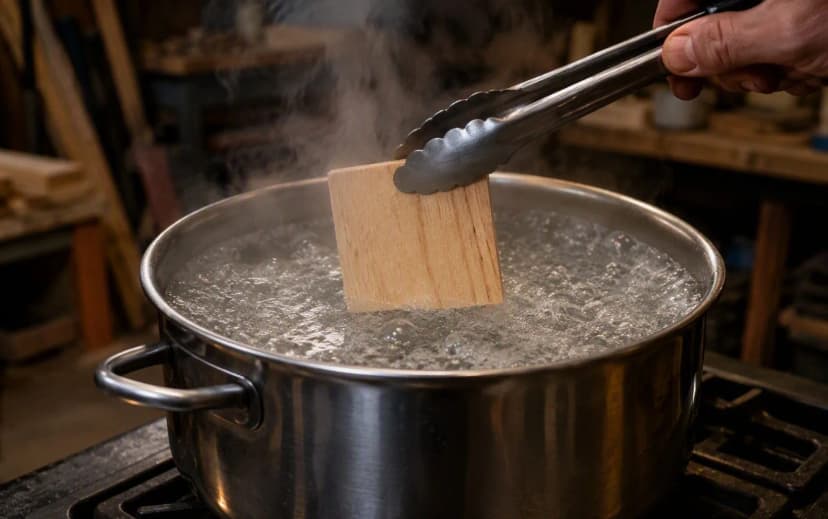
Ask the dealer for a small offcut of the exact sheet you are buying (any honest dealer will hand you one — it costs them nothing). At home:
- Cut a sample. Roughly 6×6 inches, so all four edges are exposed glue lines.
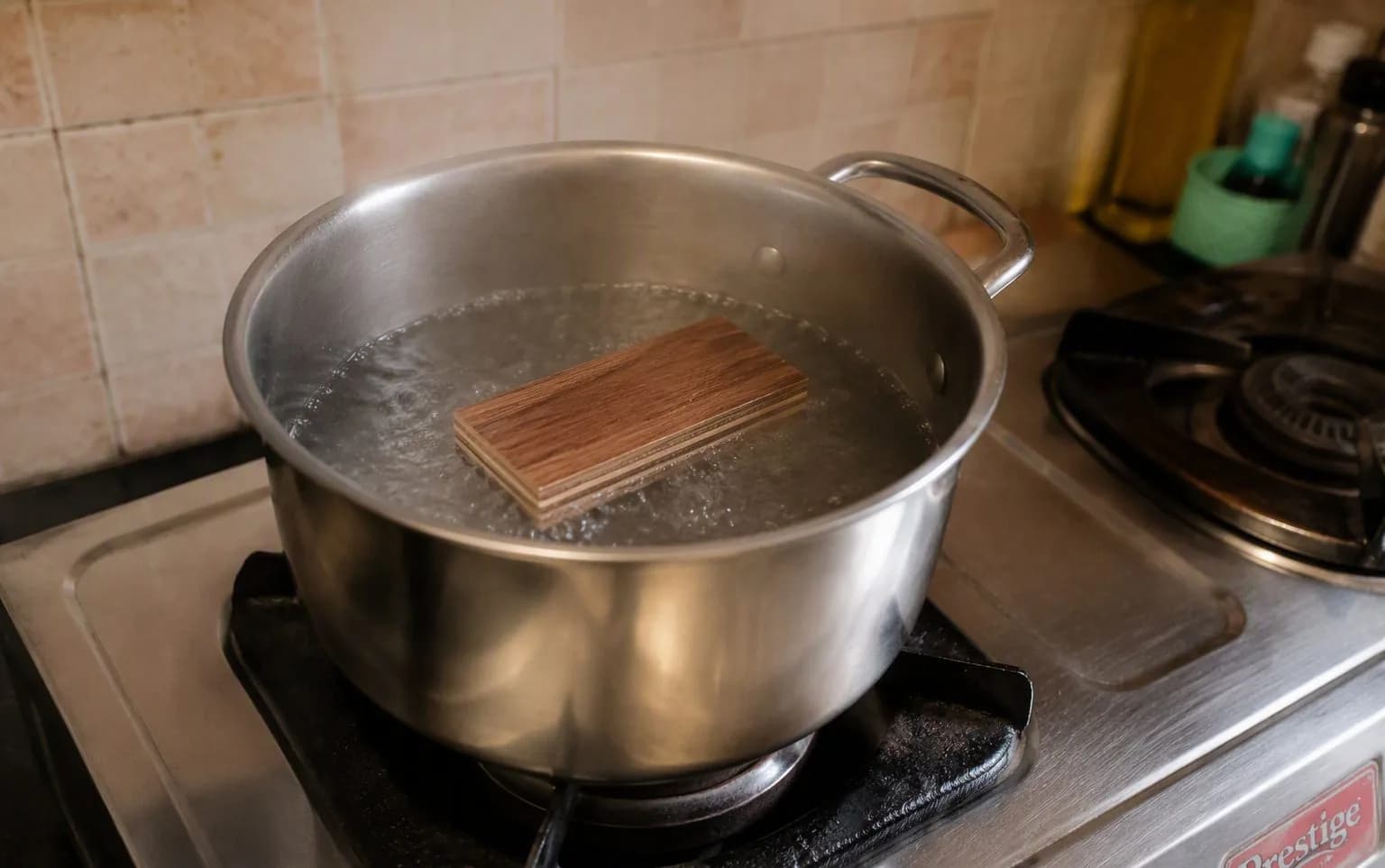
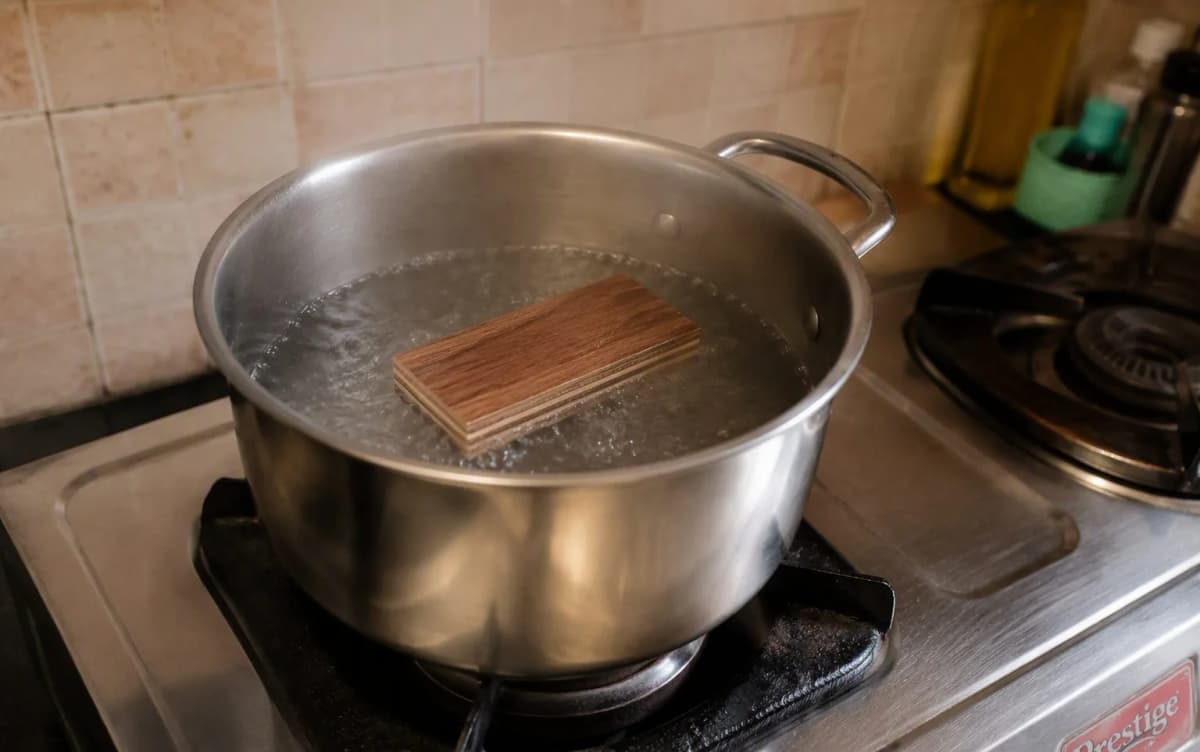
- Boil it. Fully submerged in a rolling boil for 3–4 hours. Top up the water as it evaporates.
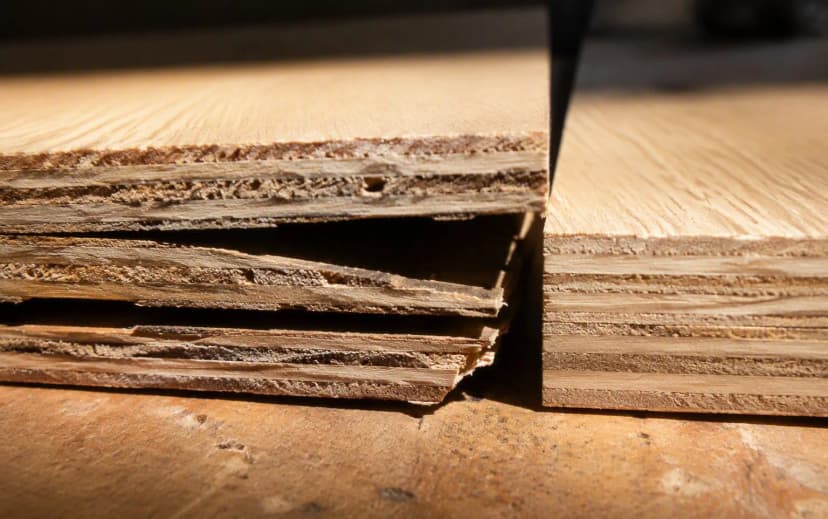
- Cool and pry. Drop it in cold water, then try to separate the plies at a corner with a knife or putty tool.
Genuine marine plywood stays bonded — the corner resists, and the wood fibres tear before the glue line opens. Fake marine (commercial ply with a better sticker) starts delaminating visibly within the first hour. This is a screening test, not a lab certification — but no counterfeit survives it, and no genuine sheet fails it.
4. The middle grade nobody mentions: BWR
The marine-vs-commercial framing hides the grade most Bangalore homes actually need. BWR (Boiling Water Resistant) is also made under IS 303, but with phenolic-type glue rather than urea — the same glue family as marine, in a panel held to the general-purpose standard rather than the marine one. It resists steam, splashes and sustained humidity, but is not tested for prolonged immersion.
Why it matters: BWR sits almost exactly where most of your "risky" furniture lives. Kitchen cabinets face steam and splashes, not standing water. Bed frames sit under a mattress that traps humidity. Wardrobes against bathroom walls absorb dampness through the plaster. All three are over-served by marine (you pay for 72-hour boil resistance you never use) and under-served by commercial MR (urea glue that slowly gives up). BWR is the correct answer, at ₹80–120/sq ft — roughly halfway between the two.
Watch the label trick: Because BWR and marine share the phenolic glue story, dealers blur them deliberately. "BWR 710" is a contradiction — BWR is an IS 303 grade; 710 is marine. If the stamp and the sales pitch disagree, believe the stamp.
5. Zone by zone: what your Bangalore home actually needs
Bangalore's climate makes this decision sharper than in most cities. Monsoon humidity runs 65–85% for months, older apartments develop seepage in bathroom-adjacent walls, and kitchens generate steam daily. The zoning answer:
| Location | What hits it | Grade | Why |
|---|---|---|---|
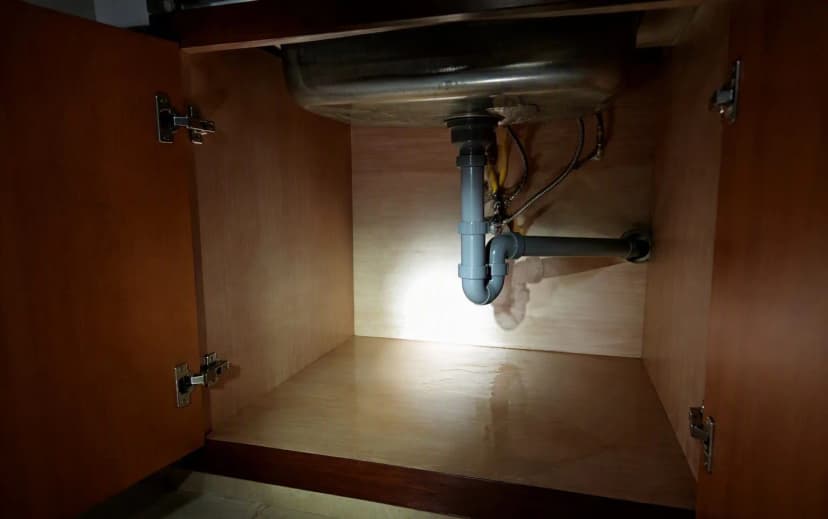
| Under-sink cabinet | Standing water, leaks | Marine (IS 710) | The one place immersion is guaranteed eventually |
| Bathroom vanity & storage | Daily steam + splashes | Marine (IS 710) | Constant wet-dry cycling kills urea glue |
| Utility / laundry cabinets | Washing machine splashes, damp floor | Marine (IS 710) | Same exposure class as bathrooms |
| Kitchen base + wall cabinets | Steam, oil vapour, occasional splashes | BWR (IS 303) | Damp but not immersed — marine is optional, MR is fatal |
| Bed frame & storage base | Humidity trapped under mattress | BWR | Condensation zone nobody thinks about |
| Wardrobe against bathroom wall | Seepage through plaster | BWR | The wall is the moisture source |
| Covered balcony storage | Humid air, wind-blown drizzle | Marine (IS 710) + weather laminate | Only if fully covered; rain exposure → WPC/metal |
| Wardrobes in dry bedrooms | Ambient humidity only | Commercial MR | The correct economy — 15–20 year life |
| TV units, bookshelves, study | Nothing | Commercial MR | Paying for water resistance here is waste |
| Wall paneling, partitions, lofts | Nothing | Commercial MR | Dry, covered, indoor |
Count the zones and the pattern emerges: a typical 2BHK needs marine grade for only 10–15% of its plywood, BWR for another 30–40%, and commercial MR for the remaining half or more. "Use marine everywhere to be safe" roughly doubles your plywood budget for protection most rooms never need; "use commercial everywhere" saves ₹20,000–30,000 now and spends ₹80,000–1,50,000 on a kitchen rebuild within five years.
6. The cost math: three ways to buy a 2BHK's plywood
Take a typical 2BHK needing about 40 sheets — say 12 for the kitchen, 14 for three wardrobes, 6 for two beds, and 8 for TV unit, study, lofts and paneling. At authorised-dealer prices for 18mm-heavy mixes:
| Strategy | Material cost | 10-year outcome |
|---|---|---|
| All commercial MR | ₹85,000–1,10,000 | Kitchen fails in 3–5 monsoons; rebuild ₹80,000–1,50,000. Cheapest bill, most expensive decade. |
| All marine BWP | ₹1,60,000–2,05,000 | Everything survives — but ₹60,000–80,000 bought boil-resistance for bookshelves that never see water. |
| Zoned: MR dry + BWR kitchen/beds + marine wet | ₹1,05,000–1,35,000 | Every zone gets exactly the protection it faces. The strategy professional suppliers recommend. |
The zoned approach lands within 15–25% of the all-commercial bill while removing the single largest failure risk in the house. That is the actual answer to "marine vs commercial": it was never either/or.
7. How to verify what you're actually buying
Because the two grades look identical once laminated, "marine" is one of the most counterfeited claims in the Bangalore market. Four checks, none optional:
- Read the stamp. Marine = ISI mark with IS 710. Commercial/BWR = IS 303. The number on the sheet is the grade; everything the dealer says is commentary.
- Verify the licence. Enter the CML number (CM/L-XXXXXXX) from the sheet on bis.gov.in or the BIS Care app. The licence must be valid, current, and belong to the brand printed on the panel.
- Scan the brand QR. CenturyPromise, Greenply's app and similar resolve the sheet's QR to its product line, thickness, plant and a unique code. A QR that doesn't resolve is not a premium sheet.
- Boil an offcut. The 3-hour home test from Section 3. It costs one offcut and settles the question physically.
And buy where verification is possible at all — an authorised dealer with racked storage, an itemised GST invoice naming the grade and IS code line by line, and a written warranty.
The grade-selection checklist
- Under-sink, bathroom, utility, covered balcony — marine (IS 710), no substitutes
- Kitchen cabinets, bed frames, bathroom-adjacent wardrobes — BWR minimum
- Dry bedrooms, living room, study, paneling, lofts — commercial MR is correct, not cheap
- IS number on the sheet matches the claim — 710 for marine, 303 for MR/BWR
- "BWR 710" or "marine IS 303" = walk away — the stamp and the story must agree
- CML verified on bis.gov.in, brand QR scanned in the official app
- Offcut boil test passed before the full order is confirmed
- 18mm marine sheet feels heavy — 25–30 kg; suspiciously light means suspiciously fake
- Invoice itemises grade + IS code per line, GST included, in your name
- Edges sealed after cutting — even IS 710 absorbs water through open edges
Frequently asked questions
What is the difference between marine plywood and commercial plywood?
The glue. Commercial plywood (MR grade, IS 303) is bonded with urea-formaldehyde resin, which handles indoor humidity but softens with sustained wetting. Marine plywood (BWP grade, IS 710) is bonded with undiluted phenol-formaldehyde resin and must survive a 72-hour boiling-water test without delaminating. Marine also uses better core veneers with minimal gaps.
Is marine plywood worth it for a kitchen in Bangalore?
For the under-sink unit, yes — that cabinet will eventually see standing water. For the rest of the kitchen, BWR grade (also IS 303, but with phenolic glue) is the cost-smart middle: it resists steam and splashes at 15–25% less than marine. Running the entire kitchen in marine grade is safe but usually unnecessary.
What is the price difference between marine and commercial plywood in Bangalore?
For 18mm sheets from established brands at authorised dealers: commercial MR runs ₹55–95 per sq ft, BWR ₹80–120, and marine BWP ₹110–160. Per 8×4 sheet that is roughly ₹1,750–3,050 (MR) versus ₹3,500–5,100 (marine). A "marine" sheet quoted at commercial prices is almost certainly not marine.
Can commercial plywood be used in a kitchen?
It is the most common and most expensive plywood mistake in Bangalore. Commercial MR plywood in a kitchen typically shows swollen shutters and delaminated edges within 3–5 monsoons, and rebuilding a failed kitchen costs ₹80,000–1,50,000 — far more than the ₹10,000–20,000 saved on material. Use BWR minimum for kitchen cabinets.
How can I verify plywood is genuine marine grade?
Check three things: the sheet carries an ISI mark with IS 710 (not IS 303), the manufacturer's CML licence number validates on bis.gov.in, and the brand's QR code resolves in its official app. For physical proof, boil a 6×6 inch offcut for 3–4 hours — genuine marine plywood's plies stay bonded; fake marine delaminates within the first hour.
Is BWR the same as marine plywood?
No. Both use phenolic-type glue, but BWR is tested under the general-purpose IS 303 standard while marine BWP must pass the stricter IS 710 specification, including a 72-hour boiling-water test and tighter core-gap limits. BWR resists steam, splashes and humidity; marine survives prolonged water contact. A sheet stamped "BWR IS 710" is a contradiction — walk away.
Where should commercial plywood be used in a home?
Anywhere dry: bedroom wardrobes, beds (use BWR for the frame), TV units, bookshelves, study desks, wall paneling, partitions and lofts. Commercial MR plywood is the correct, economical choice for roughly 60–70% of a typical Bangalore home's furniture. The mistake is not using commercial plywood — it is using it where water lives.
Does Bangalore's climate require marine plywood everywhere?
No. Bangalore's humidity (65–85% in monsoon months) ages MR glue lines faster than in drier cities, but ambient humidity is not the same as water contact. Marine grade is for wet zones — under-sink, bathrooms, utility, covered balconies. Dry bedrooms and living rooms in Bangalore run fine on MR/BWR for 15–20 years.
Get the zoning right the first time
Bring your floor plan to the EvoSpace studio — we will map every cabinet and wardrobe to the grade it actually needs, and quote it line by line with the IS codes on paper.
Get a Free Material Consultation




