The ISI stamp is only a claim — the sheet tells the truth. Here’s exactly how to check plywood quality in Bangalore in 15 minutes: ten shop-floor tests using nothing but your eyes, hands and knuckles, two home tests for water resistance, and the QR-code trick that exposes fake branded plywood instantly.
Quick answer: to check plywood quality in Bangalore at the shop, do five checks in this order: (1) verify the ISI stamp — IS 303 for MR/BWR, IS 710 for marine/BWP — with a readable CML license number; (2) inspect all four edges for even, gap-free veneer layers (9–13 plies in good 19 mm ply); (3) tap the surface — a uniform crisp sound means no internal voids; (4) lift the sheet — 19 mm 8×4 should feel dense, roughly 35–45 kg; (5) measure thickness at five points — variation above 0.5 mm is a reject.
For branded ply, scan the QR code on the sheet with the manufacturer’s app to expose fakes. Then confirm water resistance at home with a 24-hour soak or a 2–3-whistle pressure-cooker test on an offcut.
Table of Contents
Table of Contents
Why You Can’t Trust the Stamp Alone
In the Indian plywood market, the grade printed on a sheet is a claim, not a guarantee. ISI marks can be printed by anyone; “BWP 710” is routinely stamped on plywood that has never seen a phenolic resin bath; and dealers sometimes place their best sheets on top of the stack while the ones below come from a different mill entirely. This is exactly why buyers need to check plywood quality in Bangalore themselves rather than trust the label alone.
The scale of the problem is real enough that the country’s largest manufacturers now print unique QR codes on every sheet and run verification apps just to fight counterfeits of their own brands. If the industry needs an app to prove its plywood is real, you need more than a trusting look at the stamp.
The good news: plywood construction is honest. The edge shows the core, the sound reveals the bonding, and water exposes the glue. Ten minutes of testing tells you more than any label.
The 10 Shop Tests: 15 Minutes, No Tools
To check plywood quality in Bangalore properly, do these at the dealer’s shop, before sheets are loaded. Inspect at least 2–3 random sheets from the middle of the stack, not just the top one — and remember that returns after cutting are almost never accepted.
1. Verify the ISI mark, grade & CML number
Check the printing along the sheet edge: the ISI mark with the correct standard code (IS 303 for MR/BWR, IS 710 for BWP/marine), the brand name, nominal thickness, and the CML license number — the factory’s BIS license. The code must match the grade being sold: a “BWR” sheet stamped only IS 710 (or vice versa) is mislabelled. You can authenticate the CML number on the Bureau of Indian Standards website.
Pass: crisp printed stamp, correct IS code, legible CML number. Fail: stickers instead of printing, faded or photocopied-looking marks, missing numbers.
2. Inspect all four edges
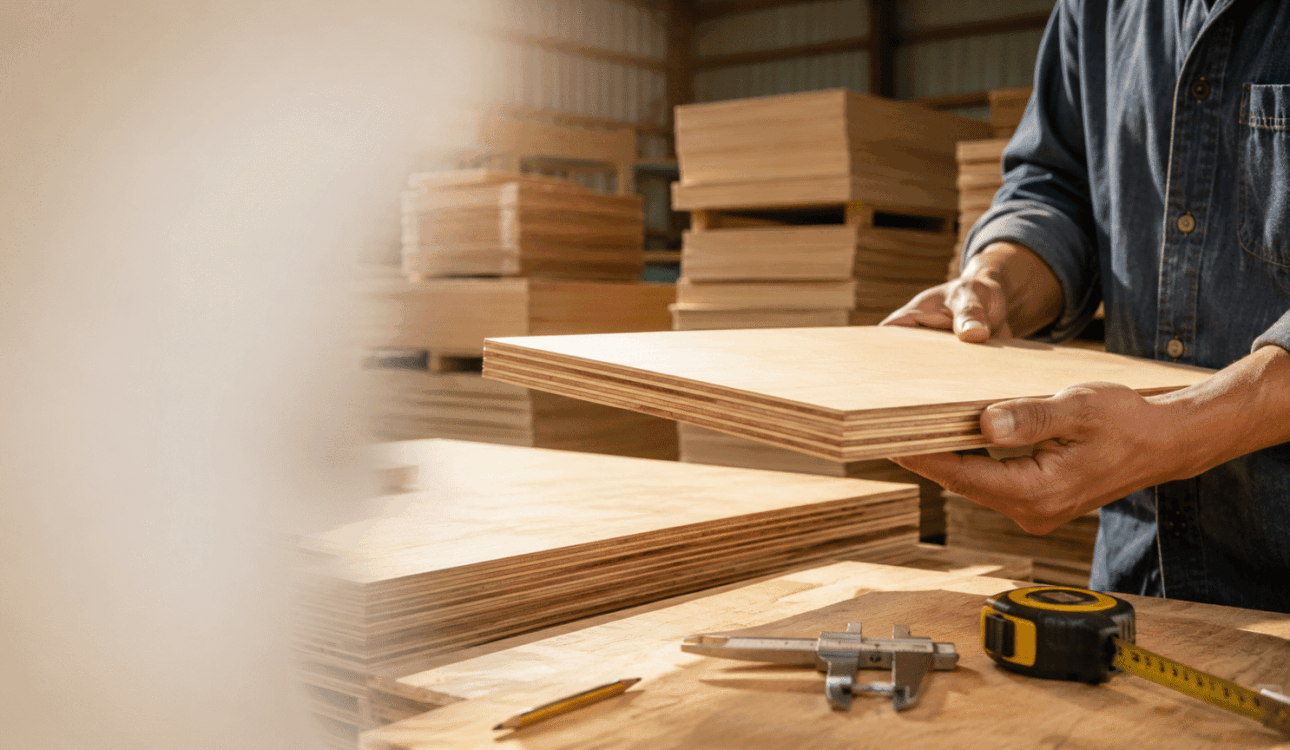
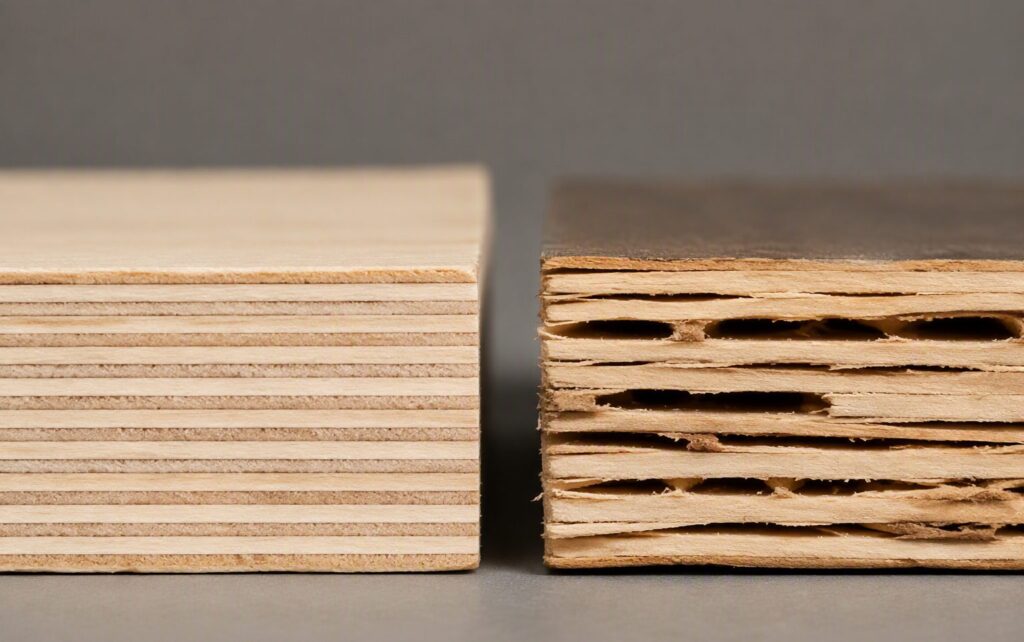
Pull a sheet partway out and examine the edges in good light. The layers should be even, full and gap-free, with thin, continuous dark glue lines. Count the plies: good 19 mm plywood has 9–13 layers; budget sheets often have 5–7 thick, unstable core layers. Watch for voids (dark gaps within or between layers — screws driven into them grip nothing), core overlaps, and bark inclusions (irregular dark patches that become weak points).
Pass: uniform layers, tight joints, no gaps. Fail: visible voids, filler patches, wildly uneven ply thickness — this single check is often enough to check plywood quality in Bangalore before you commit to a stack.
3. The knock test
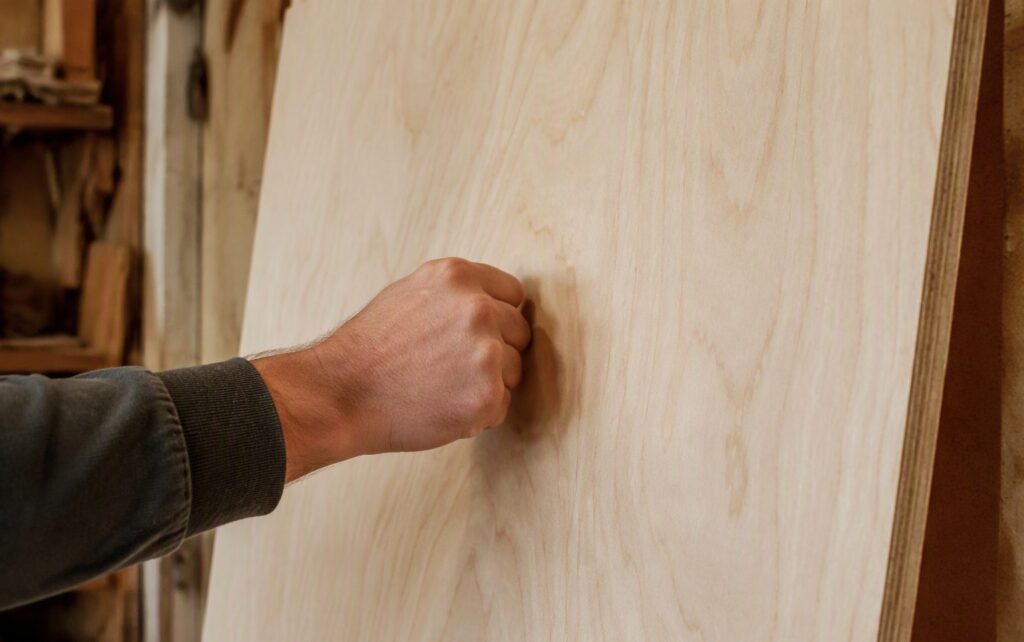
Tap across the surface with your knuckles in a grid — centre, edges, corners. A consistent crisp, solid sound means well-bonded layers; a hollow echo or dull thud means internal voids or delamination. This is the single fastest test to check plywood quality in Bangalore — it catches poor pressing and godown moisture damage in seconds, and it works on every sheet in under a minute.
Pass: same sharp sound everywhere. Fail: any hollow patch — press it; sponginess confirms the void.
4. Lift the sheet (the weight test)
A 19 mm 8×4 plywood sheet should feel dense — roughly 35–45 kg. Dense hardwood cores (gurjan, eucalyptus) hold screws and hinges for decades; feather-light sheets usually mean poplar cores or airy fillers that sag under load. One caution: damp-stored sheets absorb water and feel falsely heavy — combine this with the knock and smell tests.
5. Measure thickness at five points
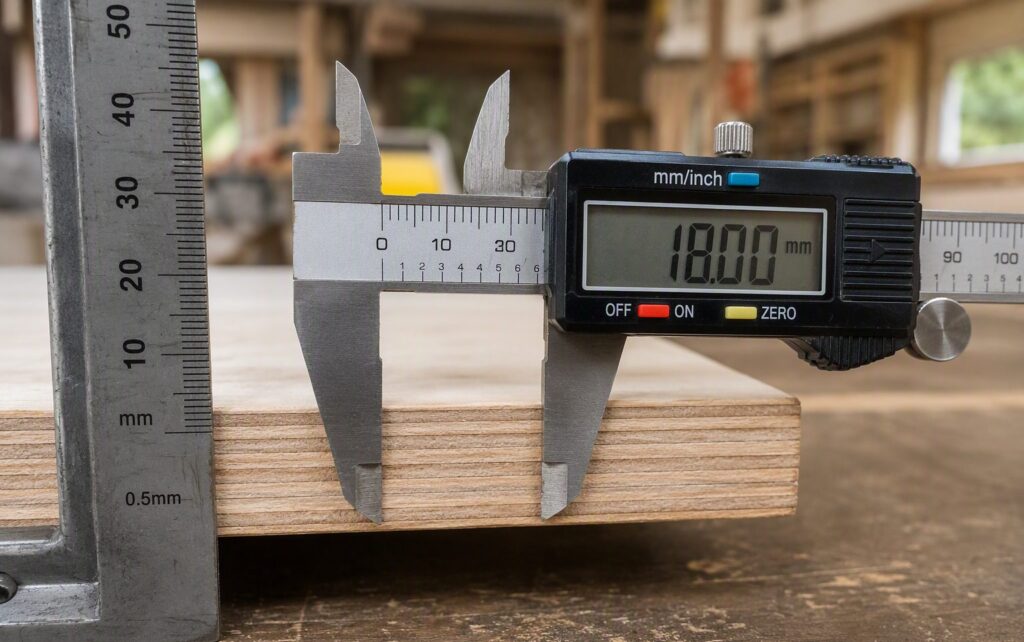
Measure all four corners and the centre with a steel scale or caliper. Variation above 0.5 mm across one sheet signals poor pressing — and it will misalign shutters, shelves and hinges no matter how skilled your carpenter is. Also compare sheets in the same lot: even if all are undersized, consistency lets the carpenter adjust; random variation between sheets (18.2 mm then 17.6 mm) makes precise work nearly impossible — another reason to check plywood quality in Bangalore sheet by sheet, not lot by lot.
Pass: ≤0.5 mm variation across the sheet. Fail: >1 mm variation, or inconsistent sheets within the lot.
6. Check flatness and flex
Lay the sheet flat on the shop floor: it shouldn’t rock or show waves over its length. Then lift one corner and flex gently — quality plywood resists without cracking or creaking. A sheet that arrives warped will stay warped; no amount of laminate or framing will truly flatten it inside a wardrobe.
7. The palm test & face veneer check
Run your palm flat across the surface — bumps and undulations will telegraph through laminates and show as imperfections in finished furniture. Hold the sheet edge-on to the light and look at the face veneer: if it’s paper-thin (under ~0.3 mm), normal sanding during polishing will cut straight through to the core. A gentle scratch with a fingernail should leave no mark on a good face.
8. The smell test
Fresh plywood smells of wood. A strong chemical smell signals high formaldehyde — an indoor air-quality concern, especially for bedrooms and kids’ rooms (better brands certify E1 or E0 emission class). A musty smell signals damp storage — walk away. A sharp phenolic odour is actually normal for genuine BWR/BWP, whose waterproof resin smells distinct from urea-bonded MR.
9. Scan the QR code
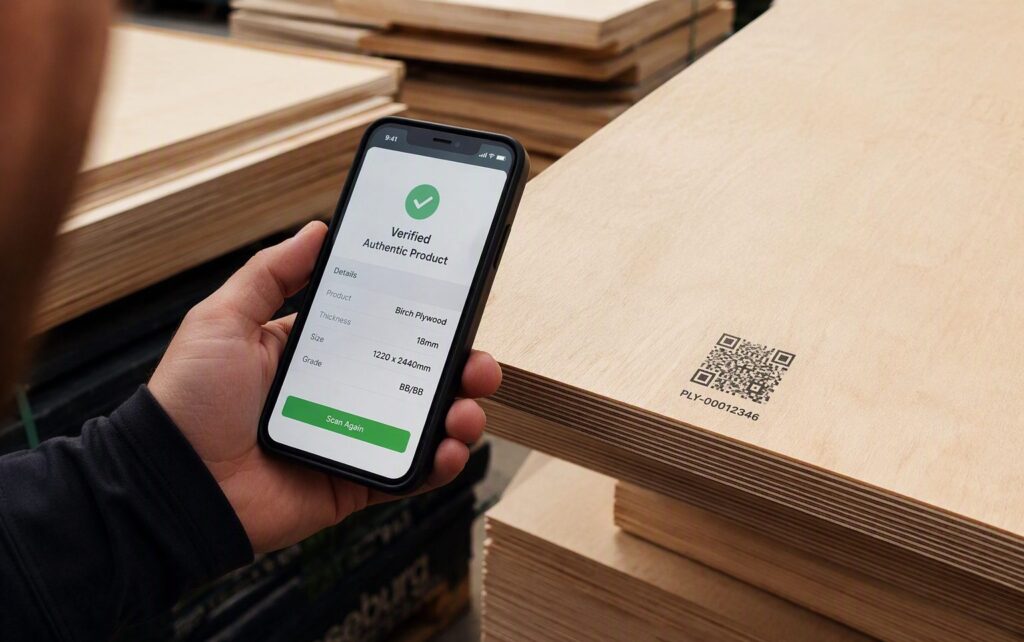
Major brands now print a unique QR code on every sheet. Download the manufacturer’s verification app (CenturyPly’s CenturyPromise, for example), scan the code, and within seconds the app confirms “genuine product” with the plant name, thickness, size and manufacturing date — and lets you download an e-warranty certificate. If the scan fails or the sheet has no code where the brand promises one, treat it as counterfeit.
Pass: app confirms genuine + e-warranty issued. Fail: “not genuine” message, missing code, or a dealer who discourages scanning.
10. Ask the dealer three questions
Quality dealers answer these without blinking: What’s the core species? (gurjan/hardwood preferred; poplar is budget). How was the stock stored, and when was this batch manufactured? (covered, ventilated storage; sheets left in monsoon damp are pre-damaged). What’s the return policy on uncut sheets? A dealer who refuses edge water tests or gets evasive about documents is telling you something — and it’s exactly the moment to check plywood quality in Bangalore yourself before paying.
The Trade-Size Trap: Why “19 mm” Is Never 19 mm
Indian plywood is sold in trade sizes that differ from actual measurements — “19 mm” plywood typically measures 17.5–18.8 mm. This is an entrenched market convention, not necessarily fraud. What separates quality from junk is consistency: good sheets hold a tight range; poor ones wander. Knowing this trade-size gap is a core part of learning how to check plywood quality in Bangalore, since a “correct” 19 mm sheet is never actually 19 mm.
| Trade size | Typical actual range | Quality product range | Common use |
|---|---|---|---|
| 6 mm | 5.2–5.8 mm | 5.5–5.8 mm | Back panels, drawer bottoms |
| 9 mm | 8.0–8.8 mm | 8.5–8.8 mm | Partitions, light shelving |
| 12 mm | 11.0–11.8 mm | 11.5–11.8 mm | Cabinet sides, drawer boxes |
| 16 mm | 15.0–15.8 mm | 15.5–15.8 mm | Shutters (calibrated) |
| 19 mm | 17.5–18.8 mm | 18.2–18.8 mm | Carcasses, beds, tables |
| 25 mm | 23.5–24.5 mm | 24.0–24.5 mm | Heavy shelving, counters |
Specify actual measured thickness when ordering hardware and planning joinery — groove depths and hinge cups depend on it. For shutters and modular work, ask for calibrated plywood (precision-sanded to ±0.5 mm).
Home Tests: The Soak, the Boil & the Pressure Cooker
Water resistance is the one property you can’t judge by eye — so to fully check plywood quality in Bangalore’s humid climate, test it at home on an offcut. These three tests escalate in severity; match the test to the grade you’re paying for.
The 24-hour soak test (for all grades)
Submerge a sample piece in a bucket of water for 24 hours, then dry and examine. Quality plywood shows minimal swelling (under ~5% of thickness) and no layer separation. MR will swell somewhat but must not delaminate; BWR/BWP should come out nearly unchanged. This single test would have prevented most of India’s swollen-kitchen disasters.
The pressure-cooker test (quick boiling check)
Put a small piece in a pressure cooker with water and run 2–3 whistles (about 10–15 minutes of pressurised boiling). Phenolic-bonded BWP survives intact; urea-bonded MR starts peeling at the edges. Not lab-accurate, but a brutally effective way to compare two brands on your kitchen stove.
What the official BIS tests demand (for context)
| Grade | Official test | Home equivalent |
|---|---|---|
| MR (IS 303) | 3 cycles: soak in 60°C water 3 hrs, dry at 65°C 8 hrs | 24-hr bucket soak |
| BWR (IS 303) | 3 cycles: boil 8 hrs, dry at 65°C 16 hrs | Pressure-cooker, 2–3 whistles |
| BWP (IS 710) | 72 hours continuous boiling, then strength-tested wet | Pressure-cooker ×3 rounds |
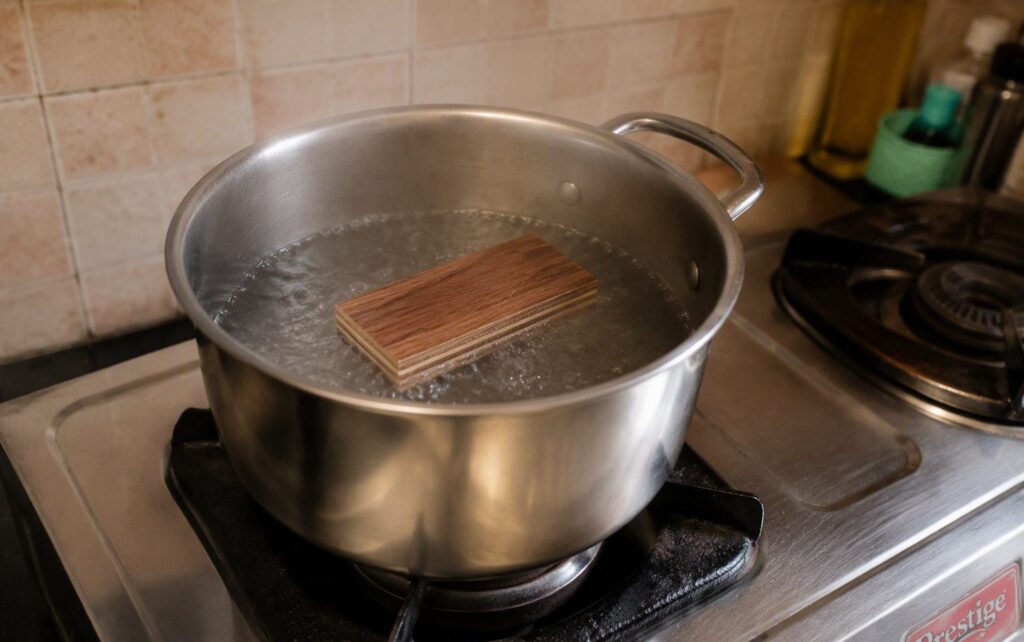
One warning that overrides every test: even genuine BWP fails if cut edges are left unsealed. Water enters through edges, not faces — seal every cut edge with putty/sealant before installation, especially around sinks.
How to Spot Fake Branded Plywood
Counterfeit plywood is common enough that leading brands built verification apps to fight it — one more reason to check plywood quality in Bangalore before you pay. The playbook is simple: local mill plywood gets branded-looking stamps and is sold at “discount” prices under famous names. Your defences:
- The price test. Genuine branded BWP costs meaningfully more than commercial ply. “Century marine at commercial prices” is not a deal — it’s a relabel. If the discount looks implausible, it is.
- The QR scan. Every genuine CenturyPly sheet carries a unique QR code verifiable in the free CenturyPromise app, which confirms the product, plant and manufacturing date and issues an e-warranty. Other major brands run similar systems. No code, or a failed scan, means walk away.
- The CML check. The CML license number stamped on the sheet can be authenticated on the Bureau of Indian Standards website — it identifies the actual licensed factory behind the mark.
- The dealer check. Buy from authorised dealers who provide a proper invoice naming brand, grade and thickness. Authorised sellers can issue e-warranty certificates; grey-market sellers cannot.
- The consistency check. Genuine branded lots are consistent sheet to sheet. If some sheets in a “branded” lot tap hollow, vary in thickness or smell different, the lot is mixed — a classic sign of counterfeit infiltration, and one more reason to check plywood quality in Bangalore sheet by sheet.
For more on grade-specific red flags, see our guide on common mistakes to avoid when buying plywood in Bangalore.
6 Mistakes Buyers Make at the Plywood Shop
- 1. Trusting the pretty face. A smooth, attractive face veneer says nothing about the core, glue or moisture resistance. Some of the worst-performing plywood has beautiful surfaces. Always check the edge.
- 2. Checking only the top sheet. Dealers place their best sheets on top. Inspect at least three random sheets from different positions in the stack — quality should be consistent through the lot.
- 3. Skipping inspection at delivery. Substitution happens between the shop and your site — intentionally or accidentally. Re-inspect every sheet on delivery before signing acceptance; returns afterwards are nearly impossible.
- 4. Ignoring storage history. Freshly manufactured or damp-stored plywood warps later as it equilibrates. Ask about batch date and storage; let sheets acclimatise flat and dry on site for 48+ hours before cutting.
- 5. Believing “waterproof” without a code. “Waterproof plywood” with no IS 710 stamp is marketing, not specification. The grade and standard code on the edge are the claim; the soak test is the proof.
- 6. Letting the carpenter choose unsupervised. Carpenter-dealer commissions are a quiet industry reality. Buy with your carpenter’s input, but inspect and pay yourself — and verify what actually arrives against the bill.
Once you know how to check plywood quality in Bangalore yourself, these mistakes become easy to avoid — and our guide to factors to consider before buying plywood covers the rest of the buying decision.
The Printable Pre-Purchase Checklist
Screenshot this the next time you need to check plywood quality in Bangalore at a dealer’s shop:
- ISI mark printed on edge with correct code — IS 303 (MR/BWR) or IS 710 (BWP) — plus legible CML number
- Edges: even plies, no voids, no overlaps, no bark patches; 9–13 plies on 19 mm
- Knock test: uniform crisp sound across entire surface, no hollow patches
- Weight: 19 mm 8×4 sheet feels dense (~35–45 kg)
- Thickness: ≤0.5 mm variation across five measurement points
- Flatness: no rocking on the floor; corner flexes without cracking
- Face: palm-smooth, veneer not paper-thin, resists a fingernail scratch
- Smell: woody or sharp phenolic (BWP) — never musty or strongly chemical
- QR code scanned and verified in the brand’s app; e-warranty downloaded
- Dealer answered: core species, batch date, storage, return policy
- Invoice names brand, grade and thickness of every sheet
- At home: 24-hr soak or pressure-cooker test on an offcut passed
- Re-inspected all sheets at delivery before signing
Frequently Asked Questions
How do I check plywood quality in Bangalore before buying?
Five quick checks at the shop: verify the ISI stamp (IS 303 for MR/BWR, IS 710 for BWP) with a readable CML number; inspect all four edges for gap-free, even layers; tap the surface — a uniform crisp sound means no voids; lift the sheet (19 mm 8×4 should feel dense, ~35–45 kg); and measure thickness at five points (variation under 0.5 mm). For branded ply, scan the QR code with the manufacturer’s app to confirm it’s genuine.
What is the knock test for plywood?
Tap the surface with your knuckles in a grid pattern, including edges and centre. A consistent crisp, solid sound indicates well-bonded layers with no voids. A hollow echo or dull thud means internal gaps or delamination — reject that sheet. It’s the fastest way to check plywood quality in Bangalore at the shop.
How can I identify fake or duplicate branded plywood?
Three checks: scan the QR code on the sheet with the brand’s verification app (e.g. CenturyPromise instantly confirms genuine CenturyPly and issues an e-warranty); verify the CML license number on the BIS website; and buy only from authorised dealers with proper invoices. Implausibly cheap “branded” plywood is almost always relabelled local ply.
How many layers should good 19 mm plywood have?
Quality 19 mm plywood typically has 9–13 plies. More, thinner plies mean better stability, less warping and stronger screw-holding. Budget variants often have only 5–7 thicker plies, which move internally and fail sooner. Count the layers on the sheet edge — face and back veneers included; this is one of the simplest ways to check plywood quality in Bangalore without any tools.
Why is “19 mm” plywood never actually 19 mm?
Indian plywood uses trade sizes: “19 mm” typically measures 17.5–18.8 mm, “12 mm” about 11–11.8 mm, “6 mm” about 5.5 mm — an established market convention. What matters is consistency: quality sheets vary less than 0.5 mm across the surface, keeping shutters aligned and hinges flush.
How do I test if plywood is really waterproof at home?
Two home tests on an offcut: soak it in a bucket for 24 hours — genuine BWR/BWP shows minimal swelling (under ~5%) and no layer separation; or boil a small piece for 2–3 pressure-cooker whistles — phenolic-bonded BWP stays intact while urea-bonded MR peels at the edges. The official BIS tests are stricter: BWP endures 72 hours of boiling, BWR three 8-hour boil-and-dry cycles — but the home version is enough to check plywood quality in Bangalore before installation.
Does heavier plywood mean better quality?
Usually yes — a dense hardwood (gurjan/eucalyptus) core weighs more and holds screws far better than a light poplar core. But weight can mislead: damp-stored sheets absorb moisture and feel heavier. Combine the lift test with the knock test and edge inspection.
Can I check plywood for termite resistance at the shop?
Not directly — treatment is chemical and invisible. Look for the manufacturer’s termite-treatment claim and warranty, ask for the treatment certificate through your dealer, and prefer BWR/BWP grades whose phenolic construction resists infestation better. Borate treatment of cut edges after installation adds protection.
How should plywood be stored before installation?
Flat, elevated off the floor, loosely covered, away from damp walls — never upright in a damp garage. This matters because how you check plywood quality in Bangalore at the shop can be undone by poor storage afterwards. Let sheets acclimatise on site for 48+ hours (longer in monsoon) before cutting, and re-check for warping before work begins.
What if the shop refuses to let me test the plywood?
That’s a red flag — confident dealers allow edge inspection, tapping and water tests on samples. It signals low confidence in their stock’s moisture resistance, which is critical in Indian conditions. Test discreetly on a corner, or buy elsewhere.
Buying Plywood for a Project?
Our team specifies and sources verified branded plywood for every project — with QR-verified authenticity, itemised bills and warranties collected on your behalf, so you never have to check plywood quality in Bangalore alone. Get a free material consultation.
Sources & references
Grade specifications and BIS test cycles referenced here follow the Bureau of Indian Standards IS 303 and IS 710. Test thresholds and ranges are indicative, compiled from industry sources (2025–26); specifications vary by manufacturer — verify against the brand’s datasheet.