
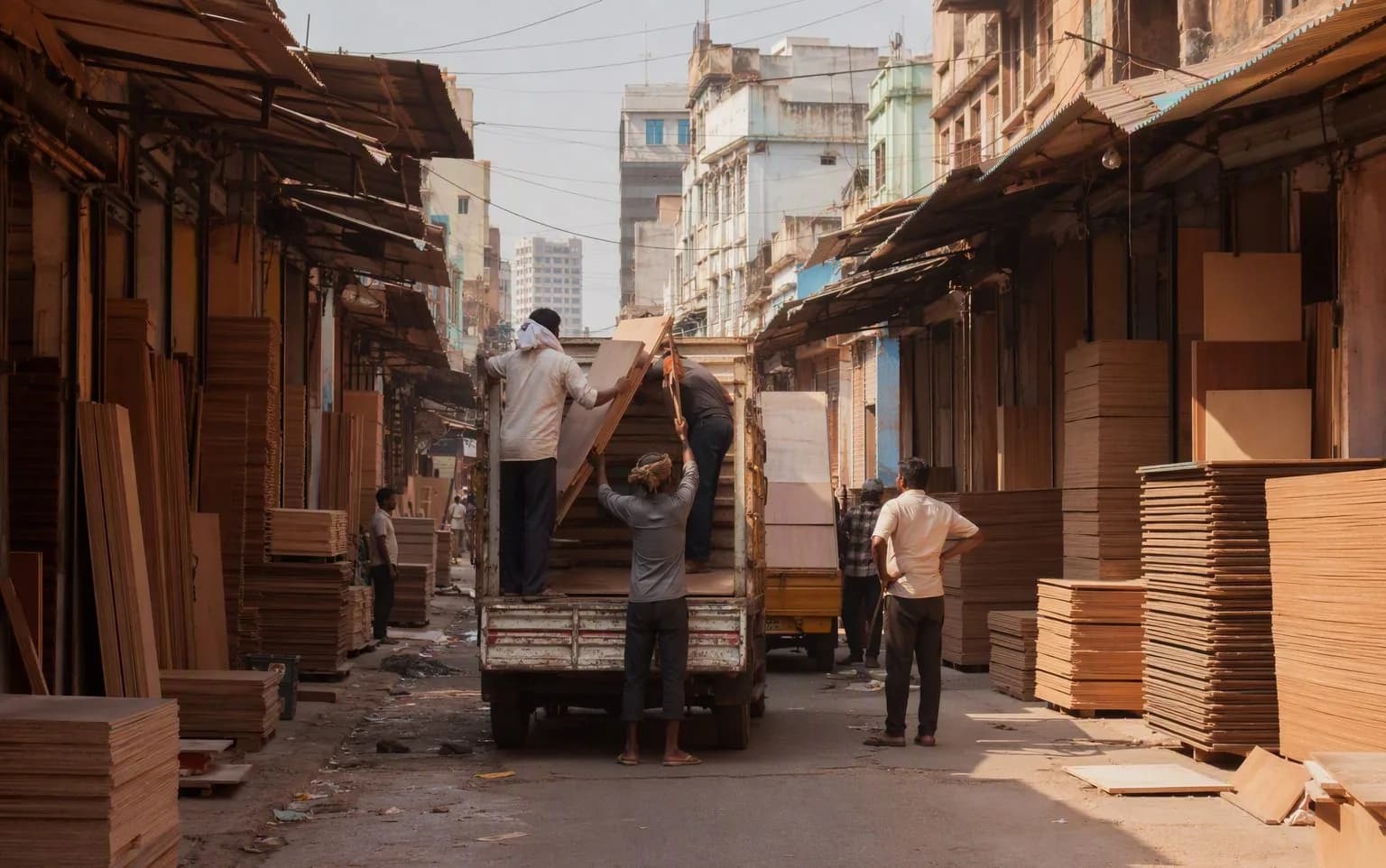
Top Factors to Consider Before Buying Plywood in Bangalore
Every plywood sheet looks identical in the shop. What separates furniture that lasts twenty years from furniture that swells in its second monsoon is a set of decisions made before money changes hands — the grade, the thickness, the core, and the dealer across the counter. Here are the eight factors, in the order you should decide them.
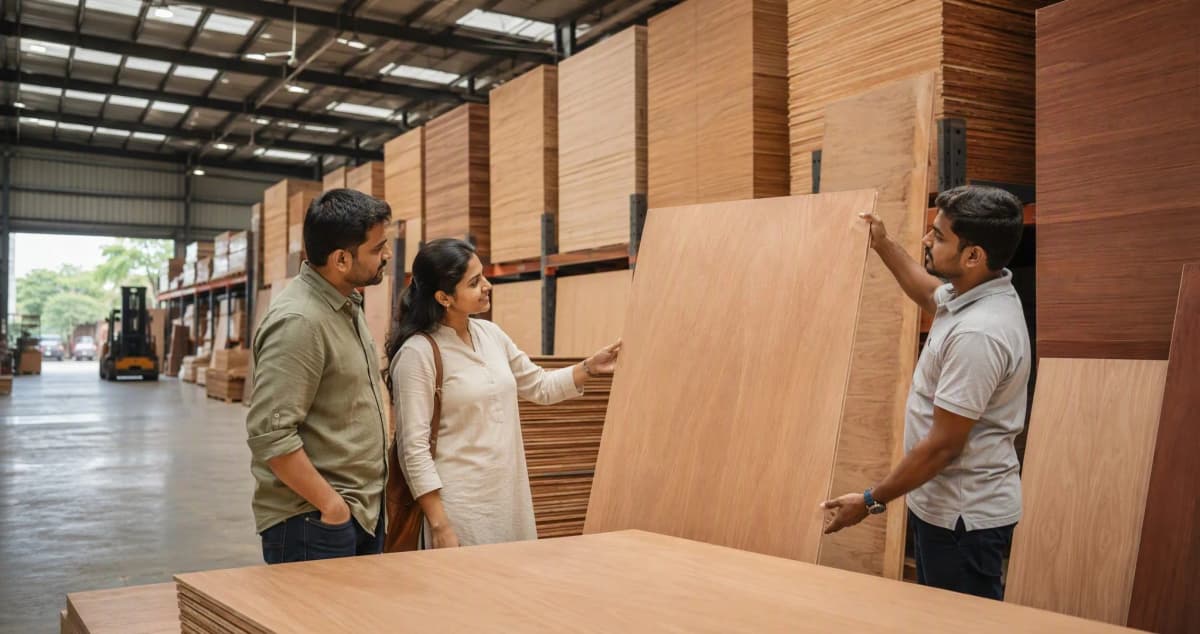
The 8 factors that decide plywood quality, in order
- Grade — MR (IS 303) for dry rooms, BWR (IS 303) for kitchens, BWP marine (IS 710) for anything that touches water
- Thickness — 18mm for carcasses and shutters, 12mm for shelves, 6mm for backs
- Core species — hardwood or gurjan for strength, eucalyptus for balance, poplar only where weight matters more than load
- Calibration — ±0.2mm thickness uniformity if your furniture is CNC-cut or machine edge-banded
- Emission class — E1 at minimum; E0 for bedrooms and children's rooms
- Certification — ISI mark with the correct IS code, a verifiable CML number, and a scannable brand QR code
- Price — ₹55–160 per sq ft for 18mm depending on grade; anything far below that range has a reason
- Supplier — an authorised dealer with proper storage, an itemised GST invoice and a written warranty
1. Grade: match the glue to the room
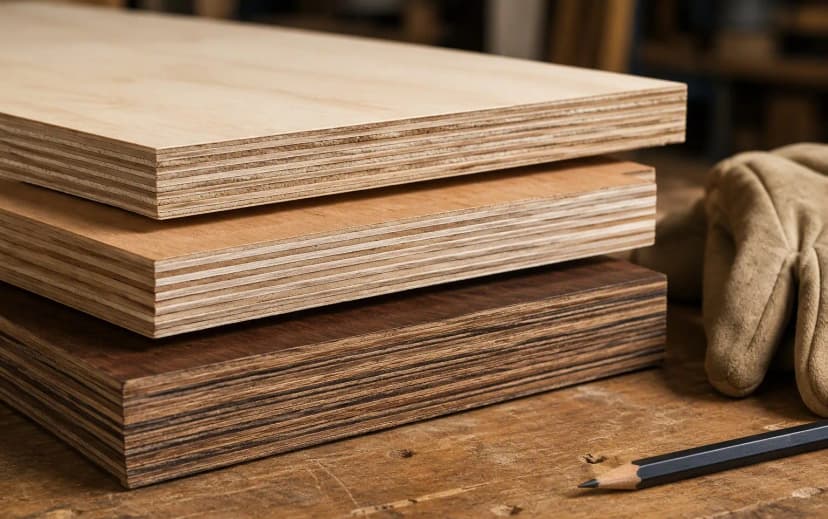
Plywood grade is decided by one thing: the adhesive holding the veneers together. MR (Moisture Resistant) plywood uses a urea-formaldehyde glue that handles ambient humidity but softens if it stays wet. BWR (Boiling Water Resistant) and BWP (Boiling Water Proof) both use phenol-formaldehyde — a chemistry that survives boiling water. The grade is not about thickness, weight, or how premium the sheet feels. It is about what the glue can survive.
The Bureau of Indian Standards splits these across two codes. IS 303 covers general-purpose plywood — both MR and BWR grades. IS 710 is the separate, stricter marine specification, and BWP panels are tested against it, including a three-hour boiling-water test. So the number on the sheet is a claim you can verify: MR and BWR are IS 303; BWP is IS 710. If a dealer quotes "BWR 710," treat it as a red flag — the two numbers are not interchangeable.
| Grade | BIS standard | Glue | Survives | Right rooms | 18mm price (₹/sq ft) |
|---|---|---|---|---|---|
| MR (commercial) | IS 303 | Urea-formaldehyde | Indoor humidity only | Bedrooms, living room, study | ₹55–95 |
| BWR | IS 303 | Phenol-formaldehyde | Splashes, steam, high humidity | Kitchen, utility, bathroom vanity (dry side) | ₹80–120 |
| BWP (marine) | IS 710 | Phenol-formaldehyde, 3-hr boil tested | Prolonged water contact | Under-sink units, bathrooms, balconies, exteriors | ₹110–160 |
Two mistakes cost Bangalore homeowners the most. The first is under-specifying: MR in a kitchen saves roughly ₹15–25 per sq ft and typically fails within 3–5 monsoons — swollen shutters, delaminated edges, a rebuild that costs ₹80,000–1,50,000. The second is over-specifying out of fear: marine-grade BWP in a bedroom wardrobe buys protection the room will never need. Grade to the room, not to the anxiety.
- Dry zones (wardrobes, TV units, bookshelves, beds): MR is sufficient and correctly priced.
- Damp zones (kitchen cabinets, utility): BWR minimum — cooking steam alone degrades MR glue lines over time.
- Wet zones (under-sink cabinet, bathroom vanity, balcony furniture): BWP / IS 710, no exceptions.
2. Thickness: match the millimetres to the load
Grade tells you where the plywood can live; thickness tells you what it can carry. For about 80% of home furniture in India, you will use just two thicknesses: 18mm for structure and 12mm for shelving. Thinner sheets flex under load — a 6mm shelf bows visibly under a stack of bed linen — while overspending on 25mm for a wardrobe side adds weight and cost with no benefit.
| Component | Thickness | Sheet weight (8×4) | Why this works |
|---|---|---|---|
| Wardrobe / cabinet carcass | 18mm | 23–28 kg | Carries load, holds hinges and screws through decades of use |
| Kitchen cabinet carcass | 18mm (BWR) | 23–28 kg | Bears countertop and stored weight plus cooking humidity |
| Shutter substrate | 18mm | 23–28 kg | Hinge mounting and flex resistance over thousands of open-close cycles |
| Internal shelves | 12mm | 13–17 kg | Adequate for typical 45–55cm spans in wardrobes and kitchens |
| Drawer sides | 12mm | 13–17 kg | Supports drawer channels properly |
| Back panels, drawer bottoms | 6mm | 5–7 kg | Non-structural — dust protection and racking resistance only |
| Bed frames, doors, long tabletops | 19–25mm | 35–42 kg | Dynamic body weight and long spans demand rigidity |
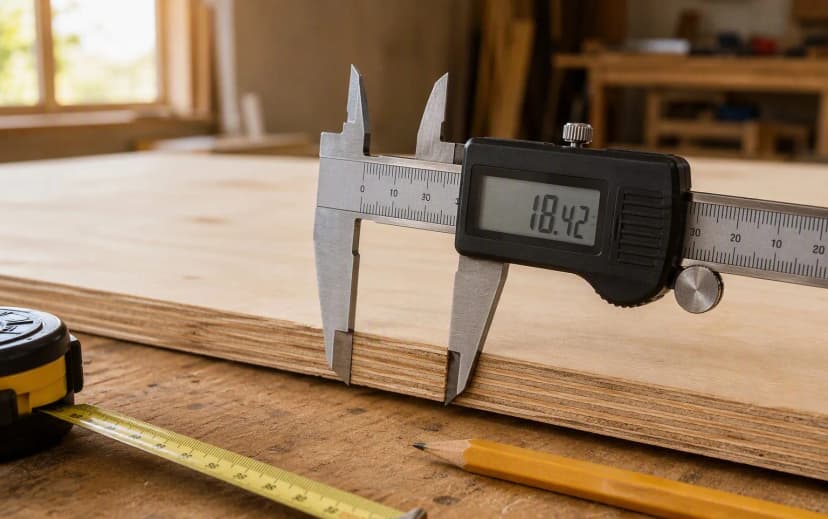
Watch for the 16mm substitution. Some dealers quote "18mm" and deliver 16mm — a meaningful drop in screw-holding and rigidity that is nearly invisible once laminated. BIS tolerances allow a genuine 18mm sheet to measure 17.5–18.5mm. Anything consistently under that is a thinner sheet sold at a thicker price. Ask to measure, or bring a caliper — it takes ten seconds and changes the conversation immediately.
Bangalore note: Price scales steeply with thickness: a 12mm sheet costs roughly 60–65% of the 18mm rate, and 6mm about 35–40%. That is why the classic corner-cut is thinning the spec — 16mm carcasses, 9mm shelves, 4mm backs. Your quote comparison means nothing until every line specifies thickness.
3. Core species: the part you can't see decides everything
The face veneer is cosmetic. The core — the stack of veneers between the faces — makes up most of the panel and decides its weight, stiffness, strength and, critically, screw-holding. Two sheets of identical thickness and grade can behave completely differently depending on the species inside.
| Core | Density | Screw-holding | Weight | Price | Best for |
|---|---|---|---|---|---|
| Gurjan / mixed tropical hardwood | Highest | Excellent | Heaviest | Premium | Kitchens, wardrobes, doors, load-bearing furniture |
| Eucalyptus (plantation) | Medium–high | Good | Moderate | Mid | Furniture-grade panels — the balanced modern choice |
| Poplar | Low | Weak | Lightest | Economy | Back panels, light partitions, budget rental work |
The classic upsell trap is gurjan-faced plywood: gurjan on the two outer veneers, poplar or softwood filler inside. It sounds like gurjan, is priced like gurjan, and performs like poplar. Ask specifically: "Is the core gurjan throughout, or only the face?" Hesitation is an answer.
Three physical checks reveal the core without opening the sheet:
- Lift it. A genuine hardwood-core 18mm sheet weighs 23–28 kg. A suspiciously light sheet has a light core.
- Read the edge. Tight, evenly-spaced plies with no gaps, overlaps or filler strips. Voids at the edge mean voids in the middle.
- Tap it. Knock across the face. A consistent solid sound is good; a dull thud or hollow patch indicates a core void exactly where your screws will go.
4. Calibrated vs regular: pay for precision only if your furniture needs it
Standard plywood allows thickness variation of roughly ±0.5–1mm across and between sheets. Calibrated plywood is run through wide-belt sanders after pressing to hold ±0.1–0.2mm across the entire sheet. That precision costs a 5–10% premium — worth it in exactly one situation.
If your furniture is being made by a modular factory — CNC-cut panels, machine edge banding, pre-laminated boards, hinge plates bored by machine — calibration is effectively mandatory. A 0.5mm variation shows up as misaligned shutters, cracked laminate at the edges, and edge banding that peels. Every modular kitchen and factory-made wardrobe quote assumes calibrated plywood; if yours doesn't say so, ask.
If your furniture is traditional on-site carpentry — a carpenter cutting and edge-lipping by hand — standard-tolerance plywood from a good brand works perfectly well. The carpenter compensates for minor variation as they work, and you save the premium. Don't let a dealer sell you calibration as a quality feature; it is a precision feature, and precision only matters when machines are doing the fitting.
5. Emission class: what your furniture releases into the room
The same formaldehyde-based resins that bond the plies also off-gas into your home for years — and a typical Bangalore apartment contains 15–25 sheets of plywood behind laminate, sealed into wardrobes and cabinets with almost no ventilation. Emission class measures how much formaldehyde a panel releases:
- E2 — the old baseline; avoid for interiors
- E1 — the acceptable modern standard; fine for most rooms
- E0 — near-zero emission; the right call for bedrooms, children's rooms and any home with asthma or respiratory sensitivity
Premium lines from the major brands increasingly ship E0 as standard, and the price difference over E1 is small relative to the project. One caution: emission labels are only comparable within the same test standard, so ask which standard the certificate references and check that the invoice and the panel marking identify the same product line. A verbal "it's E0, madam" is not a certificate.
6. Certification and authenticity: trust, but scan
Bangalore's plywood market has a significant counterfeit and grey-market layer — sheets with printed ISI marks and brand stickers over plantation cores, sold at a discount that still yields the dealer a fat margin. The good news: verification now takes about two minutes, and none of it requires trusting anyone.
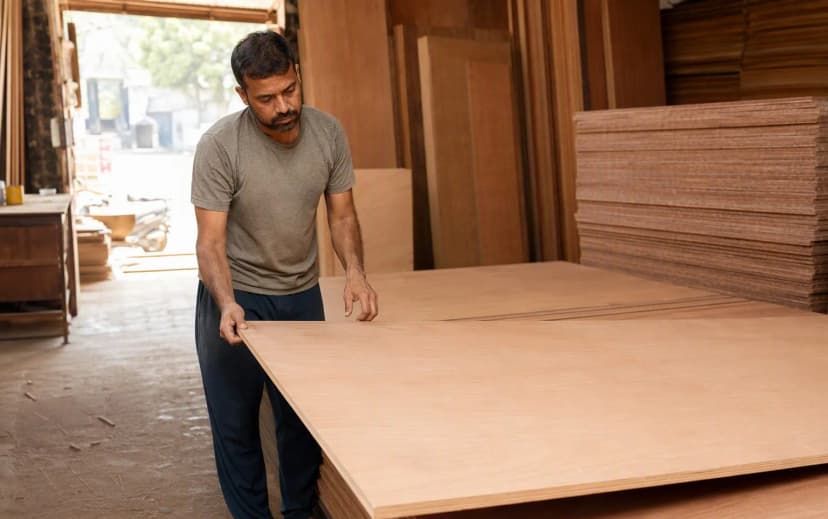
- Check the ISI mark and IS code. IS 303 for MR/BWR, IS 710 for BWP marine. A sheet claiming BWP but stamped IS 303 is not BWP, whatever the dealer says.
- Verify the CML number. Every genuine ISI-marked sheet carries the manufacturer's BIS licence number (format CM/L-XXXXXXX). Enter it on bis.gov.in or the BIS Care app — the licence must be valid and belong to the brand on the sheet.
- Scan the brand QR code. Century (CenturyPromise), Greenply and other majors print QR codes on every sheet that resolve in the manufacturer's own app to the product name, thickness, plant and a unique code. If it doesn't scan, walk away.
- Inspect the edge and face. Tight, evenly-spaced plies, a continuous glue line, no gaps or filler strips, no patches or putty on the face.
- Weigh and tap. 23–28 kg for genuine hardwood-core 18mm; a solid consistent sound across the face, no hollow thuds.
- Read the invoice before paying. Brand, product line, grade, thickness and quantity itemised line by line, with GST. "Plywood 18mm × 20" is not a professional document — and it is useless for a warranty claim.
The deeper dive: Edge reading, thickness checks, knock tests and the godown red flags each deserve their own walkthrough — we cover all of it in Common Mistakes to Avoid When Buying Plywood in Bangalore.
7. Price: what plywood actually costs in Bangalore
Plywood is priced per square foot, and a standard 8×4 sheet is 32 sq ft. These are the realistic retail ranges for established brands (Century, Greenply, Archidply, Merino) at authorised Bangalore dealers this year:
| Grade | Thickness | ₹ / sq ft | ₹ / sheet (32 sq ft) |
|---|---|---|---|
| MR (IS 303) | 6mm | ₹28–45 | ₹900–1,450 |
| MR (IS 303) | 12mm | ₹45–70 | ₹1,450–2,250 |
| MR (IS 303) | 18mm | ₹55–95 | ₹1,750–3,050 |
| BWR (IS 303) | 18mm | ₹80–120 | ₹2,550–3,850 |
| BWP marine (IS 710) | 18–19mm | ₹110–160 | ₹3,500–5,100 |
For a typical 2BHK — a kitchen plus three wardrobes — expect to buy 18–22 sheets across thicknesses: mostly 18mm BWR for the kitchen, 18mm MR or BWR for wardrobes, 12mm for shelves and 6mm for backs. At authorised-dealer prices that is a plywood bill of roughly ₹65,000–1,10,000. If a quote comes in dramatically lower, the saving is coming from somewhere — usually grade, thickness, or authenticity.
Use the price-vs-claim sanity check: IS 710 marine plywood costs more to manufacture than IS 303 because phenolic resin and marine-grade construction are genuinely more expensive. A "710-grade" sheet priced like commercial MR is telling you something. Conversely, paying BWP prices for bedroom wardrobes is over-specifying — put that money into a better core or E0 emissions instead.
Kitchen-specific math: Kitchens deserve their own grade-and-thickness spec — carcass, shutters, under-sink and loft each behave differently. See How to Choose the Best Plywood for Kitchen Cabinets in Bangalore.
8. The supplier: the factor that protects all the others
Every factor above can be defeated by the wrong supplier. A genuine grade, the right thickness and a hardwood core mean nothing if the sheet spent three monsoons on a damp godown floor, came from a mixed batch, or turns out to be a counterfeit with a good sticker. Plywood is a credence good — you cannot judge it by looking at the face — so you judge the supplier's process instead.
The non-negotiables:
- Authorised dealership — verifiable on the brand's own website dealer locator, not by the dealer's word
- Proper storage — sheets racked or on battens in a dry warehouse, never on bare ground
- Itemised GST invoice in your name — the only document a warranty claim recognises
- Written manufacturer warranty — 5–10 years on MR lines, 10–30 years (some lifetime) on BWP lines
- Exchange policy — damaged or non-conforming sheets replaced without negotiation
One more decision sits upstream of all of this: buy the material yourself. Carpenter-procured plywood commonly carries a 5–10% commission that comes out of material quality, and the cash memo that accompanies it activates no warranty. We break down the full economics in why professional plywood suppliers matter, the screening questions in how to select reliable material suppliers in Bangalore, and the procurement traps in common material-buying mistakes.
The plywood buying checklist
- Grade matched to the room — MR dry, BWR kitchen, BWP wet zones
- IS code on the sheet matches the claim — IS 303 vs IS 710, not interchangeable
- Thickness specified per component — 18mm carcass, 12mm shelves, 6mm backs, no silent 16mm
- Core species named — "gurjan throughout, or only the face?"
- Calibrated if CNC/modular — standard tolerance if on-site carpentry
- Emission class E1 minimum, E0 for bedrooms — on the certificate, not verbally
- CML number verified on bis.gov.in or the BIS Care app
- Brand QR scanned in the manufacturer's own app before paying
- Edge, weight and tap checked — 23–28 kg for hardwood-core 18mm
- Itemised GST invoice in your name — brand, line, grade, thickness, quantity
Frequently asked questions
Which plywood grade is best for a kitchen in Bangalore?
BWR (IS 303) as the minimum for all kitchen cabinets, and BWP marine grade (IS 710) for the under-sink unit. Bangalore's monsoon humidity means MR grade in a kitchen typically shows swelling within 3–5 years. BWR costs only 15–25% more than MR, while a failed kitchen costs ₹80,000–1,50,000 to rebuild.
What thickness of plywood should I use for wardrobes?
18mm for the carcass (sides, top, bottom, shutters), 12mm for internal shelves, and 6mm for the back panel. This is the industry-standard combination in India. Do not accept 16mm passed off as 18mm — the screw-holding and rigidity difference is real, and it is the most common silent downgrade in Bangalore quotes.
Is marine (BWP) plywood worth the extra cost?
Only where water actually reaches: under-sink cabinets, bathroom vanities, balcony and semi-outdoor furniture. For bedrooms and living rooms, BWP buys protection the room will never use — BWR or even MR is the right call there. Match the grade to the room, not to fear, and put the savings into a better core or E0 emissions.
How do I check plywood quality at the shop before paying?
Five checks take under two minutes: verify the ISI mark carries the correct IS code (303 or 710), scan the brand QR code in the manufacturer's app, inspect the edge for tight gap-free plies, lift the sheet (genuine hardwood-core 18mm weighs 23–28 kg), and tap the centre — a dull thud indicates core voids.
What is the price of plywood in Bangalore?
Per square foot for 18mm sheets from established brands: MR ₹55–95, BWR ₹80–120, BWP marine ₹110–160. Thinner sheets scale down roughly proportionally — 12mm costs about 60–65% of the 18mm rate, 6mm about 35–40%. A typical 2BHK with a kitchen and three wardrobes needs ₹65,000–1,10,000 of plywood.
Do I need calibrated plywood for home furniture?
Only if your furniture is being built by a modular factory or CNC-cut. Calibrated plywood holds thickness to ±0.2mm, which matters for edge banding machines, laminate adhesion and door alignment. For traditional on-site carpentry, standard tolerance plywood works fine and saves the 5–10% premium.
Which plywood core is better — gurjan, eucalyptus or poplar?
Gurjan and mixed tropical hardwood cores are densest, heaviest and hold screws best — the right choice for kitchens, wardrobes and anything load-bearing. Eucalyptus is a balanced, consistent plantation hardwood used in most quality furniture-grade panels. Poplar is light and cheap but weak on screw-holding — acceptable only for back panels and non-structural work.
Should I buy plywood myself or let my carpenter buy it?
Buy it yourself from an authorised dealer, with an itemised GST invoice in your name. Carpenter-procured material commonly carries a 5–10% commission that comes out of material quality, and the cash memo that comes with it is useless for a warranty claim. Your name on the invoice is what activates the manufacturer's 10–30 year warranty.
Buy plywood the way professionals do
Every grade verified, every sheet from a single batch, every invoice itemised — visit the Evospace studio and check our stock against everything in this guide.
Get a Free Material Consultation




