
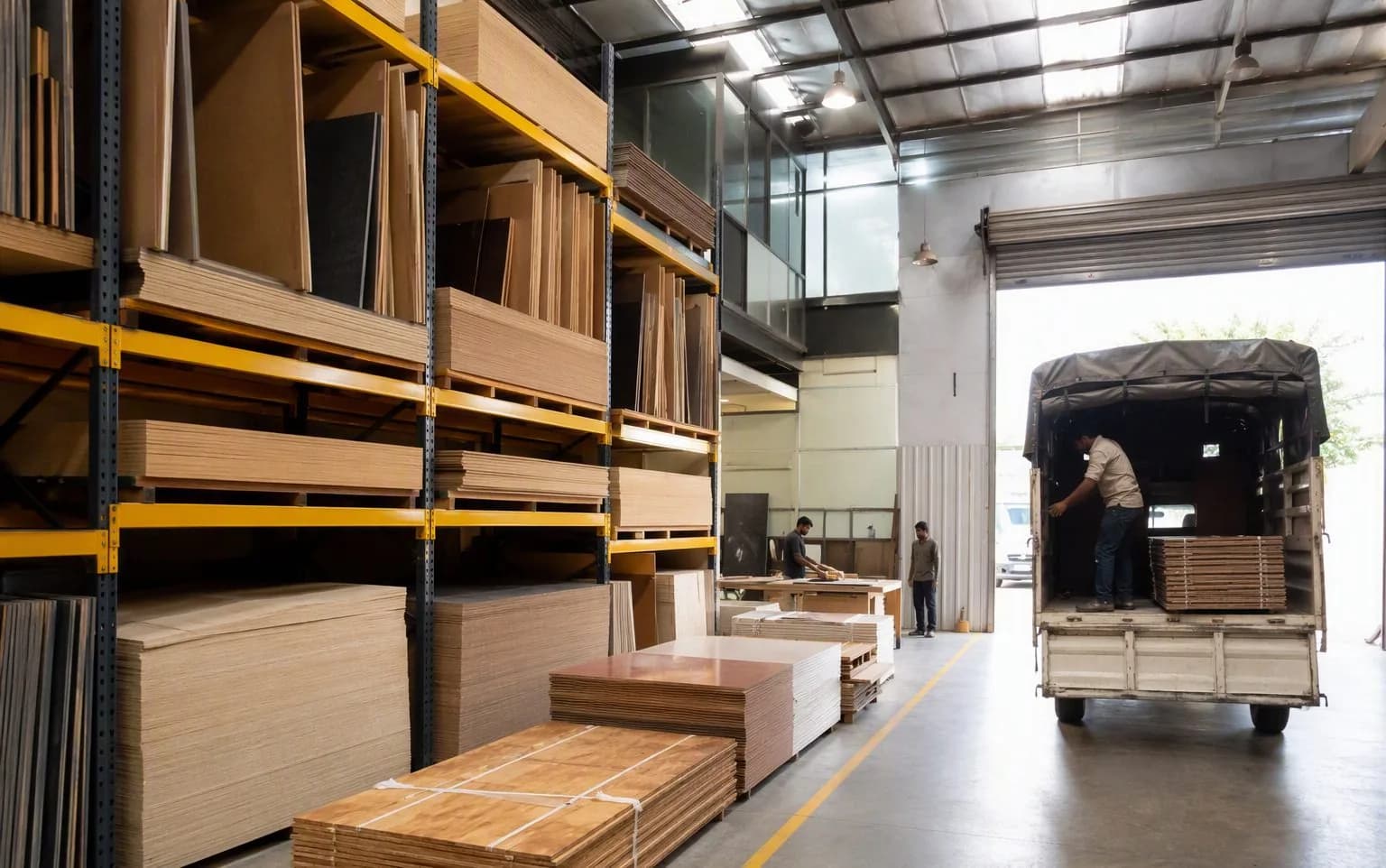
Why Professional Plywood Suppliers Matter for Interior Projects
A plywood sheet looks like a plywood sheet — until your kitchen swells in the second monsoon and the dealer who sold you "BWP" has no record of the sale. Professional suppliers exist to close that gap between what you paid for and what you actually got. Here's what they provide that the grey market cannot.
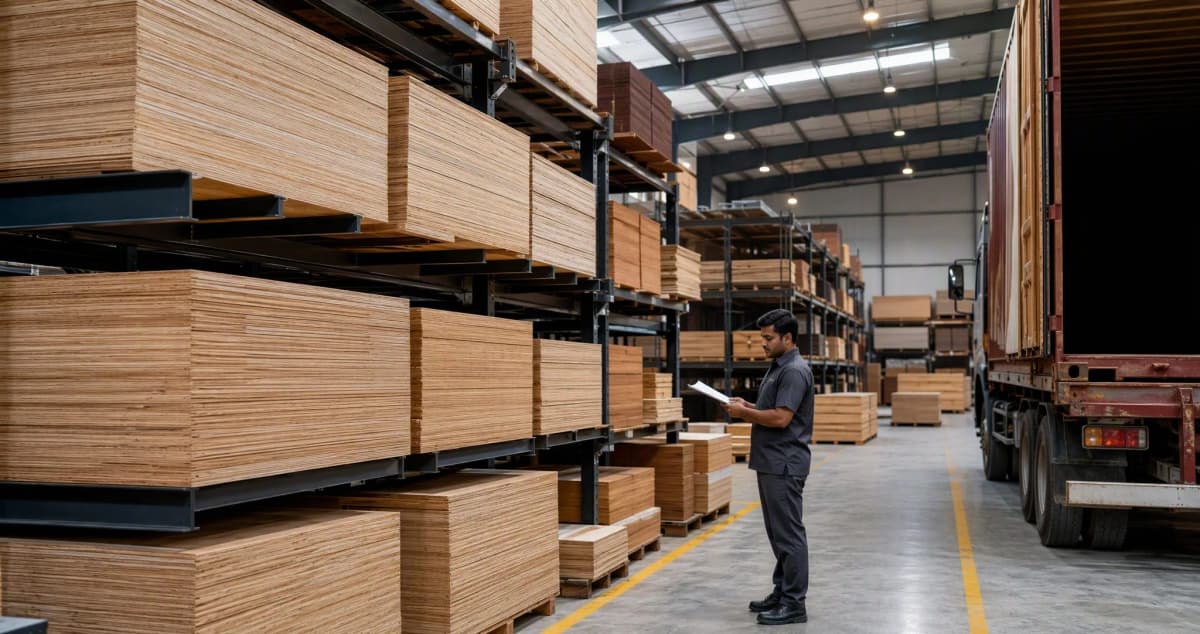
What a professional plywood supplier provides that a local shop cannot
- Genuine BIS-certified stock — verifiable ISI marks, CML numbers and brand QR codes
- Written warranty documentation — 10–30 year manufacturer warranties with your name on them
- Batch consistency — all your sheets from the same production run, matched colour and density
- Proper storage and delivery — dry racked storage, palletised delivery, no ground contact
- Itemised GST invoice — the only document a warranty claim recognises
- Exchange policy — damaged or non-conforming sheets replaced without a fight
1. The grey market: what "cheap" plywood actually is
Bangalore's plywood market splits into two tiers. The organised tier — authorised dealers for Century, Greenply, Merino, Archidply and others — sources directly from manufacturer plants, stores in dry warehouses, and provides documentation. The grey tier sources from factory seconds, overstock, discontinued batches, and outright counterfeits. The price difference is real: a grey-market "BWP" sheet can be ₹800–1,200 cheaper than the genuine article. The question is what you are actually buying.
Grey-market plywood typically falls into four categories:
- Factory seconds: Sheets that failed the manufacturer's QC for core gaps, uneven thickness, or veneer defects. They carry no warranty and are sold at a discount that still yields margin.
- Overstock or aged stock: Sheets stored for months or years in damp godowns, losing glue bond strength and dimensional stability before they ever reach your site.
- Mixed batches: Sheets from different production runs with different core species, density and colour. The wardrobe you build in March looks different from the one you build in April.
- Counterfeits: Sheets with printed ISI marks and brand stickers over plantation cores and economy glue. Indistinguishable in the shop; indistinguishable from failure in year two.
The grey market exists because plywood is a credence good — you cannot judge quality by looking at the face. You judge it by the supplier's process, which is why the supplier matters more than the sheet.
2. The 6 things a professional supplier provides
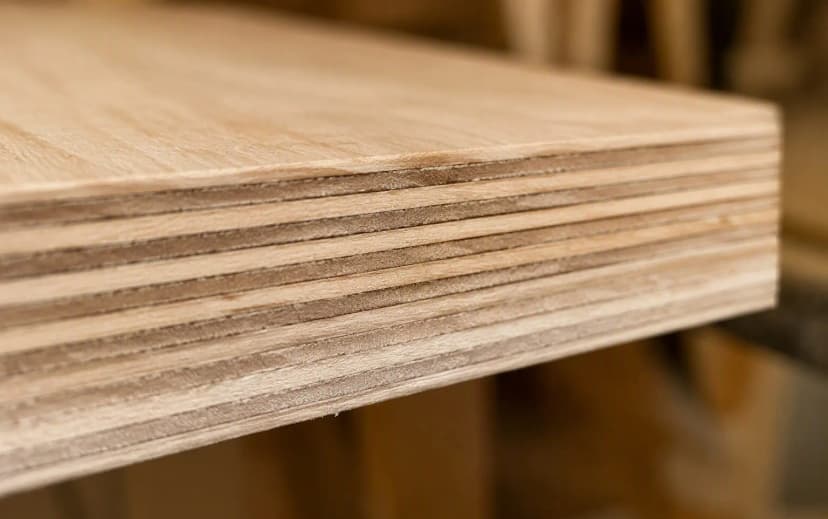
1. Genuine BIS-certified stock
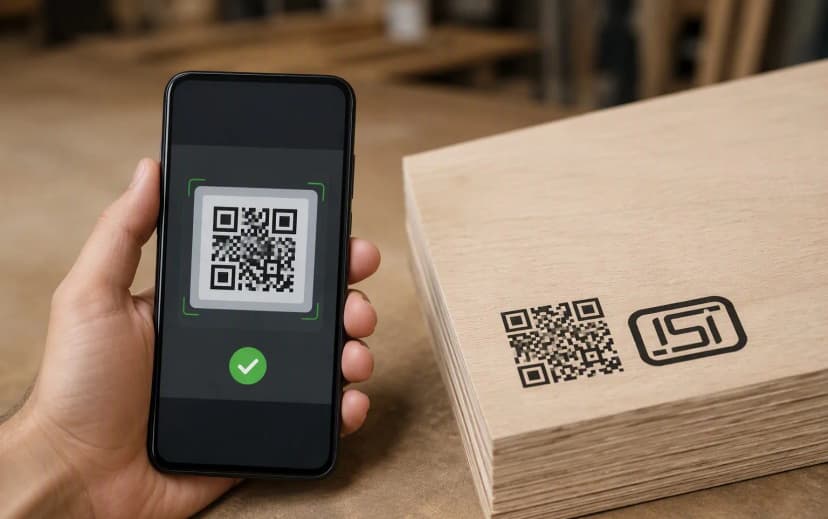
Every sheet carries a verifiable ISI mark, a CML licence number (format CM/L-XXXXXXX) that validates on bis.gov.in, and the brand's QR code scannable with the manufacturer's own app. This is not a marketing feature — it is the only third-party assurance that the glue bond, moisture resistance and formaldehyde emission meet the standard on the label.
2. Written warranty documentation
Professional suppliers issue the manufacturer's warranty card or e-warranty with your name, the product line, and the dealer stamp. Some brands offer 10-year warranties; premium BWP lines offer 25–30 years. This document is only valid with a matching GST invoice — which brings us to the third point.
3. Batch consistency
Professional suppliers order in full batches from the same production run. Your 20 wardrobe sheets come from the same press cycle, with matched colour, density and thickness. Grey-market sheets from mixed sources create the patchwork effect you see in budget interiors — same brand name, visibly different material.
4. Proper storage and delivery
Sheets are stored on racks or battens in dry warehouses, delivered on pallets, and never left on bare ground. This matters because plywood is hygroscopic — it absorbs moisture from the air and the ground, and once it warps, it does not unwarp. A sheet that spent three months on a godown floor is compromised before your carpenter touches it.
5. Itemised GST invoice
Brand, product line, grade, thickness, quantity, rate and GST — itemised line by line. This is your only enforceable proof of purchase for warranty claims, exchange claims, and future matching. A cash memo is not a substitute.
6. Exchange policy
Damaged edges, warped sheets, or non-conforming thickness are replaced without negotiation. The professional supplier's reputation depends on it; the grey-market dealer's margin depends on you not noticing.
3. Cost comparison: professional vs grey market over 10 years
| Cost element | Professional supplier (BWP) | Grey market ("BWP") |
|---|---|---|
| Material cost (20 sheets) | ₹64,000–1,10,000 | ₹18,000–24,000 |
| Warranty coverage | 10–30 years, documented | None |
| Batch consistency | Single production run | Mixed or unknown |
| Storage before delivery | Racked, dry warehouse | Godown floor, months of humidity |
| Expected lifespan in Bangalore | 15–20 years | 3–7 years |
| Replacement cost (1 kitchen + 2 wardrobes) | ₹0 | ₹80,000–1,50,000 |
| 10-year total cost | ₹64,000–1,10,000 | ₹98,000–1,74,000 |
The grey market "saving" of ₹40,000–86,000 evaporates into a replacement cost of ₹80,000–1,50,000 — plus the labour, disruption, and the fact that you live with swollen, delaminating furniture for the years in between. The professional supplier is not the expensive option; it is the option that shows its full price upfront.
4. How to verify a supplier before you buy
Verification is not a one-time event — it is a process that runs from supplier selection through delivery. Here is the full sequence:
- Check the brand's dealer locator. Century, Greenply, Merino and others list authorised dealers on their websites. If the supplier is not listed, they are not authorised.
- Visit the shop physically. Look for racked storage, dry floors, and sheets stored flat on battens. A professional supplier's warehouse looks like the photo above; a grey-market godown looks like a parking lot.
- Scan the QR code at the shop. Download the brand's app (CenturyPromise, Greenply's app and similar) and scan the sheet's QR code. It should return the product name, thickness, size, manufacturing plant and a unique code. If it does not scan, walk away.
- Verify the CML number. Enter the CML licence number (CM/L-XXXXXXX) on bis.gov.in or the BIS Care app. The licence must be valid and belong to the manufacturer whose brand is on the sheet.
- Inspect the edge and weight. Tight, evenly-spaced plies with no gaps or filler strips. Genuine hardwood plywood is noticeably heavier than plantation-core alternatives. A dull thud when tapped indicates core voids.
- Check the invoice before paying. Brand, product line, grade, thickness and quantity must be itemised. If the invoice says "plywood 18mm" without a brand and grade, it is not a professional document.
The deeper dive: Plywood deserves its own inspection routine — edge reading, thickness checks, knock tests and godown red flags. We cover all of it in Common Mistakes to Avoid When Buying Plywood in Bangalore.
5. 6 questions that separate professionals from grey market
1. "Are you an authorised dealer?"
A professional supplier says yes and shows you the dealership certificate or the brand's website listing. A grey-market dealer says "we get it directly from the factory" or changes the subject.
2. "Can I verify the CML number on bis.gov.in right now?"
A professional supplier says yes and waits while you do it. A grey-market dealer says "the sticker is there, see" — as if a printed sticker proves anything.
3. "What is the warranty and who issues it?"
A professional supplier names the manufacturer warranty (10–30 years depending on grade) and explains the claim process. A grey-market dealer offers "shop warranty" — which is worth exactly the paper it is not written on.
4. "What is your exchange policy for damaged sheets?"
A professional supplier has a written policy: photograph, report within 24 hours, replacement within a week. A grey-market dealer says "we'll see" or "transport damage is not our responsibility."
5. "Can I see the full sheet before purchase?"
A professional supplier pulls the sheet from the rack and lets you inspect both faces and all four edges. A grey-market dealer shows you a sample chip or a top sheet from a stack.
6. "Do you provide a GST invoice?"
A professional supplier issues one automatically, itemised by brand, grade, thickness and quantity. A grey-market dealer offers a cash memo or a "discount" for skipping the bill — which is also a discount on your warranty.
6. What professional delivery looks like
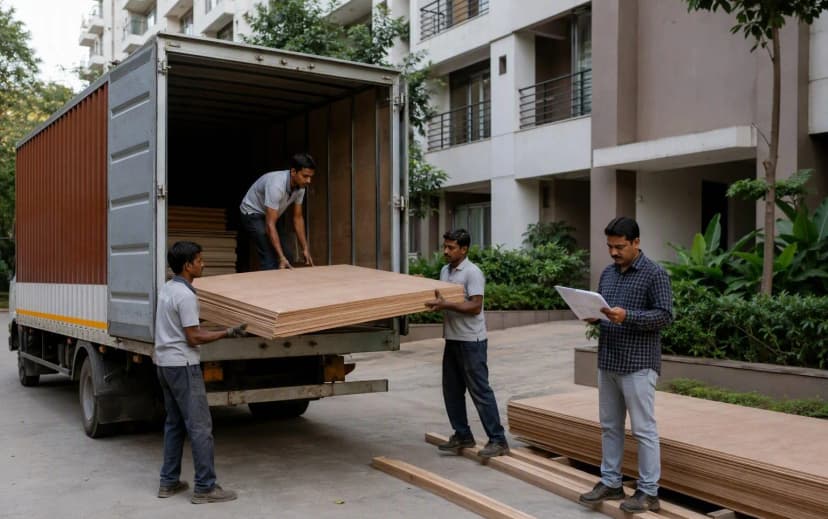
The delivery is the final test of a supplier's professionalism. Here is what should happen:
- Sheets arrive on wooden battens or pallets, never directly on the truck bed or the ground
- A delivery supervisor or your own representative checks count, batch printing and edge condition before unloading is complete
- Any damaged or non-conforming sheet is photographed, noted on the delivery receipt, and flagged for exchange before the truck leaves
- You receive a signed delivery note that matches the GST invoice — same items, same quantities, same batch codes
If the delivery process is "the driver will call you when he reaches," you are not dealing with a professional supplier. For the full delivery inspection routine, see our guide to common material-buying mistakes in Bangalore.
The supplier selection checklist
- Authorised dealer? — verified on the brand's official website, not by the supplier's word
- Racked, dry storage? — sheets on battens, not on the floor or leaning against walls
- QR code verification? — scan at the shop with the brand's own app before paying
- CML number verification? — validate on bis.gov.in or the BIS Care app
- Written warranty documentation? — manufacturer warranty card with dealer stamp
- Batch consistency? — all sheets from the same production run, matched batch numbers
- Itemised GST invoice? — brand, grade, thickness, quantity, rate, GST — line by line
- Written exchange policy? — damaged or non-conforming sheets replaced without negotiation
- Professional delivery? — sheets on battens, supervisor present, signed delivery note
- Physical inspection allowed? — full sheets pulled from the rack for your examination
Frequently asked questions
Why should I buy plywood from a professional supplier instead of a local timber shop?
Professional suppliers provide genuine BIS-certified stock with verifiable ISI marks and CML numbers, written warranty documentation (10–30 year warranties), batch consistency across your full order, proper dry storage that prevents warping, and delivery inspection protocols. Local timber shops often sell factory seconds, grey-market stock, or mixed batches with no recourse if the material fails.
How do I verify a plywood supplier is authorised?
Check the brand's official website for a dealer locator — Century, Greenply, Merino and others list authorised dealers. Ask for the dealership certificate. Verify that the plywood sheets carry the brand's QR code (scannable with the brand's app like CenturyPromise) and a CML licence number that validates on bis.gov.in. A supplier who cannot produce these is not authorised.
What does BIS certification on plywood actually guarantee?
BIS certification (IS 303 for MR/BWR, IS 710 for BWP/marine) guarantees the plywood meets minimum standards for glue bond strength, moisture resistance, dimensional stability and formaldehyde emission (E1 or better). The CML licence number on the sheet lets you verify the manufacturer's certification is current and belongs to the brand you are buying.
What is the real cost of buying cheap plywood from an unverified dealer?
Cheap unbranded plywood costs ₹900–1,200 per sheet vs ₹1,600–3,800 for certified brands — a saving of ₹10,000–20,000 on a typical 2BHK. But failure costs ₹40,000–90,000 per kitchen or wardrobe unit in replacement, plus labour and disruption. Over a 10-year horizon, the 'cheap' option typically costs 2–3× more than buying certified material from a professional supplier the first time.
What should a professional plywood supplier provide with delivery?
An itemised GST invoice naming brand, grade, thickness and quantity; the manufacturer's warranty card or e-warranty documentation; batch numbers that match across all sheets; delivery on battens or pallets (not bare ground); and a clear exchange policy for damaged or non-conforming sheets. If any of these are missing, the supplier is not operating to professional standards.
Can I buy plywood directly from the manufacturer?
Most major brands sell through authorised dealer networks rather than directly to individual homeowners. The dealer provides local availability, physical inspection, warranty documentation and after-sales support. For very large commercial orders (100+ sheets), some brands coordinate direct supply through regional sales teams — but this is not a retail channel for home interiors.
How do I check plywood quality at the supplier's shop?
Check the edge for tight, evenly-spaced plies with no gaps or voids; tap the sheet — a dull thud indicates core gaps, a crisp sound indicates solid construction; check weight — genuine hardwood plywood is noticeably heavier; smell for strong chemical odour indicating excess formaldehyde; and verify the ISI mark, CML number and brand QR code before any money moves.
What questions should I ask a plywood supplier before buying?
Ask: Are you an authorised dealer for this brand? Can I verify the CML number on bis.gov.in right now? What is the warranty period and who issues it — you or the manufacturer? What is your exchange policy for damaged sheets? Can I see the full sheet before purchase? Do you provide a GST invoice? A professional supplier answers all six immediately; a grey-market dealer hesitates on at least two.
Buy plywood from a supplier who answers all six questions
Authorised dealership, verifiable CML numbers, manufacturer warranties, batch consistency, itemised GST billing and professional delivery — the standard we hold ourselves to.
Get a Free Material Consultation




