
Common Mistakes to Avoid When Buying Interior Materials in Bangalore
Duplicate plywood with printed ISI marks. Laminates quoted at one price and billed at another. "Branded hardware" that turns out to be the brand's cheapest line. Bangalore's material market rewards buyers who check and quietly punishes buyers who trust. Here are the 10 mistakes that cost homeowners the most — and the five-minute fixes for each.
The 10 material-buying mistakes Bangalore homeowners keep making
- Shopping on price alone — the cheapest "same spec" sheet is never the same spec
- One shop, one quote — prices vary 10–20% between dealers for identical brands
- Letting the carpenter buy unsupervised — 5–10% dealer commissions distort every recommendation
- Trusting brand names without verifying — fake ISI marks and duplicate laminates are common
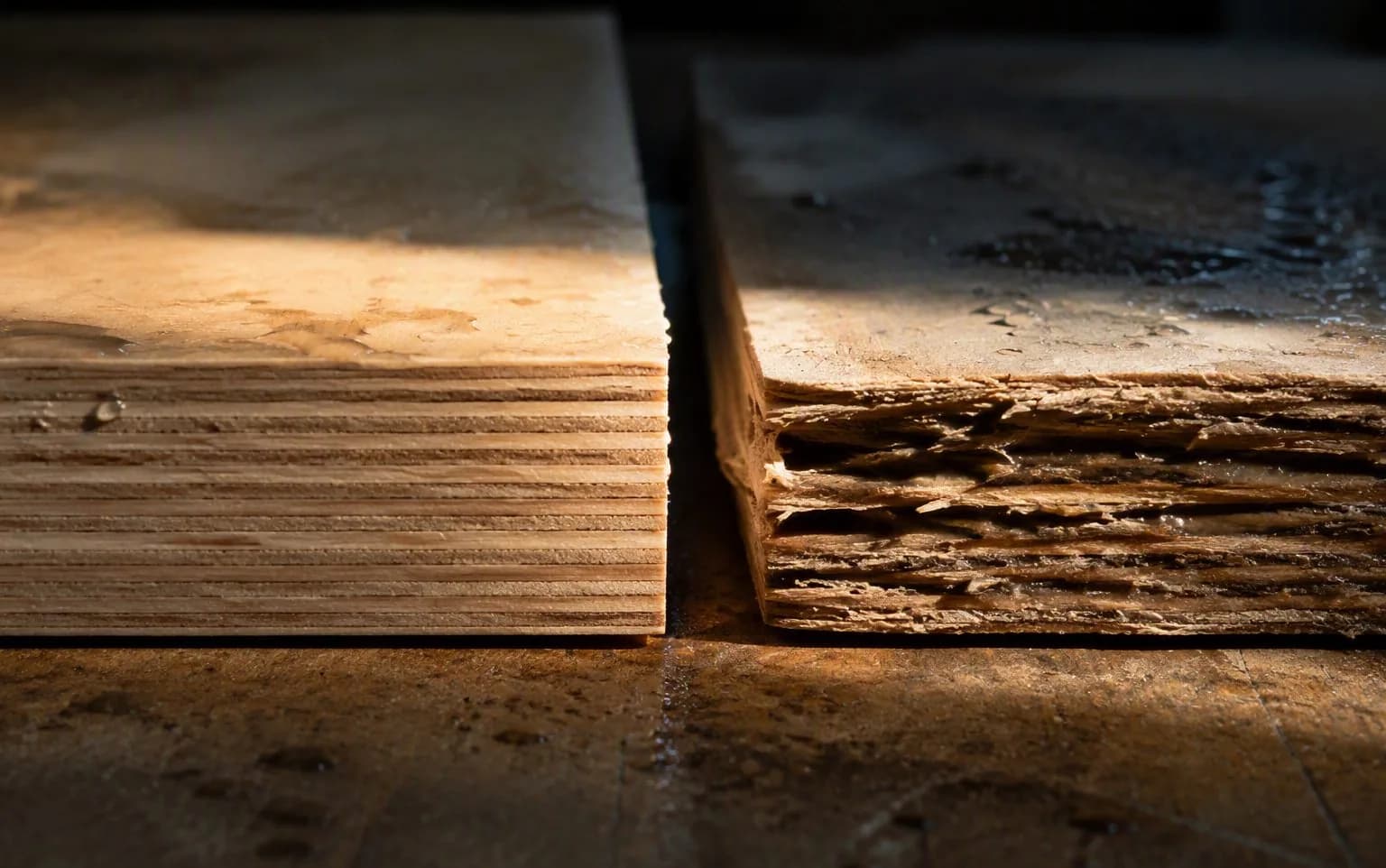
- Wrong grade for the zone — MR plywood in kitchens fails within 2–4 monsoons
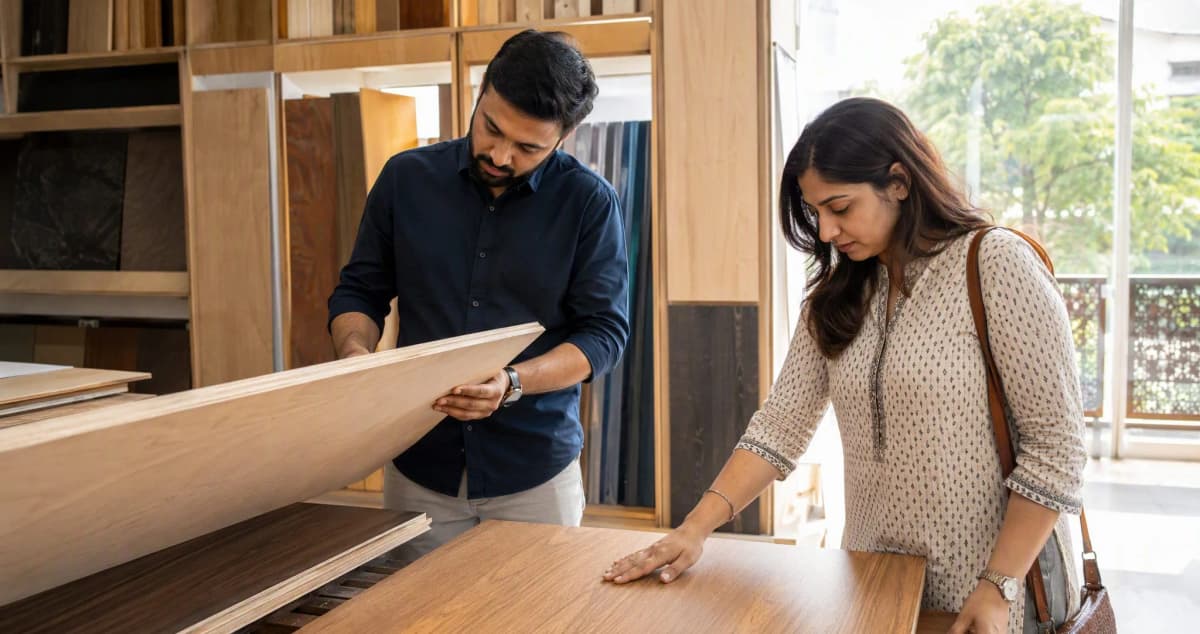
- Choosing from small samples or screens — full sheets look different in daylight
- Ignoring the invisible materials — adhesive, edge banding and hardware decide how long everything lasts
- Accepting "branded hardware" in quotes — without a named product line, it's not a specification
- Signing the delivery receipt before inspecting — your exchange rights die with that signature
- Taking a cash memo instead of a GST invoice — no itemised bill, no warranty
1. Why material buying in Bangalore goes wrong so often
Interior materials are the least transparent purchase in a home project. You can see a sofa and judge it. You cannot see inside a plywood sheet, cannot tell a genuine laminate from a duplicate by its face, and cannot test a soft-close hinge's 40,000-cycle rating in a shop. Every layer of the supply chain — brand, distributor, dealer, carpenter — knows this, and each layer has an incentive that isn't yours.
Bangalore adds its own complications. The market spans everything from organised brand showrooms to the timber godowns of J.C. Road and BVK Iyengar Road; prices for identical branded sheets vary 10–20% between dealers; monsoon humidity punishes any moisture-sensitive mistake within a couple of seasons; and the sheer volume of construction means a thriving grey market in lookalike and seconds-quality stock. A typical 2BHK interior involves ₹4.5–8 lakh of materials — enough that each mistake below is measured in tens of thousands of rupees, and a few of them in lakhs.
The good news: none of the fixes require expertise. They require fifteen minutes, a phone, and a ₹300 digital caliper.
2. Mistakes 1–3: The money mistakes
1. Shopping on price per sheet alone
Two sheets both sold as "18 mm BWP" can differ by ₹1,500 — and by core species, density, ply count and glue quality. The cheaper one is usually lighter (soft plantation core instead of hardwood), thinner in reality, and pressed with more core gaps. Branded 18 mm MR/BWR plywood in Bangalore runs roughly ₹1,800–3,800 per sheet and premium BWP ₹3,200–5,500; the very bottom of any range is almost always a compromise sheet wearing a familiar sticker.
The fix: shortlist by brand and grade first, then compare prices for the same spec across dealers. Saving ₹400 a sheet on 20 sheets saves ₹8,000 — less than rebuilding one sagging wardrobe.
2. Taking one quote instead of three
One quote is not a price; it's an opening offer. The same Merino, Greenply or Century laminate — same code, same finish — routinely varies 10–20% between an authorised dealer, a timber-market shop and a local depot. And "that brand is out of stock, this one is same-same" is the oldest switch in the trade.
The fix: get three written quotes for the exact same brand, grade and thickness — one from the brand's authorised dealer (find it on the brand's website), one from a big timber market, one from a local depot. Refuse substitutions you didn't spec. The three-quote discipline typically saves ₹30,000–80,000 on a full 2BHK material package.
3. Letting the carpenter buy on your behalf, unsupervised
Dealer commissions of 5–10% to carpenters and contractors are routine in Bangalore's trade. That creates two problems: the recommendation tilts toward the brand that pays rather than the one that lasts, and the spec quietly changes en route — "BWR not available, this is same" — while the bill doesn't. This isn't about distrusting your carpenter; his knowledge of quantities and sizes is genuinely valuable. It's about removing a conflict of interest.
The fix: separate the roles. Your carpenter advises on quantities; you choose the brand and grade; you pay the dealer directly. If he insists on "his" dealer, that dealer gets the same verification checks as any other. Our guide to selecting reliable material suppliers in Bangalore covers what a trustworthy dealer relationship looks like.
3. Trusting the brand name without verifying the sheet
Counterfeit interior materials are a well-documented problem in India, and Bangalore's construction volume makes it a prime market. A duplicate laminate looks identical in the store but delaminates, fades or scratches within months. A fake plywood sheet carries a printed "ISI" logo over a gappy plantation core. Both are sold at prices 20–40% below genuine stock — which is exactly why "bargain" dealers can undercut authorised channels.
Verification takes about a minute per sheet and costs nothing:
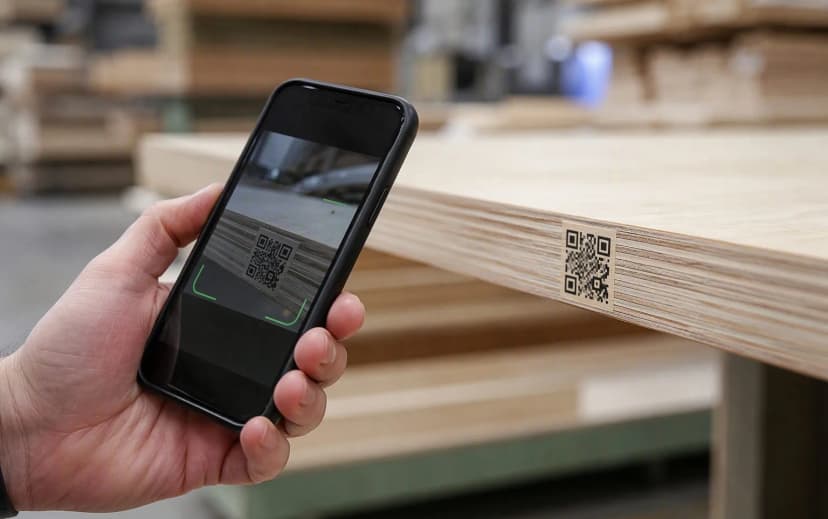
- Plywood: the sheet must carry the ISI mark plus the IS standard number (IS 303 for MR/BWR, IS 710 for BWP) plus a CML licence number in the format CM/L-XXXXXXX. Enter that number on bis.gov.in or the BIS Care app — the licence must be valid and belong to that manufacturer. Then scan the sheet's QR code with the brand's own app (CenturyPromise, Greenply's app and similar). A printed ISI logo alone proves nothing.
- Laminates: buy only from authorised dealers; check the brand's name printed on the sheet's backing; match batch numbers across all your sheets; and be suspicious of any branded 1 mm laminate priced far below the ₹900–1,750 market band.
- Hardware: check stamped brand markings on hinge arms, original packaging, and a dealer invoice naming the product line. Unusually cheap "Hettich" or "Blum" without packaging is usually neither.
The deeper dive: Plywood deserves its own inspection routine — edge reading, thickness checks, knock tests and godown red flags. We cover all of it in Common Mistakes to Avoid When Buying Plywood in Bangalore.
4. The specification mistakes
5. Wrong grade for the zone
Half of all material regret in Bangalore is a grade mistake, not a brand mistake. The classic cases: MR (dry-zone) plywood in kitchen carcasses that swell within 2–4 monsoons; raw MDF shutters in bathrooms; 0.6 mm liner laminate on exterior wardrobe surfaces that need 1 mm; economy hinges on heavy kitchen shutters. Bangalore's June–September humidity averages 75–85%, so these aren't edge cases — they're the main event. The rule: BWR minimum for all kitchen and utility cabinetry, BWP/marine for the sink unit and bathroom vanities, 1 mm laminate on all touch surfaces. Our plywood guide for Bangalore kitchen cabinets maps grades zone by zone.
6. Choosing from small samples or a phone screen
A 4×4 inch laminate chip tells you the colour family — not the grain scale, the texture, or how the sheet reads across an 8-foot wardrobe shutter. Screens are worse: every wood grain shifts warmer or cooler depending on your display. Homeowners then discover at installation that the "subtle oak" is actually busy, or the "warm grey" reads green in their north-facing bedroom.
The fix: always view the full 8×4 sheet standing upright in daylight, at the shop and ideally against your home's actual light direction. Take the sample chip home overnight before committing to 30 sheets. The same logic applies to trending finishes — see them at scale before believing them.
7. Ignoring the invisible materials: adhesive and edge banding
Nobody Instagrams their adhesive, yet it's what decides whether your laminate stays stuck. Two silent killers: economy glue under good laminate (the laminate outlasts its own bond, edges lift within a year or two), and hand-applied edge banding with contact adhesive instead of machine-applied hot-melt (EVA or PUR) banding — hand-pasted edges are the first thing to peel on shutters. Ask one question before work starts: "Which adhesive brand, and is edge banding machine-pressed?" Branded adhesive plus machine-applied banding adds perhaps 2–3% to a project and prevents the most common failure mode in Indian furniture. More on what this looks like when it goes wrong: common laminate selection mistakes.
5. The "branded hardware" trap
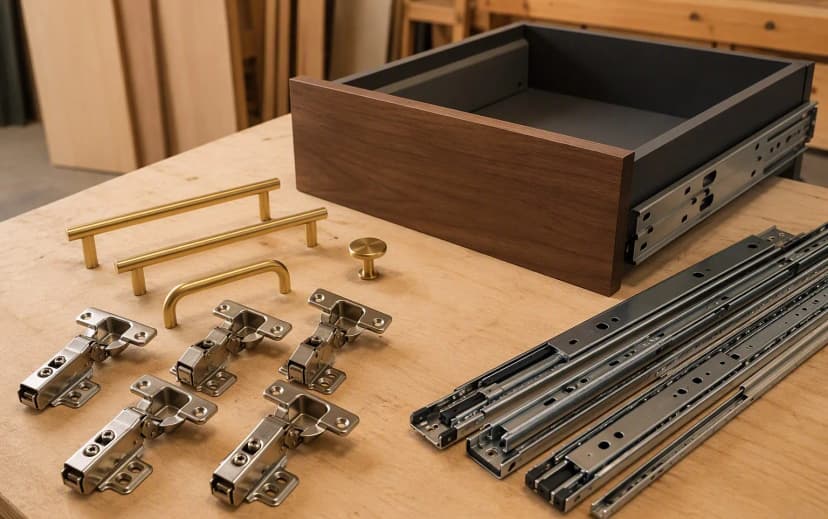
A quote that says "branded hardware" is not a specification — it's a placeholder. Every major brand spans budget to premium lines with wildly different performance: Hettich's Onsys hinge is rated around 40,000 opening cycles and sells for roughly ₹130–200 per pair, while its Sensys line is rated 80,000 cycles at ₹400–600; Blum's CLIP top BLUMOTION hinges go higher still. Drawer systems range from ₹2,500 basic sets to ₹22,500 premium ones. All of these are legitimately "branded hardware."
Before approving any quote, demand three lines in writing:
- Brand and product line — "Hettich Sensys 110° soft-close", not "Hettich-type"
- Quantity per unit type — hinges per shutter, channels per drawer, and specifically which units get soft-close
- Who owns the warranty — the hardware brand, the fabricator, or the firm invoicing you (often three different parties)
If a quote can't answer all three, it can't be compared with one that can — whatever the headline number says. On a mid-range kitchen, hardware runs ₹50,000–1,00,000; getting this line item right matters more than almost any other.
6. Delivery day and paperwork — where good purchases go bad
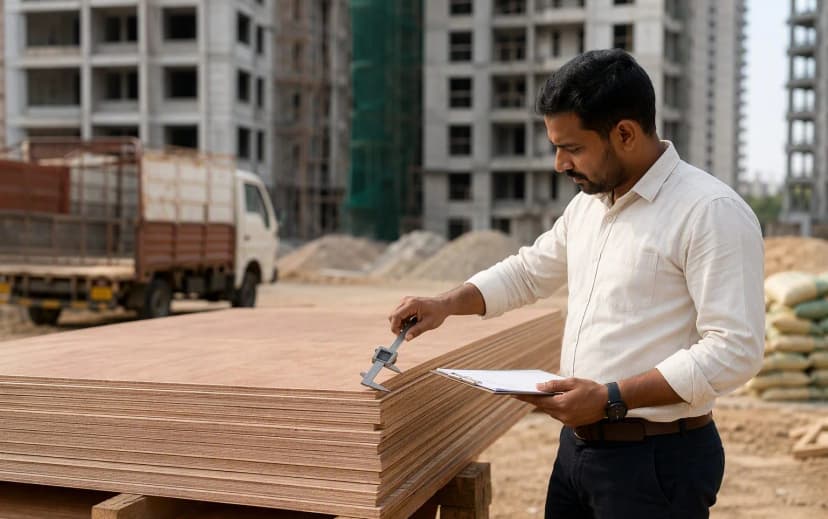
You can do everything right at the shop and still lose at the gate. Materials typically travel from godown to site in an open tempo — through traffic, sometimes through rain. Sheets arrive while you're at work; the driver asks the watchman to sign; and a week later the carpenter finds crushed corners, a warped sheet mid-stack, or three sheets from a cheaper batch. Once a receipt is signed "received in good condition," the exchange fight is nearly lost.
9. Signing before inspecting
The fix: be present, or send someone briefed. Count sheets against the invoice; check brand/grade printing on every sheet, not just the top one; walk the stack for edge and corner damage; sight along a few sheets for bowing; check for damp patches or musty smell (monsoon transit or a wet godown). Photograph any problem before signing, and write "subject to inspection" on the receipt if rushed.
10. Accepting a cash memo instead of a GST invoice
Brand warranties — some plywood and laminate lines carry 10-year warranties — are void without a valid purchase invoice. A cash memo is not one. The "5% off if no bill" offer protects the seller's tax liability, not your furniture, and dealers making that offer are statistically the ones moving grey-market stock.
The fix: insist on an itemised GST invoice naming brand, product line, grade, thickness and quantity for every item. File it with your home documents. It's your only enforceable proof of what you bought.
7. Mistake → cost → fix: the summary table
| Mistake | Typical cost | The 5-minute fix |
|---|---|---|
| Shopping on price alone | ₹15,000–40,000 in early failures | Fix brand + grade first, then compare prices for that spec |
| Taking one quote | ₹30,000–80,000 overpayment | Three written quotes: authorised dealer, timber market, local depot |
| Carpenter buys unsupervised | 5–10% commission + grade swaps | You pick the spec and pay the dealer directly |
| Skipping QR/CML verification | Duplicate stock worth ₹50,000+ | bis.gov.in / BIS Care app + brand QR app at the shop |
| Wrong grade for wet zones | ₹40,000–90,000 kitchen redo in 2–4 yrs | BWR min in kitchens, BWP at sink, 1 mm laminate outside |
| Choosing from small samples | ₹20,000–60,000 in reordered sheets | See full 8×4 sheets in daylight; take chips home overnight |
| Cheap adhesive, hand-pasted edges | ₹10,000–25,000 in peeling repairs | Branded adhesive + machine-pressed edge banding in writing |
| "Branded hardware" placeholder | ₹20,000–60,000 spec dilution | Product line + quantity + warranty owner on the BOQ |
| Signing before inspecting | Full loss on damaged/substituted sheets | Inspect count, print, edges, flatness, moisture at the gate |
| No GST invoice | Entire warranty void | Itemised GST bill with brand, grade, thickness, quantity |
Add the middle column up and a careless 2BHK material purchase can leak ₹2–3.5 lakh — roughly a third of the material budget — without anything visibly "going wrong" at the time. That's why the checklist exists.
The Bangalore material buyer's checklist
- Fix the spec before the budget: brand, grade, thickness and quantity for every material — before any dealer hears a number
- Get three written quotes for the identical spec: authorised dealer, timber market, local depot
- You choose and pay; the carpenter advises on quantities. Never the reverse
- Verify at the shop: ISI + CML on bis.gov.in, brand QR scan, backing print on laminates, packaging on hardware
- Match grades to zones: BWR/BWP for kitchens and wet areas, 1 mm laminate on touch surfaces
- See full sheets in daylight, not 4×4 chips or phone screens
- Get adhesive brand and machine edge-banding in writing from the carpenter or factory
- Hardware BOQ must name product line, quantity per unit and warranty owner — "branded" is not a spec
- Be present at delivery: count, batch print, edges, flatness, moisture — photograph problems before signing
- Take an itemised GST invoice and file it; it's the only proof your warranty recognises
Frequently asked questions
What are the most common mistakes when buying interior materials in Bangalore?
The ten costliest: shopping on price alone, buying from one shop without comparing quotes, letting the carpenter buy unsupervised, trusting brand names without QR/CML verification, wrong grades for wet zones, choosing from small samples or screens, ignoring adhesive and edge banding, accepting "branded hardware" without named product lines, signing the delivery receipt before inspecting, and taking a cash memo instead of a GST invoice.
How do I check if plywood or laminates are genuine in Bangalore?
For plywood, check the ISI mark, the IS standard number (303 or 710) and a CML licence number stamped on the sheet — then verify the CML on bis.gov.in or the BIS Care app, and scan the brand QR code with the manufacturer's official app. For laminates, buy from authorised dealers, check the brand print on the sheet's reverse, and match batch numbers. A printed logo alone proves nothing.
Is it OK to let my carpenter buy the materials?
Let him advise on quantities and sizes — that's genuine expertise — but choose brands and grades yourself and pay the dealer directly. Dealer commissions of 5–10% are routine, which tilts recommendations toward the brand that pays rather than the one that lasts, and enables quiet grade substitutions at unchanged prices.
Why do quotes and final bills differ so much for interior materials?
Most quotes are verbal or single-line, which leaves room for "market rate changes" and substitutions. The fix is a written, itemised quote naming brand, product line, grade, thickness and quantity for every material — and a final GST invoice that matches it line by line.
What does "branded hardware" in a quote actually mean?
Almost nothing. The same brand spans budget and premium lines — Hettich's Onsys hinge runs ₹130–200 per pair while its Sensys line costs ₹400–600, with double the cycle rating. Demand the product line ("Hettich Sensys 110° soft-close"), the quantity per unit, and the warranty owner in writing. Without those, quotes can't be compared.
Which plywood grade should I buy for kitchens in Bangalore's climate?
BWR (boiling-water-resistant, IS 303) minimum for all kitchen and utility cabinetry, and BWP/marine (IS 710) for the sink unit and bathroom vanities. MR grade in a Bangalore kitchen typically fails within 2–4 years — sooner during June–September, when humidity averages 75–85%.
Do I really need a GST invoice for material purchases?
Yes. An itemised GST invoice naming brand, grade, thickness and quantity is your only enforceable proof of purchase — brand warranties of up to 10 years are void without it. Dealers offering discounts for skipping the bill are usually the ones moving grey-market or substitute stock.
What should I check when materials are delivered to my site?
Be present. Count sheets against the invoice, check brand/grade printing on every sheet, inspect edges and corners, sight along sheets for warping, and check for damp patches or musty smell from monsoon transit. Photograph any problem before signing — a signed "received in good condition" receipt kills most exchange claims.
Buy materials without the guesswork
Genuine branded plywood, laminates and hardware — verified stock, itemised GST billing, and full sheets you can inspect in daylight before you pay.
Get a Free Material Consultation




