
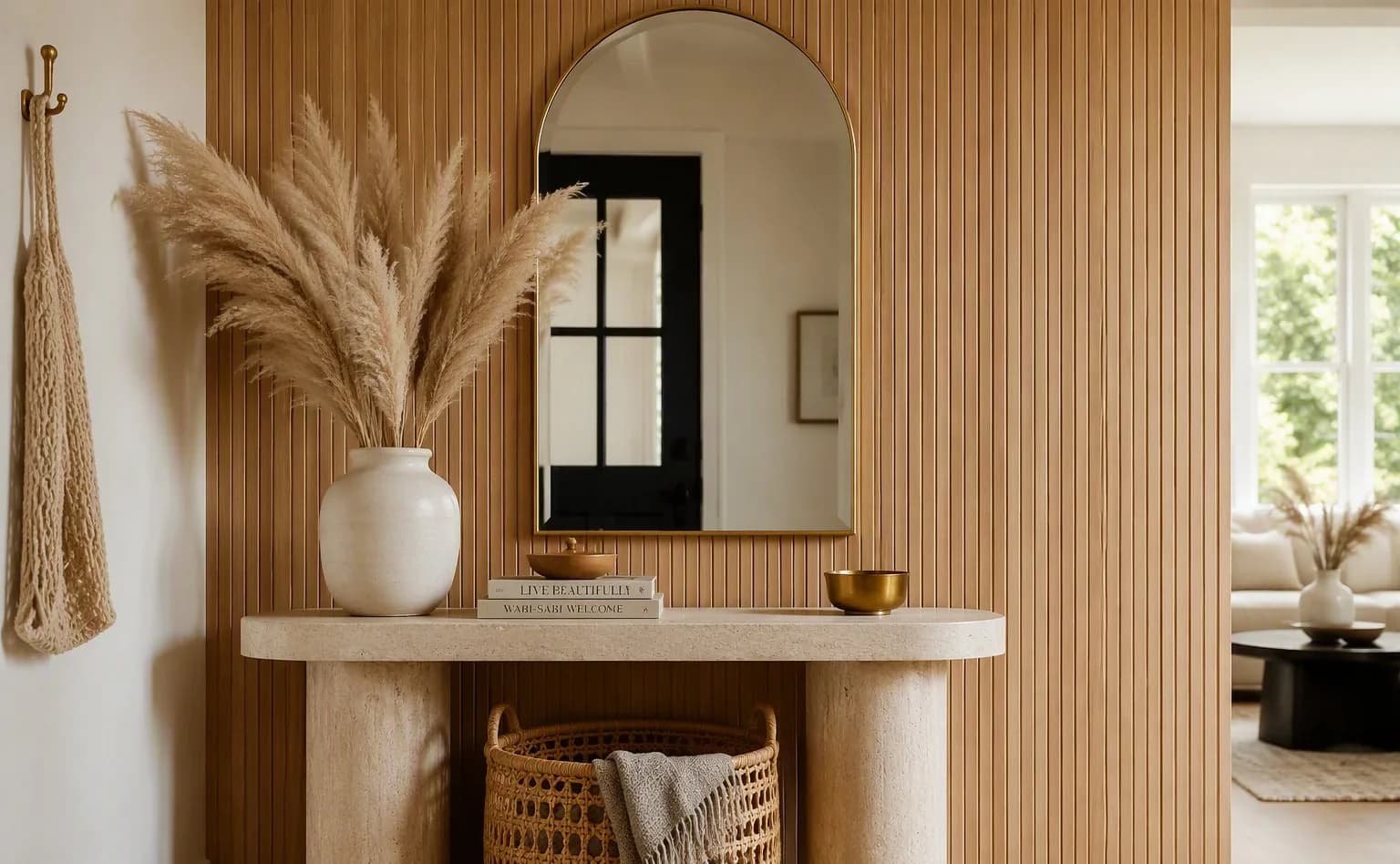
Latest Interior Design Material Trends Popular in Bangalore Homes
Walk into any newly done-up Bangalore apartment and you'll see the same shift: fluted panels on the TV wall, warm wood tones instead of sterile white, sage green kitchens, and cane accents everywhere. Here's what's actually trending, what each material costs, and how to use these trends without regretting them in five years.
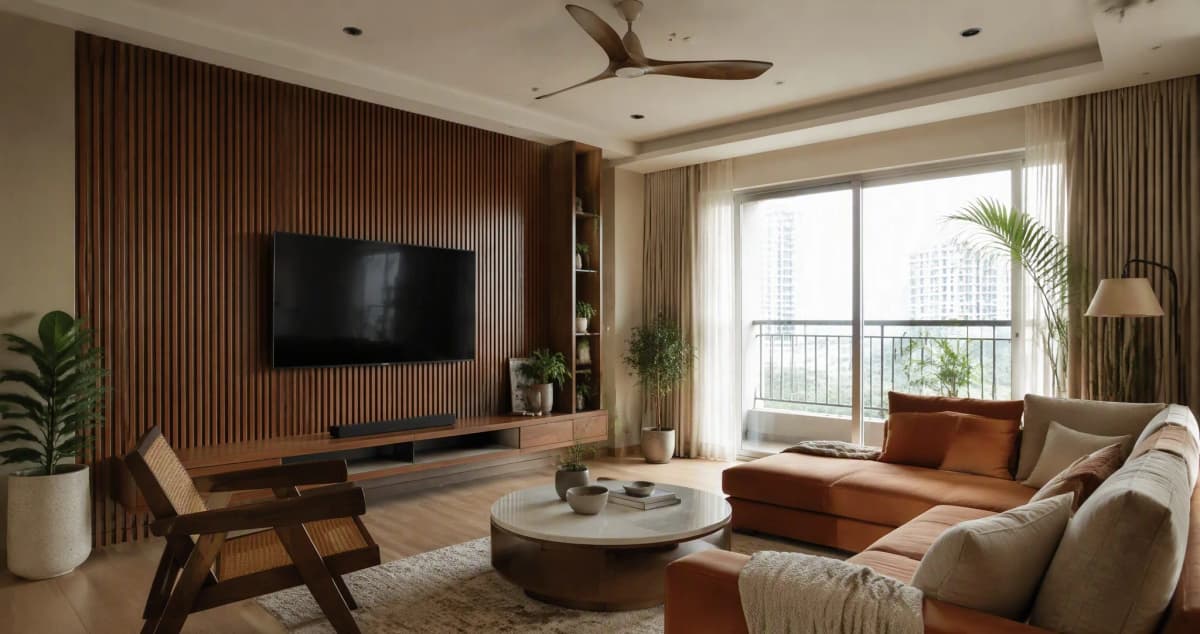
The 6 material trends defining Bangalore homes
- Fluted panels & louvers on TV walls, headboards and islands (₹80–300/sq ft)
- Warm wood grains — oak and walnut laminates/veneers replacing all-white minimalism
- Earthy two-tone kitchens — sage, terracotta and clay paired with wood
- Quartz & stone-look surfaces for counters (₹280–450/sq ft installed) and feature walls
- Cane, rattan & natural texture accents on shutters, dividers and chairs
- Climate-smart cores — BWP plywood and HDHMR chosen for Bangalore's humid monsoons
1. Why Bangalore interiors look different
For most of the early 2020s, the "modern Indian home" formula was predictable: white walls, grey flooring, high-gloss white or grey kitchens, and chrome hardware. That formula has visibly broken. Across Bangalore's new apartments — from Sarjapur Road towers to Whitefield gated communities — interiors are getting warmer, more textured and more personal.
Three forces are driving the shift. First, the garden-city instinct: Bangalore homeowners consistently ask for interiors that feel connected to nature — plants, daylight, wood and stone — a design language designers call biophilic. Second, the work-from-home permanence: with hybrid work now standard in the city's tech workforce, homes must photograph well on video calls, absorb sound, and feel calm for ten hours a day — which flat white gloss simply doesn't deliver. Third, climate realism: after enough swollen wardrobes and peeling laminates, buyers now ask about BWP plywood and moisture resistance before they ask about colour.
The result is a distinctly Bangalore version of this year's global trends: warm and textured like the international mood, but filtered through dust, monsoon humidity, compact apartment sizes and Indian cooking. Here are the six material trends actually showing up in homes across the city — with the prices and practical catches of each.
2. Fluted panels and louvers — the defining wall treatment of
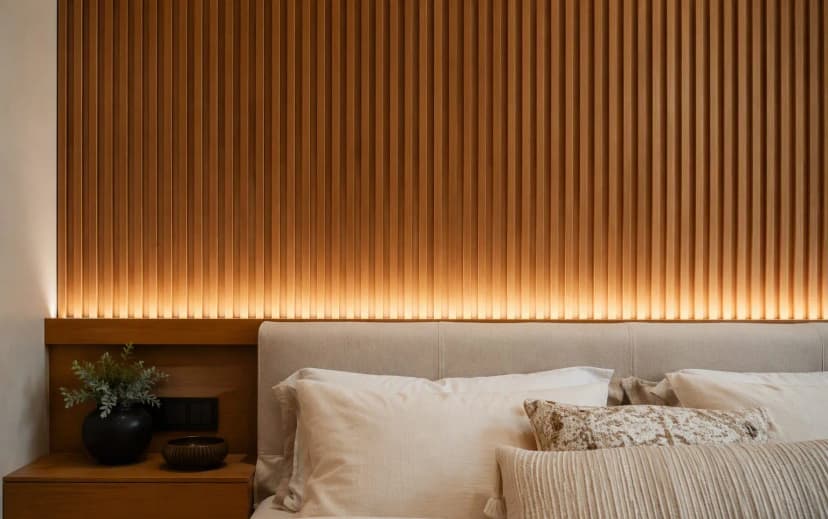
If one material owns, it's the fluted panel. Vertical grooves — in PVC, WPC, MDF or charcoal-finish louvers — now appear behind almost every new TV unit and bed headboard in Bangalore, and increasingly on kitchen islands and wardrobe shutters. Industry pricing reports list fluted WPC panels and charcoal louvers as the most-specified feature-wall finishes in India this year.
The appeal is practical as much as visual. Fluted panels add depth, shadow and a premium architectural feel to a plain wall, install dry in a few hours (versus 2–3 days of wet work for tiling or stone cladding), and hide minor wall undulations — common in Bangalore's fast-built apartment towers.
Which fluted panel for which spot
- MDF fluted panels (₹60–140/sq ft): cheapest and paintable, but only for dry, low-touch areas — bedroom headboards, study walls. Keep away from kitchens and bathrooms.
- PVC fluted panels (₹80–180/sq ft): waterproof and termite-proof; the value choice for TV walls and rental-friendly upgrades.
- WPC fluted panels (₹90–300/sq ft): denser, more premium feel, wood-tone finishes; the mainstream choice for living room feature walls.
- Charcoal louvers (~₹200/sq ft): deep wood-look slats for a warmer, heavier architectural effect — popular in premium apartments and villa interiors.
Practical tip: Fluted panels trap dust in their grooves — a real consideration in Bangalore's construction-heavy corridors like Sarjapur, Whitefield and Hebbal. If your flat faces an active construction site, choose wider grooves (easier to wipe) or keep fluting to the headboard wall rather than the window-facing wall.
3. The warm wood comeback — oak, walnut and the end of all-white
The single biggest shift of is tonal: cool greys and stark whites are out; warm neutrals are in. Wood-grain surfaces — natural oak, teak and walnut in particular — are being used across wardrobes, TV units, crockery units, wall panels and even ceiling accents. The difference from earlier "wood-look" waves is quality: homeowners now specifically ask for textured, synchronous-grain laminates that feel like real wood, or natural veneer where the budget allows.
For most Bangalore homes, the practical winner is a good 1 mm HPL wood-grain laminate: it delivers the look at ₹120–350 per sq ft installed on furniture, shrugs off scratches, humidity and daily wiping, and lasts 12–18 years — where natural veneer needs polishing maintenance and careful handling. Veneer still has its place as a single statement surface (a dining table top, a pooja unit, one feature wall) where its unique grain justifies the ₹150–400/sq ft material cost and upkeep.
We cover the specific shades and finishes trending this year — and the ones already dating themselves — in our guide to the latest laminate design trends in Bangalore homes.
4. Earthy two-tone kitchens — sage, terracotta and warm oak
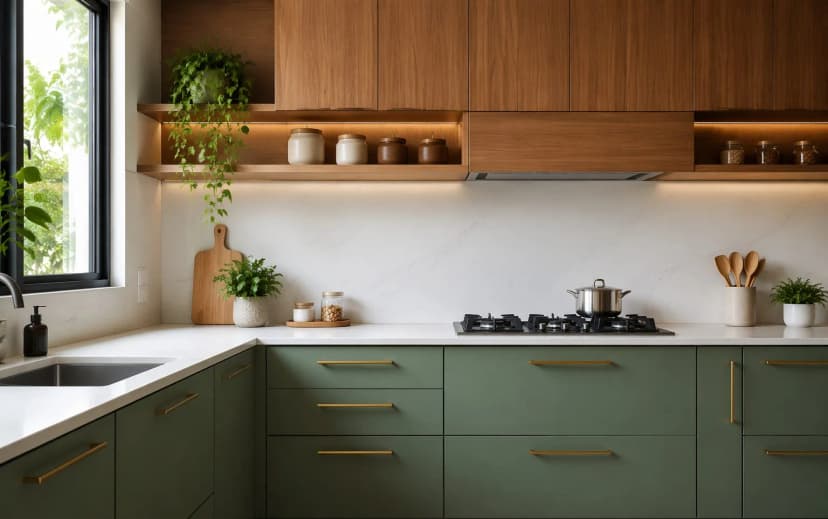
The sterile high-gloss white kitchen is officially over. The dominant Bangalore kitchen of follows a consistent recipe: matte earthy lower cabinets (sage green, terracotta, clay or warm taupe), wood-grain upper cabinets (light or mid oak), a white or cream quartz countertop, and brass or brushed gold hardware. Two-tone kitchens now outnumber single-colour ones in new modular projects across the city.
Why this exact combination works so well here: matte finishes don't show the oily fingerprint film that Indian cooking deposits on gloss shutters; dark lowers hide scuff marks from daily use; light uppers keep compact 8×10 ft apartment kitchens feeling open; and warm metal hardware ties into the brass accents used elsewhere in the home. The whole palette also flatters Bangalore's soft, often overcast daylight.
Material-wise, this trend is best executed in matte HPL laminates or anti-fingerprint acrylic on a BWP plywood or HDHMR carcass. Choosing the right core matters more than the colour — our plywood guide for Bangalore kitchen cabinets covers the grades that survive under-sink moisture, and our laminate selection guide walks through finish and thickness choices.
5. Quartz counters and stone-look surfaces — without stone's maintenance
Bangalore's countertop conversation has narrowed to two materials. Quartz (₹280–450/sq ft installed) is now the default for new modular kitchens: it's non-porous, shrugs off turmeric, oil and coffee stains, needs no sealing, and looks identical slab to slab — which matters when you're matching a counter to a laminate you chose weeks earlier. Granite (₹160–350/sq ft) remains the value and heat-resistance champion — you can park a hot pressure cooker directly on it — and local favourites like Sadarahalli grey keep it firmly relevant, especially in utility areas and rental properties.
The newer entrant is UV marble sheets — high-gloss, marble-look panels (from roughly ₹9,999 per sheet) that deliver the Italian-marble feature wall or TV backdrop at a fraction of the cost and weight of real marble, with zero sealing or etching worries. They're the fastest-growing premium wall finish in India this year, and Bangalore's apartment lobbies and living rooms are full of them.
| Material | Installed cost | Stains & sealing | Heat | Best for |
|---|---|---|---|---|
| Quartz | ₹280–450/sq ft | Non-porous; no sealing ever | Good — but use trivets for hot kadais | Daily-cooking family kitchens wanting low maintenance |
| Granite | ₹160–350/sq ft | Needs sealing every 1–2 years | Excellent — handles direct heat | Budget projects, heavy Indian cooking, rentals |
| UV marble sheet | from ₹9,999/sheet | Non-porous surface | Not for counters — walls only | Marble-look feature walls, TV backdrops, vanity panels |
6. Cane, rattan and natural texture — the handcrafted accent
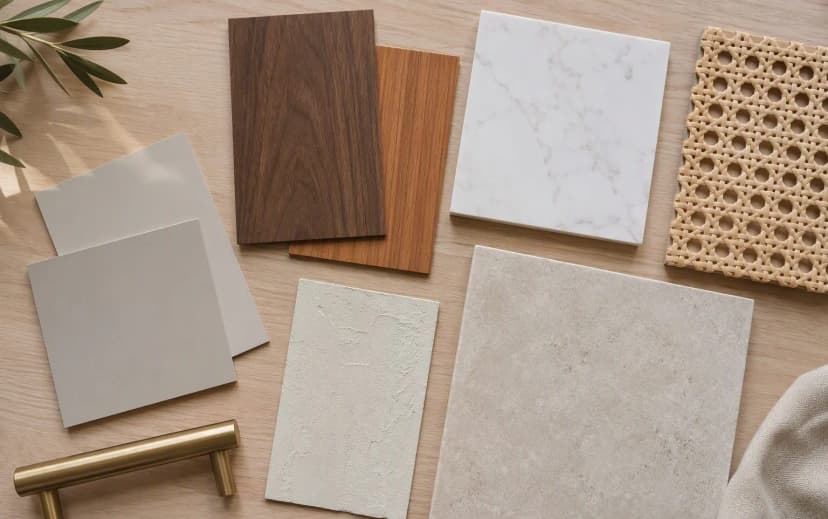
Woven cane webbing (around ₹240/sq ft as a panel material) has moved from boutique cafés into mainstream Bangalore homes — on wardrobe shutters, crockery unit doors, room dividers, bar cabinets and headboards. It pairs naturally with the warm wood trend, adds a handcrafted South-Indian warmth (cane furniture has deep roots in Kerala and Karnataka craft traditions), and has a practical bonus: cane-panelled shutters ventilate, which helps prevent the musty smell that builds up in closed wardrobes during humid monsoon months.
The supporting cast of this trend includes fluted glass inserts, linen-textured laminates, jute and cotton furnishings, and limewash-finish paints on a single accent wall. The common thread is tactility — surfaces with texture you can feel, as a counterweight to the glass screens that dominate a tech-city workday.
Buyer caution: Natural cane needs a sealed, dry environment — it can sag or mildew in persistently damp rooms. For bathrooms, utility areas or ground-floor flats with damp history, ask for synthetic rattan or cane-look laminate alternatives that give the same woven appearance with full moisture resistance.
7. Climate-smart materials — the unglamorous trend that matters most
The least photogenic trend of is arguably the most important: Bangalore homeowners now routinely ask about core materials and emission ratings, not just surface colours. The city's weather pattern — moderate temperatures but sustained monsoon humidity, sudden heavy showers, and termite-friendly conditions — punishes wrong choices within two or three seasons.
BWP / BWR plywood
Boiling-water-proof grades (Century Sainik 710, Greenply Club Prime and equivalents) are now the default spec for kitchens, wardrobes and any storage — not just "wet areas". The cost premium over MR grade is roughly 15–25%; the lifespan difference is measured in decades.
Spec: IS 710 (BWP) or IS 303 BWR · borer & termite treated
HDHMR boards
High-density, high-moisture-resistant boards have largely replaced raw MDF in Bangalore kitchens and wardrobes. They hold screws better, swell far less, and take laminate and PU finishes cleanly — the pragmatic middle ground between plywood and MDF.
Best for: shutter panels, kitchen carcasses, CNC-cut designs
Low-emission (E0/E1) materials
With families spending more hours indoors, formaldehyde emission ratings have become a genuine buying criterion. E0/E1-rated plywood and boards, low-VOC paints, and quality adhesives are now standard asks in premium Bangalore projects.
Ask for: emission grade on the invoice, not just verbally
Moisture-resistant HPL
Quality 1 mm HPL laminates from established brands (Merino, Greenlam, Century, Royale Touche) handle humidity swings without the edge-lifting that plagues cheap laminates glued with economy adhesive. The laminate is only as good as the adhesive under it.
Pair with: branded Fevicol/equivalent adhesive, machine-pressed edges
None of this is glamorous, but it is what separates a Bangalore interior that looks fresh at year ten from one that's peeling at year three. Our guide on how interior materials impact your home's durability breaks down the science in detail.
8. What trending materials cost in Bangalore
Material-only prices from Bangalore market rates and national pricing reports this year. Add 18% GST, edge banding, adhesive and labour where applicable.
| Material | Price band | Trend it serves | Watch out for |
|---|---|---|---|
| MDF fluted panels | ₹60–140/sq ft | Fluted feature walls | Dry areas only — swells with moisture |
| PVC fluted panels | ₹80–180/sq ft | Fluted walls, budget makeovers | Lighter feel; check density before buying |
| WPC fluted panels | ₹90–300/sq ft | Premium fluted walls | Price varies widely with density and finish |
| Charcoal louvers | ~₹200/sq ft | Warm wood-look feature walls | Colour consistency between batches |
| Wood-grain HPL laminate | ₹900–1,850/sheet (8×4) | Warm wood comeback | Match grain batch across sheets |
| Natural veneer | ₹150–400/sq ft | Premium wood statements | Needs polishing; adds labour cost |
| Matte solid laminate (sage/terracotta) | ₹1,100–1,850/sheet | Two-tone kitchens | Cheap mattes show oil marks — buy branded |
| Quartz countertop | ₹280–450/sq ft installed | Stone-look kitchens | Use trivets; resin scorches with direct heat |
| Granite countertop | ₹160–350/sq ft | Value stone surfaces | Seal every 1–2 years |
| Cane webbing panels | ~₹240/sq ft | Natural texture accents | Keep dry; synthetic options for damp rooms |
| BWP plywood (18 mm) | ₹90–140/sq ft | Climate-smart cores | Verify IS 710 mark and brand hologram |
| UV marble sheet | from ₹9,999/sheet | Marble-look walls | Walls only — not a countertop material |
For a full 2BHK interior, expect materials alone (plywood, laminates, panels, counters, hardware) to run ₹4.5–8 lakh depending on how heavily you lean into premium finishes — with fluted walls, quartz counters and two-tone kitchens typically adding ₹60,000–1.2 lakh over a basic all-laminate spec.
9. How to follow trends without regret — 5 rules
- Invest trendy-lite, timeless-heavy. Put budget into timeless bases (wood grains, warm neutrals, quality matte laminates, good plywood) and express bolder trends in cheap, replaceable layers — paint, cushions, decor, a single fluted wall.
- One statement per room. A fluted TV wall plus a bold colour plus patterned flooring in the same room dates fast. Pick one hero surface; let the rest support it.
- Climate before colour. In Bangalore, no trend justifies MR plywood in a kitchen or MDF panels near a bathroom. Fix the core spec first, then choose the pretty layer.
- Check the trend's running cost. Veneer needs polishing, white kitchens need constant wiping, deep grooves need dusting. Choose the trend whose maintenance you'll actually do.
- Buy physical, not from a screen. Colours and textures shift dramatically between a phone screen and your home's light. Always check full sheets and panel samples in daylight before committing — our guide to reliable material suppliers in Bangalore explains what a trustworthy showroom visit should look like.
The trend-ready material checklist
- Shortlist 2–3 trends maximum that suit your home's light, size and your cleaning habits
- Fix core materials first: BWP/BWR plywood or HDHMR for all kitchens, wardrobes and storage
- See full-size sheets and panels in daylight, not 4×4 inch chips or screen images
- Match batches: buy all sheets of a wood grain or colour in one lot to avoid shade variation
- Verify brand and grade marks (IS 710, brand holograms) on plywood and panels
- Budget the full system: panel + adhesive + edge banding + labour, not just the per-sq-ft material rate
- Plan fluted walls away from dust-heavy windows or choose wider, wipeable grooves
- Choose matte over gloss for kitchens — fingerprints and oil film are invisible on matte
- Reserve natural cane for dry rooms; use synthetic weave near moisture
- Keep invoices with brand, grade and batch — essential for warranty claims and future matching
Frequently asked questions
What are the latest interior design material trends in Bangalore homes?
Six trends dominate: fluted panels and louvers on feature walls, warm wood-grain laminates and veneers replacing all-white minimalism, earthy two-tone kitchens (sage, terracotta, warm oak), quartz countertops and stone-look surfaces, cane and rattan accents, and climate-smart core materials like BWP plywood and HDHMR chosen for Bangalore's humid monsoon months.
How much do fluted wall panels cost in Bangalore?
Material-only prices range from ₹60–140/sq ft for MDF fluted panels, ₹80–180/sq ft for PVC, ₹90–300/sq ft for WPC, and around ₹200/sq ft for charcoal louvers. A typical 100 sq ft TV or headboard wall costs roughly ₹8,000–30,000 in material, plus installation.
Is quartz or granite better for Bangalore kitchens?
Both are excellent. Quartz (₹280–450/sq ft installed) is non-porous and stain-proof with zero sealing — best for low-maintenance family kitchens. Granite (₹160–350/sq ft) is cheaper and handles direct heat from hot kadais and cookers, but needs sealing every 1–2 years. Many Bangalore homes use quartz in the main kitchen and granite in the utility area.
Which materials survive Bangalore's monsoon humidity best?
For carcasses, BWP/BWR-grade plywood (Century Sainik 710, Greenply Club Prime class) and HDHMR boards resist swelling far better than MR plywood or particle board. For surfaces, branded moisture-resistant HPL laminates applied with quality adhesive hold up reliably. Avoid raw MDF and particle board anywhere near kitchens, bathrooms and utility areas.
Are fluted panels a passing fad or a lasting trend?
Fluting is a revival of a classical architectural detail — Greek columns, Art Deco furniture — so it ages far better than printed patterns or novelty finishes. It has grown steadily for over three years and remains India's most-specified feature-wall finish. Wood-tone or neutral fluted panels stay timeless; loud coloured ones date faster.
What colours are trending for Bangalore home interiors?
Warm earthy palettes have replaced cool greys: terracotta, sage green, warm beige, clay, oak and walnut wood tones, with cream and off-white standing in for stark white. These colours suit Bangalore's soft natural light and pair naturally with brass hardware and textures like cane and linen.
How do I follow material trends without my home looking dated in five years?
Spend on timeless bases — wood grains, warm neutrals, quality matte laminates — and express bold trends in cheap, replaceable layers like paint and decor. Limit statement materials to one feature wall per room, and never compromise climate-appropriate core materials for a look. Trends should sit on top of a durable foundation, not replace it.
Where can I buy trending interior materials in Bangalore?
Specialist interior material suppliers like Evospace stock trending laminates, fluted panels, veneers, plywood and hardware under one roof, so you can compare full-size sheets in daylight and match materials across categories in a single visit. Always buy from authorised dealers who bill properly and stock genuine branded material.
See this year's trending materials in person
Fluted panels, wood-grain laminates, quartz-look surfaces, cane sheets and climate-grade plywood — compare them all side by side, in daylight, with honest pricing.
Get a Free Material Consultation




