
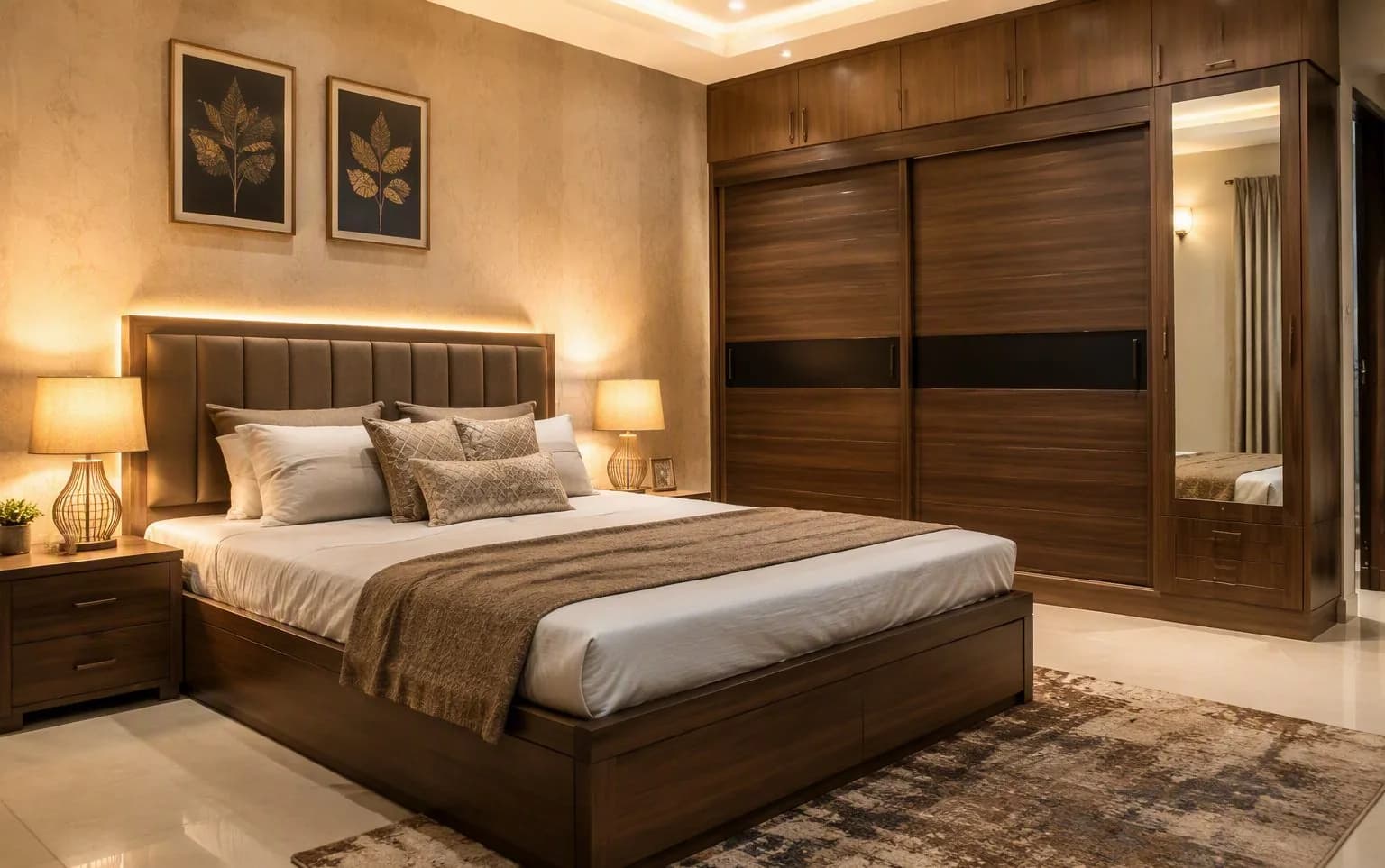
Where Is Plywood Used in Home Interiors? A Room-by-Room Guide
Open any finished Indian home and you are looking at plywood — behind the laminate, inside the wardrobe, under the mattress. A typical 2BHK hides 30–45 sheets of it. But each room asks something different of the material, and the sheet that is perfect for a bookshelf will fail in a kitchen. Here is where plywood goes, room by room — and what each location demands.
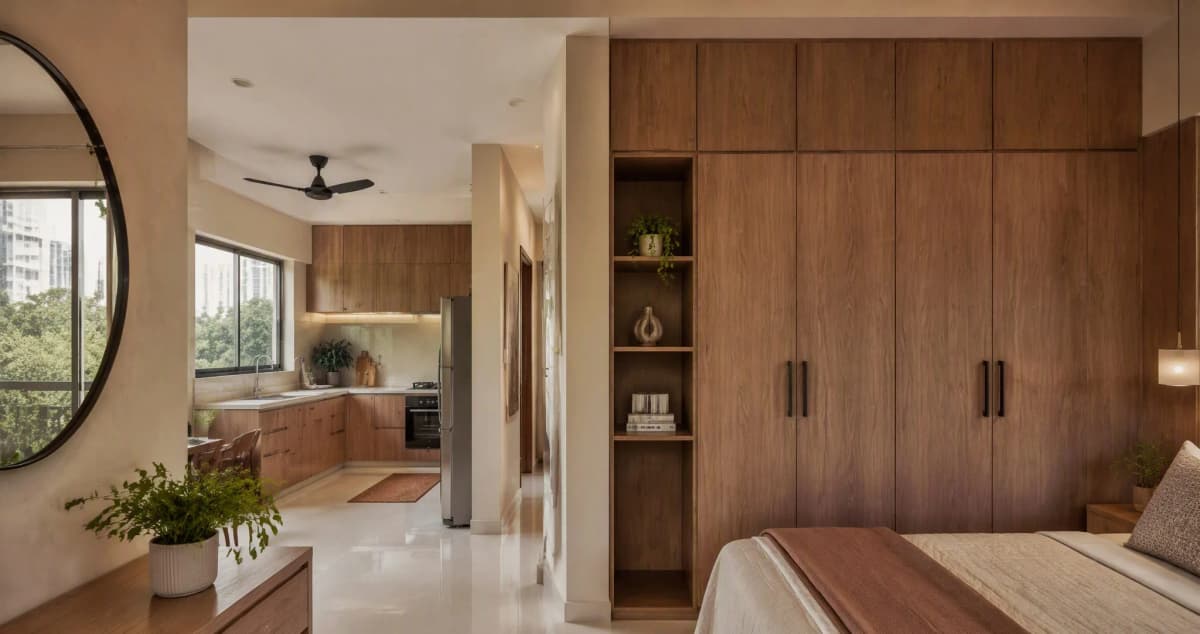
Where plywood is used, and what each room needs
- Kitchen — cabinets, shutters, loft: BWR 18mm, BWP under the sink
- Bedroom — wardrobe carcass 18mm, shelves 18mm, backs 6mm; bed frame and platform 18–19mm
- Living room — TV units and display shelves 18mm, wall paneling 6–9mm, partitions 12mm
- Bathroom & utility — vanities and storage: BWP (IS 710) only, every edge sealed
- Study / home office — desk tops 18–25mm, bookshelves 18mm with spans under 900mm
- Balcony & lofts — lofts 18–25mm; balconies only in covered, dry conditions
- Everywhere — always behind a finish (laminate/veneer/paint), always with sealed edges
1. The kitchen: plywood's hardest job
No room punishes the wrong plywood like a kitchen. Cooking steam, splashes, the slow leak under the sink, the weight of a full utensil drawer — all of it concentrates here. It is also where plywood earns its keep: a well-specified plywood kitchen outlasts particleboard and MDF alternatives by a decade or more.
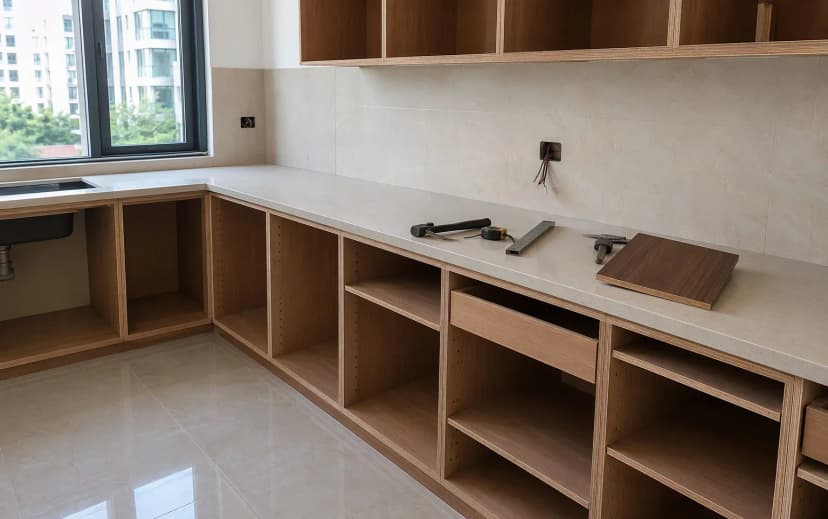
Where plywood goes in a kitchen, and what each part needs:
- Base cabinet carcass — 18mm BWR. Carries the countertop, the stored weight and the daily slam of drawers. Never MR here: cooking steam alone degrades urea-based glue lines over 3–5 years.
- Under-sink unit — 18mm BWP (IS 710). The one cabinet that will, eventually, see standing water. Marine grade is not optional here.
- Wall cabinets — 18mm BWR. They hang, so screw-holding matters as much as moisture resistance. Plywood's cross-grain construction is exactly why wall units are not made of MDF.
- Shutters — 18mm BWR. Hinge screws need full bite; laminated or acrylic-faced.
- Shelves — 18mm BWR. Crockery stacks are heavy; 12mm shelves bow under them within a year.
- Loft cabinets — 18mm BWR. Above the wall units, storing the festival vessels you touch twice a year.
- Tall unit / pantry — 18mm BWR with 12mm internal dividers.
The countertop itself is not plywood — granite, quartz or solid surface sits on top of the plywood carcass. And one non-negotiable: every cut edge gets sealed with laminate edge banding or sealant. Even IS 710 marine plywood absorbs moisture through an open edge; the boil test applies to the glue line, not the raw edge.
The kitchen deep-dive: Grades, thickness, edge sealing and shutter options for kitchens get their own guide: How to Choose the Best Plywood for Kitchen Cabinets in Bangalore.
2. The bedroom: wardrobes, beds and dressing units
The bedroom is plywood's volume job — a single wardrobe can consume 4–6 sheets, and most Bangalore bedrooms add a bed, side tables and a dresser on top. The good news: bedrooms are dry, so this is where economical MR grade legitimately belongs. The caution: wardrobes are load-bearing, and beds are the most dynamically loaded furniture in the house.
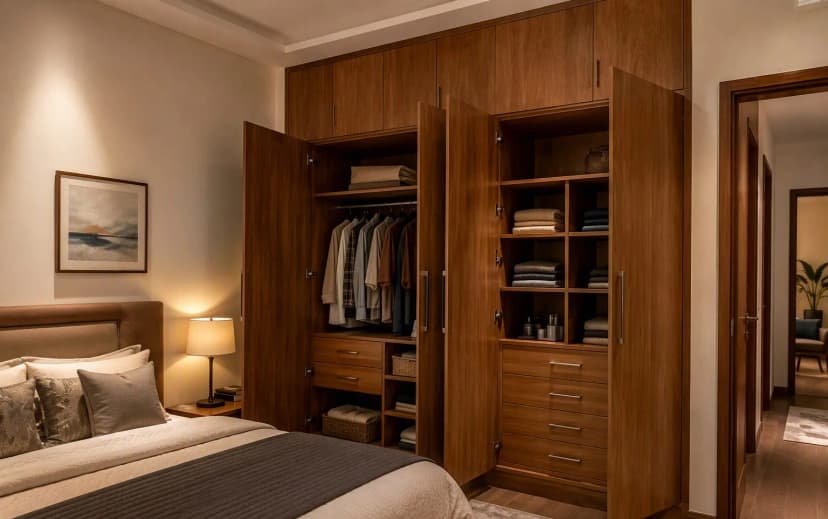
The wardrobe
- Carcass (sides, top, bottom) — 18mm MR. The structural spine that holds hinges, shelves and racking forces.
- Shelves — 18mm MR. Folded clothes and luggage are a sustained load; sag creeps in over months, not days.
- Shutters — 16–18mm MR. Flat, hinge-friendly. For shutters taller than 7 feet, quality blockboard resists warping at lower weight.
- Internal partitions — 12mm MR. Dividers carry no load — save the money here.
- Drawer sides — 12mm; drawer bottom — 6mm. The channel carries the load.
- Back panel — 6mm MR. A dust seal, nothing more. Anything thicker is dead weight and wasted money.
- Loft above the wardrobe — 18–25mm, depending on span and what you store up there.
The bed
Beds are the exception to "bedrooms are easy." Sitting on the edge, children jumping, the hydraulic lift cycling every day — a bed frame takes dynamic loads no wardrobe ever sees.
- Frame and side rails — 18–19mm BWR. BWR, not MR: the mattress traps humidity against the frame.
- Mattress platform — 18mm; 25mm if the support spacing is wide. Include ventilation holes or a slatted section so the mattress can breathe.
- Hydraulic storage base — 19mm BWR minimum. This panel carries the lift mechanism and the stored load; it is the last place to save ₹15 per sq ft.
- Headboard — 12–18mm, non-structural, usually finished in veneer or upholstered.
Dressing units, side tables and study corners in the bedroom follow the dry-room rule: 18mm where it carries load, 12mm where it divides, MR grade throughout — unless the room shares a wall with a bathroom, in which case step the wardrobe up to BWR on that side.
3. The living room: TV units, paneling, partitions and shelves
The living room is where plywood turns decorative. Loads are lighter, moisture is a non-issue, and the material's job shifts from strength to stability — staying flat, holding screws for wall-mounting, and providing a clean substrate for the finish everyone actually sees.
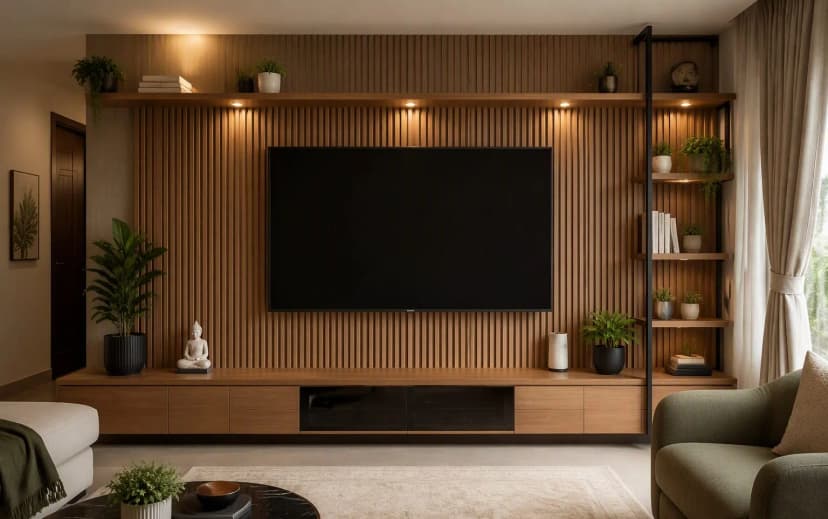
- TV unit carcass and shelves — 18mm MR. The set-top box, consoles and books are light, but the unit is wall-hung or long-spanning, so screw-holding and rigidity matter.
- TV backdrop and wall paneling — 6–9mm MR as the substrate, finished in veneer, laminate or fluted panels. The plywood carries no load; it exists to be flat and hold a finish.
- Floating shelves — 18mm, spans under 600mm between concealed brackets. The cantilever makes floating shelves the most sag-prone application in the house.
- Display and bookshelf units — 18mm shelves. See the span rule below — books are heavier than they look.
- Room partitions — 12mm on a wooden or metal frame, finished both sides.
- Shoe rack near the entrance — 12–15mm, light loads, short spans.
- Pooja unit — 18mm base, 12mm shelves, with a stone or quartz top if a diya or lamp will sit on it directly.
The span rule: Shelf sag is a span problem more than a thickness problem. Light loads (clothes, decor): 12mm is fine up to 600mm; 18mm to 900mm. Heavy loads (books, appliances): 18mm up to 600mm; add a front stiffener or centre divider beyond that. Over 1,200mm, no thickness saves you — add a vertical support. A ₹200 front lipping stiffens a shelf more than jumping from 18mm to 25mm.
4. Bathroom & utility: BWP or nothing
Bathrooms and utility areas are binary territory for plywood. The humidity is constant, water contact is routine, and there is no middle grade that survives it. Everything here is BWP marine grade (IS 710) — the only Indian specification tested against prolonged boiling-water exposure — with every edge and cutout sealed.
- Vanity cabinet — 18mm BWP, laminated inside and out, edges sealed, raised on legs or a skirting so it never sits in water.
- Mirror cabinet and wall storage — 12–18mm BWP.
- Utility / laundry storage — 18mm BWP for any cabinet near the washing machine or sink; BWR is acceptable only for high wall units well away from splash zones.
Two honest warnings. First, even genuine IS 710 plywood is water-resistant, not immortal: a vanity that sits in ponded water for months will fail regardless of grade. The grade buys you resilience against splashes, steam and the occasional leak — not against a plumbing problem you never fixed. Second, the wettest zone of all, inside the shower, is not plywood territory at all — that is tile, stone and glass.
And whatever the dealer says, MR and BWR do not belong in a bathroom. Saving ₹40 per sq ft on a vanity carcass buys you a swollen, delaminated cabinet in two to four years and a replacement that costs ten times the saving.
5. Study & home office: desks and bookshelves
The home office is where shelf engineering actually matters. Books are the heaviest common household load — a single metre of hardcovers weighs 15–20 kg — and a desk is a long, unsupported horizontal span by design.
- Desk top — 18mm for spans up to 900mm; 25mm beyond that, or 18mm with a modesty panel or leg breaking the span. A sagging desk is a slow-motion failure you notice only when the drawers stop aligning.
- Desk side panels and legs — 18mm.
- Bookshelf shelves — 18mm, spans capped at 600–800mm for books. Wider shelves need a centre divider or a solid front lipping; beyond 1,200mm, divide the unit.
- Bookshelf carcass and back — 18mm sides, 6mm back (the back also stops the unit racking).
- Overhead storage — 18mm carcass, 18mm shelves, wall-fixed into solid masonry, not plasterboard.
Grade is easy here: MR throughout, since studies are dry rooms. Spend the savings on thickness and support rather than moisture resistance you will never need.
6. Balcony, lofts and hidden storage
Lofts
The loft — the storage band above wardrobes and kitchen wall units — is pure plywood territory: 18mm for the shelf, up to 25mm if the span exceeds 900mm or you store luggage and steel trunks up there. Lofts fail silently: the sag develops over years, then the shutters stop closing. Specify the thickness once, properly.
Balconies and semi-outdoor spaces
Only if the balcony is covered and dry — no direct rain, no western sun baking the surface. In that case BWP (IS 710) plywood with a weather-resistant laminate or exterior-grade PU finish handles covered-balcony cabinets and seating boxes. The moment a surface sees actual rain or standing water, plywood is the wrong material regardless of grade — WPC boards, aluminium or solid plastic lumber are the honest answers there. We cover the full material-versus-condition logic in how interior materials impact the durability of your home.
7. Where plywood is NOT the answer
A trustworthy guide says where the material stops. Plywood is wrong for:
- Fully exposed outdoor furniture. UV and rain cycles destroy even marine plywood within a few years. Use WPC, aluminium or treated solid wood.
- Flooring. Plywood flexes and dents under point loads and foot traffic; it is a subfloor material, never a finished floor.
- Countertops. Plywood supports the countertop; it is never the surface. Granite, quartz or solid surface on top, always.
- Continuous water contact — planter boxes, aquarium stands in splash range, shower enclosures. No grade survives ponding.
- Exterior doors and window frames. These need flush-door construction or engineered timber designed for weather exposure.
The pattern: plywood is a covered, finished, indoor material. It needs a skin — laminate, veneer, paint — and sealed edges, and inside those conditions it is the most versatile sheet material in Indian interiors. Outside them, choose something else.
8. The whole-house plywood map
Everything above on one page — the specification each application actually needs:
| Room | Application | Grade | Thickness | Watch out for |
|---|---|---|---|---|
| Kitchen | Base & wall cabinet carcass | BWR | 18mm | Seal every cut edge |
| Under-sink unit | BWP (IS 710) | 18mm | The one true wet zone | |
| Shutters & shelves | BWR | 18mm | Hinge bite; crockery loads | |
| Loft above cabinets | BWR | 18mm | Span over 900mm → 25mm | |
| Bedroom | Wardrobe carcass, shelves, shutters | MR (BWR if against a bathroom wall) | 16–18mm | Never mix grades in one unit |
| Wardrobe partitions, drawer sides | MR | 12mm | Save money here | |
| Wardrobe back, drawer bottoms | MR | 6mm | Dust seal only | |
| Bed frame, platform, storage base | BWR | 18–19mm (25mm wide spans) | Dynamic loads; ventilation holes | |
| Living room | TV unit carcass & shelves | MR | 18mm | Wall-mount screw-holding |
| Wall paneling / TV backdrop | MR | 6–9mm | Substrate for the finish | |
| Floating shelves | MR | 18mm | Spans under 600mm | |
| Partitions, shoe rack, pooja unit | MR | 12–18mm | Stone top if diya sits on it | |
| Bathroom & utility | Vanity, mirror cabinet | BWP (IS 710) | 18mm | Edges sealed; raised off floor |
| Laundry / utility storage | BWP (BWR for high, dry units) | 18mm | No MR, ever | |
| Study / office | Desk top & sides | MR | 18mm (25mm long spans) | Break spans over 900mm |
| Bookshelves | MR | 18mm | Books: cap spans at 600–800mm | |
| Balcony | Covered balcony storage only | BWP (IS 710) | 18mm | Any rain exposure → use WPC/metal |
Add it up for a typical 2BHK — a modular kitchen, three wardrobes, two beds, a TV unit, a study desk, lofts — and you land at 30–45 sheets (8×4 ft), or a plywood budget of roughly ₹75,000–1,40,000 at authorised-dealer prices depending on how much of the house runs BWR/BWP versus MR. For what those sheets should cost grade by grade, see the top factors to consider before buying plywood in Bangalore.
The room-by-room plywood checklist
- Kitchen carcass 18mm BWR — under-sink unit upgraded to BWP (IS 710)
- Every kitchen cut edge sealed — the boil test covers glue lines, not open edges
- Wardrobe: 18mm carcass/shelves, 12mm partitions, 6mm back — MR in dry rooms, BWR against bathroom walls
- Bed frame and platform 18–19mm BWR — 25mm if support spacing is wide
- Hydraulic bed base never below 19mm — it carries the lift mechanism
- Bookshelves 18mm, spans under 800mm — stiffener or divider beyond that
- Desk 18mm to 900mm, 25mm beyond — or add a modesty panel
- Bathroom: BWP only, edges sealed, vanity raised off the floor
- Wall paneling 6–9mm MR — the substrate carries no load
- Balcony: plywood only if covered and dry — rain exposure means WPC or metal
- Nothing fully outdoors, nothing as flooring, nothing as a countertop
Frequently asked questions
Which plywood is used in a kitchen?
BWR grade (IS 303) 18mm for all base and wall cabinet carcasses and shutters, with BWP marine grade (IS 710) for the under-sink unit. Kitchens combine steam, splashes and heavy loads, so MR grade fails there within 3–5 years. All cut edges must be sealed, because even waterproof plywood absorbs moisture through open edges.
Is plywood good for wardrobes and bedroom furniture?
Yes — plywood is the standard material for Indian wardrobes: 18mm for the carcass, shelves and shutters, 12mm for partitions and drawer sides, 6mm for the back panel. MR grade works in dry bedrooms; choose BWR if the wardrobe stands against a bathroom wall or in a ground-floor room prone to dampness.
Can plywood be used in a bathroom?
Only BWP marine grade (IS 710), and only with every edge and cutout sealed. Vanities and mirror cabinets in BWP plywood last well; MR or BWR swells and delaminates in bathroom humidity. Even BWP fails if water ponds on it continuously — seal the edges and fix the leak.
What thickness of plywood is used for beds?
18–19mm for the frame, side rails and mattress platform — beds take dynamic loads (sitting on edges, children jumping) that static furniture never sees. Go to 25mm if the platform support spacing is wide. Hydraulic storage beds need 19mm BWR minimum for the base that carries the lift mechanism.
How many sheets of plywood does a 2BHK need?
A typical 2BHK with a modular kitchen, three wardrobes, two beds, a TV unit and a study desk uses 30–45 sheets (8×4 ft): roughly 8–12 for the kitchen, 4–6 per wardrobe, 3–4 per bed, and 2–3 each for the TV unit and study. At authorised-dealer prices that is a plywood budget of ₹75,000–1,40,000 depending on grade mix.
Is plywood better than MDF for home interiors?
For anything structural or load-bearing — carcasses, shelves, beds, kitchens — plywood wins on strength, screw-holding and moisture resistance. MDF earns its place only for painted decorative shutters, carved panels and very dry, low-load applications. A kitchen or wardrobe built on MDF is a short-lived kitchen or wardrobe.
Can plywood be used for wall paneling and partitions?
Yes — 6–9mm plywood is the standard substrate for decorative wall paneling, headboards and TV backdrops, finished with veneer, laminate or fluted panels. For room partitions, 12mm plywood on a frame gives a rigid, screw-friendly surface. Use MR grade in dry rooms; the paneling itself carries no load.
Where should plywood NOT be used?
Avoid plywood for fully exposed outdoor furniture (sun and rain destroy even marine grade within years — use WPC or metal), as a flooring surface (it flexes and dents under foot traffic), and in direct, continuous water contact like planter boxes or shower enclosures. Plywood is a covered, finished, indoor material — it needs a laminate, veneer or paint skin and sealed edges.
One home, forty sheets, zero guesswork
Bring your floor plan to the Evospace studio — we will map every room to the right grade and thickness, and hand you a single itemised quote for the whole house.
Get a Free Material Consultation




