
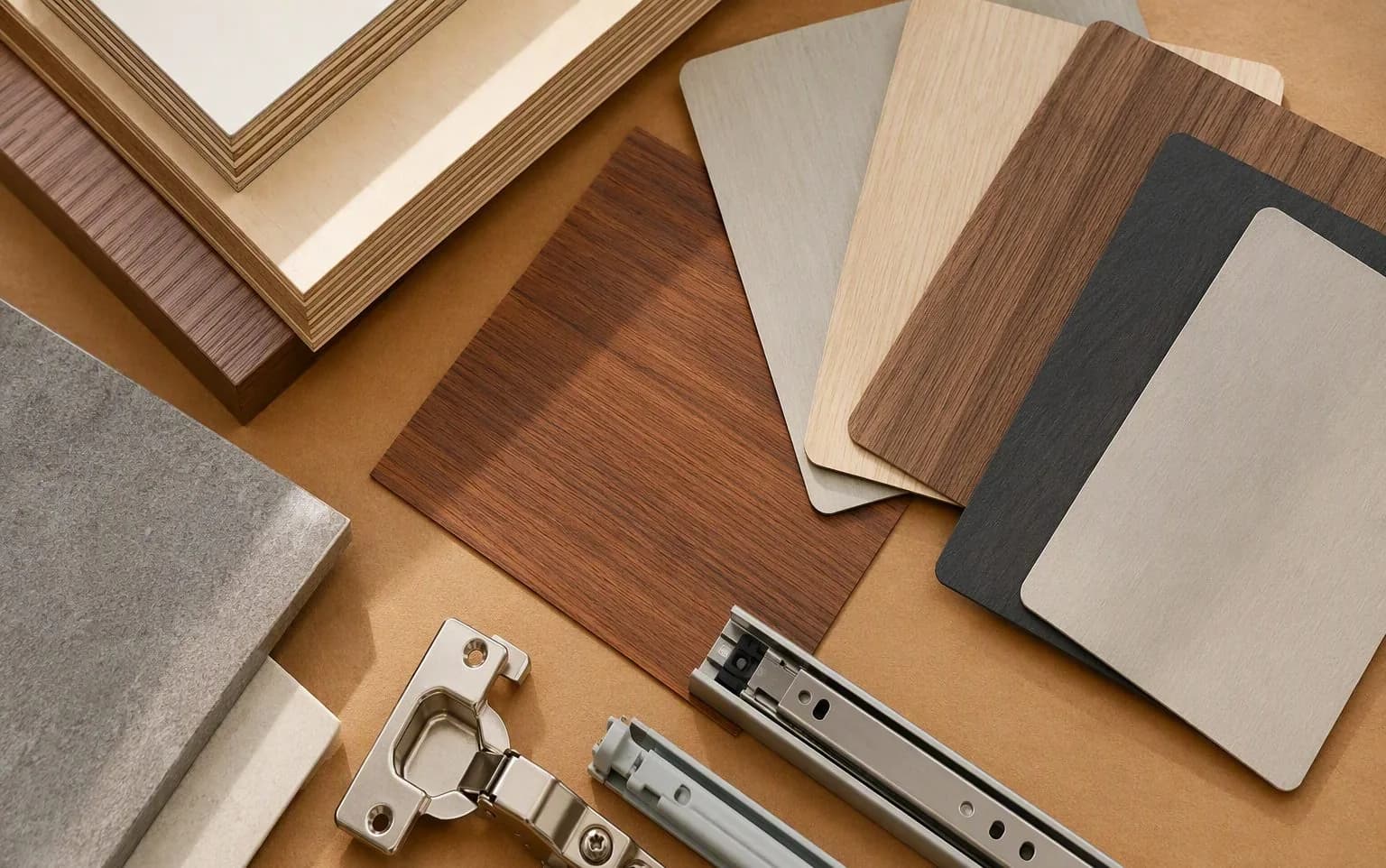
How to Choose the Right Interior Design Materials for Your Home in Bangalore
Choosing interior materials in Bangalore is not about picking the prettiest sample in the showroom. It's about matching plywood grades to your kitchen's steam, laminate finishes to your toddler's fingerprints, and flooring to your monsoon mop. This 5-step framework turns a confusing catalog into a confident decision.
The 5-step framework for choosing interior materials
- Audit your lifestyle — kids, pets, cooking hours, cleaning tolerance
- Match materials to Bangalore's climate — BWR/BWP plywood, moisture-resistant boards, low-VOC finishes
- Set a realistic budget — 30–35% plywood, 10–15% laminates, 10–15% hardware, 8–12% flooring
- Choose room by room — kitchen ≠ bedroom ≠ living room; use the spec table below
- Verify before you pay — written specs, three quotes, physical samples in daylight, GST invoice
1. Audit your lifestyle before you open a catalog
Every interior material has a hidden maintenance cost. The question is not "does this look good?" but "will I still like this after three years of my actual life?" Answer these five questions honestly before you price anything:
- How many hours do you cook daily? Heavy Indian cooking (tadka, deep frying, pressure cooker steam) rules out high-gloss acrylic and demands matte, heat-resistant laminates and a BWP carcass.
- Do you have young children or pets? Textured matte laminates hide crayon and claw marks; glossy surfaces display them. Anti-skid flooring matters more than Italian marble.
- How much time do you spend cleaning? If the answer is "as little as possible," avoid white kitchens, deep grooves, and any surface that needs sealing or polishing.
- How long do you plan to stay? A rental or 5-year horizon justifies budget laminates and vinyl; a forever home justifies BWP plywood, quartz and solid hardware.
- Which direction does your flat face? North-facing rooms need lighter materials to avoid gloom; west-facing rooms need UV-stable finishes that won't fade.
Write your answers down. They become your filter for every material decision that follows.
2. Match materials to Bangalore's climate
Bangalore's climate is deceptive. The city feels moderate, but June–September humidity averages 75–85%, sudden heavy showers are routine, and construction dust is constant. Materials that survive Delhi's dry heat or Mumbai's salt air can fail here in different ways.
Plywood: BWR vs BWP vs MR
MR (moisture-resistant) plywood is for dry bedrooms only. BWR (boiling-water-resistant) is the minimum for kitchens and utility areas. BWP (boiling-water-proof, IS 710) is non-negotiable for sink units and bathroom vanities. In Bangalore's humidity, MR in a kitchen swells and delaminates within 2–4 monsoons.
Budget: MR ₹1,200–1,800 · BWR ₹1,800–3,800 · BWP ₹3,200–5,500 per 18mm sheet
Boards: HDHMR over raw MDF
High-density, high-moisture-resistant boards hold screws better, swell less, and take laminate and PU finishes cleanly. Raw MDF is cheaper but fails fast in any room with ambient humidity — which in Bangalore means most rooms for four months a year.
Best for: shutter panels, CNC-cut designs, kitchen carcasses
Laminates: HPL over LPL
High-pressure laminates (HPL) are pressed at 1,000+ psi and survive 10,000+ abrasion cycles. Low-pressure laminates (LPL) are decorative paper on particle board — fine for a rental wardrobe, wrong for a kitchen. HPL costs more upfront but lasts 12–18 years vs 3–7.
Look for: IS 2046 stamp, 1mm thickness on touch surfaces
Flooring: tiles over wood in wet zones
Vitrified tiles are the Bangalore default for living, dining and kitchen: water-resistant, cool in summer, easy to mop. Wooden laminate flooring works in bedrooms for warmth but swells if water pools. Anti-skid ceramic is mandatory for bathrooms and balconies.
Budget: vitrified ₹80–300/sq ft installed · laminate ₹80–300/sq ft
The Bangalore rule: If a material's care instructions include "keep dry," it does not belong in a Bangalore kitchen, utility area, or bathroom. Choose the moisture-rated version even if it costs 20% more — the replacement cost is 300% more.
3. Set a realistic budget and allocate it
A 600–800 sq ft 2BHK interior in Bangalore costs ₹8–15 lakh. The biggest mistake is spreading the budget evenly. Materials that fail are expensive to replace; materials that last are cheap to own. Allocate by risk, not by visibility.
| Material category | Share of budget | Why this share |
|---|---|---|
| Plywood & boards | 30–35% | The structural core; failure means rebuilding entire units |
| Laminates & surface finishes | 10–15% | Determines daily look and feel; mid-range lasts longest |
| Hardware | 10–15% | Hinges and channels wear out; cheap ones fail in 3–5 years |
| Flooring | 8–12% | High traffic; replacement is disruptive and expensive |
| Painting & wall finishes | 5–8% | Low risk, easy to refresh; don't overspend here |
| Kitchen counter | 5–8% | Quartz or granite; the single highest-wear surface in the home |
The priority order: kitchen and wardrobes first (highest wear, highest replacement cost), then flooring, then living room, then bedrooms. A ₹15 lakh budget spent evenly fails in the kitchen in year 3; spent by priority, it lasts 15 years.
4. Choose room by room — the spec table
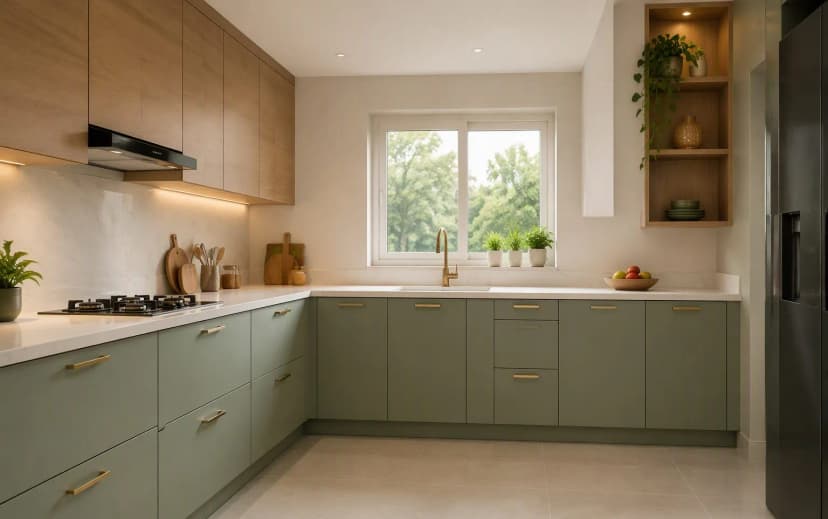
Every room has a different wear profile. The kitchen faces steam, oil and heat. The bedroom faces dust, sunlight and luggage scuffs. The living room faces guests, children and furniture drag. One material cannot win everywhere.
| Room / zone | Carcass / core | Surface finish | Counter / floor | Hardware note |
|---|---|---|---|---|
| Kitchen | BWP plywood or HDHMR | 1mm matte HPL laminate | Quartz ₹280–450/sq ft or granite ₹160–350 | Soft-close hinges, SS channels, branded |
| Wardrobes | BWR plywood 18mm | 1mm HPL laminate exterior, 0.8mm interior | — | Soft-close hinges, drawer channels rated 40kg+ |
| Living room | BWR plywood or HDHMR | Wood-grain laminate or veneer | Vitrified tiles ₹80–300/sq ft | Standard hinges, decorative handles |
| Bedroom | BWR plywood | Matte or textured laminate | Laminate flooring ₹80–300/sq ft | Standard, focus on smooth operation |
| Bathroom / vanity | BWP plywood or PVC board | 1mm laminate or acrylic | Anti-skid ceramic ₹40–80/sq ft | SS 304 grade, rust-proof |
| Balcony / utility | BWP or exterior-grade board | UV-stable laminate or paint | Anti-skid ceramic or Kota stone | SS hardware, weather-rated |
For the kitchen shutter finish debate — laminate vs acrylic vs PU — see our laminate selection guide and the benefits of laminates breakdown.
5. Verify before you pay — the 5-point check
By this point you know what you need. Now make sure you get it. The market is full of lookalikes, grade swaps and verbal promises that evaporate at delivery.
- Get the spec in writing. Every material must have brand, product line, grade, thickness and quantity on the quote. "Premium laminate" is not a spec; "Greenlam 1mm HPL, code 5301, matte" is.
- Get three quotes for the identical spec. Prices for the same branded sheet vary 10–20% between authorised dealers, timber markets and local depots.
- Verify at the shop. Plywood: ISI mark + CML number on bis.gov.in + brand QR scan. Laminates: backing print + batch match. Hardware: stamped brand + original packaging.
- See full sheets in daylight. A 4×4 chip or a phone screen will lie about grain scale and colour temperature. View the 8×4 sheet upright, in natural light, against your room's orientation.
- Inspect delivery before signing. Count sheets, check batch printing on every sheet, walk the stack for edge damage, and photograph any problem before the driver leaves.
For the full verification routine, see our guide to common material-buying mistakes in Bangalore.
6. The 5 most expensive selection mistakes
1. Choosing by showroom lighting
Showrooms use warm 3000K spotlights that make every wood grain look rich and every white look crisp. Your home's north-facing 6500K daylight will show the same laminate as flat or green-tinged. Always take the sample home and view it at 8am, 1pm and 6pm.
2. Buying the trend, not the material
Fluted panels, high-gloss acrylic and bold colours photograph well but date fast and show wear. Invest in timeless bases (wood grains, warm neutrals) and express trends in paint and decor you can change cheaply.
3. Skimping on the invisible layers
The laminate is only as good as the adhesive under it and the edge banding around it. Economy glue and hand-pasted edges are the top two causes of laminate failure in Bangalore homes. Spend the extra 2–3% here.
4. Over-specing low-use areas
BWP plywood in a bedroom wardrobe is wasted money; BWR is sufficient. Quartz in a rental kitchen is wasted money; granite is sufficient. Match the grade to the actual wear, not to anxiety.
5. Ignoring the replacement cost
A ₹400/sheet saving on 20 sheets saves ₹8,000. Replacing a failed kitchen carcass costs ₹40,000–90,000 plus labour and disruption. The cheapest material is the one you never have to replace.
The material selection checklist
- Write your lifestyle profile — cooking hours, kids/pets, cleaning time, stay duration
- Map every room to its wear zone — wet, high-touch, low-touch, outdoor
- Set the budget by risk — 30–35% plywood, 10–15% laminates, 10–15% hardware
- Get three written quotes for the identical brand, grade and thickness
- Verify every sheet — ISI/CML on plywood, backing print on laminates, packaging on hardware
- View full sheets in daylight at the shop and against your home's light direction
- Match batches — buy all sheets of a colour or grain in one lot
- Get adhesive and edge-banding specs in writing — machine-pressed, branded glue
- Demand a GST invoice with itemised brand, grade, thickness and quantity
- Inspect delivery at the gate — count, print, edges, flatness, moisture — before signing
Frequently asked questions
How do I choose interior materials for my Bangalore home?
Follow a 5-step framework: (1) audit your lifestyle — kids, pets, cooking frequency, cleaning tolerance; (2) match materials to Bangalore's climate — BWR/BWP plywood for kitchens, moisture-resistant boards for utility areas; (3) set a realistic budget and allocate 30–35% to plywood, 10–15% to laminates, 10–15% to hardware; (4) choose room by room using the spec table; (5) verify every quote with written specs, three quotes, and physical samples in daylight.
Which materials last longest in Bangalore's climate?
BWP (marine) and BWR plywood last 15–20 years in Bangalore's humid monsoon climate, versus 3–5 years for MR plywood in kitchens. HDHMR boards outperform raw MDF. HPL laminates outlast veneer and acrylic in high-touch zones. Vitrified tiles outlast marble in daily-use floors. Quartz outlasts granite in kitchens if you prefer zero sealing.
What is the best plywood for Bangalore homes?
For kitchens, utility areas and bathrooms: BWP/marine grade (IS 710) such as Century Sainik 710 or Greenply Club Prime. For bedrooms and living rooms: BWR (IS 303) is sufficient. For all furniture: choose 18 mm BWP or BWR with a calibrated core, verified by QR code and CML number on bis.gov.in. Budget ₹1,800–3,800 per sheet for BWR, ₹3,200–5,500 for BWP.
How much should I budget for a 2BHK interior in Bangalore?
A 600–800 sq ft 2BHK interior in Bangalore typically costs ₹8–15 lakh. Material allocation: plywood 30–35%, laminates 10–15%, hardware 10–15%, flooring 8–12%, painting 5–8%, and the remainder for labour, design and contingency. Prioritise the kitchen and wardrobes — they carry the highest wear and the highest replacement cost if speced wrong.
Is laminate or acrylic better for kitchen shutters?
For most Bangalore kitchens, matte or textured HPL laminate is the better choice: it hides fingerprints and oil marks, costs ₹120–350/sq ft vs ₹350–700 for acrylic, and survives heavy Indian cooking with a damp cloth. Acrylic wins only if you want a mirror-gloss look and commit to daily microfiber wiping. PU paint is for custom colours; lacquered glass for ultra-premium.
Should I choose vitrified tiles or wooden flooring?
Vitrified tiles (₹80–300/sq ft installed) are the practical Bangalore default: durable, water-resistant, easy to clean, and cool underfoot in summer. Wooden laminate flooring (₹80–300/sq ft) works in bedrooms for warmth but must avoid wet areas and cannot be refinished. Choose tiles for living/dining/kitchen, laminate for bedrooms, and anti-skid ceramic for bathrooms.
How do I avoid being overcharged by interior material dealers?
Get three written quotes for the exact same brand, grade and thickness. Verify plywood ISI marks and CML numbers on bis.gov.in. Check laminate backing print and batch numbers. Demand a GST invoice naming every item. Inspect delivery before signing. And never let the carpenter buy on your behalf without you choosing the spec and paying the dealer directly.
What is the most common mistake when choosing interior materials?
Choosing by showroom appearance instead of lifestyle and climate. A glossy white kitchen photographs well but shows every fingerprint and oil stain in a home that cooks daily. MR plywood looks identical to BWP in the shop but swells within 2–4 monsoons. The fix: write your usage profile (kids, pets, cooking hours, cleaning time) before you enter a showroom, and match materials to it.
See materials matched to your home, not a catalog
Bring your floor plan and lifestyle profile. We'll build a physical material board for your exact rooms — plywood, laminates, flooring and hardware you can touch, compare and verify.
Get a Free Material Consultation




