
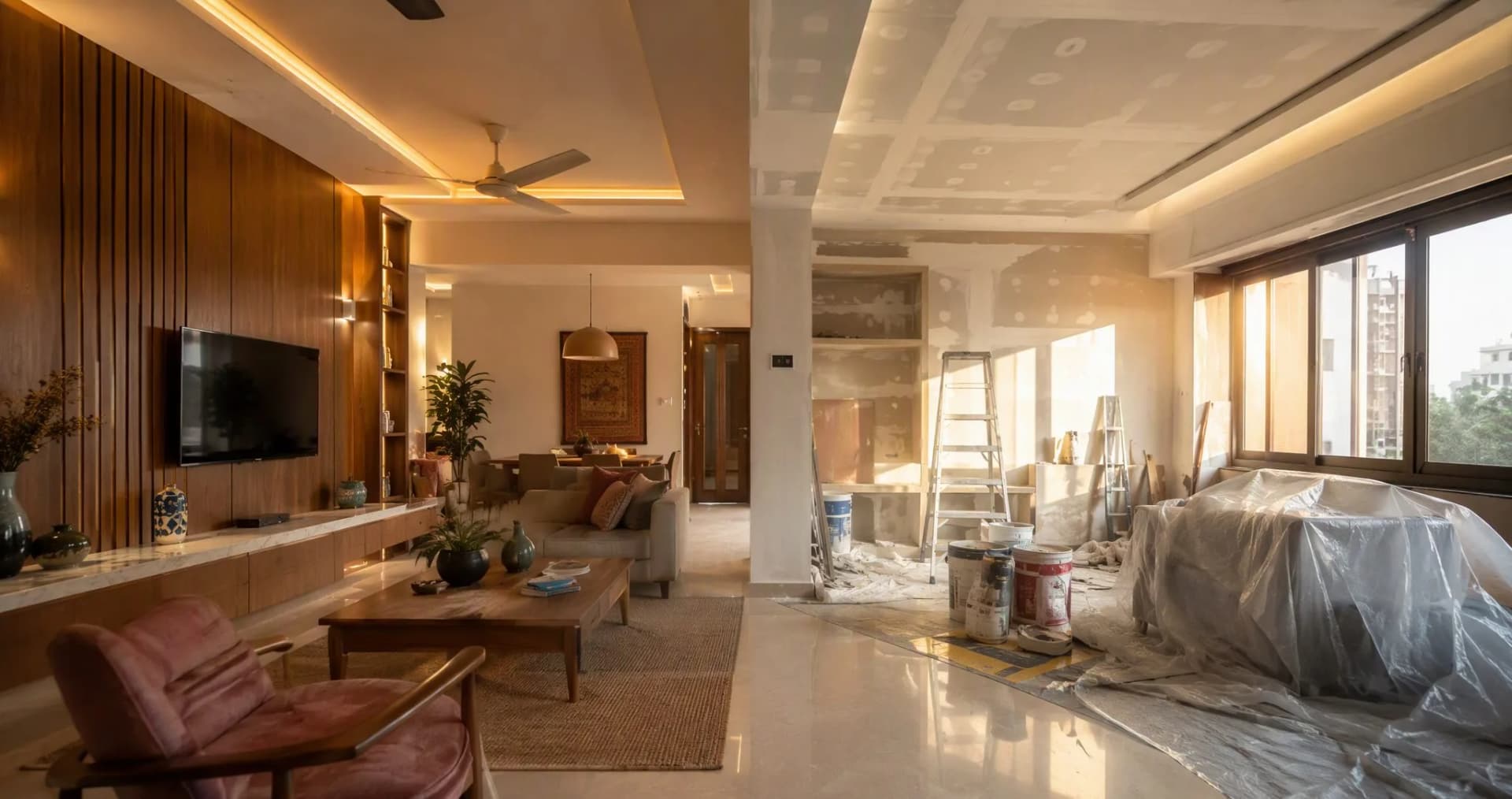
When Does a Home Remodeling Project Make Sense? A Decision Guide for Indian Homeowners
Repaint, renovate, or pack up and move — the wrong call costs lakhs. Here is the honest framework: the warning signs that say your home needs more than a patch-up, real costs per square foot, what actually pays you back at resale, and a checklist to know if you are truly ready.
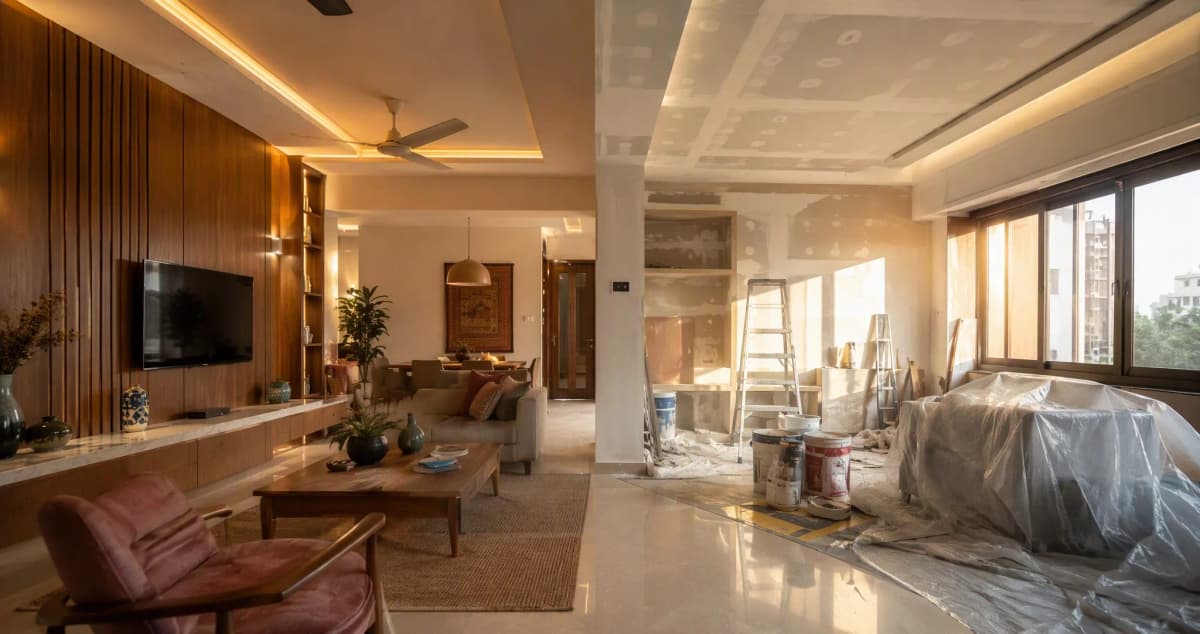
When does a home remodeling project make sense?
A remodel makes sense when the problems are systemic rather than isolated: wiring or plumbing over 15–20 years old, a kitchen or bathrooms that fail daily, a layout that no longer fits your family, or the third round of repairs in the same room. It makes financial sense when you plan to stay at least 4–5 more years — renovating typically costs 30–50% less than buying an equivalent home once stamp duty and moving costs are counted. Budget ₹800–1,400 per sq ft for a standard renovation, keep 15–20% contingency in older flats, and expect 8–16 weeks for a full-home project.
It does not make sense when the real problem is the location, the building structure, or the floor plan — or when a gut renovation would cost 60–80% of building new. In those cases, the honest answer is to move.
1. Seven signs your home is asking for a remodel — not another patch-up
Most Indian homeowners don't decide to remodel. They slide into it, one repair at a time, until the plumber knows their flat better than they do. The discipline is to step back and ask whether the problems are isolated or systemic. Isolated failures get repaired. Systemic failure gets remodelled. Here are the seven signs that you've crossed the line.
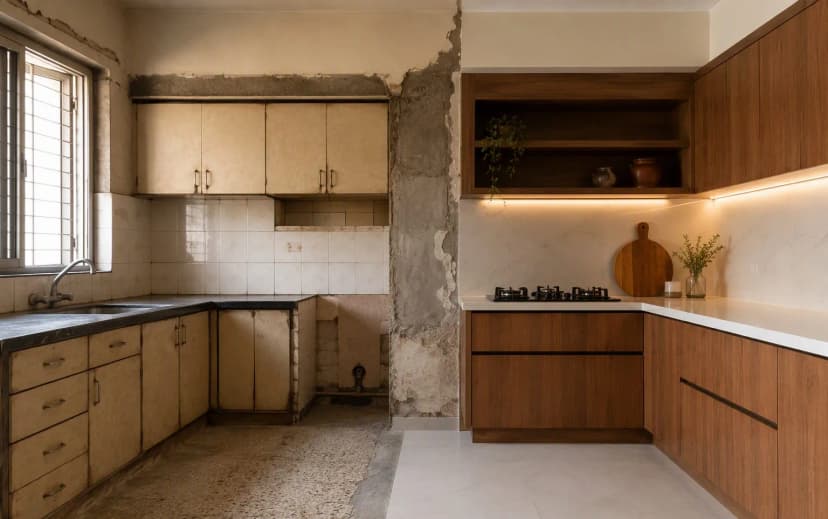
1. The same room has been repaired three times. A tap replaced, then a pipe, then the seepage repainted — that's not bad luck, it's a system at end of life. The third repair usually costs more than the renovation would have, spread over time.
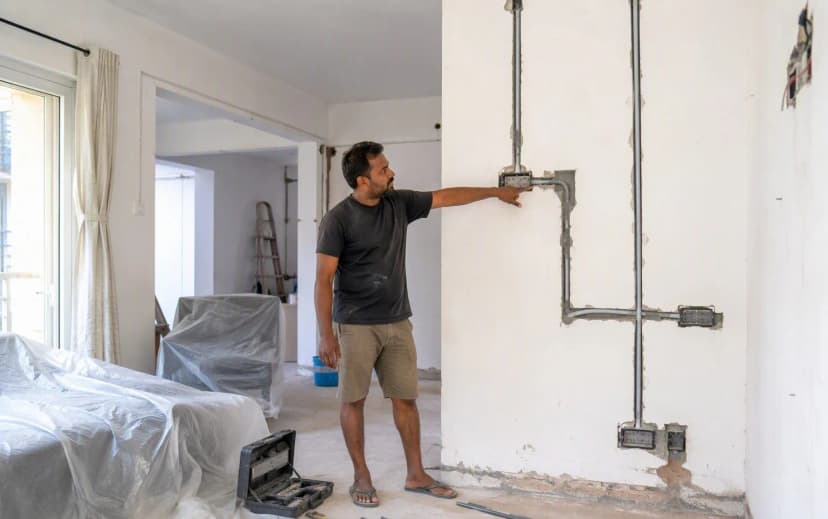
2. Your wiring or plumbing is 15–20+ years old. Old copper wiring with degraded insulation is a fire risk, and old GI plumbing corrodes from the inside. If your home predates modular MCBs and concealed CPVC piping, the electrics and plumbing are a safety issue, not an aesthetic one — and you can't fix them one socket at a time.
3. The kitchen fails you every single day. Swollen cabinet shutters near the sink, a counter too narrow for modern appliances, no chimney vent, two plug points for five appliances. When a room you use three times a day fights you three times a day, it has earned a rebuild.
4. The bathrooms have chronic seepage or dated plumbing. Recurring damp patches on the wall shared with a bathroom mean failed waterproofing. Retiling over it is cosmetic; the waterproofing membrane underneath has to be redone, which means the bathroom comes apart anyway.
5. The layout no longer matches your life. A child who needs a study, parents moving in, permanent work-from-home — when the floor plan fights the family, furniture rearranging stops working. This is the strongest argument for a remodel that includes layout changes.
6. You're embarrassed to have people over. This sounds vain, but it's a legitimate quality-of-life signal. A home should be a source of comfort, and when every room reminds you of deferred maintenance, the psychological cost compounds daily.
7. You're planning to sell or rent within 2–3 years. A targeted refresh before listing — paint, lights, working bathrooms, a presentable kitchen — routinely returns more than it costs. Section 05 covers which pre-sale upgrades pay back and which don't.
Count the signs. One or two — repair them and save your money. Three or more, especially any involving wiring, plumbing, or waterproofing — a remodel is almost certainly cheaper over the next five years than the repairs you'll otherwise make one at a time.
2. Repair, renovate, or move: making the three-way decision
Every "should we redo the house" conversation is actually three options, not two. The mistake most families make is comparing renovation cost against zero — doing nothing. The honest comparison includes what staying-put-but-patching costs over five years, and what moving actually costs after the invisible line items.
| Factor | Repair & patch | Renovate | Move to a new home |
|---|---|---|---|
| Typical cost (1,200 sq ft flat) | ₹50K–2 lakh (recurring) | ₹10–17 lakh (standard scope) | Price gap + 10–12% transaction costs |
| Timeline | Days, repeated forever | 6–16 weeks, once | 3–9 months search + registration + move |
| Disruption | Minimal each time, endless overall | High for 2–4 months, then done | High — school, commute, community all reset |
| Solves systemic problems? | No — defers them | Yes, if scoped right | Yes — but buys a new set of unknowns |
| Fixes a bad location? | No | No | Yes — the only option that does |
| Best when | Problems are isolated, home is <10 yrs old | Location works, layout/structure sound, staying 4–5+ yrs | Location, building, or floor plate is the real problem |
The transaction-cost math is what tips most decisions toward renovation. Selling and buying in India costs roughly 10–12% of the property value in stamp duty (5–7% depending on the state), registration, brokerage on both ends, and moving — before you've spent a rupee on the new home itself. On a ₹1.5 crore upgrade, that's ₹15–18 lakh evaporating in friction, which is the entire budget of a premium renovation. This is why, across Indian metros, renovating typically works out 30–50% cheaper than buying an equivalent home that already has everything you want.
But renovation loses — clearly — in three situations. First, the location is the problem: commute, school district, safety, or neighbourhood decline can't be renovated away. Second, the building is the problem: a society with structural distress, chronic water shortage, or litigation is not yours to fix. Third, the floor plate is the problem: if you need 40% more carpet area, no interior designer can conjure square footage.
3. The five levels of renovation — pick your tier before you pick your tiles
"Renovation" covers everything from a ₹2 lakh repaint to a ₹60 lakh gut job, and most budget blow-ups happen because the family starts at Tier 1 and drifts to Tier 3 mid-project. Decide your tier on paper, in writing, before the first quote. Each tier up roughly doubles the spend and the timeline.
| Tier | What it includes | Cost per sq ft | Timeline | Can you live in the home? |
|---|---|---|---|---|
| 1. Refresh | Paint, lights, fans, curtain/hardware swaps, deep clean, minor carpentry repairs | ₹150–350 | 2–3 weeks | Yes, easily |
| 2. Targeted rooms | Kitchen remodel or bathroom redo (not both), new wardrobes, selective flooring overlay | ₹400–900 | 4–7 weeks | Yes, with inconvenience |
| 3. Standard full-home | Kitchen + all bathrooms, flooring, paint, electrical upgrades, new storage throughout | ₹800–1,400 | 8–14 weeks | Partially — one room at a time |
| 4. Premium remodel | Layout changes (non-structural walls), full rewiring + replumbing, false ceilings, premium finishes, automation | ₹1,500–2,500 | 12–20 weeks | No — move out |
| 5. Gut & rebuild | Everything back to bare shell including structural changes, all MEP replaced, then rebuilt | ₹2,500–4,000+ | 7–9 months | No — and budget rent for 9 months |
Two guardrails matter here. First, the Tier 5 inflection point: a full gut-and-rebuild typically costs 60–80% of new construction. At that level, stop and ask whether you're renovating out of genuine logic or emotional attachment — sometimes the honest answer is that the shell isn't worth saving. Second, scope creep: "since the wall is open anyway, let's also…" is the most expensive sentence in renovation. Every addition feels small; in aggregate they add 20–30% to the bill. Put changes through the same written approval as the original scope.
Whatever tier you pick, the rooms that get planned properly cost less and finish faster. If the kitchen is in scope, our guide on what to decide before your brand-new kitchen and the explainer on kitchen design styles will save you from mid-project changes — the most expensive kind.
4. What remodeling actually costs across India
Renovation quotes in India are notoriously slippery because nobody states the assumptions. Here are the numbers with the assumptions attached, so you can interrogate any quote you receive.
City matters as much as scope. Labour and material logistics vary sharply across metros. For a standard Tier 3 renovation, expect roughly ₹2,500–4,500 per sq ft in Mumbai at the top of the market, ₹2,200–4,000 in Delhi NCR, and ₹2,000–3,800 in Bangalore and Hyderabad, with Pune and Chennai slightly lower. These are full-project rates including labour, materials, and finishing at a mid-market specification.
Rooms don't cost the same. Kitchens and bathrooms consume a wildly disproportionate share of any renovation budget because they concentrate plumbing, electrical, waterproofing, tiling, and cabinetry into the smallest rooms of the house:
| Room | Typical budget | What drives the cost |
|---|---|---|
| Kitchen | ₹1.5–6 lakh | Cabinetry carcass + shutters, countertop (granite vs quartz), chimney/hob, rewiring for appliances, plumbing reroute |
| Bathroom (each) | ₹80K–3 lakh | Waterproofing membrane, tile replacement, CP fittings, plumbing lines, glass partition |
| Bedroom (each) | ₹1–4 lakh | Wardrobes (the big one), flooring, paint, lighting, electrical points |
| Living / dining | ₹1.5–6 lakh | Flooring, false ceiling, TV/panel wall, lighting design, paint or texture finish |
A worked example keeps this honest: a 1,200 sq ft, 15-year-old 2BHK in Bangalore at Tier 3 scope — kitchen, two bathrooms, flooring, full repaint, wardrobes, electrical upgrade — lands at ₹12–17 lakh all-in at mid-market specification. The same flat at Tier 1 (paint, lights, repairs) is ₹2–4 lakh. Both are called "renovation" by the people quoting them. Always ask which tier a quote assumes.
5. The ROI question: what pays you back and what never will
Some renovation money is an investment; most is consumption. Neither is wrong — you live in the house, after all — but know which rupee is which before you spend it. The pattern across Indian resale markets mirrors global data: restraint wins, customisation loses.
| Upgrade | Typical spend | Resale impact | Verdict |
|---|---|---|---|
| Fresh paint throughout | 1–2% of home value | 2–3% lift in perceived value | Best ROI in renovation, period |
| Minor kitchen refresh (new shutters, counter, hardware on a sound carcass) | ₹1.5–3 lakh | Kitchens sell homes; a dated kitchen discounts the whole flat | Strong — highest-impact room |
| Bathroom modernisation | ₹1–2 lakh per bath | Kills the "we'll have to redo this" buyer objection | Strong, especially before listing |
| New flooring | ₹1.5–4 lakh | Recovers cost if neutral; bold choices polarise buyers | Neutral — keep it quiet |
| Full custom luxury remodel | ₹25 lakh+ | Buyers won't pay a premium for your taste | Weakest ROI — do it for yourself, not resale |
The discipline is a simple question: who is this renovation for? If you're staying 7–10 years, spend on what makes your daily life better and stop calculating payback — the return is the decade of living. If you're selling within 2–3 years, reverse the logic completely: paint, lights, working bathrooms, a presentable kitchen, and nothing custom. The worst outcome is spending Tier 4 money with Tier 1 time left in the home.
6. Timing, budget, approvals: the unglamorous half that decides whether the project succeeds
Renovations rarely fail on tile selection. They fail on money, permissions, and sequencing — the parts nobody posts on Instagram. Get these six things right before demolition day.

- Lock the scope in writing. Room by room, what's included, what isn't, and what happens to the quote if walls reveal surprises. A one-page scope document prevents 80% of mid-project disputes.
- Budget the invisible lines. Beyond the quote: 15–20% contingency for flats over 20 years old (10–15% for newer), designer fees at 10–15% of project cost if you hire one, and 4–10 weeks of rent if you're moving out.
- Get the society NOC before booking anyone. Most societies require a renovation NOC and impose working-hour and debris-disposal rules. Starting without one can get the work stopped mid-demolition.
- Engineer-first on anything structural. Any wall you want to remove gets a structural engineer's assessment first — no exceptions, no matter what the contractor says. Many cities also require municipal intimation for structural changes.
- Sequence MEP before finishes. Electrical rewiring and plumbing rerouting happen before plastering, tiling, and cabinetry — never after. Changing your mind about switch locations after tiling is the most expensive change order in renovation.
- Choose the season deliberately. October–February is the ideal window: dry air cures plaster, paint, and waterproofing faster, and you finish before monsoon. Starting demolition in June invites moisture delays at every wet stage.
One more unglamorous decision: who supplies the materials. When the contractor supplies everything, you pay their margin and get whatever brands maximise it. When you source the core materials — plywood, laminates, boards, hardware — from a specialist supplier, you control quality at the exact points where quality determines how long the renovation lasts. Our guides on selecting reliable material suppliers and the common mistakes when buying interior materials walk through both.
The 12-point "are you actually ready" checklist
Before you sign anything or swing the first hammer, every one of these should be a yes. Any no is a conversation to have first, not a detail to figure out mid-project.
Remodel-readiness checklist
- We counted the warning signs — three or more apply, or a safety issue (wiring, plumbing, seepage) forces the decision
- We're staying in this home at least 4–5 more years — or this is a deliberate pre-sale refresh
- We compared against moving, including the 10–12% transaction costs, and renovation still wins
- The location, building structure, and floor plate are NOT the problem
- We've picked our tier on the scope ladder — in writing — and the family agrees on it
- The budget includes 15–20% contingency, designer fees, and rent if we're moving out
- Society NOC is applied for; structural changes have an engineer's written assessment
- Electrical and plumbing changes are fully planned BEFORE any finish work starts
- Core materials (plywood, laminates, hardware) are specified by brand and grade, not "as per contractor"
- We have a start window between October and February, or accept the monsoon penalty
- Living arrangements for the dusty phase are decided — stay sealed in, or move out 4–10 weeks
- A change-order rule exists: any addition gets priced in writing before work proceeds
Twelve yeses means you're ready. If the checklist surfaced doubts, that's the checklist working — a renovation started with unresolved doubts is how families end up with a half-tiled bathroom and a finished budget.
Frequently asked questions
How do I know if my home needs remodeling or just repairs?
Repair when a single element has failed in isolation — a leaking tap, a cracked tile, one swollen shutter. Remodel when problems are systemic: multiple rooms feel dated, storage and layout no longer match your life, wiring and plumbing are 15–20 years old, or you are planning repairs in the same room for the third time. If three or more of the warning signs apply, a remodel usually costs less over five years than serial repairs.
Is it cheaper to renovate or buy a new house in India?
In most Indian cities, renovating is 30–50% cheaper than buying an equivalent home that already has everything you want, once you add stamp duty (5–7%), registration, brokerage, moving costs, and the price gap between your current and target home. Renovation wins when your location, structure, and floor plate work; moving wins when the problem is the address, the building, or the floor plan itself.
How much does home renovation cost per square foot in India?
As a broad range: a cosmetic refresh (paint, lights, hardware) runs ₹300–700 per sq ft; a standard renovation with new kitchen, bathrooms, and flooring runs ₹800–1,400 per sq ft; a premium renovation with layout changes and better materials runs ₹1,500–2,500 per sq ft; and a luxury gut renovation runs ₹2,500–4,000+ per sq ft. Mumbai sits at the top of the range, Bangalore and Hyderabad in the middle.
Which home renovation gives the best return on investment?
Fresh paint gives the highest ROI of any renovation — typically a 2–3% lift in resale value for a spend of 1–2% of the home's value. Minor kitchen refreshes (new shutters, counter, hardware on a sound carcass) recoup well because kitchens sell homes. Bathroom modernisation follows. Highly customised luxury remodels recoup the least, because the next buyer rarely shares your taste.
Should I move out during a home renovation?
For cosmetic work (paint, lights, one room at a time), you can usually live through it with dust sheets and sealed doors. For anything involving kitchen demolition, bathroom waterproofing, flooring across the home, or rewiring, move out for 4–10 weeks. Staying through a dusty demolition phase typically adds 2–3 weeks to the timeline and strains the family far more than the rent you save.
How long does a full home renovation take in India?
A cosmetic refresh takes 2–3 weeks. A standard kitchen-plus-bathrooms renovation takes 6–10 weeks. A full-home renovation with layout changes typically runs 8–16 weeks from demolition to handover, plus 2–4 weeks of design and approvals before work starts. Material delays, society work-hour restrictions, and monsoon moisture are the three most common causes of slippage.
Do I need society permission to renovate my flat in India?
Yes, almost always. Housing societies require a renovation NOC before work begins, and many impose rules on working hours, debris disposal, and lift usage. Structural changes — moving or breaking any RCC wall or column — additionally require a structural engineer's assessment and, in many cities, municipal approval. Never let a contractor convince you a wall is "not load-bearing" without an engineer's certificate.
How much contingency should I keep for a renovation budget?
Keep 10–15% of the project cost as contingency for newer construction, and 15–20% for homes older than 20 years. In older flats, the most common budget-breakers are corroded plumbing lines discovered after opening walls, electrical wiring that needs complete replacement, and seepage damage hidden behind bathroom tiles. If the contingency comes back unspent, that is a good renovation, not a wasted provision.
Renovating? Start where renovations actually succeed or fail — the materials.
At Evospace, we supply the plywood, laminates, veneers, and boards that decide whether your renovation still looks new in 2036. Genuine brands, IS-graded material, and honest guidance on what each room actually needs.
Get a Free Material Consultation




