
How to Identify High-Quality Plywood for Home Interiors in Bangalore
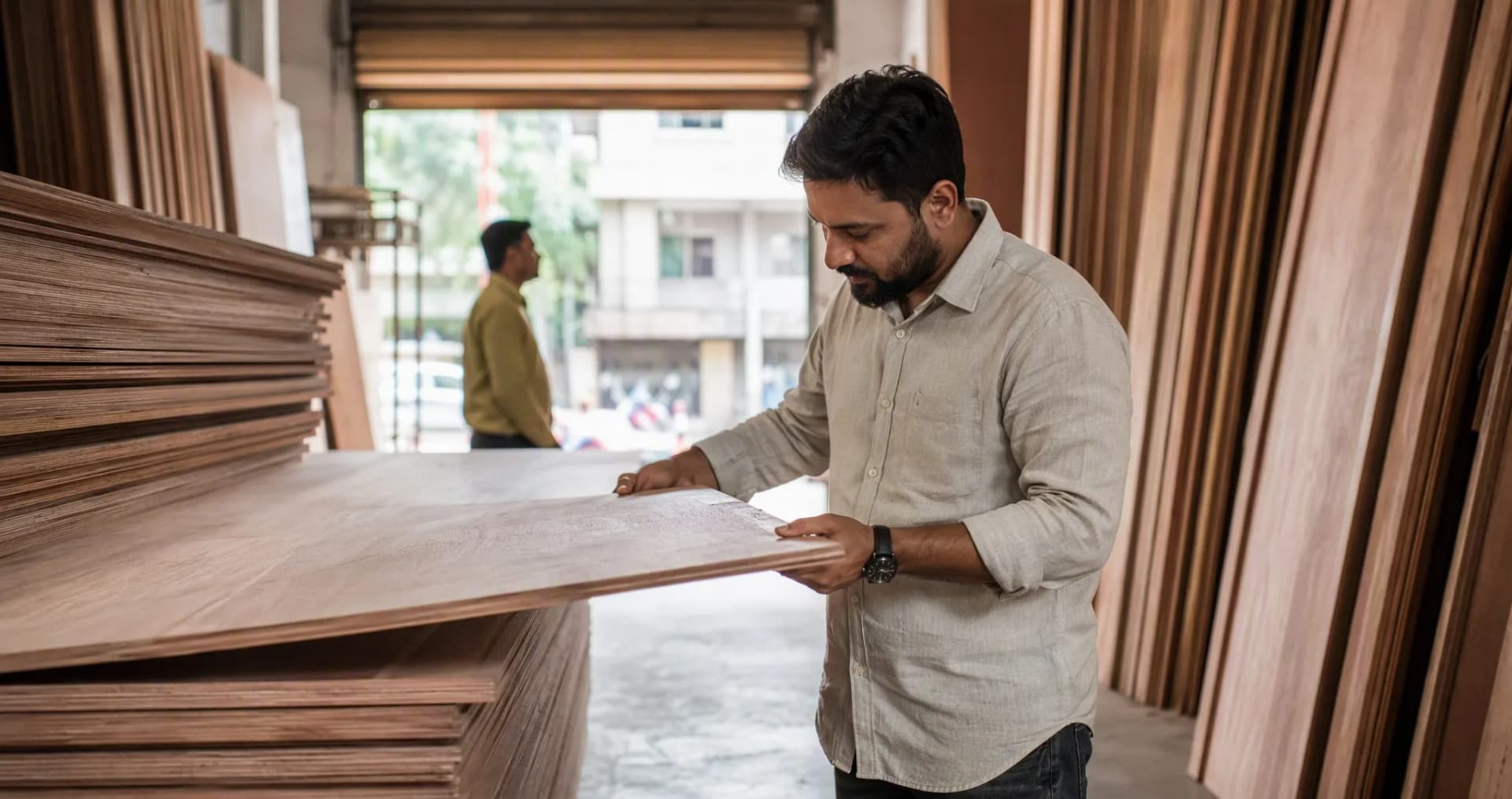
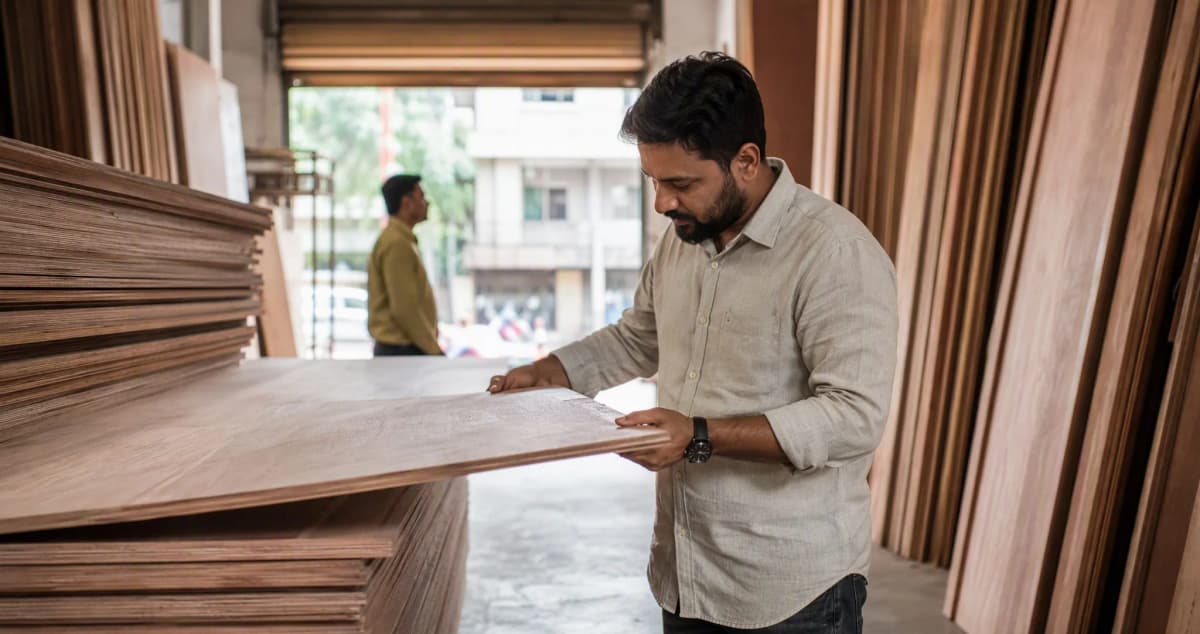
Two sheets can look identical on the rack and perform like different materials in your home. The difference is visible — in the stamp, the edge, the sound and the weight — if you know where to look. This is the two-minute inspection routine, explained check by check.
Identifying quality plywood — the 30-second answer
- Quality is two things: the right grade for the room (MR / BWR / BWP) and good manufacturing. A well-made MR sheet beats a badly made "marine" sheet.
- Read the stamp first: genuine ISI = ink-stamped IS number (IS 303 or IS 710) + full CM/L licence number that verifies on manakonline.in or the BIS Care app. Stickers and missing numbers are fakes.
- Read the edge: 11–13 thin, even plies on an 18 mm sheet, no gaps, no overlaps, no pale filler strips. The edge is the sheet's X-ray.
- Tap and lift: a solid "thock" across the whole face (hollow = hidden void), and real heft — a hardwood-core 18 mm sheet weighs roughly 23–28 kg.
- Measure it: a genuine "18 mm" sheet reads 17.0–17.8 mm, with under ±0.5 mm variation across the sheet. More variation = rocking doors and uneven laminate.
1. Quality is two separate things — and most buyers only check one
When a Bangalore homeowner asks for "good plywood," they usually mean one of two different things. The first is grade fitness: is this the right type of plywood for where it will live? MR (moisture resistant, IS 303) for dry bedrooms, BWR for kitchens and humid zones, BWP/marine (IS 710) for under-sink cabinets and bathrooms. The second is manufacturing quality: whatever the grade, was this particular sheet made well — dense core, tight plies, honest thickness, real certification?
Both matter, and they fail independently. A premium marine sheet in a dry wardrobe is wasted money. A well-made MR sheet in that same wardrobe will serve twenty years. And a badly made sheet — voids in the core, thin fake stamps, swollen edges from wet storage — will fail in any room, whatever the sticker claims. We cover the grade-versus-room question in detail in Marine Plywood vs Commercial Plywood: What Should You Use in Bangalore. This guide is about the second half: how to judge the sheet itself, in the shop, with your own hands.
Bangalore's plywood market mixes genuine branded stock, licensed regional mills, and outright counterfeits — often in the same lane of shops. Industry estimates suggest fake or mis-stamped ISI marks are common enough that verification, not trust, is the only safe default. The good news: every check below is free and takes seconds.
2. The stamp: ISI, CM/L and the fakes
Every legitimately certified plywood sheet sold in India carries its credentials printed along the edge — ink-stamped or laser-etched, never a sticker. A complete, genuine marking has three parts: the ISI logo, the IS number (IS 303 for general-purpose MR/BWR, IS 710 for marine/BWP), and a CM/L number — the Certification Marks Licence, a unique code tied to that manufacturer's BIS licence. Under the current revisions, look for IS 303:and IS 710:2024.
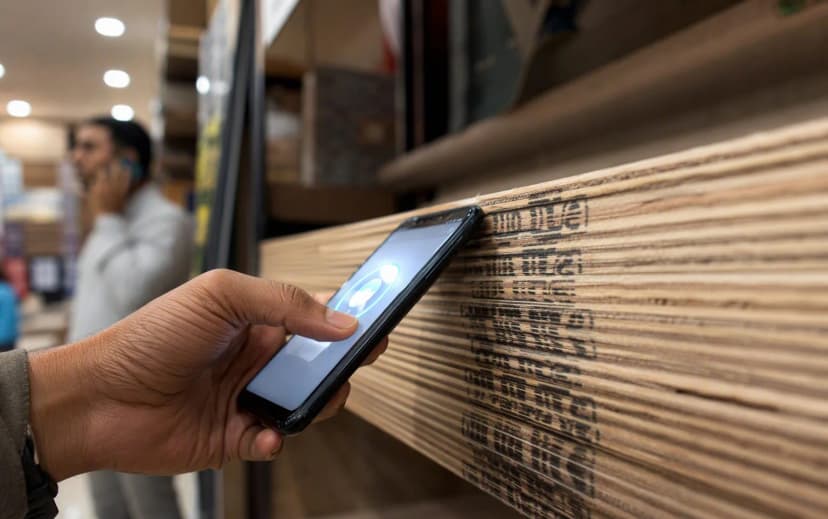
The CM/L number is your verification key, and checking it is free:
- Copy the full CM/L number from the sheet edge (format: CM/L-XXXXXXXXXX). Ask the dealer to unbundle a sheet if the stack hides the stamps — any honest dealer will.
- Verify it officially. Enter the number on the BIS Manakonline portal (Conformity Assessment → Search a Licence) or in the BIS Care app under "Verify Licence Details".
- Match three fields: the manufacturer name must be the brand on the panel, the product scope must cover plywood to the claimed IS standard, and the licence status must be active — not expired or cancelled.
Premium brands add a second layer: QR codes printed on the sheet that resolve in the brand's own app (CenturyPromise, Greenply's app and similar) to the exact product line, thickness and plant. A QR that doesn't resolve is telling you something.
| Feature | Genuine | Fake indicator |
|---|---|---|
| Printing | Ink-stamped or laser-etched into the edge, deep and uniform | Sticker label, or faded/smudged ink applied after production |
| IS number | States IS 303 or IS 710 explicitly | Vague "ISI certified" or "ISI quality" with no number |
| CM/L number | Full number, verifies to the same manufacturer on the BIS portal | Missing, partial, or returns no record / a different company |
| Consistency | Same stamp format on every sheet in the bundle | Mixed stamps, or only the top sheet of the stack is stamped |
| Invoice | GST invoice names brand, grade, IS code and thickness line by line | Generic "plywood" invoice that could describe anything |
One limit to know: a valid CM/L proves the factory is licensed for that standard. It does not prove this particular sheet came from that factory — which is why the physical tests below still matter, and why the invoice must name the grade and IS code in writing. The full delivery-day verification routine is in Why Professional Plywood Suppliers Matter for Interior Projects.
3. Read the edge: plies, gaps and cores
The edge of a plywood sheet is its X-ray. Everything the factory did — or skipped — is visible in cross-section, and this single check catches more bad plywood than every other test combined. Pull a sheet partway out of the stack and look along all four edges under decent light.
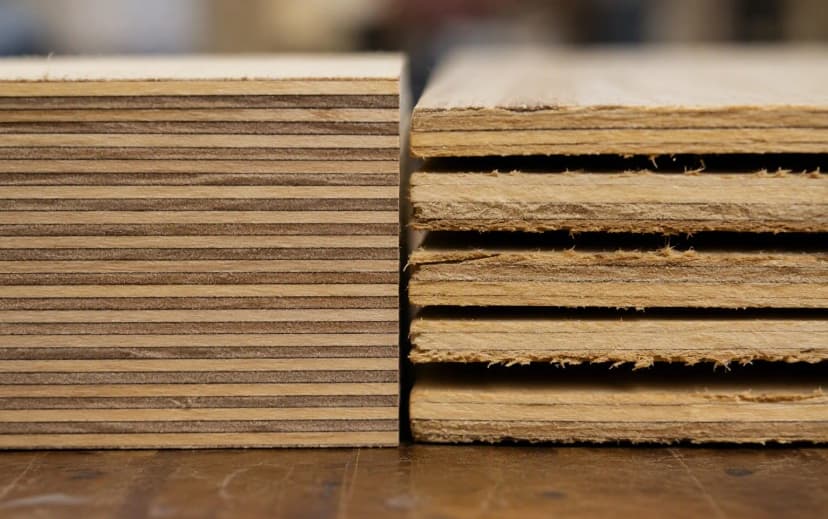
Count the plies. On an 18 mm sheet, quality construction shows 11–13 thin, even veneers with tight glue lines. More, thinner plies mean better stability, stiffness and screw-holding, because each glue line adds strength and each thin veneer moves less with humidity. Budget sheets show 7–9 fat plies — cheaper to press, quicker to warp.
Hunt for voids and overlaps. A void is a gap inside or between plies — it shows as a dark slit or hole along the edge. Voids are invisible from the face but crack under screws and sag under shelves, and they always seem to land exactly where a hinge plate needs to go. An overlap — where two core veneers overlap instead of meeting cleanly — creates a hard ridge that telegraphs through laminate. Also watch for pale, soft filler strips sandwiched between darker hardwood faces: the sheet looks hardwood at the edge but is pulp in the middle.
Read the species. Dense, dark, reddish-brown plies usually mean hardwood (gurjan, eucalyptus) — heavy, strong, screw-holding. Pale, thick, soft-looking plies usually mean poplar or mixed plantation core — lighter, weaker, cheaper. Neither is "fake," but poplar-core sold at hardwood prices is one of the market's oldest tricks. The full species breakdown is in Top Factors to Consider Before Buying Plywood in Bangalore.
4. The tap test and the lift test
The edge shows you the outside of the core. These two tests check what's happening in the middle of the sheet, where your eyes can't reach.
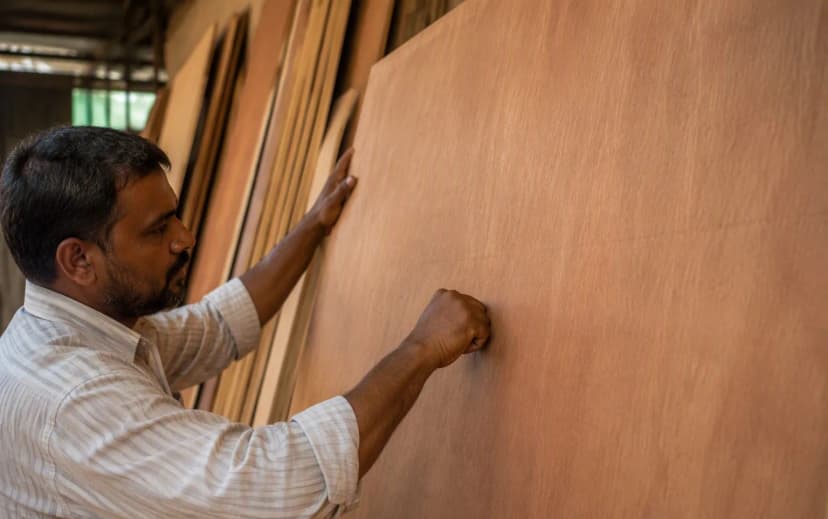
The tap test. Knock firmly with your knuckles in a grid pattern across the whole face — centre, four corners, edge midpoints. A well-bonded sheet answers with a consistent, solid thock everywhere. A hollow, papery or drum-like patch means a void or a delamination pocket where plies never bonded. One hollow patch is a defect; several is a rejected sheet. This takes twenty seconds and there is no way for a bad sheet to fake its way through it.
The lift test. Density is honest. A hardwood-core 18 mm sheet (8×4 ft) weighs roughly 23–28 kg; a marine-grade sheet runs heavier still, around 25–30 kg. If an "18 mm hardwood" sheet lifts like cardboard, the core is poplar or filler, whatever the invoice says. One caveat: weight is a clue, not a verdict — a sheet stored wet is also heavy, which is one more reason to buy from dealers with covered, racked storage rather than a godown floor.
No single test is proof. A heavy sheet with hollow sounds is bad. A clean-sounding sheet with 7 fat plies and edge voids is bad. Quality is when stamp, edge, sound, weight and thickness all agree — that agreement is what you're actually buying.
5. Thickness, calibration and flatness
Plywood thickness in India is nominal — "18 mm" is a label, not a measurement. A genuine 18 mm sheet measures 17.0–17.8 mm in practice. What matters is consistency: measure at four corners and the centre (a ₹150 tape works; a digital caliper is better), and the variation across the sheet should stay within ±0.5 mm. Beyond that, the sheet was poorly pressed, and the consequences arrive at installation: wardrobe doors that rock, laminate that bubbles over ridges, CNC-cut modular panels that don't align.
Two related checks take ten seconds more. Flatness: lay the sheet on a flat floor or sight down its length — no rocking, no visible bow or twist across a metre. Mild warp sometimes relaxes after acclimatising indoors for 48 hours; a twisted sheet never does. Calibration: if your interiors are factory-made (modular kitchen, CNC wardrobes), ask for calibrated plywood — sanded to a tighter thickness tolerance so every panel in a run is identical. It costs a little more and saves its price in carpentry rework.
And one substitution trap: some dealers quietly pass 16 mm sheets into an 18 mm order. On a 40-sheet order that's real money, and your carpenter's measurements assume 18. Measure the delivered stack — not the sample you were shown in the shop. More of these traps in Common Mistakes to Avoid When Buying Plywood in Bangalore.
6. Face, smell and the water-drop test
Read the face in raking light. Tilt the sheet so light skims across it. You're looking for patches (oval repairs where knots were cut out — a few small ones are normal, a face full of them is a cheap core veneer), bubbles or blisters (local delamination), rough unsanded patches, and a face veneer so thin you can see the core grain telegraphing through — that face will sand through the first time it's polished.
Smell the glue. It sounds odd; it works. Phenolic-bonded plywood (BWR, marine) has a darker glue line and a sharp, phenolic smell at a fresh-cut edge. Urea-bonded MR ply is lighter-coloured with a milder smell. If a sheet sold as "marine" looks and smells like light urea board, believe your nose over the sticker. Either way, a strong chemical stench that makes your eyes water signals cheap, high-emission glue — walk away.
The water-drop test. Put a spoonful of water on the face and edge and wait 30 minutes. On genuine BWR/BWP, the water beads and the sheet shows no swelling or darkening at the edge. On MR, expect some absorption — that's why MR doesn't belong in wet zones. And if you're buying marine grade for an under-sink cabinet, ask for an offcut and boil it for 3–4 hours at home: genuine phenolic glue lines hold; fakes open at the edges within the first hour. The full test method is in our marine vs commercial comparison.
7. The 15-year math: cheap vs quality
"Quality plywood" stops being an abstract virtue when you price the alternative. A 2BHK interior uses roughly 35–45 sheets. Here is what the choice actually costs in Bangalore at authorised-dealer prices, 18 mm:
| Choice | Material cost today | What you get | 15-year outcome |
|---|---|---|---|
| Unbranded economy (fake or no ISI, poplar/filler core) | ₹55,000–75,000 | 7–9 plies, edge voids, sagging shelves, hinges pulling out, swollen edges after the first monsoon | Kitchen and wardrobe repairs or rebuild within 3–5 years: ₹80,000–1,50,000. The cheap sheet is the expensive one. |
| Certified branded, zoned correctly (verified CM/L, hardwood core, MR + BWR + marine by zone) | ₹1,05,000–1,35,000 | 11–13 tight plies, solid tap, honest thickness, 5–25 year written warranties | No structural failures; furniture outlasts the laminate on it. Higher resale and rental appeal. |
The premium for verified quality is roughly ₹30,000–60,000 on a whole home — about what a single kitchen rebuild costs. Quality plywood isn't a luxury tier; it's the break-even point of interior work. Room-by-room quantities and grades are mapped in Where Is Plywood Used in Home Interiors: A Room-by-Room Guide.
The 90-second shop checklist
Everything above, compressed into what to actually do standing at the dealer's rack:
Per sheet, before you pay
- Stamp is ink or laser on the edge — IS 303 or IS 710 stated, never a sticker
- CM/L number copied and verified on manakonline.in / BIS Care app — manufacturer matches the brand
- Brand QR scanned in the official app and resolves to this exact product line
- Edge shows 11–13 thin, even plies (18 mm) — no voids, no overlaps, no pale filler strips
- Tap test across the face: solid "thock" everywhere, zero hollow patches
- Lift test: 18 mm hardwood sheet feels like 23–28 kg, not cardboard
- Thickness measured at 5 points: 17.0–17.8 mm, variation under ±0.5 mm
- Sheet lies flat — no rocking, bow or twist
- Face clean in raking light; no blisters; smell matches the claimed glue
- Grade matches the room — don't let anyone sell you MR for a kitchen
- GST invoice names brand, grade, IS code and thickness line by line, in your name
Frequently asked questions
How can I check plywood quality before buying in Bangalore?
Five quick checks: verify the stamp's CM/L number on manakonline.in or the BIS Care app; count 11–13 tight plies on the edge of an 18 mm sheet; tap the face in a grid pattern listening for hollow patches; lift the sheet (a hardwood-core 18 mm sheet weighs roughly 23–28 kg); and measure thickness at five points — genuine 18 mm reads 17.0–17.8 mm. Under two minutes per sheet.
How do I know if the ISI mark on plywood is genuine?
A genuine mark is ink-stamped or laser-etched on the edge and includes the IS code (IS 303 or IS 710) plus a full CM/L licence number. Enter that number on the BIS Manakonline portal or BIS Care app — a genuine licence shows the matching manufacturer and an active status. Stickers, missing numbers, or numbers that return no record are fakes.
Is heavier plywood always better quality?
Weight is a clue, not a verdict. Heavy usually means dense hardwood veneers rather than poplar or filler — good for screw-holding and sag resistance. But wet-stored plywood is also heavy. Combine the lift test with the edge inspection and tap test; a heavy sheet with hollow sounds or edge gaps is still a bad sheet.
How many plies should good 18 mm plywood have?
Typically 11–13 thin, even veneers with tight glue lines and no gaps. Budget sheets often show 7–9 thick plies with voids or soft filler strips. More, thinner plies mean better stability, stiffness and screw-holding.
Can I check plywood quality after it is laminated or installed?
Only partially. Laminate and edge banding hide the face, the stamp and most of the edge, so substitution becomes almost impossible to prove. Verify at the shop or at delivery — photograph the stamp on multiple sheets, reconcile the invoice, and run the physical tests before cutting begins.
Which plywood grade is best for home interiors — MR, BWR or BWP?
No single grade is "best" — quality means matching the grade to the room. MR (IS 303) for dry bedrooms and living areas, BWR for kitchens and humid zones, BWP/marine (IS 710) for under-sink and bathroom zones. A well-made MR sheet in a dry bedroom outlasts a poorly made marine sheet anywhere.
Does the brand matter, or is the ISI mark enough?
Both, for different reasons. The verified CM/L proves the factory is licensed and audited for that standard; the brand adds batch consistency, warranty support and QR authenticity checks. An unbranded sheet with a genuine licence can be good; a famous brand name whose CM/L doesn't verify is a counterfeit.
How much thickness variation is acceptable?
For a sheet sold as 18 mm, expect 17.0–17.8 mm with under ±0.5 mm variation across the sheet. More variation means poor pressing — rocking doors, uneven laminate, misaligned CNC panels. For factory-made modular work, ask for calibrated plywood.
Buy plywood you're allowed to inspect
At the Evospace studio, every sheet is on the rack for you to stamp-check, tap and measure — and every quote names the brand, grade and IS code in writing, line by line.
Get a Free Material Consultation




