
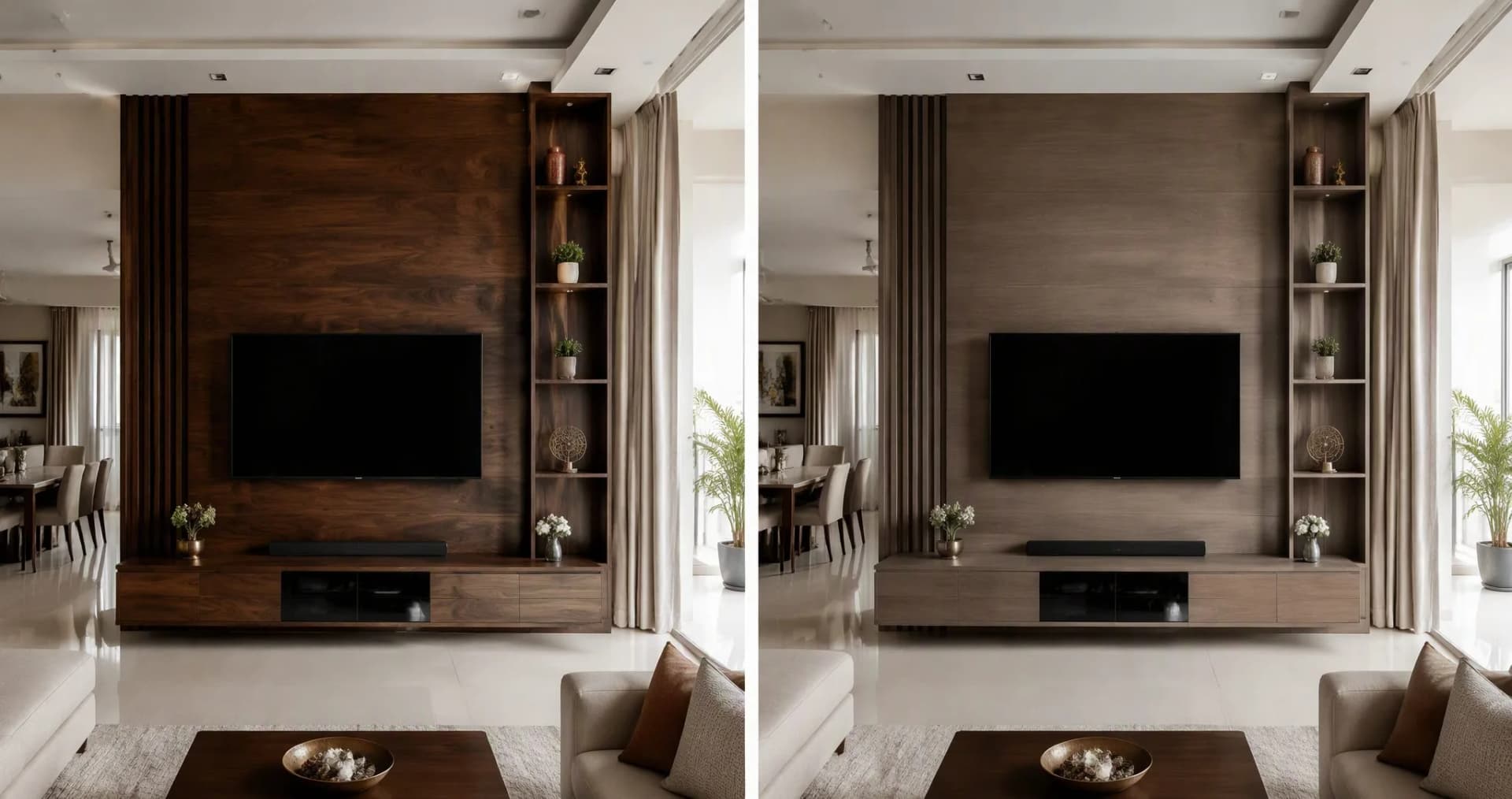
Veneer vs Laminate: Which Is Better for Modern Indian Homes?
One is a thin slice of a real tree; the other is a printed, resin-armoured surface built for abuse. Both can be the right answer — in different rooms. Here's the honest comparison: what each actually is, what it costs, how it survives Indian kitchens and monsoons, and the room-by-room map we use at Evospace.
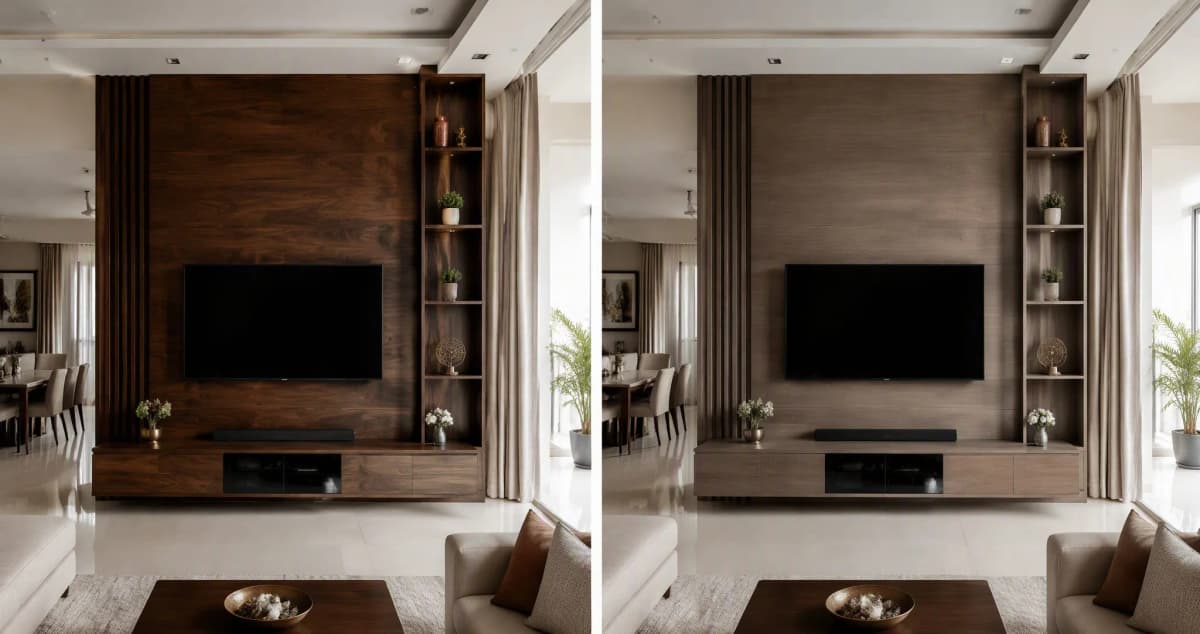
Veneer vs laminate — the 30-second answer
- Veneer = a 0.5–0.6 mm slice of real wood pressed onto plywood/MDF. Unique grain, warm touch, can be sanded and re-polished — but porous, scratch-prone and maintenance-hungry. ₹75–250+/sq ft, plus polishing.
- Laminate = printed decorative paper fused with resins under high pressure. Scratch-, stain-, moisture- and heat-resistant, wipe-clean, zero polishing. ₹40–250/sq ft, ready the day it's pressed.
- Kitchens, bathrooms, rentals, kids' rooms: laminate, full stop. Steam and daily wiping destroy veneer.
- Statement pieces in dry rooms — entrance door, dining table, TV panel, headboard: veneer earns its premium here.
- The smart default for modern Indian homes is hybrid: laminate everywhere it works hard, veneer where you touch and look closely. Expect roughly 70–80% laminate / 20–30% veneer by area.
1. What each material actually is
Most veneer-vs-laminate confusion comes from the fact that both are thin skins glued onto the same substrates — plywood, MDF or particle board. The skin is where they part ways.
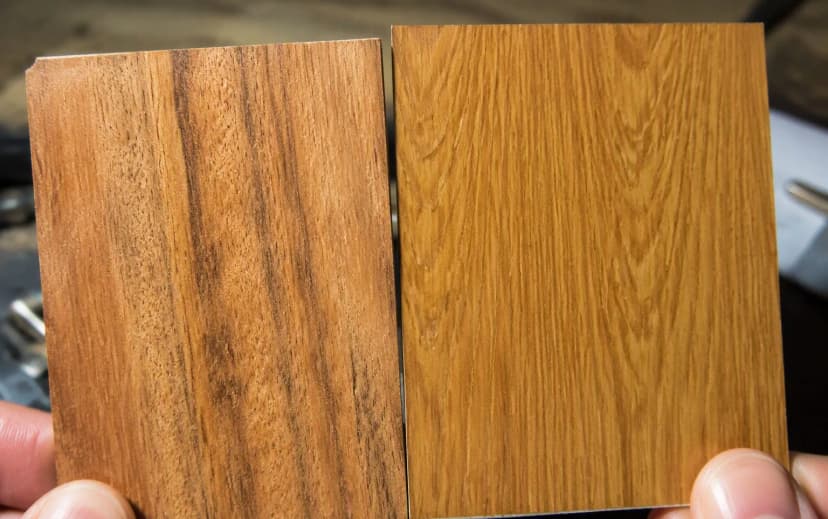
Veneer is real wood, sliced thin. A log is rotary-cut or sliced into leaves typically 0.5–0.6 mm thick in the Indian market, then pressed onto a substrate. Because it's an actual slice of a tree, every sheet is unique — the grain, the figure, the slight colour shift from leaf to leaf. You'll meet three families at a Bangalore dealer: natural veneer (teak, walnut, oak, wenge — teak alone is roughly half the Indian market), engineered/reconstituted veneer (fast-growing plantation wood, dyed and restructured to imitate exotic species — more uniform, cheaper), and specialty finishes like smoked, dyed and steamed veneers.
What veneer is not: finished. A raw veneer surface must be sanded, stained if desired, and polished — melamine for a matte natural look, PU for a richer, harder coat. That finishing step is real money and real time, and it's where veneer's maintenance story begins.
Laminate is paper, resin and pressure. Decorative paper (printed with wood grain, stone, fabric, solid colour — anything) is fused with kraft paper and melamine/phenolic resins under high pressure and temperature. The result is High Pressure Laminate (HPL), sold in 8×4 ft sheets, usually 0.8 mm or 1 mm thick for furniture. In India you know it as Sunmica — a brand name that became the generic word, like Xerox. The modern range is enormous: matte, high-gloss, textured, synchronised-pore (embossing follows the printed grain), anti-fingerprint, metallic, stone and fabric finishes.
Veneer is a natural product that must be protected. Laminate is a protective product that imitates nature. Every difference in this article — cost, care, climate behaviour — flows from that single sentence.
2. Head-to-head: the 10-factor table
| Factor | Veneer | Laminate (HPL) | Winner |
|---|---|---|---|
| What it is | 0.5–0.6 mm slice of real wood | Printed paper + melamine/phenolic resin | — |
| Appearance | Unique grain, depth, warmth; no two panels alike | Uniform print; premium textures convincing at a distance | Veneer |
| Scratch resistance | Low–moderate; shows scratches | High — built for daily abuse | Laminate |
| Moisture & steam | Porous; swells, bubbles, fades if wet | Surface shrugs off spills and steam | Laminate |
| Heat resistance | Low — heat can loosen the glue, sun fades the polish | Moderate–high | Laminate |
| Maintenance | Re-polish every few years; wipe spills instantly | Damp cloth; nothing else, ever | Laminate |
| Repair | Sands and re-polishes like new | Cannot be repaired — a deep chip means replacing the panel | Veneer |
| Material cost | ₹75–250+/sq ft (species-dependent) | ₹40–150/sq ft decorative; ₹150–300 premium | Laminate |
| Lifespan | 15–25+ yrs with maintenance | 10–20 yrs with zero maintenance | Tie |
| Eco profile | Thin slice = efficient timber use; biodegradable | Resin composite; not easily recyclable | Veneer |
Read the pattern, not just the rows: laminate wins every durability and convenience factor; veneer wins every beauty and longevity-with-care factor. The decision is never "which is better" — it's "which set of factors does this particular surface face every day?" That's what the room map in Section 05 answers.
3. The real cost math (with the part quotes leave out)
Material prices only tell half the story. Veneer's quote hides a second line item — polishing — and laminate's quote hides nothing, because there's nothing left to do after pressing. Here's the honest all-in comparison for finishing one wardrobe shutter bank, roughly 100 sq ft of surface, Bangalore:
| Line item | Veneer (natural teak) | Laminate (1 mm HPL) |
|---|---|---|
| Surface material | ₹8,000–25,000 (₹80–250/sq ft) | ₹5,000–12,000 (₹50–120/sq ft) |
| Pressing / labour to apply | ₹3,000–5,000 | ₹3,000–5,000 |
| Finishing (sanding + melamine/PU polish) | ₹8,000–15,000 (₹80–150/sq ft) | ₹0 |
| Day-one total | ₹19,000–45,000 | ₹8,000–17,000 |
| 10-year upkeep | Re-polish 1–2 times: ₹8,000–25,000 | Cleaning cloth: ₹0 |
Two conclusions fall out. First, a veneered surface typically costs 2–3× a laminated one, all-in — which is why whole-home veneer is a luxury decision, not a default. Second, veneer's counter-argument is repairability: when a laminated panel chips badly, you replace the panel (and may not find the same design years later); when veneer dulls or scratches, ₹80–150/sq ft of re-polishing makes it new again. Over 20 years of careful ownership, veneer can actually be the cheaper beautiful option — laminate is the cheaper practical one.
4. Indian climate: humidity, heat, monsoon
This is the section most comparisons skip, and the one that matters most in Bangalore, Chennai, Mumbai, Kochi and everywhere the monsoon spends months. Veneer is wood, and wood breathes: it absorbs moisture from humid air, expands, contracts, and — if the polish coat is thin or ageing — clouds, fades or lifts at the edges. Veneer furniture near a balcony door or in a bathroom-adjacent bedroom is living on borrowed time.
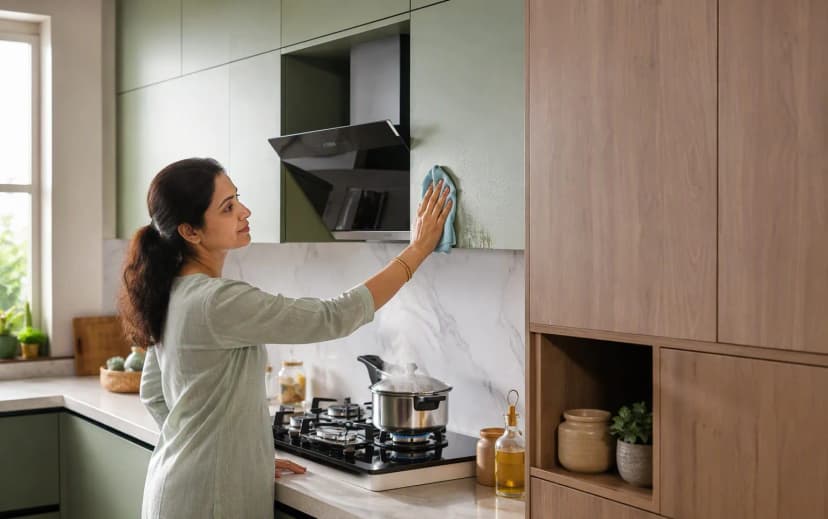
Laminate's resin skin doesn't care. It doesn't absorb humidity, doesn't expand across seasons, and doesn't mind being wiped down daily. This is why interior designers across South India default to laminate for kitchens, wardrobes near bathrooms, utility areas and rental homes — not because it's prettier, but because it's dimensionally boring, and boring is a virtue in a humid climate.
Interior, dry, air-conditioned or well-ventilated rooms — the living room TV wall, the master headboard, the dining table, the entrance door (inside face). Keep veneer away from direct sun (UV fades the polish), away from wet zones, and budget a melamine re-coat every few years. Also note: whatever the skin, the core still matters — pair the finish with the right plywood grade, as covered in Marine vs Commercial Plywood.
5. Room by room: the decision map
This is the map we walk through at the Evospace studio when a homeowner asks "veneer or laminate?" — because the correct answer changes every few metres:
| Surface | What it faces daily | Our call | Why |
|---|---|---|---|
| Kitchen cabinets & tall units | Steam, oil, water, daily wiping | Laminate (1 mm HPL) | The single harshest zone in the house; veneer clouds and lifts here |
| Bathroom vanities | Direct water, humidity | Laminate only | Veneer in a bathroom is a repair waiting to happen |
| Wardrobes (daily-use) | Hand contact, bag bumps, humidity through walls | Laminate | Zero maintenance; vast design range; kids-proof |
| Kids' room furniture | Everything a child can do to a surface | Laminate | Scratch and stain resistance is the whole game |
| Rental / investment property | Unknown tenants, zero upkeep | Laminate | Survives neglect; easy panel swaps between tenancies |
| Entrance door (inside face) | First impression, hand contact | Veneer | The "wow" surface guests actually touch |
| Living room TV wall / display unit | Looks, light, little physical wear | Veneer | Depth and grain carry the room; minimal wear |
| Dining table top | Close-up daily contact | Veneer (PU-polished) | The tactile centre of the home; PU handles hot plates better than melamine |
| Master bedroom headboard | Touch, low wear, dry air | Veneer | Warmth where you start and end the day |
| Study / home office desk | Mouse friction, coffee rings, daily use | Laminate (textured) | Or veneer + desk mat if you must have the wood feel |
Notice the principle: veneer follows low wear and high visibility; laminate follows high wear and daily contact. The map also assumes your substrate is right — a veneered wardrobe over a bathroom wall still needs a BWR-grade core. The grade-by-zone logic is in Where Is Plywood Used in Home Interiors: A Room-by-Room Guide, and laminate selection itself is covered in How to Choose the Right Laminates for Your Home Interiors.
6. The hybrid strategy we recommend
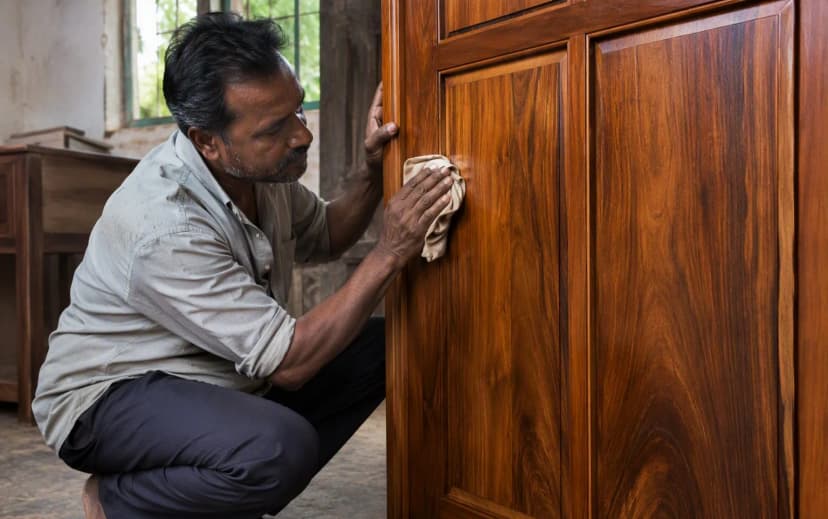
Most modern Indian homes we fit out at Evospace end up at roughly the same place: 70–80% laminate, 20–30% veneer by surface area. Laminate quietly handles the kitchen, wardrobes, utility and kids' rooms — the surfaces that work for a living. Veneer is deployed like jewellery: the entrance door, the living room's feature panel, the dining table, the master headboard. Guests remember the veneer; your daily life runs on the laminate.
Three rules make the hybrid work visually:
- Match tones, not species. If the veneer is teak, pick laminates in the same warm family — wood-look laminates sit next to real veneer convincingly when the undertone matches, and clash when it doesn't. Put physical samples side by side in your room's light, not under showroom tubes.
- Give veneer the spotlight positions. Veneer earns its premium at eye level and touch distance. Don't spend it inside wardrobes, on loft shutters, or anywhere a door usually hides it.
- Keep one texture family per room. Mixing high-gloss laminate, matte laminate and polished veneer in a single room reads as three decisions, not one. Two finishes per room is the ceiling.
And a budget note: a hybrid home typically lands 15–25% above an all-laminate home on finishing cost — and 40–60% below an all-veneer one, with none of the maintenance burden. It is, in our experience, where value and beauty actually intersect. For the broader material-selection framework, see How to Choose the Right Interior Design Materials for Your Home in Bangalore and Common Mistakes to Avoid When Selecting Laminates for Furniture.
The decision checklist
Veneer or laminate? Answer per surface
- Will this surface see steam, splashes or daily wet wiping? → Laminate
- Is it a kitchen, bathroom, utility or kids' room? → Laminate, no debate
- Is this a rental or will upkeep realistically not happen? → Laminate
- Will people touch it and see it up close every day, in a dry room? → Veneer earns its place
- Is it the first thing guests see (door, TV wall, dining table)? → Veneer
- Budget tight on a whole-home scope? → Laminate everywhere, veneer on one hero piece
- Want a finish that can be renewed in 10 years instead of replaced? → Veneer
- Choosing laminate — insist on 1 mm HPL for doors and shutters, not 0.8 mm liners
- Choosing veneer — budget the polish (melamine/PU) into the quote on day one
- Either way — the plywood grade underneath must match the room's moisture zone
Frequently asked questions
Which is better for Indian homes, veneer or laminate?
Neither wins outright — they solve different problems. Veneer is real wood: richer look, warm touch, re-polishable, but costly and maintenance-hungry. Laminate is a printed resin surface: tough, wipe-clean, affordable. Most modern Indian homes use both — veneer for statement pieces in dry living areas, laminate for kitchens, wardrobes and high-traffic furniture.
Is veneer or laminate better for a kitchen in India?
Laminate — specifically 1 mm HPL. Daily steam, oil vapour, splashes and aggressive cleaning are exactly what make veneer swell, bubble and fade. Laminate handles all of it and wipes clean.
What is the price difference between veneer and laminate in India?
Decorative laminates run roughly ₹40–150/sq ft (premium textures ₹150–300). Natural veneers run ₹75–250+/sq ft, engineered veneers ₹75–150. The bigger gap is finishing: veneer needs melamine/PU polishing at roughly ₹80–150/sq ft, while laminate is ready the day it's pressed. All-in, veneer typically costs 2–3× laminate.
Can you tell veneer and laminate apart just by looking?
Up close, yes. Veneer's grain never repeats and you can feel pores and warmth; laminate's printed grain repeats at intervals and feels uniformly smooth. At the edge, veneer shows a thin wood layer; laminate shows a crisp paper-based edge. From across a room, premium wood-look laminates are genuinely hard to distinguish.
Does veneer last longer than laminate?
With maintenance, yes — veneer can be sanded and re-polished several times and last 15–25+ years. Laminate looks new for 10–20 years with zero upkeep but can't be repaired; a deep chip means replacing the panel. Veneer lasts longer if you maintain it; laminate lasts longer if you don't.
Is laminate waterproof?
The surface is highly water-resistant — spills bead and wipe off. But water reaching the core through unsealed edges or boring holes will still swell the substrate, so edge banding matters as much as the sheet. Veneer is porous even when polished and should never see standing water.
Is veneer more eco-friendly than laminate?
Generally yes: veneer is a thin slice of real timber — one log yields hundreds of sheets — and it's biodegradable; engineered veneers use fast-growing plantation species. Laminate is a resin composite that isn't easily recyclable, though its long, maintenance-free life narrows the practical gap.
Can laminate look as good as real wood veneer?
Premium synchronised-pore laminates are remarkably convincing at normal distance — the embossing follows the printed grain. What they can't replicate is depth: the way real grain shifts with light, and the one-of-a-kind figure of a natural flitch. For surfaces touched and seen up close daily, veneer still wins the eye test.
Feel the difference before you decide
Veneer and laminate samples sit side by side at the Evospace studio — touch them, scratch them, hold them in daylight, and we'll map every surface of your home to the finish it actually needs.
Get a Free Material Consultation




