
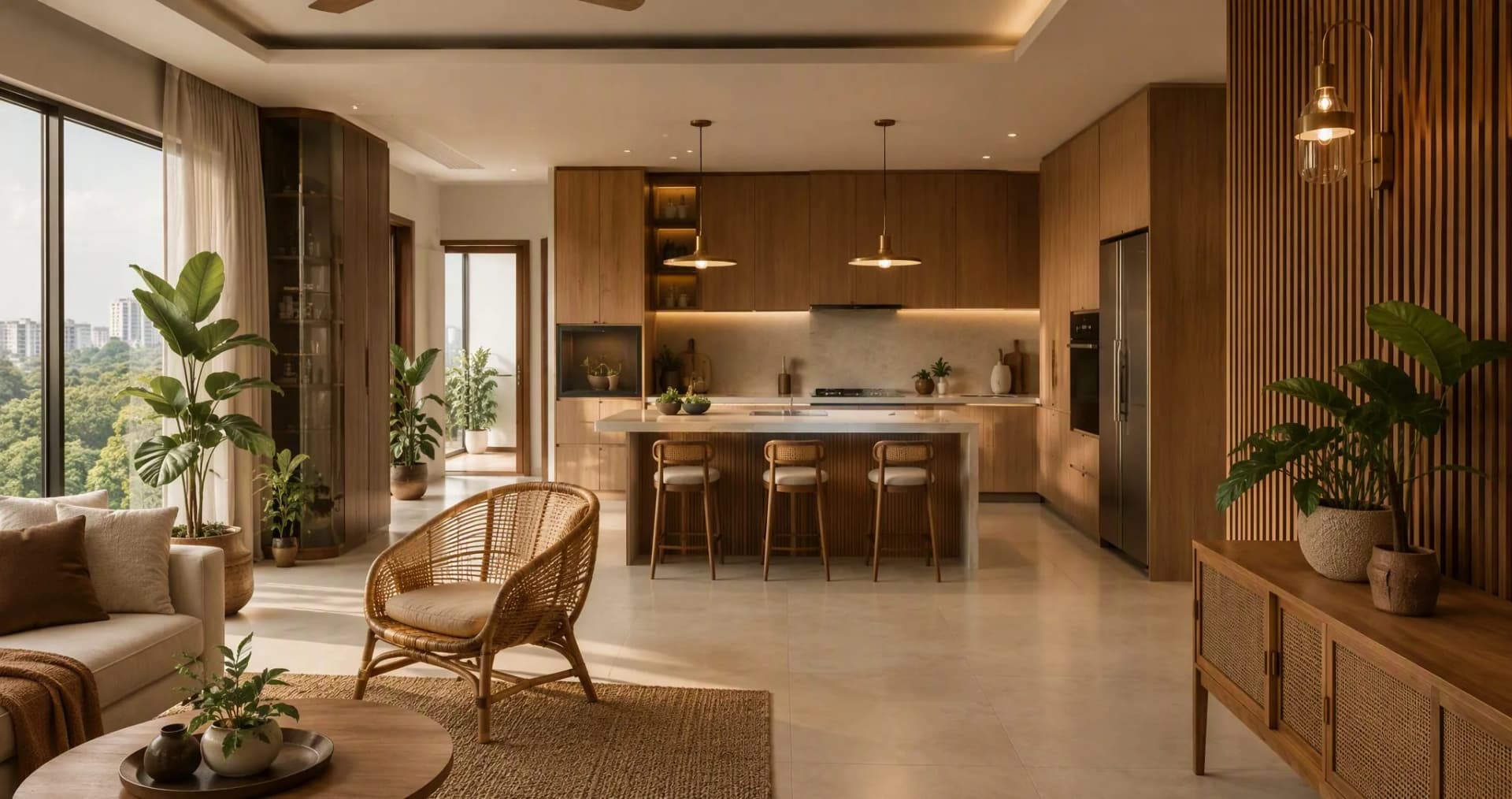
Latest Interior Material Trends Popular in Bangalore Homes
Walk into any well-designed Bangalore apartment finished in the last year and you'll see the same shift: matte instead of gloss, warm wood instead of grey, texture instead of flat paint. Here are the eight material trends actually showing up in the city's homes — what each costs, where it works, and how to use it without regretting it in five years.
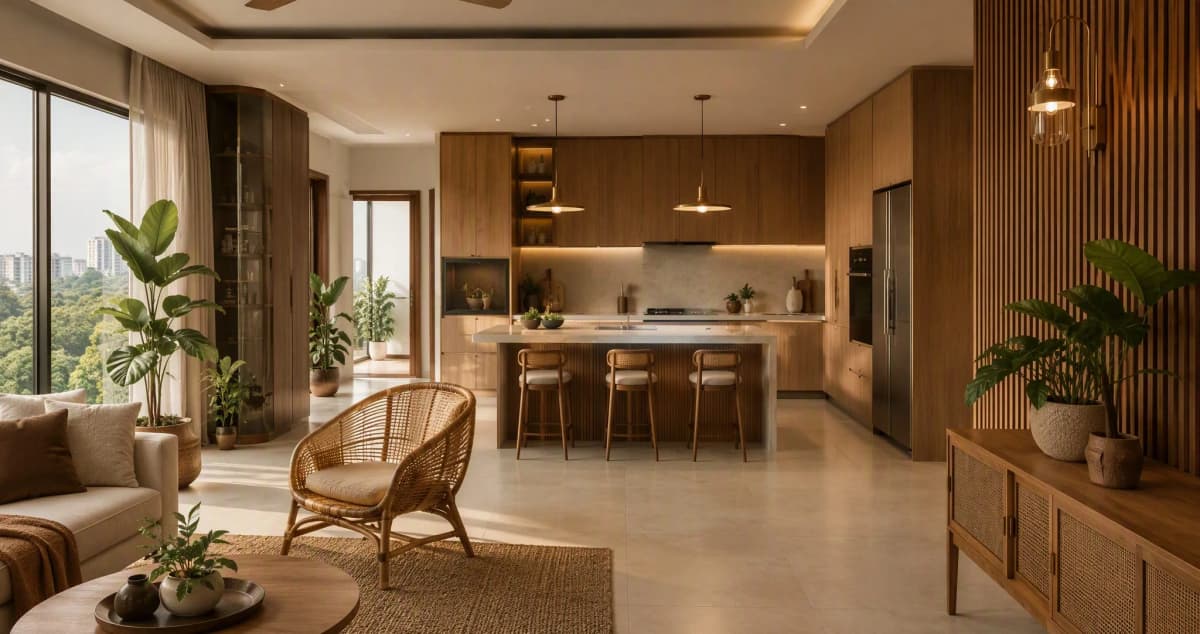
Bangalore's material palette: matte & anti-fingerprint finishes replacing gloss, warm wood tones (oak, walnut, teak) replacing cool grey, fluted and reeded panels on accent walls and shutters, earthy neutral palettes with jewel-tone accents, stone-look surfaces and large-format tiles for seamless floors and counters, cane and rattan woven into shutters and furniture, limewash and textured walls replacing flat paint, and sustainable, low-VOC materials moving from niche to default. The sections below cover cost, best use, and the mistakes to avoid with each.
The eight material trends defining Bangalore homes right now
These aren't Pinterest imports — they're what's actually being specified in Bangalore apartments and villas, from Whitefield high-rises to Jayanagar renovations. For each: what it is, what it costs, and where it works.
Matte & anti-fingerprint finishes
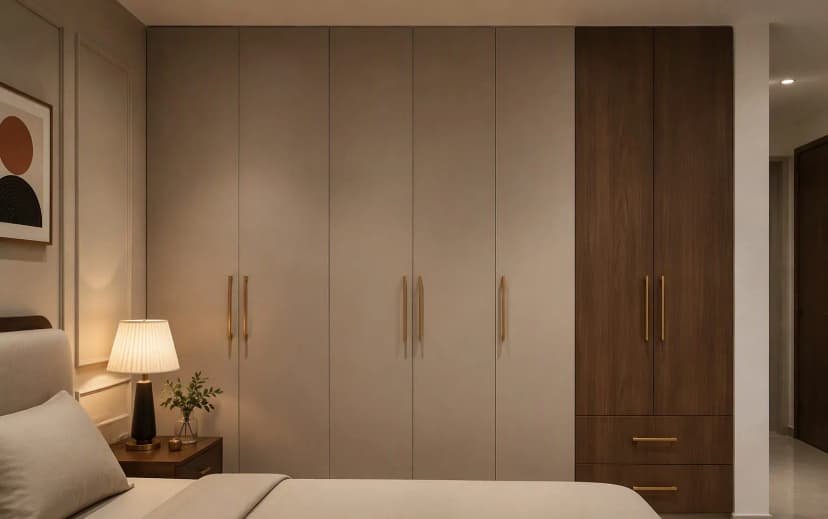
Gloss is officially out for daily-use surfaces. Super-matte laminates, soft-touch and PET panels now dominate wardrobes and kitchens because they hide fingerprints, oil haze, and Bangalore's ever-present dust. They read premium without shouting, and they photograph beautifully in the diffused light of an apartment.
Use it for: kitchen shutters, wardrobe runs, TV units, study desks. Cost: super-matte laminates and PET panels run ₹1,200–2,200 per sq ft finished — a modest premium over standard laminate.
Warm wood tones
The grey decade is over. Light oak, walnut, teak, and ash finishes — in laminate, veneer, or fluted panels — bring warmth that suits both Bangalore's soft natural light and Indian décor. Designers pair them with ivory, beige, and brass rather than the old grey-and-chrome formula.
Use it for: everywhere, but especially wardrobes, TV walls, and kitchen tall units. Woodgrain laminates cost no more than solids; natural veneer with polish runs ₹2,200–4,500 per sq ft.
Fluted & reeded panels
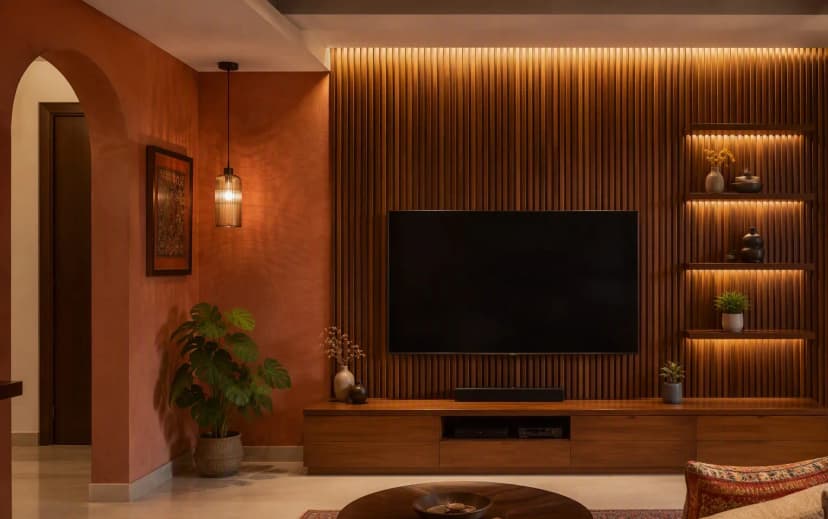
The single most visible trend in Bangalore right now. Vertical fluting adds rhythm and shadow to TV walls, wardrobe shutters, kitchen islands, and pooja niches. It also flatters the city's compact apartments — vertical lines pull the eye up and make 9-ft ceilings feel taller.
Use it for: one accent surface per room, not four. MDF or WPC fluted panels run ₹250–600 per sq ft; solid wood or veneer-faced fluting goes higher. Deep flutes collect dust — choose slim reeds for easy wiping.
Earthy neutral palettes
Beige, greige, ivory, terracotta, clay, and sage have replaced stark white and cool grey. The palette suits Bangalore's light and pairs naturally with wood and brass. Deep jewel tones — burgundy, jade, ink blue — appear as accents on a single shutter bank or niche, not whole rooms.
Use it for: walls, laminates, and textiles. Earthy laminates and paints cost the same as any other colour — the discipline is free. Test swatches against your actual daylight; Bangalore's east- vs west-facing light changes these shades dramatically.
Stone-look surfaces & large-format tiles
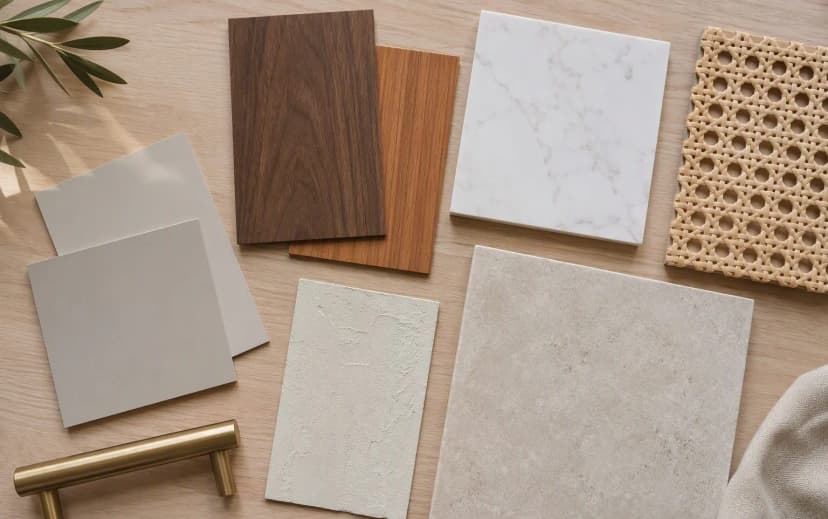
Real marble is losing ground to quartz counters and large-format porcelain slabs that mimic marble, travertine, and terrazzo. Fewer grout lines mean rooms look bigger and clean easier — a real consideration in dusty Bangalore. 800×1600 mm and 1200×2400 mm formats are now standard in mid-premium apartments.
Use it for: floors, kitchen counters, TV-wall cladding. Large-format porcelain runs ₹90–250 per sq ft (material), quartz counters ₹250–600 per sq ft. Insist on experienced layers — big tiles punish poor workmanship.
Cane, rattan & woven textures
Woven cane webbing on wardrobe shutters, rattan chairs, and bamboo light fixtures add a breathable, crafted layer that softens all that matte surface. It's a revival of a material South India has used for centuries — now framed as contemporary.
Use it for: shutter inserts, headboards, loose furniture, and lighting. Keep natural cane indoors and away from damp; for balconies use synthetic wicker. Cane shutter inserts add roughly ₹150–400 per sq ft over plain shutters.
Limewash & textured walls
Flat emulsion is giving way to limewash, micro-texture, and subtle plaster finishes that give walls depth without pattern. In Bangalore's filtered light, these finishes shift gently through the day — a premium effect at near-paint prices.
Use it for: living room feature walls, bedrooms, foyers. Limewash and texture finishes run ₹35–90 per sq ft applied. They mark more easily than washable emulsions — keep them off corridor walls where bags and shoulders brush.
Sustainable & low-VOC materials
The quietest but most durable trend: E0/E1 low-formaldehyde boards, low-VOC paints, reclaimed wood, and bamboo panels. Families with children and elderly parents are driving this — indoor air quality finally weighs as much as looks. Reputable brands now publish emission grades; ask for them.
Use it for: everywhere, with the biggest health return in bedrooms and kids' rooms. Low-VOC paints cost 10–20% more; E0/E1 boards a modest premium over standard. See our material quality guide for why this pays back.
The finish decision: laminate vs membrane vs acrylic vs PU
This is the one finish decision every Bangalore homeowner must make, and where most trend money actually goes. Honest comparison, prices: (deep-dive kitchen material guide: best plywood for modular kitchens)
| Finish | Look | ₹/sq ft (finished) | Strengths | Watch out for |
|---|---|---|---|---|
| Matte / super-matte laminate | Velvet-matte, huge colour & woodgrain range | ₹1,000 – 1,800 | Cheapest per look; scratch-resistant; anti-fingerprint grades now common | Visible edge banding lines; choose 1 mm+ edge band and laser/Rehau edging where possible |
| Membrane (PVC foil) | Seamless wrapped look, can carry grooves & profiles | ₹1,500 – 2,800 | No edge banding; soft matte; suits shaker/fluted profiles | Foil can lift near the hob with heat + humidity; keep it off base units beside the stove |
| Acrylic | Deep mirror gloss (matte acrylics exist too) | ₹1,800 – 3,500 | Premium gloss depth; UV-stable; wipes clean | Shows fingerprints and micro-scratches; quality varies hugely by brand |
| PU (polyurethane) paint | Silky matte or satin, any colour, seamless | ₹2,500 + | Most premium feel; seamless edges; best moisture seal when cured | Costliest; repairs need a pro; quality depends entirely on the applicator |
| Veneer + polish | Real wood grain, warm and unique | ₹2,200 – 4,500 | Authentic wood; ages with character; repairable | Needs periodic polish maintenance; sheets vary — hand-pick them |
Bangalore practical note: whatever finish you choose for the kitchen, the carcass matters more. Specify BWR plywood minimum (BWP for the sink unit) — a ₹3,000/sq ft acrylic shutter on an MR-grade carcass fails in one monsoon. Our BWR vs BWP guide and Bangalore buying-mistakes guide cover this in detail.
How to use trends without dating your home
Trends churn every 4–6 years; interiors should last 12–15. The trick is knowing which layer of your home to spend trend money on. (The full decision framework: things to consider before choosing interior materials.)
| Layer | Examples | Rule |
|---|---|---|
| Fixed & expensive | Flooring, carcasses, main wardrobes, kitchen counters | Timeless only: neutral large-format tile, warm wood or neutral laminate, quartz. You'll live with these 15+ years. |
| Semi-fixed | Shutter finishes, wall finishes, fluted panels | One trend per room, maximum. These can be re-finished in 8–10 years at moderate cost. |
| Replaceable | Paint accents, handles, lights, loose furniture, textiles | Go as trendy as you like. A ₹30,000 refresh here resets the whole home's look. |
Verify before you buy: trends attract fakes — especially "anti-fingerprint" laminates and "E0" boards. Check physical samples in daylight, verify brands, and buy from authorised dealers. Our material verification guide has the full shop-floor routine.
The trend-proof material checklist
Before you finalise any trending material, run it through these eight questions.
- Layer check: is this trend going on a fixed layer (floor, carcass, wardrobe) or a replaceable one (paint, handles, loose furniture)? Trends belong on replaceable layers.
- Light check: have you seen the physical sample in your home's actual daylight — morning and evening? Catalogue photos lie; Bangalore's east and west light change everything.
- Maintenance check: who cleans this, and how? Deep flutes, gloss, and limewash all carry upkeep — be honest about your household.
- Climate check: Bangalore's monsoon humidity (75–85%) punishes MR-grade boards and poorly bonded foils. BWR/BWP carcasses first, finishes second.
- Heat check: anything beside the hob needs heat tolerance — PU or laminate near cooking zones, never membrane foil.
- Air-quality check: ask for the formaldehyde emission grade (E0/E1) on boards and low-VOC certification on paints — especially for bedrooms and kids' rooms.
- Sample check: for veneer and natural stone, hand-pick the actual sheets/slabs. Two "identical" veneer sheets can look like different species.
- Resale check: if you might rent or sell within 5–7 years, keep fixed layers neutral — tenants and buyers pay for calm, not for your burgundy kitchen.
Frequently asked questions
What are the top interior material trends in Bangalore?
Eight trends lead: matte and anti-fingerprint finishes, warm wood tones (oak, walnut, teak), fluted and reeded panels, earthy neutral palettes, stone-look surfaces and large-format tiles, cane and rattan accents, limewash and textured walls, and sustainable low-VOC materials.
Are matte finishes better than glossy for Indian homes?
For most Indian homes, yes. Matte and super-matte anti-fingerprint finishes hide smudges, oil haze, and dust far better than high gloss, which shows every fingerprint and scratch. Gloss still works in small doses — a single accent unit or a compact kitchen that needs reflected light — but matte is the lower-maintenance default for daily-use surfaces.
Which kitchen shutter finish is trending — laminate, membrane, acrylic, or PU?
Super-matte anti-fingerprint laminates and PET panels are the volume trend; matte membrane remains the mid-range favourite for profiled shutters; acrylic is chosen for glossy premium looks; PU is the premium matte or satin option. In Bangalore's market, expect roughly ₹1,000–1,800 per sq ft for laminate, ₹1,500–2,800 for membrane, ₹1,800–3,500 for acrylic, and ₹2,500+ for PU.
Do fluted panels work in small Bangalore apartments?
Yes, with restraint. Vertical fluting draws the eye upward and makes low ceilings feel taller. Use it on one surface — a TV wall section, a wardrobe run, or a pooja niche — rather than a whole room, and choose slim reeded profiles over deep flutes in compact rooms. Budget roughly ₹250–600 per sq ft depending on MDF, WPC, or solid wood.
What colours are trending for interiors?
Warm neutrals and earth tones have replaced cool greys: beige, greige, ivory, terracotta, clay, sage green, and warm browns, with deep jewel accents (burgundy, jade, ink blue) in small doses. Warm wood tones — light oak through walnut — anchor most material palettes.
Are cane, rattan, and bamboo practical in Bangalore's climate?
Yes — Bangalore's moderate, dry-ish climate suits natural cane and rattan better than humid coastal cities. Keep them out of direct rain (balconies need synthetic wicker), dust them monthly, and avoid damp bathrooms. Bamboo-engineered boards and panels are stable and increasingly available through Bangalore material studios.
How much do trending interior finishes cost per sq ft in Bangalore?
Indicative supply-and-install ranges: decorative laminate ₹80–250 per sq ft (material) or ₹1,000–1,800 finished shutters, membrane ₹1,500–2,800, acrylic ₹1,800–3,500, PU polish ₹2,500+, veneer with polish ₹2,200–4,500, fluted panels ₹250–600, limewash or texture paint ₹35–90, large-format tiles ₹90–250 (material).
How do I use trends without my interiors looking dated in five years?
Put timeless, neutral, high-quality materials on the expensive fixed layers — carcasses, floors, main wardrobes — and express trends on cheap, replaceable layers: paint, one fluted panel, handles, loose furniture, and textiles. A walnut-and-greige base with terracotta accents ages gracefully; an all-terracotta kitchen does not.
See the trends in person before you commit.
Visit our Bangalore studio to touch and compare this year's trending materials — super-matte laminates, fluted panels, cane, veneer, quartz, and more — under real light, with honest guidance on what suits your home and budget.
Visit the Studio




