Wardrobe Hardware Checklist: Channels, Hinges, Handles & Locks to Specify Before the Carpenter Starts
The most expensive sentence in Indian interiors is "we'll decide the hardware later." Hinge cups, sliding tracks and lock bodies are cut into your wardrobe while it is being built, so the hardware list has to be final before the first sheet of plywood is cut. Here is every item to lock in, with specs, brands and 2026 prices.
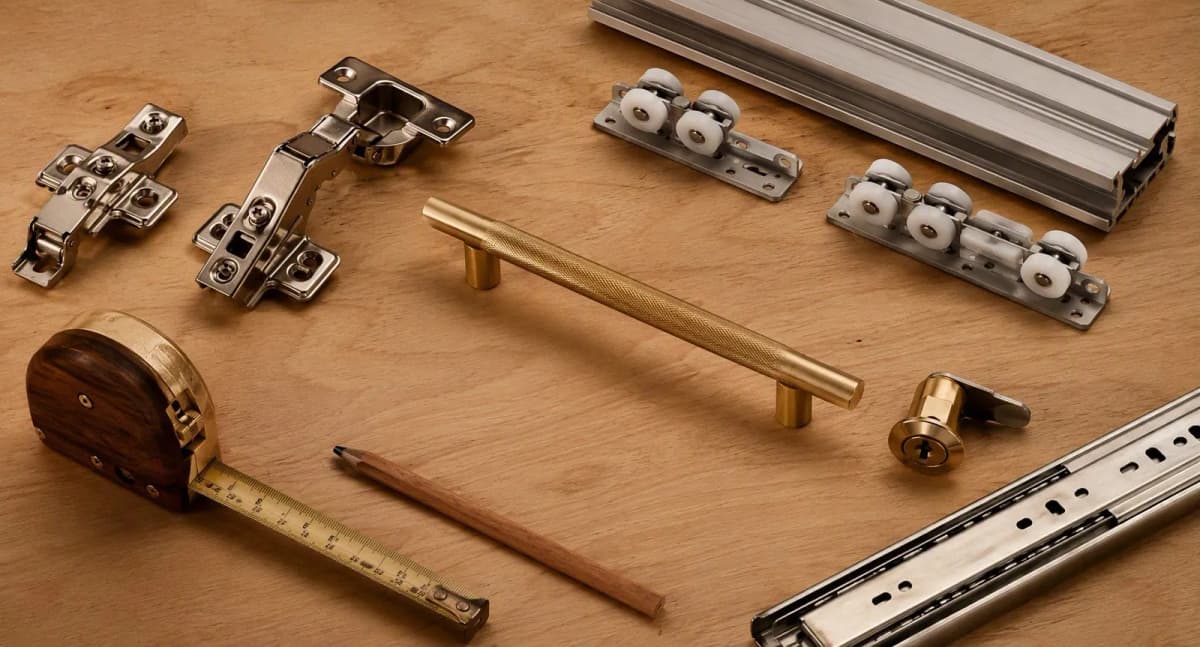
Wardrobe hardware: the quick answer
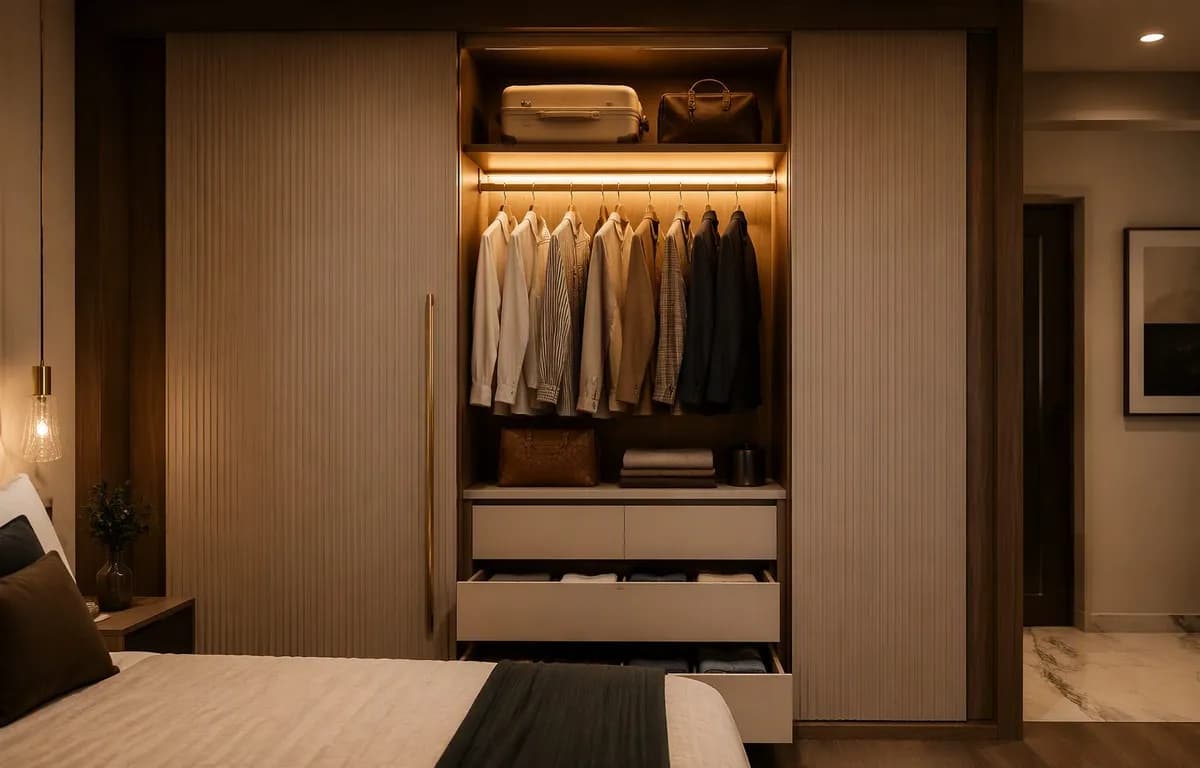
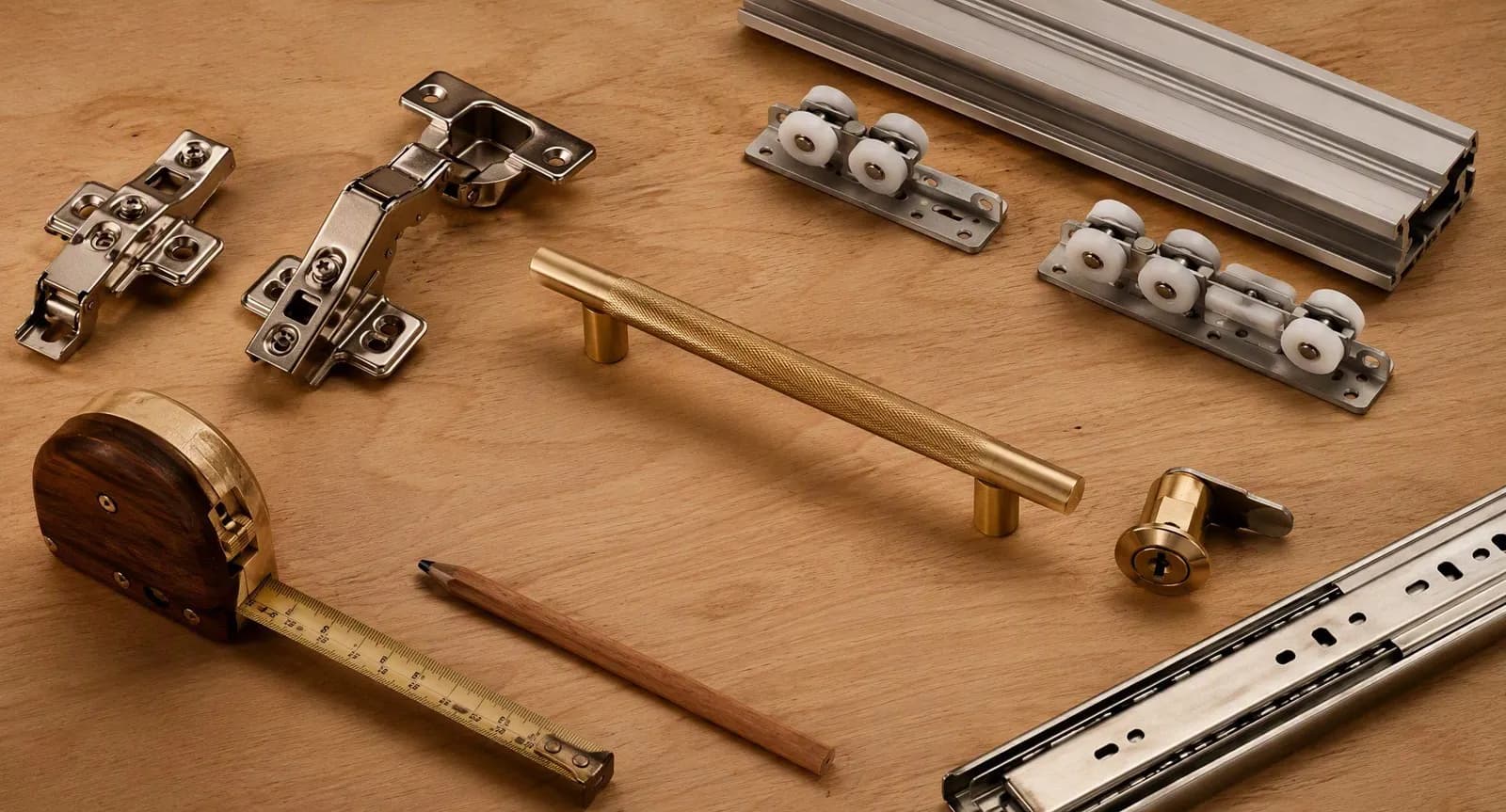
A wardrobe needs five categories of hardware: (1) shutter hardware, soft-close concealed hinges for hinged doors, or a sliding channel system for sliding doors; (2) drawer channels, telescopic or undermount tandem; (3) handles or knobs; (4) locks, a cam lock on hinged shutters, a duo lock on sliding doors; and (5) interior fittings like hanging rods, shelf pins and soft-close dampers.
To specify it, write down the brand, model, size and quantity of each item before carpentry begins. Every one of these components is cut into the wood during construction, hinge cups are bored 35 mm into the shutter, sliding tracks are recessed into the carcass top and floor, lock bodies are mortised into the shutter edge. A typical 7×8 ft wardrobe needs ₹4,000–₹18,000 of hardware depending on brand, and changing the spec mid-build means patched shutters and wasted material.
The rule of thumb: spend on the parts that move (hinges, channels, rollers), save on the parts that don't (handles, shelf pins, rods). A ₹60 handle on a ₹450 hinge beats a ₹600 handle on a ₹40 hinge every single time.
1. Why hardware is decided before carpentry, not after
Most Indian homes are built the other way round. The carpenter marks out the wardrobe, cuts the sheets, builds the carcass, and then someone asks, "hardware kya lagana hai?" By that point, half the decisions have already been made for you, silently, by the way the carcass was built. And the ones that haven't will now cost extra to implement.
Every moving part of a wardrobe physically enters the wood:
- Hinge cups are bored 35 mm wide and 12–13 mm deep into the back of each shutter. The boring positions depend on the hinge brand and crank you choose.
- Sliding tracks sit in grooves or channels recessed into the top and bottom of the carcass, the carcass depth changes depending on whether you pick a slim single-track or a deep double-track soft-close system.
- Lock bodies are mortised into the shutter edge or drilled through the face, before the laminate or veneer is pressed, ideally.
- Drawer channels determine the exact internal width of the drawer box: a 45 mm telescopic channel pair and a tandem box need different side clearances, so the drawer has to be built for the channel, not the other way round.
Retrofitting any of these after the carcass is laminated means drilling into finished surfaces, patching mistakes, and accepting compromises. The carpenter isn't wrong to ask early, you're wrong if you don't have the answer ready.
Hardware is typically 8–12% of a wardrobe's total cost, but it accounts for nearly 100% of what you touch and hear every day. Shutters don't "feel premium" because of the laminate, they feel premium because of the hinge damping and the handle weight. Budget accordingly.
2. Sliding channels: the system that carries your doors
If you've chosen a sliding wardrobe, the channel system is the single most important hardware decision in the entire project. A 8×2.5 ft sliding shutter in 18 mm plywood with laminate weighs 25–45 kg. That weight rolls back and forth on four small wheels, thousands of times a year. This is not the place for the ₹120 set.
Top-hung vs bottom-rolling
- Bottom-rolling (the Indian standard): the shutter weight sits on rollers running in a floor track; a top guide keeps it upright. Cheaper, easier to install and align, forgiving of slightly out-of-square carcasses. The floor track collects dust and needs occasional cleaning.
- Top-hung: the shutter hangs from an overhead track; the floor has only a small guide. No floor track to trip over or clean, and the glide feels lighter, but the carcass top must be genuinely rigid (or reinforced), and installation tolerances are tighter. Preferred for premium floor-to-ceiling builds.
What to specify
- Load rating: match it to your shutter weight with headroom, 50 kg rated systems for standard laminate shutters, 60–80 kg for acrylic, glass or veneer-heavy doors.
- Soft-close / damper: a two-way soft-close damper catches the shutter in both directions and stops the slam-and-bounce that loosens rollers over time. On a bedroom wardrobe used at 6 am and 11 pm, this is a marriage-saving ₹800–₹1,500.
- Track count: two tracks for a standard 2- or 3-door wardrobe (doors pass each other); confirm track depth with the carpenter because it eats into carcass depth, typically 80–100 mm total.
- Wheel material: nylon or POM wheels with ball bearings, not plain plastic, the difference is audible from day one.
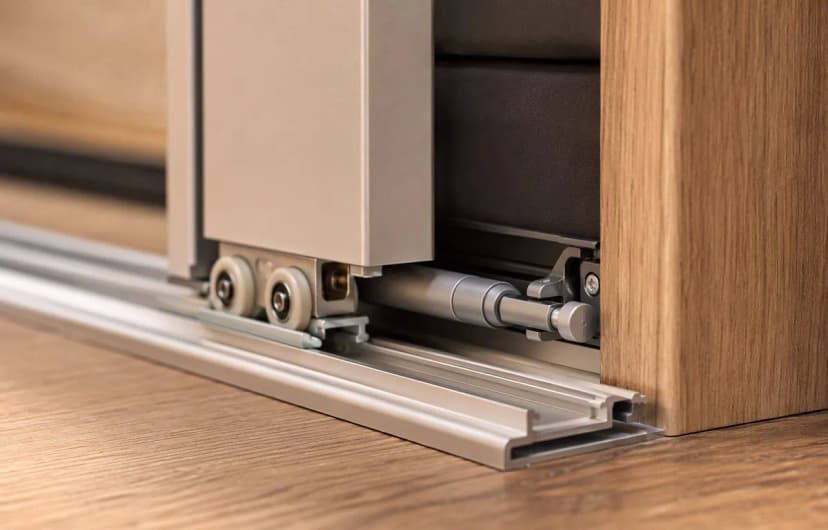
2026 price reality (per door, supply only): a basic aluminium roller set starts around ₹120–₹360; a branded soft-close one-door kit runs ₹300–₹800; heavy 60 kg systems ₹1,100–₹1,200; and premium two-way soft-close four-wheel sets reach ₹1,800–₹2,300. Hettich and Häfele sliding systems sit at the top of this range; Labacha's wardrobe sliding fittings cover the design-led end where the track finish needs to match premium interiors. The carpenter's fitting charge is separate, typically ₹500–₹1,500 per door.
Sliding saves swing space (the bed can sit 45 cm away) but shows you only half the wardrobe at a time and costs more in hardware. Hinged gives full access and cheaper, more repairable hardware but needs 50–60 cm of clear floor in front. In compact city bedrooms sliding usually wins; everywhere else, hinged is the better value. This decision changes the carcass itself, it cannot be made later.
3. Hinges: cranks, angles and how many per shutter
For hinged wardrobes, the concealed cup hinge (also called a Euro hinge or auto hinge) is the whole game. Three variables decide whether your shutters close flush, open wide enough, and survive a decade of daily use.
1. The crank, the spec most homeowners never hear about
The crank is the bend in the hinge arm, and it controls overlay, how far the shutter sits over the carcass edge:
- 0 crank (full overlay): the shutter fully covers the side panel. The standard for most modern wardrobes, clean, continuous face.
- 8 crank (half overlay): two shutters share one central partition, each covering half of it. Common in budget double-door units.
- 16 crank (inset): the shutter sits inside the carcass frame, flush with the edges. A premium, furniture-like look that demands precise carcass work.
Specify the wrong crank and the shutters overlap, gap, or simply won't close. Your carpenter knows which one the design needs, but only if the hinge you buy actually exists in that crank. Branded ranges stock all three; the ₹40 unbranded hinge usually comes in exactly one.
2. Opening angle
Standard hinges open 95–110°. A 165° wide-angle hinge lets the shutter fold almost flat against the adjacent panel, essential when the wardrobe sits tight against a side wall or bed, or when you have internal drawers that need the shutter fully out of the way. Wide-angle hinges cost more (₹300–₹700 vs ₹130–₹450) and are usually used selectively, one per wardrobe where access is tight.
3. Soft-close, non-negotiable in 2026
Integrated soft-close (the damper is built into the hinge arm, like Hettich's Sensys Silent System) beats clip-on dampers that can fall off. Rated cycles tell the durability story: branded hinges are tested to 80,000–100,000+ open-close cycles; unbranded ones to 5,000–15,000. A wardrobe shutter cycles roughly 2,000–3,000 times a year, do the maths and the cheap hinge is a 2–4 year fuse.
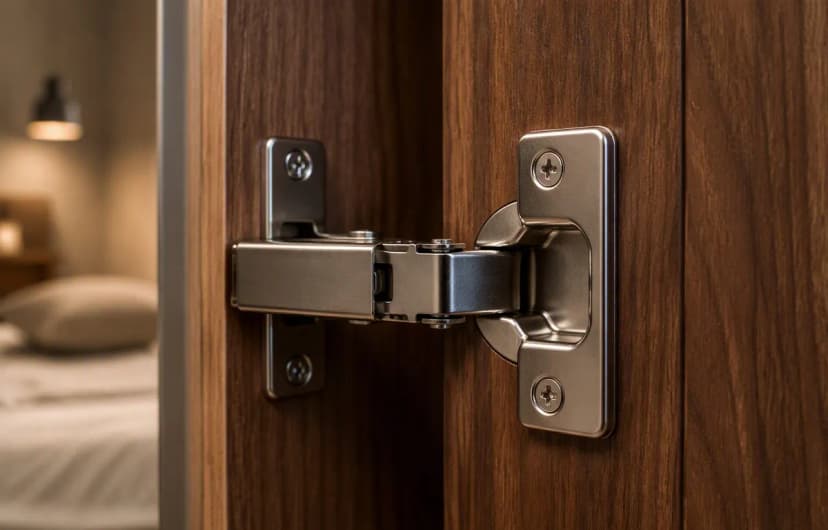
How many hinges per shutter?
- Up to ~900 mm tall: 2 hinges
- 900–1,600 mm: 3 hinges
- 1,600–2,100 mm: 4 hinges
- Full-height 2,100–2,400 mm in 18 mm ply/HDHMR: 5 hinges
Under-hinging is the number-one cause of sagging wardrobe doors in Indian homes. A full-height laminate shutter weighs 12–18 kg, two hinges will hold it for a year, then the top screw starts tearing out of the particle core.
Hettich Sensys/Intermat ₹130–₹450, best value, 100k cycles, made partly in India · Häfele ₹200–₹700, premium damping feel · Ebco ₹80–₹350, fine for guest rooms and rentals · Unbranded ₹15–₹60, avoid on anything permanent. In humid and coastal cities, ask for the rust-resistant or SS variants, the cheap zinc plating on local hinges pits within two monsoons.
4. Drawer channels: telescopic vs tandem
Wardrobe drawers open more often than wardrobe doors, innerwear, socks, watches, daily-wear jewellery. The channel (runner) decides whether that daily pull feels like a filing cabinet or a German car door.
- Side-mount telescopic channels (₹250–₹900/pair): steel ball-bearing runners fixed to the drawer sides. Full extension, 25–45 kg ratings, easy to fit and replace. The workhorse choice, Ebco and Indian brands cover this well.
- Undermount tandem boxes (₹1,800–₹5,000/drawer set): the drawer sides themselves are slim metal boxes riding on concealed undermount runners. Integrated soft-close, 30–70 kg ratings, 100k+ cycles, and the runner is invisible. Hettich InnoTech Atira and Häfele Matrix Box are the benchmarks. This is what "premium wardrobe" actually feels like.
- Bottom-mount roller channels (₹80–₹300/set): the white epoxy runners in budget furniture. Partial extension, ~15 kg real-world capacity, no soft-close, and they fail in 2–4 years in humid cities. Acceptable only for rental furniture.
Specification note for the carpenter: channel type changes the drawer box dimensions. Telescopic channels need about 12.5–13 mm clearance per side; tandem boxes have their own drilling and notch pattern. The drawer boxes are built after the channel is chosen, never before. And always fit soft-close on at least the top drawer: it's the one that gets slammed.
5. Handles and knobs: the visible layer
Handles are the one wardrobe component chosen for looks, and that's legitimate, because they're the only part you see when everything is closed. The detailed buying logic (materials, finishes, sizing, prices) is in our door handle buying guide; the wardrobe-specific rules are short:
- Size to the shutter: around ⅓ of the shutter height for long pulls on tall doors, 288–600 mm on full-height shutters, 96–224 mm (hole-to-hole) on small shutters and drawers.
- Sliding wardrobes need recessed or slim handles, profile/edge pulls or concealed handles. A projecting bar handle on the leading door blocks the door behind it. Labacha's concealed and profile handle ranges exist precisely for this.
- Match the finish family across the room: wardrobe handles, drawer knobs and the bedroom lever handle should share one finish, brass, matte black, or whatever you've chosen. Scale varies by door; colour does not.
- Material matters less here: wardrobe handles carry no latch and no weather, good zinc or aluminium with a quality finish is genuinely fine, which frees budget for the hinges and channels that do the work.
Labacha's wardrobe handle collections (Sleek, Urban, Royal and Texture styles) cover 96 mm drawer pulls through to 600 mm+ long handles in brass, PVD, matte black and antique finishes, ₹60–₹600 per piece for standard sizes, more for designer long handles. If you're matching wardrobe handles to new cabinet hardware elsewhere in the home, order both from the same finish batch, brass tones vary subtly between production runs.
6. Locks: which doors actually need them
Most wardrobes need exactly one lock, for the drawer or shutter that holds documents, cash and jewellery. More locks than that is daily irritation; fewer is a false economy. The options:
- Cam lock (₹150–₹600): a small cylinder through the shutter or drawer front, turning a flat cam that hooks behind the carcass. The standard for hinged shutters and drawers. Godrej, Ebco and Harrison cover this range; pick one with a brass cylinder over die-cast.
- Sliding wardrobe lock (₹400–₹700): sliding doors can't use a cam lock, the bolt has nothing fixed to bite into. Dedicated sliding locks like Godrej's duo side-locking 25 mm model (~₹550) clamp both shutters together from the edge. Carpenter-friendly to install, but only if the shutter overlap was planned for it.
- Multi-point / deadbolt furniture locks: overkill for most homes; relevant if the wardrobe doubles as serious storage in a rental or shared flat.
Two rules: decide the lock position before laminates are pressed (drilling a finished face for a lock body leaves permanent witness marks), and keep one spare key outside the room, wardrobe locks get lost at exactly the wrong moments.
7. The wardrobe hardware checklist to hand your carpenter
Everything above, compressed into the list itself. Fill in the blanks, screenshot it, send it on WhatsApp before work starts, this is the document that prevents the "we'll adjust it later" conversation.
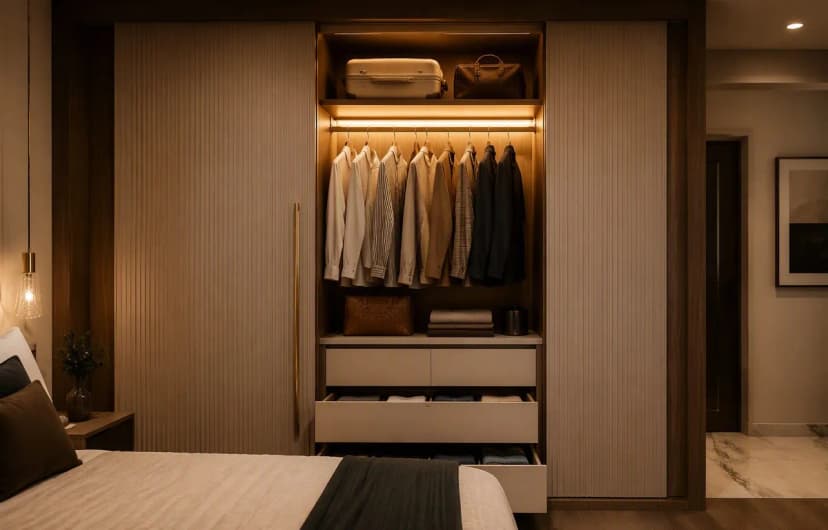
Specify before carpentry starts
- Door type decided, hinged or sliding, locked at the drawing stage. It changes the carcass depth, width and cost.
- If sliding: channel system brand, load rating (50/60/80 kg), top-hung or bottom-rolling, two-way soft-close included, track depth shared with the carpenter.
- If hinged: hinge brand + model, crank per shutter position (0 / 8 / 16), opening angle (110° standard, 165° where access is tight), integrated soft-close.
- Hinge count per shutter, 2 up to 900 mm, 3 to 1,600 mm, 4 to 2,100 mm, 5 for full-height heavy shutters.
- Drawer channel type chosen, telescopic (₹250–₹900/pair) or tandem box (₹1,800–₹5,000/set), and the carpenter told before drawer boxes are built, because side clearances differ.
- Drawer load ratings matched to contents, 25 kg for clothes, 40 kg+ for files, books or the sari drawer.
- Handles listed with sizes, hole-to-hole mm for each shutter and drawer (96/128/160/224/288–600), slim or recessed profiles on sliding doors, one finish family across the room.
- Lock positions marked, which shutter/drawer, cam lock (hinged) or duo lock (sliding), decided before laminates are pressed.
- Interior fittings listed, hanging rods (with end brackets), shelf pins, pull-out trays, mirror, tie/saree pull-outs, sensor light strips if wanted.
- Brand named on paper, not verbally, "Hettich-type" is not Hettich. Ask to see original branded packaging at installation; genuine hinges and channels carry the embossed brand name on the metal.
- Spares agreed, one extra hinge, one extra roller set and the channel model numbers recorded, so a failure in year six is a ₹200 fix, not a treasure hunt.
- Post-installation test written into the deal, every shutter and drawer cycled ten times, soft-close verified on every unit, alignment checked, before final payment.
8. What it all costs in 2026
Hardware for one typical 7×8 ft hinged wardrobe, 4 shutters, 3 drawers, 1 lock, 12 handles/pulls, at three honest specification levels. Fitting labour (₹3,000–₹8,000 depending on city and complexity) is separate and roughly the same at every level, which is precisely why cheap hardware is false economy: the labour to fit a ₹40 hinge costs the same as the labour to fit a ₹300 one, and you'll pay it twice.
| Item | Qty | Value spec (Ebco / Indian brands) | Mid spec (Hettich) | Premium (Häfele / designer) |
|---|---|---|---|---|
| Soft-close hinges | 16–18 | ₹1,300–₹3,500 | ₹2,400–₹6,000 | ₹4,000–₹9,000 |
| Drawer channels / tandem | 3 drawers | ₹750–₹2,700 | ₹5,400–₹10,500 | ₹7,200–₹15,000 |
| Handles & knobs | ~12 pcs | ₹700–₹2,500 | ₹1,500–₹4,500 | ₹4,000–₹10,000 (Labacha designer lines) |
| Lock | 1 | ₹150–₹400 | ₹300–₹600 | ₹500–₹900 |
| Rods, pins, misc. | - | ₹600–₹1,200 | ₹900–₹1,800 | ₹1,500–₹3,000 |
| Wardrobe total | - | ₹3,500–₹10,300 | ₹10,500–₹23,400 | ₹17,200–₹37,900 |
| Sliding upgrade | 2–3 doors | +₹1,000–₹3,000 | +₹3,000–₹7,000 | +₹6,000–₹14,000 |
Where the premium actually pays: hinges and drawer channels, the parts with cycle ratings. A Hettich hinge at ₹300 amortised over 15 years of daily use costs about 5 paise per open. Where you can safely economise: handles (zinc with a good finish is fine indoors), shelf pins and rods (load is static), and locks (one good cam lock beats three cheap ones). For a whole 3BHK, typically 3 wardrobes plus a crockery unit and TV unit, budget ₹15,000–₹30,000 at value spec, ₹35,000–₹70,000 at Hettich level.
Unbranded hardware cuts one wardrobe's bill to ₹1,500–₹3,000. It is typically rated for 5,000–15,000 cycles against 100,000+ for branded gear, in humid Indian cities, that's a 2–4 year lifespan. Replacing hinges and channels later means paying for hardware and labour a second time, plus the risk of damaged shutters during rework. Over ten years, "cheap" is the most expensive option on the table.
Frequently asked questions
What hardware does a wardrobe need and how do I specify it?
Five categories: shutter hardware (soft-close concealed hinges, or a sliding channel system), drawer channels (telescopic or tandem), handles/knobs, locks (cam lock for hinged, duo lock for sliding), and interior fittings (rods, shelf pins, dampers). Specify by writing the brand, model, size and quantity of each before carpentry starts, hinge cups, sliding tracks and lock bodies are cut into the wood during construction and can't be cleanly retrofitted.
Which hinges are best for wardrobe doors in India?
Soft-close concealed cup hinges. Hettich Sensys/Intermat (₹130–₹450) is the value benchmark with 100,000+ rated cycles; Häfele (₹200–₹700) is the premium pick; Ebco (₹80–₹350) suits secondary rooms. Skip unbranded ₹15–₹60 hinges, 5,000–15,000 cycle ratings mean failure within 2–4 years. In humid or coastal cities, ask for rust-resistant finishes.
Is a sliding wardrobe better than a hinged one?
Sliding saves floor space (no swing clearance needed) but shows only half the wardrobe at once and costs more in hardware, ₹1,500–₹6,000+ per door for soft-close channel sets versus ₹260–₹900 for a pair of hinges. Hinged gives full access and cheaper, easier repairs but needs 50–60 cm of clear space in front. In compact bedrooms sliding wins; otherwise hinged is better value. Decide before the carcass is drawn, it can't be changed later.
How many hinges does a wardrobe shutter need?
Two hinges up to ~900 mm shutter height, three up to 1,600 mm, four up to 2,100 mm, and five for full-height 2,100–2,400 mm shutters in 18 mm ply or HDHMR. Under-hinging is the most common cause of sagging wardrobe doors, a full-height laminate shutter weighs 12–18 kg, and two hinges will eventually tear out of the board.
What is the difference between 0-crank, 8-crank and 16-crank hinges?
The crank controls overlay. 0 crank = full overlay (shutter covers the carcass side fully, the standard), 8 crank = half overlay (two shutters share one partition), 16 crank = inset (shutter sits flush inside the frame, a premium look). The wrong crank means shutters that overlap, gap or won't close, and budget unbranded hinges often come in only one crank, forcing the design to compromise.
Do wardrobe doors need locks?
Usually one lock per wardrobe is enough, on the drawer or shutter holding documents and valuables. Hinged shutters take a cam lock (₹150–₹600); sliding doors need a dedicated duo side-locking model like Godrej's 25 mm sliding wardrobe lock (~₹550). Decide the position before laminates are pressed, drilling a finished shutter for a lock leaves permanent marks.
How much does wardrobe hardware cost in India in 2026?
For a 7×8 ft hinged wardrobe with 4 shutters, 3 drawers and a lock: roughly ₹4,000–₹10,000 with value brands, ₹10,000–₹23,000 with Hettich, ₹17,000–₹38,000 premium. Sliding adds ₹3,000–₹12,000 in channels. Unbranded hardware drops the bill to ₹1,500–₹3,000 but typically fails in 2–4 years, and fitting labour costs the same regardless, so you pay it twice.
What should I check when the carpenter finishes my wardrobe?
Cycle every shutter and drawer ten times. Shutters should close with a damped finish and even gaps; sliding doors should glide with one finger and stop without slamming; drawers should reach full extension smoothly. Verify soft-close engages on every hinge, locks turn from both key positions, handles have no burrs, and adjustment screws remain accessible. Raise any grinding, rattling or wobble before final payment, hardware alignment is a 15-minute fix on day one and a full rework later.
Keep reading
- Door Handle Buying Guide for Indian Homes
- What Thickness of Plywood Is Best for Wardrobes?
- Common Mistakes to Avoid When Buying Interior Materials
- How to Select Reliable Interior Material Suppliers
- How Interior Materials Impact the Durability of Your Home
- How to Choose the Right Interior Materials for Your Dream Home