Alabaster Sheet for Backlit Walls: Uses, Cost per Sq Ft & Installation in Bangalore
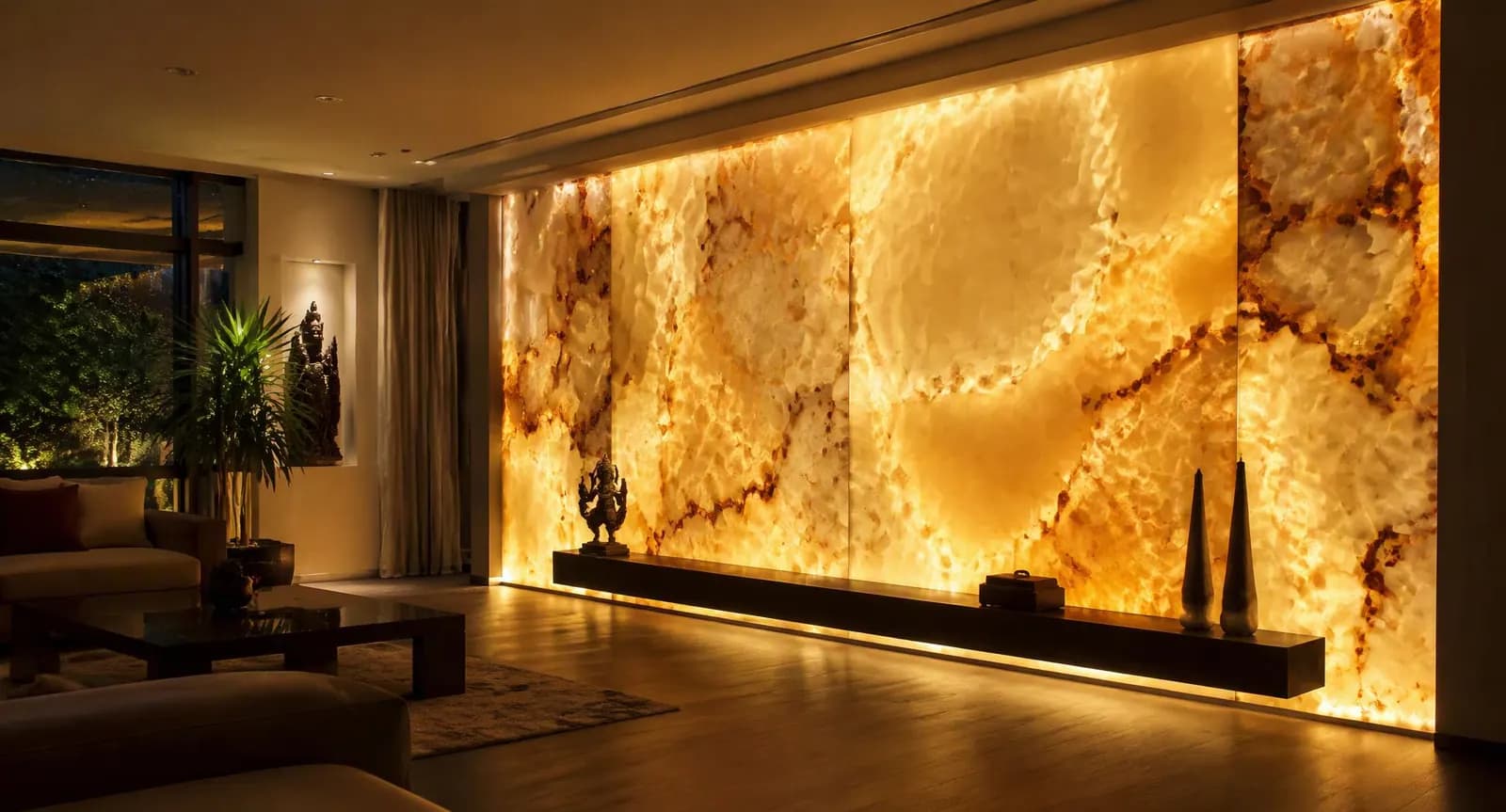
That warm, glowing stone wall you've seen in hotel lobbies and premium homes? It's usually not stone at all, it's an alabaster sheet lit from behind. Here's what the material actually is, what it costs per sq ft in Bangalore in 2026, and the installation details that decide whether your wall glows evenly or shows stripes.
The quick answer
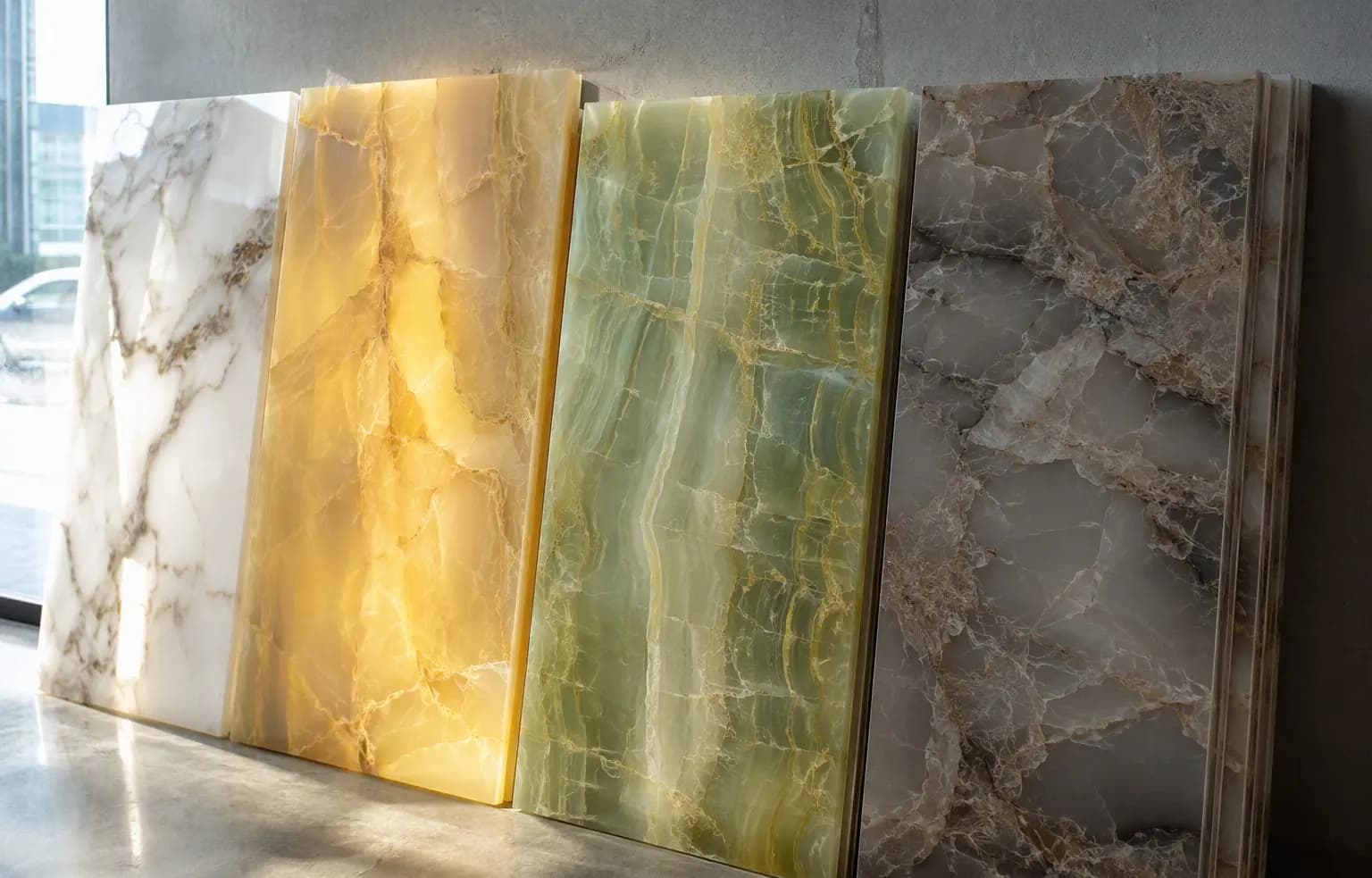
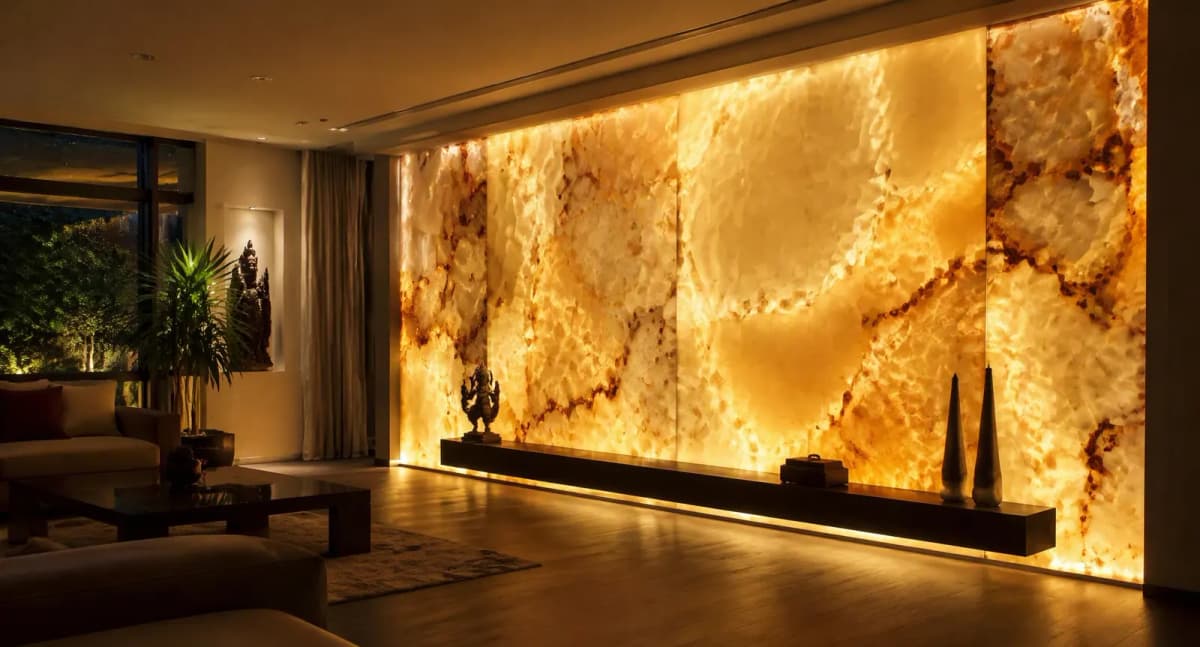
An alabaster sheet is a translucent decorative panel, most commonly an acrylic or resin sheet textured and veined to imitate natural alabaster stone, sold in 8×4 ft panels and 3–12 mm thicknesses. Yes, it is designed to be backlit: mount the sheet 50–100 mm in front of evenly spaced LED strips and the wall glows with a warm, stone-like depth that no paint, wallpaper or laminate can imitate.
In Bangalore in 2026, faux alabaster sheets cost ₹150–₹350 per sq ft for basic patterns, ₹350–₹650 for designer onyx looks, and ₹650–₹1,000+ for premium or large-format sheets; natural stone veneer panels run ₹180–₹450+ per sq ft. Installation with frame, LEDs and labour typically adds ₹250–₹500 per sq ft.
The one rule that matters most: judge the sheet lit from behind, not in daylight, and test your LED layout at night before the sheets go up. Almost every bad alabaster wall you've seen failed on one of those two steps.
1. What an alabaster sheet actually is
Natural alabaster is a soft, fine-grained translucent stone, gypsum or calcite, that has been carved into lampshades and sculptures for centuries because light passes through it with a uniquely warm, cloudy glow. Solid stone alabaster walls do exist in ultra-luxury projects, but they are heavy, brittle, porous and ruinously expensive.
The alabaster sheet sold across India is the practical answer to that: a factory-made panel that reproduces the look and light behaviour of the stone without the weight or fragility. The standard format is an 8×4 ft sheet (32 sq ft) in 3–12 mm thickness, made from acrylic or polyester resin with veining that is either printed, cast in layers, or swirled directly into the resin. The better sheets have depth, the veins sit inside the material, not just on the surface, which is what makes them glow convincingly when backlit.
The properties that matter on site:
- Translucent: the whole point. Light transmission varies by thickness and pattern, always test before buying.
- Lightweight: a 6 mm acrylic sheet is a fraction of the weight of stone, one person can carry an 8×4 panel.
- Unbreakable in normal handling: unlike glass or stone, it survives transport and on-site cutting.
- Cuttable with standard tools: circular saw or router with fine blades; edges can be polished.
- Moisture-resistant: non-porous surface, wipes clean, fine for bathrooms and humid cities.
- Heat-sensitive: acrylic softens with sustained heat, keep away from hobs, halogen lamps and direct sun on exteriors.
It sits in the same family as translucent onyx sheets, "light-pass" panels and artificial marble sheets, dealers often use the names interchangeably. What you're really buying is controlled translucency with a stone pattern.
2. Faux vs natural: know which one you're buying
Two very different products share the name "alabaster sheet" in the Indian market, and the price gap between them is 2–4×. Neither is a scam, but you should know which one your quote refers to.
| Faux alabaster sheet (acrylic / resin) | Natural translucent stone veneer | |
|---|---|---|
| What it is | Acrylic or polyester resin sheet with printed/cast veining | 1–2 mm slice of real alabaster/onyx bonded to fibreglass or resin backing |
| Price (2026) | ₹150–₹1,000 / sq ft | ₹180–₹450+ / sq ft before backing & finishing; landed cost higher |
| Weight | Very light, one-person carry | Heavier; needs proper substrate and handling |
| Pattern | Repeatable, uniform, large walls match perfectly | Every panel unique; adjacent sheets may not match |
| Cutting | Circular saw/router on site | Stone tools; edge chipping risk |
| Moisture | Non-porous; bathroom-safe | Gypsum stone dislikes wet zones; needs sealing |
| Look when lit | Even, consistent glow; premium cast sheets have real depth | Unmatched organic depth, the real thing |
| Best for | Homes, showrooms, pooja rooms, counters, 95% of projects | Statement luxury walls where budget is secondary |
The quick authenticity tests if a seller claims "natural": real stone feels cold and slightly soapy to the touch, is noticeably heavier for its size, and has irregular veining that continues imperfectly across panels. Faux sheets are uniform, slightly warm to the touch, and feather-light. A fingernail scratches gypsum alabaster (Mohs ~2); it does nothing to acrylic.
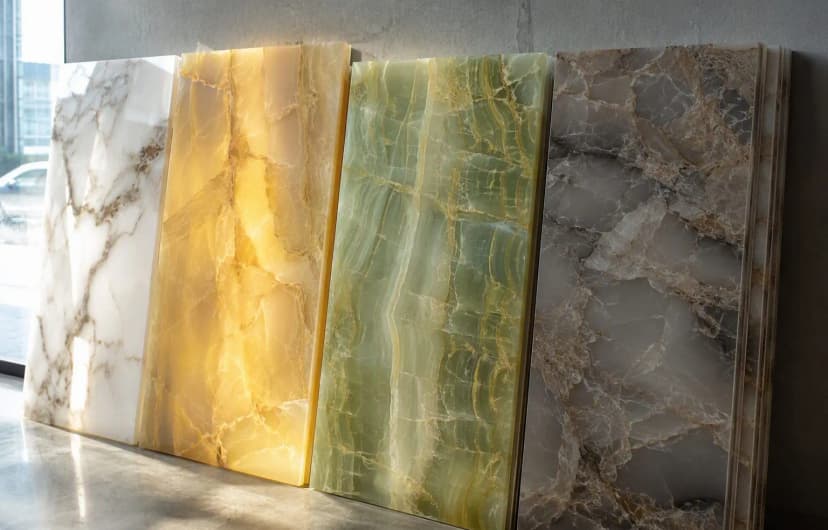
"Alabaster sheet", "onyx sheet", "light-pass sheet", "translucent marble sheet", "artificial onyx panel", in the Indian market these are largely the same product family: translucent resin/acrylic panels. Dealers pick the name by pattern, not chemistry. Don't compare quotes by name; compare by thickness, sheet size, and how the sample looks backlit.
3. Where alabaster sheets actually work in a home
Alabaster earns its keep in exactly one situation: where light can get behind it. Used flat on a wall like a laminate, it's an expensive plastic sheet. Backlit, it's the single most dramatic surface per rupee in interior materials. The proven applications, in order of how often we see them in Bangalore homes:
- Living room feature wall / TV backdrop, the signature use. A 10×8 ft backlit panel behind the TV unit or sofa wall. Honey onyx and white marble patterns dominate here.
- Pooja room backdrop, arguably the best use in Indian homes: a small 4×4 ft glowing panel behind the idol creates the temple-lamp atmosphere permanently. Keep the LED cavity sealed from diya smoke and maintain 150 mm+ clearance from open flame.
- Bar counters and reception desks, the front face of a counter in 8–12 mm sheet, backlit. Commercial-grade drama, and the thicker sheet handles knocks.
- Bedroom headboard wall, a dimmable warm glow behind the bed replaces table lamps entirely. Use 2700K and put it on a dimmer.
- Partitions and screens, a backlit alabaster panel divides a living-dining space while glowing on both sides (choose sheets finished on both faces).
- Ceiling coffers and skylight panels, thin 3–4 mm sheets in false-ceiling recesses, lit from above. Keep panels small enough to stay flat.
- Niches, mandir shelves, display backdrops, small cut pieces behind artefacts in showrooms and homes.
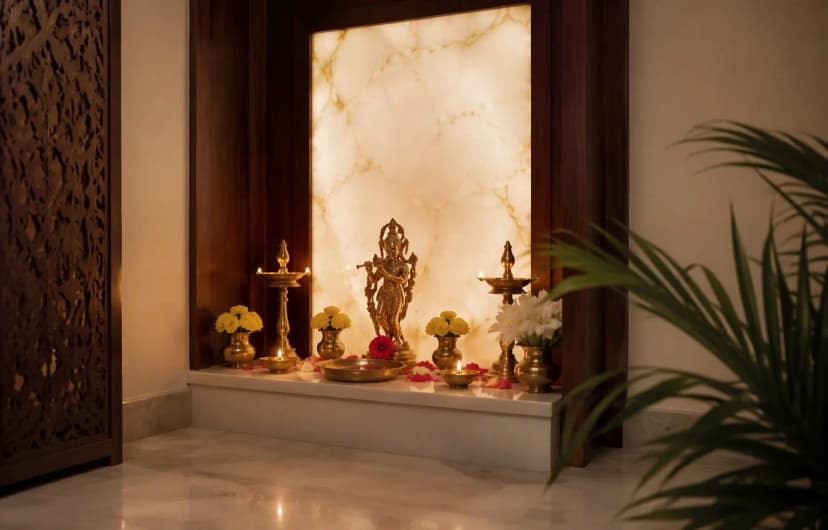
Skip alabaster on exteriors (UV yellows the resin), within 300 mm of hobs or any open flame, on floors (it scratches), and anywhere it will be glued flat to a wall with no backlight, a ₹400/sq ft sheet used like a ₹60 laminate is money burning. If the wall will never be lit, use a high-gloss marble laminate instead and save 80%.
4. Cost per sq ft in Bangalore, 2026
Prices move with thickness, pattern complexity and brand, but the market settles into clear bands. These are sheet-only rates from Bangalore and national dealer listings in 2026:
| Band | What you get | Price per sq ft | 8×4 ft sheet (32 sq ft) | Right for |
|---|---|---|---|---|
| Economy | 3–4 mm, printed veining, single-colour onyx looks | ₹150–₹350 | ₹4,800–₹11,200 | Ceilings, small inserts, budget pooja backdrops |
| Mid-range | 5–6 mm, deeper cast veining, designer onyx/marble patterns | ₹350–₹650 | ₹11,200–₹20,800 | Feature walls, headboards, partitions, the sweet spot |
| Premium | 8–12 mm, large-format, rare patterns, both-face finishes | ₹650–₹1,000+ | ₹20,800–₹32,000+ | Bar counters, reception desks, double-sided partitions |
| Natural stone veneer | Real translucent stone on fibreglass backing | ₹180–₹450+ (before backing/finishing) | Project-priced | Statement luxury installs |
Bangalore-specific notes: current dealer listings for standard 5–6 mm backlit-ready sheets cluster around ₹540–₹660 per sq ft for designer patterns, and the full retail range quoted across city dealers runs roughly ₹500–₹2,500 per sq ft depending on quality and format, the top of that range being natural and imported large-format panels. Expect 5–10% wastage on cuts, and note that many wholesale suppliers have minimum order quantities of 8–10 sheets.
| Component | Value build | Mid build | Notes |
|---|---|---|---|
| Alabaster sheets (3 nos 8×4) | ₹16,000–₹28,000 | ₹34,000–₹52,000 | Economy vs mid-range band from Table 2 |
| Frame (aluminium/wood) | ₹6,000–₹9,000 | ₹8,000–₹12,000 | Levelled grid, service access designed in |
| LED strips + drivers | ₹8,000–₹14,000 | ₹14,000–₹24,000 | High-density 24V, CRI 90+, dimmable driver |
| Mounting hardware + sealant | ₹2,000–₹4,000 | ₹3,000–₹5,000 | Z-clips / edge profiles / translucent sealant |
| Labour (frame + electrical + sheet) | ₹12,000–₹20,000 | ₹16,000–₹26,000 | ₹150–₹325 per sq ft combined trades |
| Total (80 sq ft wall) | ₹44,000–₹75,000 | ₹75,000–₹1,19,000 | ~₹550–₹1,500 per sq ft installed |
For perspective: the same wall in book-matched natural onyx slab would run ₹3–6 lakh. The alabaster sheet delivers 85% of the effect at 20–30% of the cost, which is precisely why it exists.
5. Backlighting: the part that makes or breaks the wall
Every failed alabaster wall you've seen, the ones with bright stripes, dark patches, or a cheap plastic look, failed at the lighting, not the sheet. The material only diffuses what you put behind it. Four variables decide the result:
1. The gap: 50–100 mm between LED and sheet
Too close (under 40 mm) and each LED strip prints a bright line on the stone. Too far (over 150 mm) and the glow turns dim and muddy. The workable band is 50–100 mm, 75 mm is the installer favourite.
2. Strip spacing: no wider than the gap
The rule of thumb: strip-to-strip spacing should not exceed the strip-to-sheet distance. At a 75 mm gap, run strips at 75 mm or closer. Wider spacing is exactly how you get zebra stripes. Use high-density strips, 120–240 LEDs per metre, because widely spaced diodes show as dots through thinner sheets.
3. Electrical spec: 24V, CRI 90+, dimmable
- 24V constant-voltage strips, 12V strips visibly dim at the far end of runs over ~5 metres; 24V holds brightness across a full wall.
- CRI 90 or higher, cheap 80-CRI strips render the veining grey and plasticky. High CRI is what makes honey onyx look like honey.
- Colour temperature: 2700–3000K for warm onyx and amber patterns; 4000K neutral for white marble looks. Avoid 6000K, it turns the stone clinical and blue.
- Dimmable driver, always, a feature wall at 100% brightness overwhelms a living room at night. Budget ₹1,500–₹4,000 extra for dimming; you will use it daily.
- Heat: mount strips on aluminium channels or an aluminium-clad frame. Trapped heat in a sealed cavity shortens LED life and can warp thin sheets.
4. For flawless walls: light-guide panels
On large or commercially critical installs (hotel lobbies, showrooms), LED light-guide panels (LGP) replace strips entirely, an edge-lit acrylic plate that emits perfectly even light across its whole face. They cost 3–5× strips per sq ft but eliminate striping risk completely. For a once-in-a-decade 15-ft lobby wall, they're worth pricing.
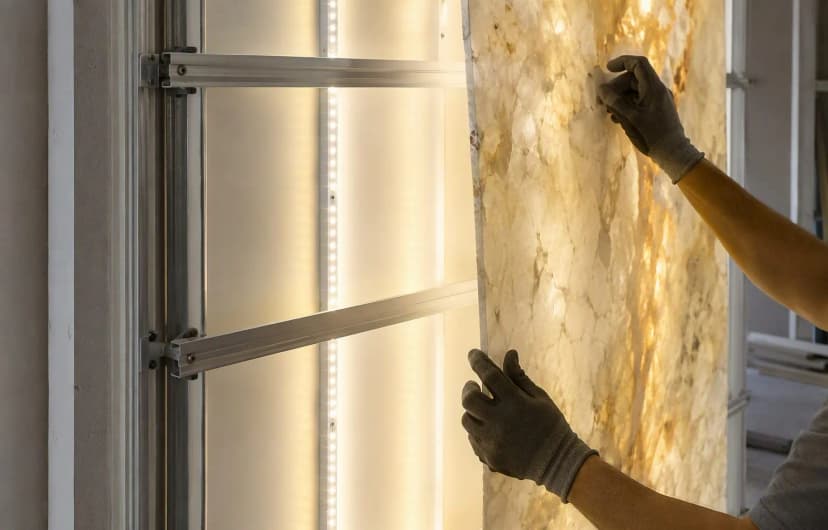
Before a single sheet goes up, switch the LEDs on at night and photograph the bare frame. Every wiring fault, dead strip, spacing error and hotspot is visible instantly, and costs nothing to fix. After the sheets are mounted, the same fix means de-mounting the wall. Every professional installer does this test; if yours doesn't know about it, that's a signal.
6. Installation, step by step
- Frame first. A level grid of aluminium box section (or well-seasoned wood) fixed to the wall, designed around the LED spacing and the sheet sizes, plan so sheet joints land on frame members.
- Run the LEDs. Parallel strip runs at the calculated spacing, mounted on aluminium channel, wired back to the driver. The driver goes in an accessible location, a cabinet, a false-ceiling hatch, never sealed behind the sheet.
- The night test (see above) before anything covers the frame.
- Mount the sheets removably. Mirror screws with caps, Z-clips, or an aluminium edge profile that pinches the sheet edges. Never glue the sheet flat, LEDs have a 5–8 year service life, and the wall must open for service without breaking panels.
- Treat the joints. Butt joints finished with colour-matched translucent sealant, or covered with a slim brass/SS trim profile for a deliberate panelled look. On veined patterns, dry-lay the sheets first and orient the veins to flow across joints.
- Leave an access panel. One section (usually a bottom corner) fitted to open for driver and wiring service.
- Final dimming setup. Set the default brightness with the family in the evening, usually 40–70%, and label the driver circuit.
Timeline: a straightforward 10×8 ft wall is a 3–5 day job across frame, electrical and sheet mounting. Add a week if sheets are ordered to size or a pattern is being matched across multiple panels.
7. The buyer's checklist
Before you order alabaster sheets
- See the actual sheet backlit, a sample against your intended LED colour temperature, in a dark room. Patterns that look rich in daylight can go flat or streaky when lit.
- Confirm faux or natural on the quote, the 2–4× price gap means the word "alabaster" alone tells you nothing.
- Thickness matched to use, 5–6 mm for backlit walls, 3–4 mm for ceilings/inserts, 8–12 mm for counters and high-traffic panels.
- Veins cast in, not just printed, check the sheet edge: surface-printed veining disappears at cut edges and looks flat when lit; cast/layered veining has depth.
- Same batch for the whole wall, resin sheets vary slightly between production runs; order all panels (plus 5–10% wastage) in one lot.
- LED spec written down, 24V, 120–240 LED/m, CRI 90+, 2700–4000K, dimmable driver, aluminium channel mounting.
- Gap and spacing planned, 50–100 mm gap; strip spacing no wider than the gap.
- Night test in the contract, LEDs tested and photographed before sheet mounting.
- Removable fixing + access panel, no glue-flat installations; driver reachable without breaking sheets.
- Both-faces finish for partitions, standard sheets are one-sided; double-sided glow needs both-face sheets.
Frequently asked questions
What is an alabaster sheet and can it be backlit on a wall?
An alabaster sheet is a translucent decorative panel, either an acrylic/resin sheet textured to look like natural alabaster stone, or thin real stone on a fibreglass backing. Both transmit light, which is their purpose: mount the sheet 50–100 mm in front of evenly spaced LED strips and the wall glows with warm, stone-like depth. It's the standard material for feature walls, pooja backdrops, reception counters and bar fronts.
What is the price of alabaster sheet per sq ft in Bangalore?
In 2026: ₹150–₹350 per sq ft for basic printed sheets, ₹350–₹650 for designer 5–6 mm onyx/marble patterns (current Bangalore dealer listings cluster at ₹540–₹660), and ₹650–₹1,000+ for premium or large-format sheets. Natural stone veneer runs ₹180–₹450+ per sq ft before backing and finishing. Installation with frame, LEDs and labour adds roughly ₹250–₹500 per sq ft, a full 10×8 ft backlit wall lands between ₹44,000 and ₹1.2 lakh depending on specification.
Is alabaster sheet real stone?
Usually not, most sheets sold in India are faux alabaster: acrylic or polyester resin with printed or cast veining. Real translucent stone veneer exists but costs more and is heavier. Faux sheets are lighter, unbreakable in handling, moisture-resistant and far cheaper. The tests: real stone feels cold and soapy, is heavy for its size, and has irregular organic veining; faux sheets are uniform and feather-light.
Which thickness of alabaster sheet is best for backlit walls?
5–6 mm is the sweet spot, flat and stable on a frame, yet thin enough to transmit light evenly. 3–4 mm glows best but can ripple on large panels; keep those for ceilings and small inserts. 8–12 mm suits counters and bar fronts where impact matters, but transmits less light and costs up to twice as much per sq ft.
What LED lights are used behind alabaster sheets?
High-density 24V LED strips (120–240 LEDs/metre) in parallel runs 50–100 mm behind the sheet, spaced no wider than their distance from the sheet. Specify CRI 90+ so veining reads as stone, 2700–3000K for warm honey patterns or 4000K for white marble, and a dimmable driver. For large seamless walls, LED light-guide panels give perfectly even light at 3–5× the strip cost.
Can alabaster sheets be used in bathrooms or kitchens?
Yes for faux acrylic/resin sheets, non-porous and wipe-clean. Keep them 300 mm+ from hobs and open flame (acrylic softens with sustained heat), and manage LED-cavity heat with aluminium channel mounting. Natural gypsum alabaster dislikes wet zones and needs sealing. Neither type belongs outdoors, UV yellows resin and degrades stone veneer backings.
How is an alabaster sheet installed on a wall?
Levelled frame on the wall → LED strips run in parallel with the driver in an accessible spot → night test of the bare frame → sheets mounted 50–100 mm in front on mirror screws, Z-clips or edge profiles (never glued flat, LEDs need future service) → joints sealed with translucent colour-matched sealant or trim → one removable access panel left for the driver. A 10×8 ft wall is typically a 3–5 day job.
Where can I buy alabaster sheets in Bangalore?
Interior material suppliers and decorative panel dealers across the city stock them, with clusters around Mysore Road, Timber Yard Layout and Deepanjali Nagar. Evospace stocks backlit-ready alabaster sheets in multiple patterns and sizes at Deepanjali Nagar, see our alabaster sheet supplier page for patterns and stock. Wherever you buy, view the actual sheet lit from behind before ordering.
Keep reading
- Alabaster Sheet Supplier in Bengaluru
- How to Choose the Right Interior Design Materials
- Common Mistakes to Avoid When Buying Interior Materials
- How Interior Materials Impact the Durability of Your Home
- How to Select Reliable Interior Material Suppliers
- What Thickness of Plywood Is Best for Wardrobes?
- Door Handle Buying Guide for Indian Homes